
You are at the bedside, night shift, trying to discharge a 58‑year‑old with NSTEMI who needs dual antiplatelet therapy. Pharmacy flags: “Consider alternative to clopidogrel – CYP2C19 poor metabolizer.” The resident scrolls through a multi‑page pharmacogenetic PDF, full of rs numbers and star alleles, clearly lost. The cardiologist wants an answer now: “Can we safely use clopidogrel or not?”
This is where point‑of‑care genomics either becomes useful medicine or decorative noise in the chart.
Let me walk through how to actually interpret pharmacogenetic panels at the bedside, what matters clinically, and where the ethical landmines sit when you start dropping DNA‑based recommendations into real patient care.
1. What “Point‑of‑Care Genomics” Actually Means (In Reality, Not In Brochures)
Strip away the buzzwords. Point‑of‑care genomics, in the context of pharmacogenetics, means:
You are making a real‑time prescribing or dosing decision with the help of a genomic result that is already in the chart (or returns quickly enough to matter), and you are expected to interpret it without a genetics team holding your hand.
Today, that usually shows up in three ways:
- Pre‑emptive panels ordered by health systems and stored in the EHR (e.g., “pharmacogenomic profile” on file).
- Reactive single‑gene tests ordered when a specific drug is under consideration (e.g., HLA‑B*57:01 before abacavir).
- Direct‑to‑consumer or third‑party test results that patients bring to you (often half‑baked, poorly annotated, or off‑label).
Most institutions are drifting toward pre‑emptive panels for common genes:
| Gene | Key Drugs (Examples) | Typical Use Case |
|---|---|---|
| CYP2D6 | Codeine, tramadol, SSRIs | Pain, psychiatry, cardiology |
| CYP2C19 | Clopidogrel, PPIs, SSRIs | Cardiology, GI, psych |
| CYP2C9 | Warfarin, NSAIDs | Anticoagulation, pain |
| VKORC1 | Warfarin | Anticoagulation |
| HLA-B | Carbamazepine, abacavir | Neuro, HIV, derm |
| SLCO1B1 | Simvastatin | Cardiology (statin myopathy risk) |
The catch: the panel report is usually written by a bioinformatics vendor, not by someone who has to face the patient at 2 a.m. So you get color‑coded “actionable,” “use with caution,” “normal metabolizer” labels, but the report rarely answers the two questions that actually matter at the bedside:
- Do I change the drug?
- Do I change the dose?
You have to fill that gap.
2. How to Read a Pharmacogenetic Report Without Drowning
Most clinicians get stuck because they try to parse the raw genetics. Star alleles, SNP IDs, diplotypes. You need to mentally rewire: the clinical unit of meaning is the “phenotype,” not the genotype.
The usual path is: genotype → diplotype → phenotype → clinical recommendation.
So at the bedside, you skip directly to phenotype and recommendation.
Step 1: Find the Phenotype Label
Every decent pharmacogenetic report will map the genotype to a phenotype. For example:
- CYP2C19: *2/*2 → “Poor metabolizer”
- CYP2C19: *1/*17 → “Rapid metabolizer”
- CYP2D6: *1/*1xN → “Ultrarapid metabolizer”
- CYP2C9: *2/*3 → “Poor metabolizer”
- SLCO1B1: *5/*5 → “Poor function”
Your first move: ignore the star jargon, find the phenotype line. If the report does not clearly state the phenotype, it is a bad clinical report.
Step 2: Map Phenotype to Drug Behavior
Then you ask: does this phenotype increase exposure, decrease exposure, or alter toxicity for the specific drug in front of you?
For example:
CYP2C19 poor metabolizer + clopidogrel
→ Less active metabolite → Less antiplatelet effect → Higher ischemic risk.CYP2D6 ultrarapid metabolizer + codeine
→ Excess morphine formation → Respiratory depression risk.CYP2D6 poor metabolizer + paroxetine
→ Higher plasma levels → Side‑effect risk.
This is the entire clinical game: what happens to drug exposure and effect. If you know the direction of change, CPIC guidelines will usually tell you what to do.
Step 3: Use CPIC / DPWG Like You Use UpToDate
Do not reinvent pharmacogenomics from scratch. Two groups have done the heavy lifting:
- CPIC (Clinical Pharmacogenetics Implementation Consortium)
- DPWG (Dutch Pharmacogenetics Working Group)
Use them like you use UpToDate for disease management: you do not memorize; you know where to look and how to apply.
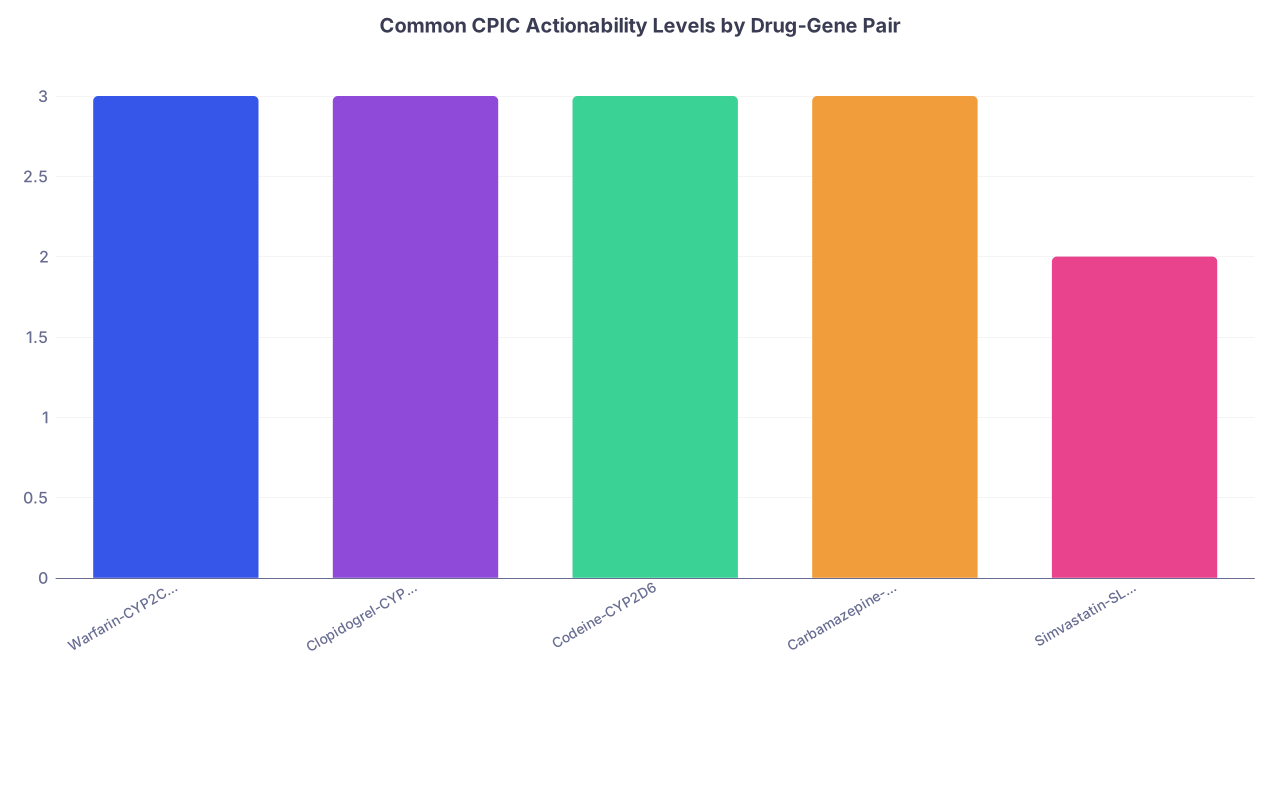
| Category | Value |
|---|---|
| Warfarin-CYP2C9/VKORC1 | 3 |
| Clopidogrel-CYP2C19 | 3 |
| Codeine-CYP2D6 | 3 |
| Carbamazepine-HLA-B | 3 |
| Simvastatin-SLCO1B1 | 2 |
(Think of “3” here as high‑actionability, clear dosing or drug‑choice guidance.)
At the bedside, you should be doing something like this:
- Quickly identify gene + drug pair.
- Mentally recall or quickly check whether there is a CPIC or DPWG guideline.
- Map the reported phenotype to the recommended action.
You do not need to memorize the exact dose adjustment percentages. You do need to know which genes + drugs are non‑negotiable versus optional.
3. Concrete Bedside Scenarios: How To Actually Use These Panels
Let me go through real‑world style cases and the specific thought process.
Case 1: NSTEMI, Stent Planned – CYP2C19 and Clopidogrel
Back to your original scenario.
The chart says:
- CYP2C19 genotype: *2/*2
- Reported phenotype: “Poor metabolizer”
- Comment snippet: “Reduced conversion of clopidogrel to active metabolite. Consider alternative antiplatelet agent such as prasugrel or ticagrelor.”
Your questions:
Is this report clinically trustworthy?
If it comes from a CLIA‑certified lab and the phenotype is standard, yes.Does CPIC support acting on this?
Yes. For ACS patients undergoing PCI, CPIC recommends using alternative therapy in poor and intermediate metabolizers.What do you do at the bedside?
You do not give clopidogrel as standard therapy. You choose prasugrel (if no contraindication) or ticagrelor.
So you tell cardiology:
“Patient is a CYP2C19 poor metabolizer; CPIC and multiple studies show impaired clopidogrel response. I recommend prasugrel or ticagrelor instead of clopidogrel.”
That is point‑of‑care genomics used correctly: simple, binary, guideline‑backed.
Case 2: Severe Depression, Multiple SSRI Failures – CYP2D6/CYP2C19
You are seeing a 35‑year‑old with treatment‑resistant depression. Outpatient psychiatry sent a multi‑page pharmacogenetic panel. The PDF highlights:
- CYP2D6: Poor metabolizer
- CYP2C19: Ultrarapid metabolizer
The vendor’s report color‑codes several SSRIs as “use with caution” or “lower efficacy.” Psychiatry wants your take because the patient is being admitted for suicidal ideation.
What matters clinically:
- CYP2D6 poor metabolizer: higher exposure to many medications partly cleared by CYP2D6 (e.g., paroxetine, venlafaxine, some TCAs).
- CYP2C19 ultrarapid: lower exposure to drugs relying on CYP2C19 (e.g., citalopram, escitalopram, sertraline to a lesser extent).
You do not let the glossy report tell you the drug choice by itself. Vendor panels often overreach. Instead:
Use the phenotype to explain prior failures:
Low levels of escitalopram due to ultrarapid CYP2C19 → underdosing despite “normal” mg.
Side effects with paroxetine due to poor CYP2D6 → overexposure.Use CPIC/DPWG to identify better options:
For example, you might lean toward sertraline with aggressive titration or an antidepressant less affected by these pathways (e.g., mirtazapine, bupropion — being mindful of other interactions).
At the bedside, you are not writing a genomics essay. You are doing a few clear things:
- Contextualize past drug failures and side effects.
- Pick a drug that the patient’s metabolism will not sabotage from day one.
- Document succinctly: “Choice of X informed by CYP2D6/CYP2C19 phenotype; see CPIC guideline Y.”
Case 3: New HIV Start – Abacavir and HLA‑B*57:01
This one should be automatic.
- HLA‑B*57:01 positive → Abacavir is contraindicated. Not “use with caution.” Not “monitor closely.” You do not prescribe it.
At the bedside, the conversation is simple:
“You have a genetic variant that makes a severe, potentially life‑threatening reaction to the HIV medication abacavir much more likely. Because of that, we are choosing a different medication that is safer for you.”
No hand‑waving about “probabilities” or “might consider.” This is black‑and‑white.
Case 4: Carbamazepine Start in an Asian Patient – HLA‑B*15:02
You have a new seizure patient of Chinese ancestry, and neurology wants to start carbamazepine. The pharmacogenetic panel shows:
- HLA‑B*15:02 positive.
In certain Asian populations, this allele is tightly associated with SJS/TEN risk with carbamazepine. CPIC is explicit: avoid carbamazepine, oxcarbazepine, and related agents in HLA‑B*15:02‑positive individuals unless there is no alternative and benefits massively outweigh risks.
At the bedside you should say:
“You have a genetic marker we know is associated with a serious skin reaction to carbamazepine in people of your background. We should choose a different seizure medicine.”
Again, decisive. No “maybe.”
Case 5: Warfarin Initiation – CYP2C9 and VKORC1
This one is trickier because:
- You can adjust warfarin with INR anyway.
- There are dosing algorithms that integrate genotype, age, weight, etc.
Your patient’s panel shows:
- CYP2C9 *2/*3 (poor metabolizer)
- VKORC1 −1639 AA (increased sensitivity)
This predicts higher sensitivity to warfarin and lower dose requirements. At the bedside, that means:
- Do not start at a standard 5–10 mg daily “load and see” approach.
- Consider a lower starting dose — often in the 2–3 mg range — and closer early INR monitoring.
You do not need to memorize the exact formula. You need to remember: “both variants push me toward a lower initial dose; I will not blast them with standard loading.”
If a dosing calculator is available in the EHR, use it. If not, use clinical judgment with a clear bias toward caution.
4. What You Should Not Do With Pharmacogenetic Panels
Misuse is rampant. I have seen:
- Clinicians chasing minor gene variants with minimal evidence while ignoring blood pressure and renal function.
- “Pharmacogenomic consults” where the entire plan is switching SSRIs based on a vendor traffic‑light system with zero attention to actual symptoms.
- Residents ordering expensive panels for stable patients where nothing would change.
So let me be blunt about a few things.
Do Not Treat Every Variant as Actionable
Not every gene‑drug pair on a panel is ready for bedside use.
Some are:
- Strong, reproducible evidence.
- Clear guidelines.
- Major effect sizes.
Others are:
- Weak associations.
- Small effect sizes.
- Conflicting data.
You should be biased toward acting on:
- HLA‑B*57:01 with abacavir.
- HLA‑B*15:02 with carbamazepine in susceptible populations.
- CYP2C19 and clopidogrel in ACS/PCI.
- CYP2D6 and codeine / tramadol, especially in children and breastfeeding mothers.
- Warfarin with combined CYP2C9 and VKORC1, if you are actually using warfarin.
You should be cautious and modest with:
- Subtle SSRI/SNRI adjustments where clinical monitoring still dominates.
- Statin decisions where lifestyle and dose modifications may outweigh small genetic risk increments.
Do Not Let Vendor Algorithms Replace Clinical Reasoning
If your decision is “the report said red, so I switched,” you are doing it wrong.
For any change, you should be able to answer:
- What is the phenotype?
- How does it affect drug exposure or toxicity?
- Is there a respected guideline backing this change?
If you cannot answer those, pause. Look it up. Or do not act on it yet.
Do Not Overpromise to Patients
A classic ethical mistake: you tell the patient, “This genetic test will help us find the perfect drug for you.”
False. Pharmacogenetics improves probabilities; it does not guarantee outcome. You are stratifying risk, not writing destiny.
Be honest:
“This genetic information helps us avoid some medications that are more likely to cause you serious side effects or not work well for you. It does not tell us exactly which drug will be perfect, but it gives us a better starting point.”
5. The Ethics of Bedside Genomics: Where You Can Get Burned
This is not just “more data.” You are dealing with deeply personal biological information that can extend far beyond a single drug choice.
Three major ethical domains you cannot ignore: consent, privacy, and equity.
Informed Consent – Not the Check‑Box Version
A lot of institutions bury pharmacogenetic testing consent inside a generic “lab testing” form. That is lazy. DNA is not another BMP.
Before you rely on panel data at the bedside, ask yourself:
- Did the patient ever understand that this was genetic testing?
- Were they informed that results could be reused for future medications?
- Were they told about potential incidental findings or long‑term storage?
In a perfect world, pharmacogenetic consent should cover:
- Scope: This test looks at genes that influence how you process medications.
- Use: Results may be used now and in the future for other prescriptions.
- Limitations: It does not predict all side effects or guarantee drug success.
- Risks: Privacy risks, possible re‑interpretation over time.
At the bedside, you can at least make sure the patient understands when you are basing a decision on their DNA:
“I am choosing this medication partly based on your genetic test results, which tell me how your body is likely to process certain drugs.”
Not “hidden genomics.”
Privacy and Data Handling – Genomics Is Sticky
Once genetic data is in the EHR, it is effectively permanent. You cannot “untest” it. And you have to assume:
- It will be accessed repeatedly by other clinicians.
- It may be used for quality improvement or research (depending on institutional policy).
- It might be exposed in data breaches more severely than a BMP panel would be.
There is also a realistic fear from patients about misuse — insurability, employment, discrimination. In the United States, GINA covers some of this, but not all (e.g., does not cover life insurance or long‑term care insurance).
Your role at the bedside is not to give a law lecture, but you should be able to say something like:
“Your genetic test results are part of your medical record and are protected like other health information. There are laws that limit how this information can be used outside of your medical care, but they are not perfect. If you ever have concerns about who can see this information, we can connect you with genetics or legal resources.”
Overly reassuring or breezy statements like “no one can ever misuse this” are unethical.
Health Equity – Who Gets “Precision” and Who Gets “Good Enough”
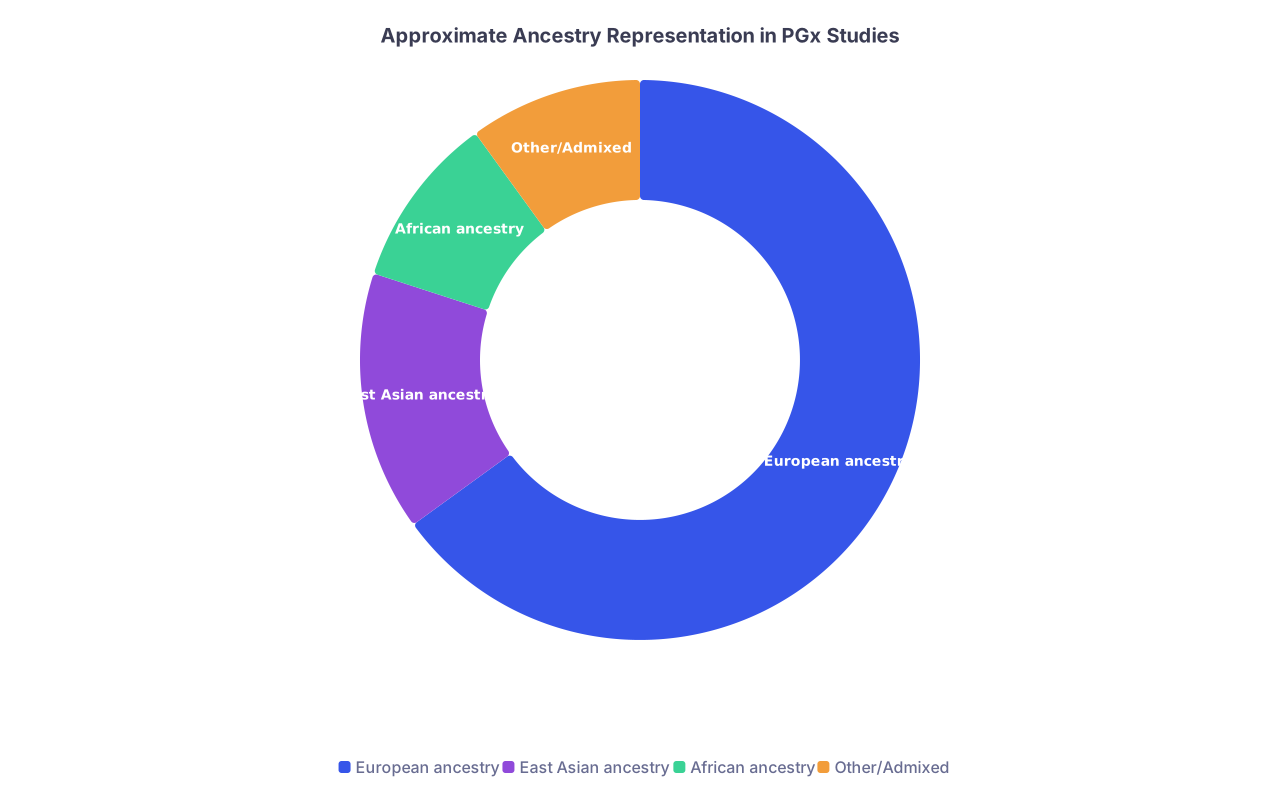
Most pharmacogenetic evidence is heavily biased:
- Populations of European ancestry are overrepresented.
- Many star allele systems work poorly in diverse backgrounds.
- Calls of “normal” versus “poor” metabolizer can be wrong if rare variants are missed.
| Category | Value |
|---|---|
| European ancestry | 65 |
| East Asian ancestry | 15 |
| African ancestry | 10 |
| Other/Admixed | 10 |
So if you uncritically apply pharmacogenetic rules derived from mainly European cohorts to, say, a West African or Southeast Asian patient, you may be overstating your confidence.
You also need to watch for access inequities:
- Patients in academic systems get panels and “precision dosing.”
- Patients in underfunded settings get standard regimens, sometimes without even basic labs.
At the bedside that translates to being explicit about uncertainty:
“For people with your background, we have less genetic data, so while this test is still useful, we are a bit less certain about how accurate some parts might be. We will still be monitoring your response very closely.”
Precision without humility quickly becomes arrogance.
6. Developing Personal Competence in Bedside Pharmacogenomics
You are not going to become a pharmacogenetics expert overnight, and you do not need to. You need functional literacy plus a few skills.
Skill 1: Recognize High‑Stakes Pairs Instantly
You should be able to look at a chart and immediately know:
“This gene result is clinically important right now.”
At minimum, commit these high‑stakes pairs to memory:
- HLA‑B*57:01 – Abacavir → Avoid if positive.
- HLA‑B*15:02 – Carbamazepine (in Asian ancestry) → Avoid if positive.
- CYP2C19 – Clopidogrel in ACS/PCI → Avoid or modify if poor/intermediate metabolizer.
- CYP2D6 – Codeine/tramadol (especially kids, breastfeeding) → Avoid ultrarapid and poor metabolizers.
- CYP2C9 / VKORC1 – Warfarin start → Lower starting dose or use algorithm.
Everything else you can look up, but these you should recognize on sight.
Skill 2: Use Structured References, Not Vendor Marketing
Never rely solely on the vendor‑produced PDF. Always cross‑check major decisions against:
- CPIC guidelines (freely accessible).
- DPWG where available.
- Institutional protocols if they exist.
Build the habit: if you see a genotype that affects a current med, you quickly pull up the relevant CPIC diagram on your phone or workstation. Like you would with antibiotic dosing in renal failure.
Skill 3: Communicate Clearly to Patients and Colleagues
You need a short, plain‑language way to explain:
- What the gene result means.
- How it changes your decision.
- What it does not predict.
Something like:
“Your test shows that your body breaks down this type of medication much more slowly than average. That means if we used the standard dose, you could have more side effects. So we are starting at a lower dose and will increase carefully.”
Or, to a colleague:
“Given their CYP2C19 poor metabolizer status and the CPIC guideline, I would strongly recommend we avoid clopidogrel post‑PCI and choose prasugrel or ticagrelor instead.”
Notice the structure: phenotype → impact → specific recommendation.
Skill 4: Know When to Call For Backup
There are times when you should not be the final word:
- Complex psych panels where polypharmacy and multiple genes interact.
- Rare variants with unclear function.
- Situations where the patient is highly anxious about genetic risk or family implications.
In those cases, loop in:
- A clinical pharmacologist.
- A pharmacogenomics service (if your institution has one).
- A genetic counselor, especially if broader implications exist.
Using help is not a failure of competence. Misinterpreting and overconfidently acting on shaky genomic data is.
7. Where This Is Going – And How Not To Get Left Behind
The trajectory is obvious. Genomic data is getting cheaper and more embedded:
- More patients will arrive with pre‑emptive panels in their charts.
- EHRs will start auto‑flagging high‑risk gene–drug pairs.
- Clinical decision support will push you toward recommended regimens.
Done well, this reduces cognitive load and prevents catastrophes (e.g., abacavir hypersensitivity, codeine‑related deaths). Done badly, it becomes alert fatigue and blind dependence on algorithms you do not understand.
Your best defense is conceptual clarity:
- You understand, at a high level, how genotype → phenotype → drug effect works.
- You know which gene–drug issues are “never ignore” versus “nice to know.”
- You can explain and defend your reasoning to a patient, a colleague, or a lawyer.
That is what “personal development” in this space actually looks like: not collecting certificates, but being the person on the team who can look at a pharmacogenetics report and say, “This matters,” “This does not,” and “Here is exactly what we are going to do with it.”
Key Takeaways
At the bedside, ignore star‑allele noise; focus on the reported phenotype and how it changes drug exposure or toxicity for the specific medication in front of you, using CPIC/DPWG as your backbone.
Treat a small set of high‑stakes gene–drug pairs as non‑negotiable (HLA‑B57:01–abacavir, HLA‑B15:02–carbamazepine, CYP2C19–clopidogrel, CYP2D6–codeine, CYP2C9/VKORC1–warfarin) and be more cautious with low‑effect, poorly validated signals.
Ethically, you owe patients honest consent, realistic expectations, and respect for privacy and equity; point‑of‑care genomics is not just more data, it is a qualitatively different category of information that you are now responsible for using – and explaining – wisely.