
It is 4:30 p.m. You are already behind in clinic. Your next patient walks in, sits down, and the first thing they say is:
“I brought my Apple Watch data. My heart rate is all over the place. Can we go over it?”
Your EHR is already open with 10 problem list items. Their watch shows resting HR, HR variability, sleep stages, “readiness scores,” and a 24-page PDF they faithfully printed. You have 15 minutes. Ethically, you want to respect their effort and autonomy. Practically, you do not have time to be a data scientist.
This is where most clinicians get stuck. The tech moved faster than the workflow. Faster than regulation. Faster than training.
Here is how you fix it.
You need a simple, repeatable framework to turn chaotic wearable data into clear, ethical, and clinically sound care plans—without blowing up your schedule or your sanity.
I will give you that framework.
The Core Problem: Too Much Noise, Not Enough Signal
Let me be blunt: raw wearable data is mostly noise. The problem is not a lack of data. It is:
- Lack of clinical thresholds
- Lack of validated algorithms
- Lack of workflows for review, documentation, and follow-up
- Very fuzzy ethical boundaries around responsibility and liability
Patients show you:
- Step counts from Fitbit or Garmin
- Sleep “scores” from Oura or Whoop
- Continuous HR from Apple Watch
- ECG strips “detecting AFib”
- Glucose traces from CGM (Dexcom, Libre) pulled into third-party apps
- Blood pressure from random Amazon cuffs, sometimes Bluetooth-synced
Most clinicians react in one of two bad ways:
Dismissive
“These watches are not accurate. Don’t worry about it.”
→ You just invalidated the patient’s effort and undermined trust.Over-absorbed
You go line-by-line through unvalidated metrics, over-interpret them, and end up ordering unnecessary tests.
→ You medicalize noise and create more anxiety.
You need a third path: structured, selective engagement.
The Simple Framework: SIFT → MAP → ACT → LOOP
Here is the framework I use and teach:
- SIFT – Decide in under 60 seconds what data is even worth considering
- MAP – Connect that subset of data to specific, evidence-based clinical questions
- ACT – Translate those questions into concrete care plan elements
- LOOP – Create clear follow-up, data boundaries, and ethical guardrails
Memorize that: SIFT → MAP → ACT → LOOP.
We will walk through each step with scripts, thresholds, and workflows you can drop into practice tomorrow.
Step 1: SIFT – Decide What Data You Will Actually Use
Your first job is not to interpret data. It is to filter it.
You have about 60 seconds in real clinic time for this step.
1.1 Start With a One-Line Purpose Question
Before you look at a single chart, ask:
“Tell me in one sentence what you are hoping we can answer with this data.”
You are forcing focus. You are also signaling: this is a clinical conversation, not a tech support session.
Common one-line purposes:
- “I am worried my heart rate is too high at rest.”
- “I want to improve my sleep quality.”
- “I am training for a marathon and want to be sure I am doing it safely.”
- “My watch said I might have AFib—am I in danger?”
Once you have the purpose, you can decide what categories of data are relevant and ignore the rest.
1.2 Use a Simple Triage Table
Here is a quick triage table you can mentally apply when you see a wearable data dump.
| Data Type | Usually Useful? | When It Matters Clinically |
|---|---|---|
| Resting heart rate | Yes | Baseline fitness, overtraining, autonomic issues |
| Irregular rhythm alerts | Yes (screening) | AFib suspicion in appropriate population |
| Step count / activity | Yes | Lifestyle counseling, rehab, chronic disease |
| Sleep duration | Yes | Insomnia, depression, cardiometabolic risk |
| Sleep stages (light/REM) | Rarely | Research only; not validated for decisions |
| HR variability scores | Rarely | Performance / wellness, not standard clinical use |
Script this:
“There is a lot of information here. For your concern about [X], the pieces I can reliably use are [A and B]. The others are still experimental and not part of standard medical decision-making. Let us focus on what is actionable.”
You have now ethically constrained the scope.
1.3 Decide If the Device Is Even Trustworthy for This Use
Hidden but critical step. The device must be:
- Worn consistently
- From a reasonably validated vendor for that metric
- Measuring something clinically relevant
Concrete thresholds I use:
HR and rhythm
- Apple Watch, some Garmins, newer Fitbits: decent for resting HR trends and arrhythmia alerts.
- Not equivalent to a Holter monitor or 12‑lead ECG.
Steps / activity
- Most major brands are “good enough” for trend-level exercise counseling.
Sleep
- Duration (time in bed, estimates of sleep) is somewhat useful.
- Sleep stage breakdown? Ignore for medical decisions.
Say this out loud:
“Your watch is reasonably good at tracking [X], but not designed to replace medical devices like [Y]. We can use this for trends and lifestyle guidance, not to make high‑risk decisions.”
You just drew an ethical line.
Step 2: MAP – Connect Data to Specific Clinical Questions
Once you have filtered the data, the next move is to map it to concrete, answerable clinical questions.
Do not start from the data. Start from the problem list.
2.1 Anchor Wearable Data to Existing Diagnoses or Risks
Ask yourself:
- Does this data help with:
- BP control?
- Diabetes management?
- AFib risk?
- Heart failure symptoms?
- Obesity and metabolic syndrome?
- Depression / anxiety / insomnia?
If the answer is no, you are probably drifting into “interesting but useless.”
Example:
Patient with obesity, prediabetes, and depression. They bring 6 months of step counts and sleep duration.
- Directly relevant to: weight, insulin sensitivity, mood, energy.
- You can map: “We will use your steps and sleep as biomarkers of behavior change.”
Healthy 24-year-old with no symptoms, panicked about HR variability and “body battery.”
- You map to: anxiety, health literacy, prevention.
- Focus on education and boundaries, not disease hunting.
2.2 Translate Data to Three Categories: Baseline, Trend, Trigger
To avoid drowning, classify what you see into three types:
Baseline – What is normal for this person?
- Average resting HR over weeks
- Average daily steps
- Usual sleep duration
Trend – Has something materially changed?
- Resting HR up by >10 bpm for >1–2 weeks without clear cause
- Steps dropped by >30–40% over a month
- Sleep consistently <6 hours
Trigger – Is there a specific event that might warrant evaluation?
- Multiple irregular rhythm alerts in a week
- HR spikes at rest above 120 bpm with symptoms
- Severe nocturnal desaturation if connected to a validated oximeter
Once you label each piece of data as Baseline, Trend, or Trigger, it becomes much easier to decide your next move.
You can literally say:
“Let us separate this into three things: what your normal looks like, what seems to have changed, and any red-flag events your device has flagged. Then we will decide what is medically important.”
Step 3: ACT – Turn Data Into a Real Care Plan
This is the part everyone skips. They either just reassure, or they over-test. You are going to be more deliberate.
The ACT step has four concrete outputs:
- Lifestyle prescription
- Monitoring protocol
- Medical evaluation plan (if needed)
- Documentation and communication
We will walk each.
3.1 Build a Simple, Quantified Lifestyle Prescription
Wearables are fantastic for behavior change, not for advanced diagnostics. Lean into that.
You want 1–3 specific, measurable targets linked to the patient’s data.
Examples:
Activity for a sedentary, obese patient
- Baseline: 2,000–3,000 steps / day
- Plan:
- Week 1–2: Target average 4,000 steps / day
- Week 3–4: Target average 5,000 steps / day
- Script:
“Your average is around 2,500 steps. For the next two weeks, your sole goal is an average of 4,000. That is roughly an extra 15–20 minutes of walking. We will use your watch to see if that happened.”
Sleep for an insomniac with short duration
- Baseline: 5 hours reported / night
- Plan:
- Fixed wake time
- Bedtime only when sleepy
- Track: total time in bed and total sleep time from wearable
- Script:
“Ignore the sleep stages. For the next month, we care about just two numbers: what time you get out of bed and the approximate total hours of sleep. Your watch can help approximate this.”
Write these targets directly into your plan, not as vague advice.
3.2 Create a Monitoring Protocol (So You Are Not On-Call for Every Blip)
Ethical problem: once you acknowledge the data, patients assume you are now “monitoring” it. You are not. Unless you are paid and staffed to do so, you cannot safely promise continuous review.
Fix this with a monitoring protocol that is specific and bounded.
Define:
- What they track
- How often they look at it
- When to contact you
- What not to do (e.g., not emailing screenshots daily)
Example protocol for AFib risk in a 70-year-old with Apple Watch alerts:
Patient checks:
- Irregular rhythm notifications
- Any ECG recordings they actively capture
Thresholds to call clinic:
- 2 or more irregular rhythm alerts in one week
- Any alert plus symptoms (palpitations, dizziness, chest discomfort)
What you explicitly clarify:
“I am not continuously watching your data. The watch does not send me alerts. If you see 2 or more irregular rhythm notifications in a week, or you have symptoms with any alert, you should call us. Otherwise, just mention it at your regular appointments.”
This reduces your liability and prevents false expectations.
3.3 Decide on Medical Evaluation: When to Escalate
You need some explicit mental rules for when wearable data justifies additional testing. Here is a simple decision flow.

| Step | Description |
|---|---|
| Step 1 | Wearable HR or rhythm concern |
| Step 2 | Assess trends and alerts |
| Step 3 | Urgent ED or same day eval |
| Step 4 | Clinic visit and ECG |
| Step 5 | Reassure and lifestyle focus |
| Step 6 | Symptoms present |
| Step 7 | Red flags |
| Step 8 | Persistent abnormal pattern |
Concrete examples:
Resting HR trend
- If resting HR increases by >15 bpm from baseline for >2 weeks, without clear explanation (infection, meds, caffeine, deconditioning), consider:
- Office visit
- ECG
- Labs (TSH, CBC, etc.)
- If associated with symptoms → escalate sooner.
- If resting HR increases by >15 bpm from baseline for >2 weeks, without clear explanation (infection, meds, caffeine, deconditioning), consider:
Irregular rhythm alerts (Apple Watch AFib notifications)
- Repeated alerts + age > 65 or CHA₂DS₂-VASc risk factors → consider:
- 12‑lead ECG
- Ambulatory monitor (Holter / patch)
- One isolated alert, no symptoms, young healthy patient → document discussion, no immediate work-up, clear reassurance and monitoring protocol.
- Repeated alerts + age > 65 or CHA₂DS₂-VASc risk factors → consider:
Sleep and oxygen data (when using a validated oximeter or CPAP integration)
- Nighttime desaturations <88% repeated → sleep medicine referral or further testing
- Wearable-only “low oxygen” alerts from unvalidated consumer devices? Be cautious. Corroborate with clinical context or formal testing if symptoms exist.
The ethic here: do not ignore consistent patterns, but also do not treat consumer data as diagnostic without confirmation.
3.4 Document and Communicate Clearly (Protects You and the Patient)
Your note should explicitly include:
- What devices/data the patient is using
- What you considered clinically relevant
- Any thresholds or algorithms you explained as experimental or non-clinical
- The monitoring protocol and when to seek care
- The behavioral targets tied to the data
Example note snippet:
“Patient presented Apple Watch data (Series 8) with 3 months of HR and activity trends. Reviewed resting HR trends and step counts; did not use proprietary ‘readiness’ scores or sleep stages for medical decision-making, as these are not validated clinical tools. Resting HR largely stable (60–70 bpm), no documented irregular rhythm alerts. Average step count ~2,800/day.
Agreed on behavior plan: increase activity to 4,000 steps/day average for 2 weeks, then 5,000/day as tolerated. Patient instructed that I do not continuously monitor wearable data. Advised to call clinic if device generates repeated irregular rhythm alerts or if palpitations, dizziness, or chest discomfort occur. No indication for further cardiac testing at this time.”
That paragraph does more to protect you—and help the patient—than a dozen reassuring phrases said off the record.
Step 4: LOOP – Turn It Into an Ongoing, Ethical Partnership
If you stop after a single visit, the patient either:
- Falls off the plan, or
- Keeps emailing you screenshots forever
Closing the loop means building a simple follow-up structure and some ethical boundaries.
4.1 Schedule Specific Follow-Up Around Data, Not Vibes
Do not say “We will see how it goes.” Say:
- “We will review your step and sleep data again in 8 weeks.”
- “Bring your watch or app with the last 30 days visible.”
- “We will only look at average daily steps, average resting HR, and any alerts you bookmarked.”
This does three things:
- Creates accountability for behavior change
- Prevents ad hoc, constant data review
- Makes the next visit efficient
You can even template your MA/nurse instructions:
“At next visit, please help patient open their [device/app]. Capture:
- Average daily step count over last 30 days
- Average resting heart rate
- Number of irregular rhythm alerts (if any)”
Now your staff helps with the data wrangling.
4.2 Clarify Communication Channels and Boundaries
You must be explicit, or you will drown in portal messages.
Say something close to this:
“If you see a value that scares you, first ask: ‘Am I having concerning symptoms?’ If yes, call us or go to urgent care/ED depending on severity.
If you are not having symptoms, and it is just a number that is a bit off, write it down and bring it to our next appointment. If your watch gives you the same abnormal message several times in a week, then send us a single message summarizing that pattern.”
And document that you had this conversation.
Ethically, this protects the patient from both overreaction and underreaction. It also avoids an implicit promise that you are “on call” for their device alerts.
Ethics: Autonomy, Nonmaleficence, and Digital Inequity
You are in the “Personal Development and Medical Ethics” phase, so let us address the quiet part: wearable data is an ethical minefield.
5.1 Respect Patient Autonomy Without Becoming Their Device Slave
Patients invest money and identity into these devices. When you dismiss them outright, patients hear:
- “My effort does not matter.”
- “My questions are stupid.”
- “Doctor is out of date.”
You can respect autonomy by:
- Acknowledging the effort:
“You have clearly put in effort tracking this. Let us use the parts that are medically reliable.”
- Explaining limits honestly:
“These companies move fast. Medicine moves slower because we need strong evidence before acting. So we will use your data mainly to support your lifestyle goals, not as a primary diagnostic tool.”
That balance is what good ethics looks like in the exam room.
5.2 Avoid Harm: Overdiagnosis, Anxiety, and False Security
Three ways wearable data can harm:
- Overdiagnosis – Chasing benign variations with tests, procedures, labels.
- Anxiety spirals – Health‑anxious patients checking their numbers 50 times a day.
- False reassurance – Patient ignores symptoms because “watch says I am fine.”
Your job is to name these risks out loud:
“These devices can sometimes scare people with minor fluctuations. They can also miss serious problems. We will use them as one piece of information, but not the final word.”
And for anxious patients:
“If you are checking this number more than 3–4 times per day, that is no longer health‑promoting. Part of our plan will be to limit how often you look, and focus on weekly averages instead.”
5.3 Watch for Digital Inequity
Wearable integrations tend to favor:
- Younger, wealthier, more tech‑savvy patients
- Those with time and resources to optimize fitness
If you are not careful, you create two classes of care: those with rich data, and those with none.
Practical fix:
- Do not let “lack of wearable” reduce the care quality. Use simple, low‑tech tracking (paper logs, pedometer, brief self‑reports).
- Occasionally offer guidance even without devices:
“If you do not use a tracker, you can still do this. Just aim for a 20–30 minute brisk walk most days and jot it down.”
From an ethical standpoint, wearable data should enhance, not replace, your standard of care.
Putting It All Together: A Worked Example
Let me quickly run a full scenario using SIFT → MAP → ACT → LOOP.
Patient: 55-year-old male, HTN, BMI 32, borderline A1c, mild OSA on CPAP. Brings Garmin data.
Visit Flow:
SIFT
- Ask: “In one sentence, what are you hoping to get from your Garmin data today?”
- Patient: “I want to know if I am active enough and if my sleep is okay for my heart.”
- Decide: Focus on:
- Average daily steps / activity minutes
- Sleep duration
Ignore: - HR variability, “body battery,” detailed sleep stages
- Ask: “In one sentence, what are you hoping to get from your Garmin data today?”
MAP
- Existing problems: HTN, prediabetes, OSA, obesity → all linked to activity and sleep.
- Classify:
- Baseline:
- Steps: avg 3,200/day
- Sleep: 6.5 hours estimated
- Trend:
- Steps have increased from 1,500/day last year (patient recalls) to 3,200/day now.
- Weight down 5 lbs since last visit.
- Trigger:
- None. No arrhythmia alerts (Garmin), no major HR spikes with symptoms.
- Baseline:
ACT
- Lifestyle prescription:
- Increase to 5,000 steps/day average over next 6 weeks.
- Maintain 7+ consistent CPAP nights per week, aim for 7 hours in bed.
- Monitoring protocol:
- “Look at your weekly average steps once per week. Do not worry about daily ups and downs.”
- Medical evaluation:
- BP still slightly above goal → adjust meds.
- No cardiac work-up prompted by device.
- Documentation:
- Note describes what was used and what was explicitly not used, plus plan and thresholds.
- Lifestyle prescription:
LOOP
- Follow-up:
- “We will check your BP, weight, and Garmin averages again in 3 months.”
- Boundaries:
- “I am not monitoring your Garmin in real time. If you start having chest pain, severe shortness of breath, or feel like your heart races for more than a few minutes, do not wait for the device. Call us or go to the ER.”
- Follow-up:
This takes 3–5 minutes extra. Not 30. And it materially changes the care plan.
A Quick Visual: Where Wearables Actually Help
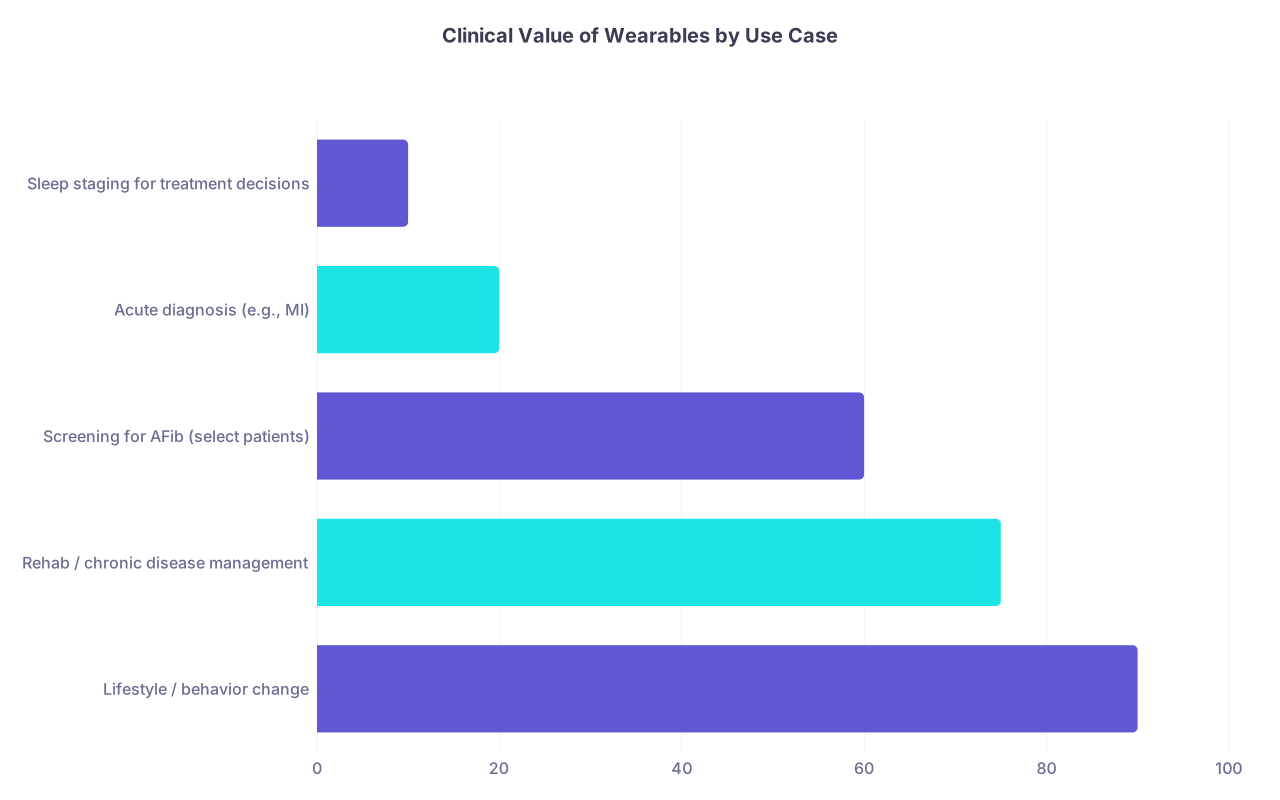
| Category | Value |
|---|---|
| Lifestyle / behavior change | 90 |
| Rehab / chronic disease management | 75 |
| Screening for AFib (select patients) | 60 |
| Acute diagnosis (e.g., MI) | 20 |
| Sleep staging for treatment decisions | 10 |
Interpretation (my opinion, based on current evidence and practice):
- Outstanding for lifestyle / behavior change
- Very helpful in chronic disease and rehab monitoring when used correctly
- Moderately helpful as a screening nudge for AFib in at‑risk groups
- Poor for acute diagnosis or precise sleep staging in routine clinical practice
Use them where they are strong. Ignore where they are weak.
Your Next Step: Build Your Own Micro-Protocol
Do not just nod and move on. Take 10 minutes today and create a one-page micro‑protocol for your practice.
Open a blank document and write:
- Devices and data we will engage with (e.g., steps, resting HR, irregular rhythm alerts, CGM glucose)
- Things we will not use for medical decisions (sleep stages, readiness scores, HRV, etc.)
- Standard scripts for:
- Setting expectations: “I do not monitor this data continuously…”
- Explaining limits: “These metrics are still experimental from a medical standpoint…”
- Thresholds for escalation unique to your specialty (cardiology, primary care, psych, etc.)
- Follow-up plan template that staff can recognize and support
Then at your very next clinic session, when a patient walks in with a wrist full of sensors and a head full of questions, pull that protocol up and use SIFT → MAP → ACT → LOOP in real time.
That is how you turn wearable chaos into an actionable, ethical care plan—without losing control of your clinic day.