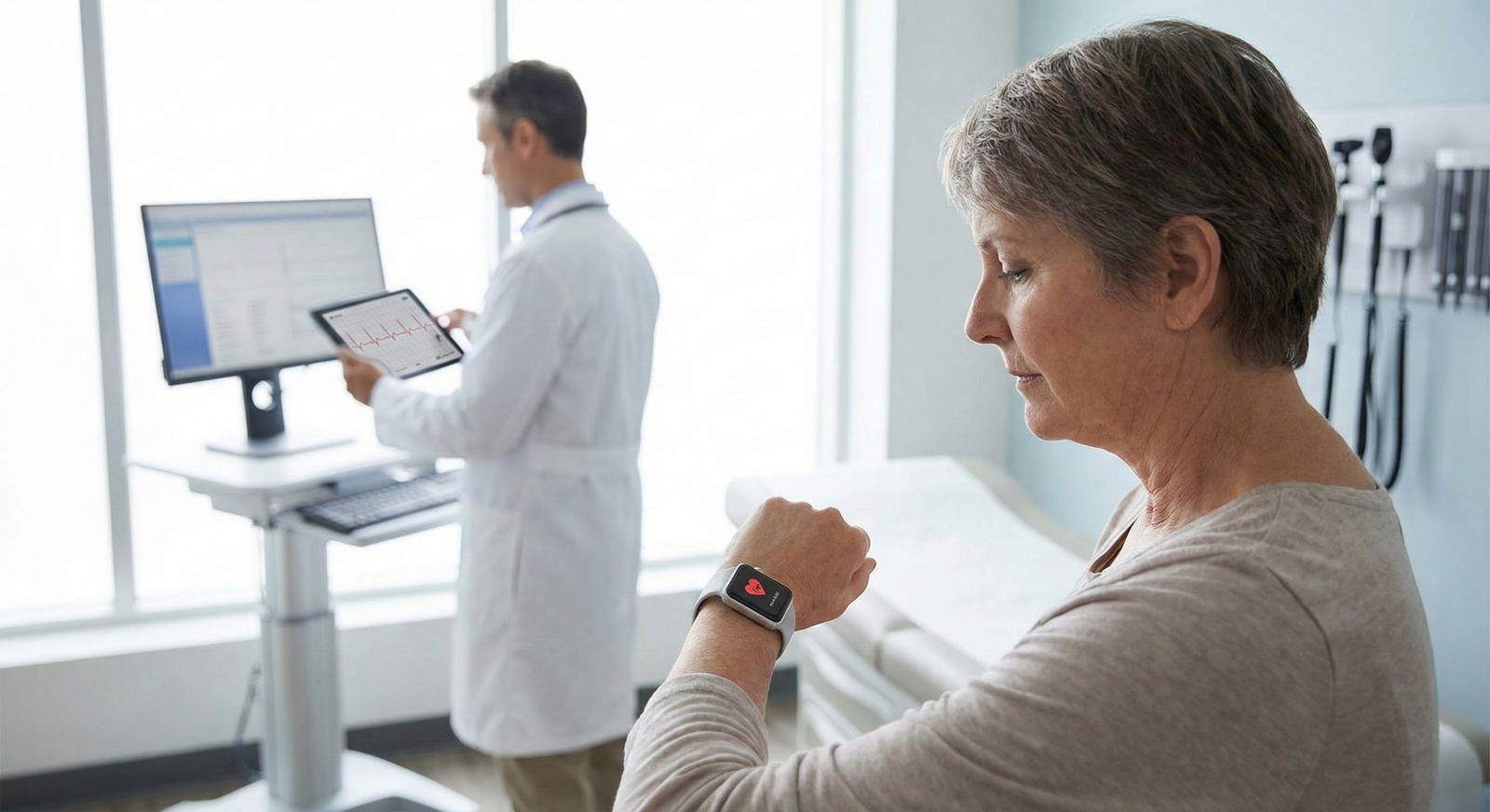
Consumer wearables are generating more atrial fibrillation “diagnoses” than many cardiology clinics. And a non-trivial share of them are wrong.
If you are going to let a watch trigger a cascade of testing, anxiety, and sometimes treatment, you need to know the error bars. Because the data show a harsh reality: even a “highly accurate” atrial fibrillation (AF) algorithm can drown clinicians in false alarms when prevalence is low.
Let’s walk through what the numbers actually say—Apple Heart Study, Fitbit, Kardia, randomized trials, real-world chart reviews—and what that means for your practice, your counseling, and your ethics.
1. The central problem: high specificity, low prevalence, lots of noise
On marketing slides, AF detection performance looks stellar:
- Sensitivities in the 95–98% range
- Specificities in the 98–99% range
- Area-under-curve values above 0.95
If you stop there, you think: problem solved. But the problem is not specificity alone. It is base rate.
Atrial fibrillation prevalence in the general adult population is roughly:
- 0.1–0.2% in people under 40
- 2–4% in people over 65
- 8–10% in those over 80
Now plug this into a wearable screening context. A mostly healthy, tech-savvy cohort, median age 40–50, AF prevalence easily under 1% at any given time. In that scenario, even a 1–2% false positive rate produces far more false AF alerts than true ones.
Here is a simple illustration. Assume:
- True AF prevalence in the watched population: 1%
- Sensitivity: 98%
- Specificity: 98%
Out of 10,000 users:
- True AF: 100 people
- Correctly flagged (true positive): 98
- Missed (false negative): 2
- No AF: 9,900 people
- Incorrectly flagged (false positive): 2% of 9,900 ≈ 198
- Correctly ignored (true negative): ≈ 9,702
So:
- Total AF alerts: 98 true + 198 false = 296
- Positive Predictive Value (PPV): 98 / 296 ≈ 33%
Two-thirds of AF alerts are wrong, despite what looks like an excellent algorithm.
This is the core math you must have in your head when you talk to patients about wearable AF alerts. “99% accurate” is a technically true but practically misleading statement.
2. What the major studies actually found
Let’s stop hand-waving and look at data from large trials and validation studies of AF detection by wearables.
2.1 Apple Heart Study (PULSE Study)
- N ≈ 419,000 Apple Watch users
- Median age 41 years
- 0.52% received an irregular pulse notification over a median 117 days
Among those who got a notification and completed confirmatory ECG patch monitoring:
- AF documented on ECG in about 34% overall (and higher in older groups)
So for a typical adult Apple Watch user in that study, roughly two-thirds of AF notifications were not confirmed as AF by the gold standard.
That 34% is a real-world PPV estimate. Not 90%. Not 80%. Low 30s overall.
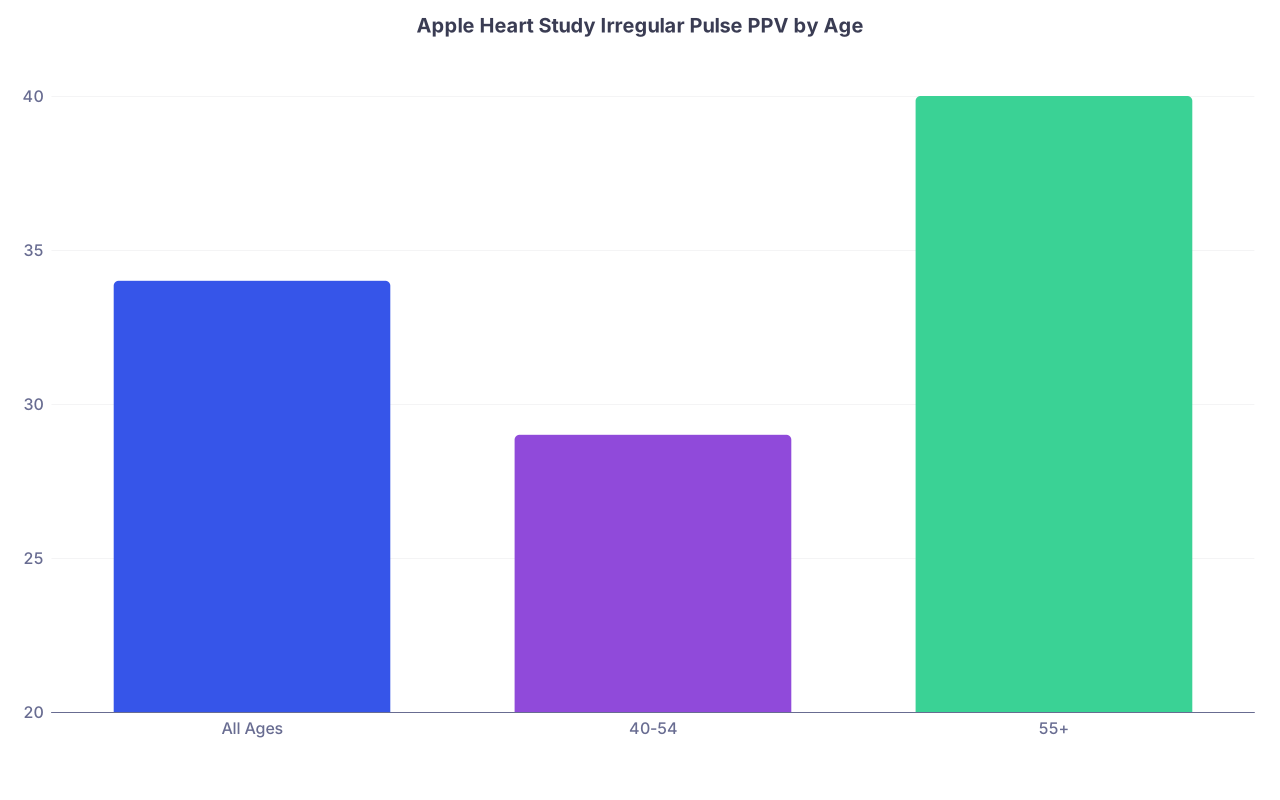
| Category | Value |
|---|---|
| All Ages | 34 |
| 40-54 | 29 |
| 55+ | 40 |
Interpretation:
- False positive rate at the device/algorithm level is small.
- False positive burden at the user and system level is large, because so few wearers actually have AF at any given time.
2.2 Fitbit and irregular rhythm notification (IRN) study
Fitbit’s PPG-based AF detection has similar logic, and the pivotal study submitted to the FDA reported:
- N ≈ 455,000 participants in a large-scale virtual study
- About 1% got an “irregular rhythm” notification
In the subset that completed confirmatory ECG patch monitoring, the PPV of notifications for AF was about 32–34%, very similar to the Apple Heart Study.
So once again: roughly one in three notifications corresponds to true AF. Two out of three do not.
2.3 Single-lead ECG wearables (Kardia, Apple ECG)
Algorithm performance improves when devices record an actual ECG instead of inferring rhythm from pulse variability.
In controlled validation:
The Kardia single-lead device has been reported with:
- Sensitivity ≈ 98–99% for AF
- Specificity ≈ 97–99%
Apple Watch ECG (12-lead-validated) has shown:
- Sensitivity in the mid-90s for AF
- Specificity around 98–99%
These are excellent test characteristics for one-off, user-triggered ECGs. However, the positive predictive value still swings with prevalence:
- In a cardiology clinic population (prevalence of AF in those tested maybe 20–50%), PPVs are high.
- In a self-screening, low-risk population (prevalence 1–2%), PPVs drop.
The device-paper statistics do not tell you the false positive experience of the average anxious 35-year-old checking their watch ECG every time they feel a skipped beat.
3. False positives vs “clinically useless positives”
Not every “false” AF signal is truly false in a technical sense. There are several buckets:
- True AF, correctly detected
- True AF, missed (false negative)
- No AF, device says AF (false positive)
- Non-AF arrhythmias or benign phenomena, device says AF
Patients care less about the technical category and more about “Did this lead to something useful, or just worry and testing?”
In chart reviews and small real-world series, you see patterns:
- A big share of false positives are due to motion artifact, poor contact, or ectopy that the algorithm mislabels as AF.
- Another fraction identifies other arrhythmias (PACs, atrial flutter) that are not AF but are not completely benign either.
- Then there is the special case: paroxysmal, infrequent AF that the device might be catching, but ECG confirmation is tricky because episodes are brief and sporadic.
From an ethical standpoint, lumping all “non-confirmed notifications” into “false positives” understates complexity. But from a workload and anxiety standpoint, anything that leads to extra visits, extra tests, and no actionable change is functionally a false positive.
4. How bad can the false positive burden get?
Let’s quantify a realistic clinical scenario.
Assume you practice in an urban clinic with 2,000 adult patients, tech-savvy, median age 45.
Say 25% use an AF-capable wearable (500 people).
True AF prevalence in that subset? Let us be generous and say 2% (10 people), given some older and higher-risk individuals.
Assume:
- Device irregular rhythm notification sensitivity: 98%
- Specificity: 98%
- People wear them consistently for a year.
Out of 500 users:
- True AF: 10
- Correct alerts: ≈ 10 × 0.98 = 10 (rounding)
- No AF: 490
- False alerts: 490 × 0.02 = 9.8 ≈ 10
So you expect ~20 AF notifications per year among your panel:
- 10 true
- 10 false
That looks manageable. Now reality intrudes:
- Users repeatedly trigger manual ECGs and panic over borderline or “inconclusive” readings.
- Algorithms are tuned differently by updates; “non-ideal” signals can suddenly generate more alerts.
- Some people have high PAC burdens or sinus arrhythmia that fool the algorithm more often.
Empirically, clinicians in busy practices are reporting something closer to one to several wearable-related arrhythmia visits per week, not per year. Which suggests either:
- More users than you think
- Worse real-world specificity than the pivotal trials
- Or far more “worried well” using ECG features without algorithmic flags and bringing in ambiguous strips
Bottom line: even low single-digit false positive rates can translate into a non-trivial fraction of your outpatient arrhythmia workload.
5. False positive rates by scenario: a structured comparison
Let us put some rough ranges side by side. These are ballpark numbers synthesized from published data and typical prevalence assumptions, not exact for every device or population.
| Scenario | AF Prevalence | Sensitivity | Specificity | Approx. PPV |
|---|---|---|---|---|
| General healthy adults, PPG alerts only | 0.5–1% | 95–98% | 98–99% | 20–35% |
| Age 55+, PPG alerts only | 3–5% | 95–98% | 98–99% | 40–60% |
| Self-triggered single-lead ECG, low risk | 1–2% | 95–99% | 97–99% | 35–60% |
| Cardiology clinic, high-risk patients | 20–40% | 95–99% | 97–99% | 80–95% |
What this table really says: most of the false positive pain sits in the first two rows—exactly where most wearables are being used.
6. Ethical tension: beneficence vs non-maleficence in low-prevalence screening
AF screening with wearables feels intuitively good:
- Earlier AF detection
- Potential stroke risk reduction via earlier anticoagulation
- Patient “empowerment” and engagement
The problem is that the evidence for population-level benefit is weak so far, while the evidence for harm—overdiagnosis, overtreatment, anxiety, cascades of testing—is accumulating.
From a classic four-principles lens:
- Beneficence: potential to prevent stroke in a subset with silent AF
- Non-maleficence: real risk of unnecessary anticoagulation, invasive testing, labeling, and chronic anxiety
- Autonomy: patients value access to their own data, even if imperfect
- Justice: resource diversion from higher-yield interventions (BP control, smoking cessation) to chase watch alerts
I have seen this play out in a very mundane way:
- 42-year-old software engineer, CHA₂DS₂-VASc = 0, walks in with a folder of Apple Watch strips labeled “possible AF.”
- Holter, event monitor, and echo all essentially normal except occasional PACs.
- Three visits, hours of clinician time, thousands of dollars in testing, no change in management. But lingering fear: “What if my watch is right and the tests are missing it?”
On the flip side, yes, there are the stories where a paroxysmal AF episode captured by a watch led to anticoagulation and, plausibly, stroke prevention. Those cases are real. They are just not the majority.
Ethically, mass deployment of a technology with a PPV in the 20–40% range for a moderately serious condition must be justified with outcome data, not just diagnostic accuracy. Right now, the outcome data are thin.
7. Counseling: what you should actually tell patients about false positives
Let us translate the math into language that doesn't require a Bayesian primer.
For a healthy 40–50-year-old with no major risk factors:
- “If your watch flags possible AF, there is a decent chance—often higher than 50%—that it is not true atrial fibrillation when we check you with a medical-grade ECG.”
- “The watch is good at saying ‘something about your rhythm is odd,’ but it is not a final diagnosis. It is an early-warning system, not a verdict.”
- “Out of 3 people with a watch alert like yours, 1 will actually have AF, and 2 will not. We still take it seriously, but we also do not panic based on the watch alone.”
For an older or higher-risk patient (say, 70+ with hypertension):
- “In your age group, these alerts are more likely to be meaningful. Roughly half, sometimes more, do correspond to true AF when we confirm it.”
- “We will still confirm with an ECG or monitor, but I treat your alerts with a higher index of suspicion.”
You also have to set expectations about repetitive testing:
- “If we do a high-quality ECG or a 24–48-hour monitor and do not see AF, repeated testing every few weeks for the same watch alert usually does not add much, unless your symptoms clearly change.”
Do not underestimate the psychological impact. Many patients interpret:
- No AF on ECG
as - “The test must have missed it, because my watch says otherwise.”
That requires a direct correction. Explain pretest probability, episodic nature, and the limited clinical consequences for low-risk profiles.
8. Workflow and triage: separating noise from signal
Pure ethics language is not enough; you need operational strategies. Otherwise, your clinic drowns in PDF uploads of watch rhythms.
Here is a practical triage framework that I have seen work in real practices:
Documentation channel
Have a standardized way for patients to submit strips (portal upload, specific email) and make it explicit: “We review these within X business days; not for emergencies.”First-pass filter
Train an MA or nurse to categorize incoming strips: clearly normal, obviously AF, inconclusive/poor quality. Many modern EMRs can store a library of example strips for comparison.Structured response templates
Develop short standardized messages for common scenarios:- “Strips show normal sinus rhythm with occasional extra beats; no evidence of AF.”
- “This pattern could be AF; we recommend an in-clinic ECG or monitor.”
- “Signal quality is too poor; please record while resting, then resend.”
Risk-based escalation
Combine the strip review with clinical context: age, CHA₂DS₂-VASc, symptoms, known structural heart disease. A high-risk patient with a borderline strip gets a lower threshold for formal monitoring.
This is not just workflow efficiency. It is an ethical requirement to manage the harms of false positives rationally rather than on a first-come, first-served panic basis.
9. Where the data are heading: trials and regulation
Several ongoing studies are trying to answer the big unanswered question:
Does wearable-based AF screening reduce hard outcomes (stroke, systemic embolism, cardiovascular death) enough to justify its false positive burden?
Some key points from what we know so far:
- Randomized data comparing wearable screening vs usual care are limited and early.
- Many people detected with short, asymptomatic AF episodes (e.g., ≥6 minutes but <24 hours) sit in a gray zone where the net benefit of anticoagulation is unclear.
- Current guidelines are cautiously permissive, not enthusiastic, about mass AF screening with consumer devices.
Regulators have mostly cleared these tools as “detection” or “notification” features, not as diagnostic replacements. That distinction matters medicolegally:
- The watch is allowed to say “irregular rhythm suggestive of AF.”
- You are still responsible for deciding whether it is actually AF and what to do about it.
From an ethical standpoint, that is the right call. The device should not be the one to initiate a treatment with serious bleeding risks.
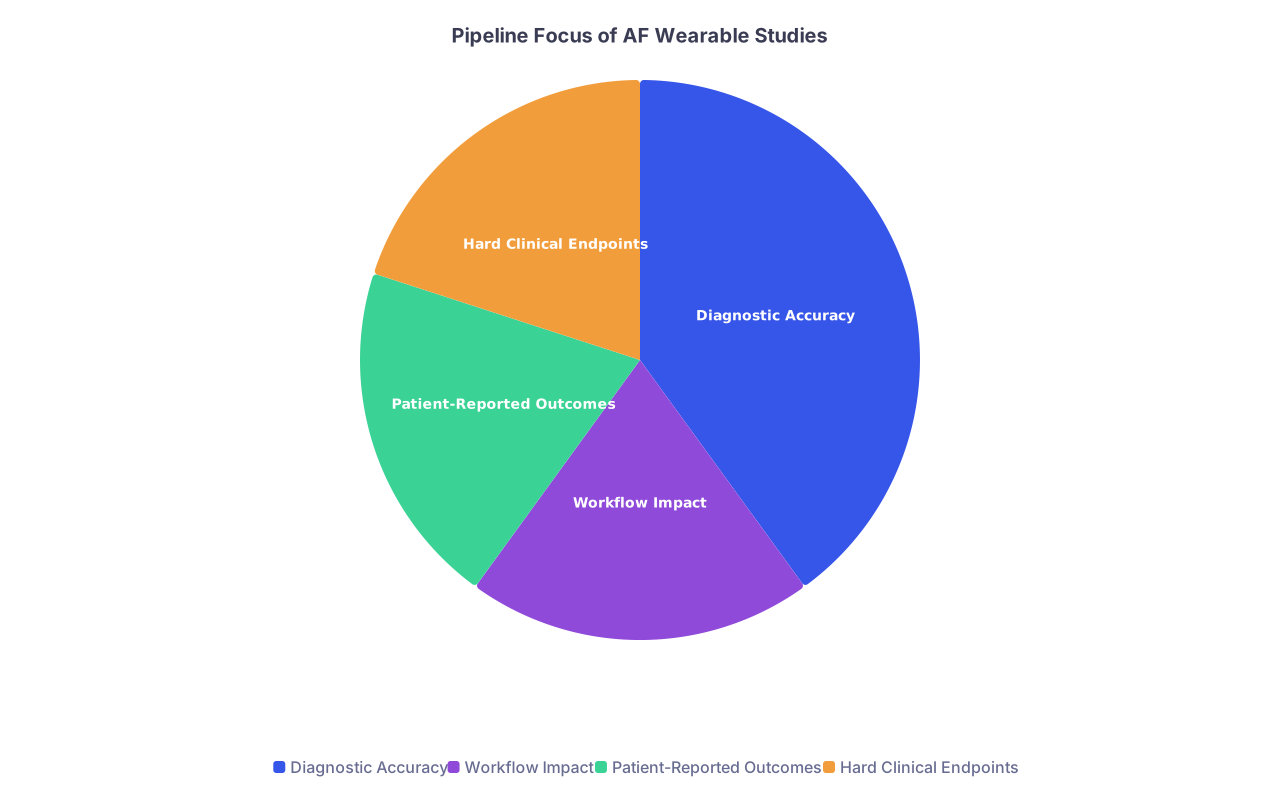
| Category | Value |
|---|---|
| Diagnostic Accuracy | 40 |
| Workflow Impact | 20 |
| Patient-Reported Outcomes | 20 |
| Hard Clinical Endpoints | 20 |
Notice how much of the research weight is still on diagnostic accuracy rather than on “Did people actually have fewer strokes without more bleeding and anxiety?”
10. Practical boundaries: when to push back
You are allowed—ethically and professionally—to say “no” to endless testing driven by false positives.
Some examples:
- Young, low-risk patient, normal ECG and 24-hour Holter, CHA₂DS₂-VASc = 0, persistent borderline watch readings
- Reasonable stance: reassure, no further rhythm testing unless symptoms or risk factors change.
- Older, high-risk patient with a single ambiguous strip and clean 14-day monitor
- Reasonable stance: document discussion, consider shared decision-making around repeat monitoring vs watchful waiting; do not default to indefinite repeat monitors.
- Patient demanding anticoagulation purely because “my watch keeps saying AF” in the face of repeated negative medical-grade testing
- Reasonable stance: decline, explain bleeding risk, and rely on documented, guideline-concordant criteria instead of consumer device labels.
The ethical anchor is proportionality: the invasiveness and risk of investigations and treatment should match the strength of evidence of disease, not the decibel level of the device’s notifications.
11. The future: can we tame the false positive problem?
Technically, yes. At least partially.
Several strategies are being explored:
Dynamic thresholds
Algorithms that adjust their alert thresholds based on user risk profile (age, comorbidities). Low-risk users would see fewer alerts, raising PPV.Multi-signal integration
Combining PPG, accelerometer (activity), and perhaps even intermittent ECG to improve specificity and reduce spurious flags from motion or ectopy.Longer confirmation windows
Instead of alerting after a few minutes of irregularity, requiring longer continuous episodes or repeated events over days before firing a notification.Contextual messaging
Notifications that include Bayesian context: “Based on your age and history, about 1 in 3 alerts like this represent true AF. Follow up with a clinician for confirmation.”

| Step | Description |
|---|---|
| Step 1 | Raw PPG Irregularity |
| Step 2 | Lower Alert Threshold |
| Step 3 | Higher Alert Threshold |
| Step 4 | Require Repeat Episodes |
| Step 5 | Send AF Notification |
| Step 6 | No Notification |
| Step 7 | User Risk High |
| Step 8 | Episode Duration Long |
Ethically, the more we can selectively target those at meaningful risk—and spare low-risk users from constant false positives—the more defensible mass AF screening becomes.
Right now, we are not there yet at scale.
12. If you remember nothing else, remember this
Three points.
The data show that in general wearable populations, only about 1 in 3 AF alerts are confirmed as true AF on medical-grade ECG. That is the false positive reality behind the shiny sensitivity/specificity numbers.
False positive “rates” are low, but the absolute false positive “burden” is high in low-prevalence groups. This burden translates into clinic congestion, cascades of testing, and significant patient anxiety.
Ethically, you should treat wearable alerts as prompts for risk-based confirmation, not as diagnoses. Set expectations, use structured triage, and be willing to say “enough” when repeated negative testing collides with persistent device-driven fear.
Use the tech. Just do not outsource your judgment to it.