
It’s 1:17 a.m. You’re on VSLO, program websites, Reddit, maybe even Doximity, and this awful thought is looping in your head:
“What if I pick a residency that’s… kind of old‑school and not very innovative. And I lock myself into 3–7 years of feeling behind while everyone else is doing AI, new devices, cool trials, global stuff? What if I ruin my future because I chose ‘safe’ over ‘cutting edge’?”
You click on one program’s “Research & Innovation” tab and it’s… one paragraph from 2017. Another program has a full-page AR/VR surgery video, AI triage tool, innovation institute, digital health track, and 50 logos of industry partners. You feel your stomach drop.
“Am I about to make a permanent, career-defining mistake because I rank the ‘wrong’ one?”
Let me say the scary thing plainly: you probably will second-guess your choice at some point.
But that’s not the same as “you ruined your career.”
Let’s unpack this properly, because the anxiety here is real and honestly, pretty rational.
What “Non-Innovative” Actually Looks Like (Versus What You’re Imagining)
When we say “non-innovative program,” your brain probably jumps to a caricature:
- No one does research
- Attendings don’t know what telehealth is
- Paper charts, no EMR
- Nobody cares about QI, AI, devices, trials, anything forward-thinking
I’ve never seen a legitimate ACGME program that actually looks like that.
More often, “non-innovative” really means one of these:
- They don’t market innovation well on their website
- They’re clinically heavy, academically light
- They don’t have a branded “Innovation Track,” “Digital Health Pathway,” or glossy lab photos
- QI and research exist, but it’s more mundane: antibiograms, readmission projects, workflow changes, bread-and-butter clinical trials
To give you some structure, here’s how programs tend to actually sort out:
| Feature | Highly Branded-Innovative | Typical 'Non-Innovative' |
|---|---|---|
| Dedicated innovation track | Yes | Rare |
| Industry/startup ties | Common | Occasional |
| Big grant funding (NIH) | Often | Variable |
| Routine QI projects | Yes | Yes |
| Access to research | Abundant | Present if you ask |
So a “non-innovative” program might actually just be: “We don’t advertise this well, and our residents are too busy admitting 20 patients a night to make TikToks about AI.”
The Real Fear: Am I Locking Myself Out of Future Opportunities?
That’s the core terror, right? Not just “I’ll be bored,” but:
“I won’t match into fellowship.”
“I’ll never get into academic medicine.”
“I’ll miss the whole wave of medical innovation and always be 10 years behind.”
Let me be blunt: training at a less flashy, non-innovative program can make some things harder… but it almost never makes them impossible.
I’ve watched:
- A community IM resident with basically zero research match GI at a big academic center after grinding out case reports and one solid QI project.
- A “middle-of-nowhere” FP resident end up leading telehealth implementation for a whole system because she volunteered to be the annoying person who understood the EMR better than anyone else.
- A surgery resident from a regional, not-famous program become an early adopter of robotics because her attending was willing to train and she seized it, even though the program never said “innovation” on the website once.
You’re not buying a lifetime membership to “non-innovative physician status” with your rank list.
Residency is a launchpad, not a prison.
What Actually Predicts Whether You’ll Be “Innovative” Later
Here’s the part no one says out loud because it sounds a little harsh:
The biggest determinant of whether you become someone who’s involved in innovation is… you. Your habits. Your curiosity. Your tolerance for extra work when you’re already tired.
And yes, the environment matters, but not in the binary way we pretend.
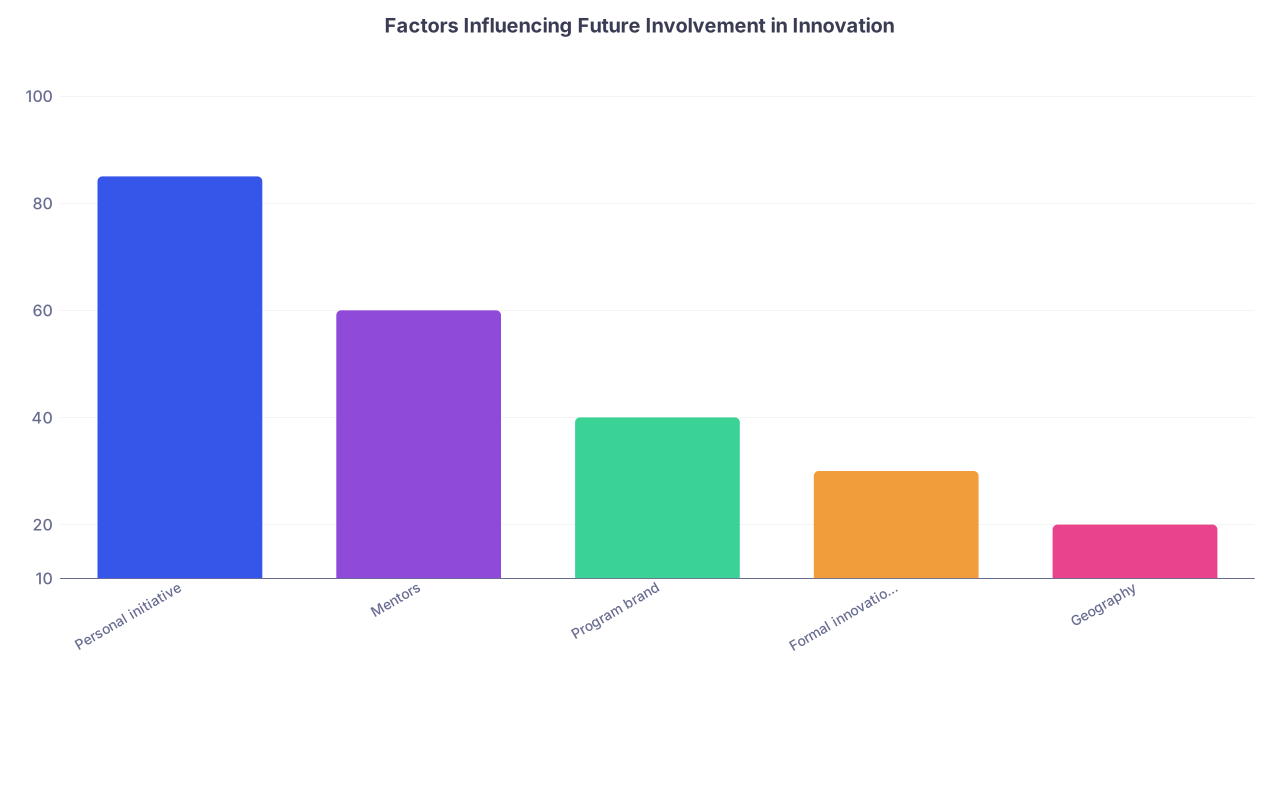
| Category | Value |
|---|---|
| Personal initiative | 85 |
| Mentors | 60 |
| Program brand | 40 |
| Formal innovation track | 30 |
| Geography | 20 |
Those numbers aren’t from some randomized trial; they’re reality from watching class after class of residents:
- The ones who email 3 attendings asking, “Can I help with your project?” get involved.
- The ones who say yes when someone asks, “Hey, want to help pilot this new workflow?” end up on the poster.
- The ones who’re actually curious, not just prestige-chasing, grow into people others see as “innovators,” even if they start from nowhere special.
A hyped “innovation program” can absolutely help. It gives you prebuilt paths. Mentors. Infrastructure. It lowers the activation energy.
But it does not replace the part where you have to push for opportunities, protect time, and do stuff that won’t show up in your paycheck.
Worst-Case Scenario Thinking: What If I Really Do Regret It?
Let’s run the nightmare through.
You match at a solid, clinically strong but pretty traditional program. No innovation lab. Limited research. Everyone talks about “getting the work done,” not “disrupting healthcare.”
Year 1–2, you feel like you’re just surviving. Night float. Codes. Notes. You see friends at sexier programs posting lab photos with pipettes and VR headsets and “excited to share our new AI triage study” on LinkedIn. You feel like a dinosaur.
You think: “I messed up. I should’ve gone all-in on that one academic place that waitlisted me for an interview.”
Now what?
There are real levers you still have:
Micro-innovation inside your rotation.
Every service has broken processes. You can start with tiny things: standardizing a handoff template, helping build an order set, creating a checklist. That’s not just survival — that’s systems thinking. That is innovation; it’s just not branded.Find the one or two attendings who care.
There’s almost always a quietly nerdy attending with a QI habit or a small trial. They’re not on the homepage. You hear about them because someone says, “Yeah, Dr. X is always doing some project, you should ask them.”Use your “vacation” / electives strategically.
You can do away electives at bigger centers. You can spend a month at an academic place doing research. You can connect with innovation centers as a visiting resident.Leverage external ecosystems.
Online courses in digital health. Remote research collaborations. Virtual hackathons. Industry-sponsored QI projects. There’s an entire parallel universe of innovation that doesn’t care where you’re a resident if you show up and do work.Play the long game.
Fellowship. MPH. MBI. Post-residency innovation fellowships. Hospitalist job at an organization with a big innovation arm. None of these are blocked by you having trained at a “normal” residency.
So worst case: yes, you feel behind for a while. You’ll compare. You’ll hurt a bit.
That still isn’t the same thing as “irreversible, career-ending mistake.”
But Won’t Programs Judge Me Later If I’m From a “Boring” Place?
They might judge at first glance. People are biased. Program names matter. That’s just the truth.
But here’s the part we conveniently ignore when we freak out:
When you show up with actual output — projects, presentations, skills — they care way more about that than your program’s marketing copy.
I’ve literally heard selection committee conversations that go like this:
“She’s from [mid-tier program], but look at this QI work and this implementation project. She’s clearly driving change where she is.”
Vs.
“He’s from [top-10 place], but I don’t see anything here besides standard pathway stuff. No initiative, no leadership. Just rode the wave.”
Your program’s brand is a filter, not a sentence. It sets the initial impression. You override that impression with what you actually did.
A More Honest Risk: Choosing a “Shiny” Program That’s Toxic
Here’s the scenario almost nobody warns you about because it doesn’t photograph well.
You chase the most “innovative” program. The one with all the buzzwords: AI, robotics, startup partners, incubation hub, digital health lab.
You arrive and discover:
- The clinical workload is brutal and chaotic
- Innovation is reserved for a tiny subset of residents the PD likes
- Most residents don’t have time for any of it
- The culture is malignant: no psychological safety, lots of shaming, no support
Now you’re trapped in a place that markets innovation but doesn’t actually give you realistic access to it.
That kind of regret is worse, in my opinion, than “I’m at a solid but quiet program where I had to build my own opportunities.”
If I had to choose between:
- A calmer but “non-innovative” place with good humans, decent schedule, and room to grow my own stuff
- A shiny “innovation powerhouse” that burns me out and kills my curiosity
I’d take the first every time. I can add innovation later. I can’t easily undo burnout and trauma.
You Don’t Actually Know What Kind of Doctor You’ll Want to Be… Yet
Another piece of this anxiety: you’re assuming “innovation” will definitely be central to your identity forever.
Maybe it will. But maybe you:
- Fall in love with complex clinical work and just want to be amazing at bread-and-butter medicine
- Realize you hate research timelines and prefer near-term patient impact
- Have kids. Suddenly that extra 10–20 hours/week of “innovation work” is dead on arrival.
- Care more about teaching, leadership, or ethics work than RCTs and devices.
I’ve seen people force themselves into “innovation” roles they don’t enjoy because they felt like that was what ambitious doctors were supposed to do.
You’re allowed to change your mind. 24-year-old “Innovation or bust” you and 33-year-old “I want to leave the hospital by 6 and not write 3 IRB applications” you might not want the same thing.
So yes, try to pick a place that doesn’t shut doors. But don’t torture yourself trying to optimally game a future you that doesn’t exist yet.
How to Sanity-Check a “Non-Innovative” Program Before You Commit
Here’s where you can be a little calculated, even inside all the anxiety.
Forget the marketing terms. Ask residents and faculty concrete questions like:
- “If I wanted to do a research or QI project, what would that realistically look like here?”
- “Do residents present at regional or national conferences? How often?”
- “Is there anyone here doing digital health / implementation / systems work?”
- “Has anyone gone into academic medicine, informatics, admin, or innovation fellowships from here?”
You’re not asking if they have an “Innovation Institute.” You’re checking if:
- Residents have bandwidth for anything beyond just surviving
- There are at least one or two mentors who care about moving the field forward
- People have actually done something with that environment

| Step | Description |
|---|---|
| Step 1 | Residency Program |
| Step 2 | Strong Clinician Focus |
| Step 3 | Local QI Projects |
| Step 4 | Presentations and Posters |
| Step 5 | Fellowship or Leadership Role |
| Step 6 | External Collaborations |
| Step 7 | Interest in Innovation |
If a program checks none of those boxes — no interest, no time, no mentorship, no track record — then yes, you should think hard about whether that aligns with who you are.
But most places clear at least the minimal bar of: “If you show up and push a bit, there’s room to do something.”
The Quiet Upside of Training Somewhere “Normal”
This part doesn’t get any glamour, but it matters ethically and professionally.
“Non-innovative” often correlates with:
- Higher volume, more autonomy, more exposure to real-world mess
- Underserved populations
- Fewer layers of bureaucracy between you and decision-making
- Opportunities to improve very broken, very human systems that actually impact patients
You learn what medicine really looks like in the trenches. The way care actually fails. The gaps where innovation could genuinely help, not just look good in a press release.
People who come from these places often have a clearer moral compass and stronger sense of what’s worth innovating around.
They’re not chasing shiny tools. They’re solving ugly problems.
There’s nothing “less than” about that.
Quick Reality Check Before You Spiral
If you remember nothing else from this whole nervous rant, take this:
You can absolutely:
- Train at a “non-innovative” program
- Feel pangs of envy watching friends in glossier places
- Still become the kind of physician who’s involved in meaningful, ethical, forward-thinking work
The path might be messier. You might have to create more of your own opportunities. You’ll definitely have regret-flavored nights scrolling LinkedIn and feeling behind.
But your residency program is not the sole determinant of whether you get to be part of medical innovation.
Your curiosity, persistence, and willingness to keep experimenting with your career — that’s the real engine.
And you’re taking that with you wherever you match.
FAQ (Exactly 6 Questions)
1. Will choosing a non-innovative residency hurt my chances at competitive fellowships?
It can make things less automatic, but not impossible. Fellowship programs care about demonstrated academic or systems engagement: research, QI, leadership, teaching. You can get those at a “non-innovative” program by being intentional — finding mentors, doing smaller projects, and presenting at regional or national venues. The name on your program matters, but what you did there usually matters more.
2. How can I tell if a program is truly “non-innovative” vs just bad at marketing?
Ignore the website gloss and ask residents specific, behavior-based questions: “When was the last time a resident presented at a conference?” “Who’s doing QI or research?” “Are there any residents involved in informatics, admin, or digital health?” If they can name concrete examples and you hear stories like “Oh yeah, X did a neat sepsis project,” that’s not dead. That’s just quiet.
3. Is it smart to rank a more innovative but toxic-feeling program higher?
I’d be very cautious. A program that looks cutting edge but feels unsafe, unsupportive, or malignant can crush the exact curiosity and energy you need to do innovative work. A healthier, less flashy environment where you can think, rest, and experiment is almost always a better long-term bet than a prestige machine that burns you out.
4. What if I realize halfway through residency that I actually do care a lot about innovation? Am I too late?
No. You can start small wherever you are: join or start a QI project, ask to help with an ongoing study, connect with external groups (virtual research, online innovation communities, telehealth pilots). You can then use electives, away rotations, or post-residency fellowships and degrees (like informatics or health systems) to ramp that up. Mid-residency pivots happen all the time.
5. Does being at a non-innovative program make me ethically “less good,” like I’m not helping move medicine forward?
Not at all. Providing solid, compassionate, evidence-based care to real patients in non-glamorous settings is morally substantial work. Innovation isn’t ethically superior by default — some “innovations” are wasteful or harmful. If anything, clinicians who understand real-world constraints from “normal” programs often design more ethical, grounded innovations later.
6. Practically, what’s one thing I can do now if I’m scared of choosing the wrong type of program?
Make a short list of 3–5 programs you’re considering and talk to current residents, not just faculty. Ask them whether they’ve been able to pursue any project or idea outside of pure clinical work, no matter how small. Then, when you build your rank list, prioritize a place where residents aren’t completely crushed — because the ability to breathe and be curious will matter more to your future innovation potential than any website’s buzzwords.
Years from now, you won’t remember every brochure or website line about “innovation” that you obsessed over. You’ll remember whether you gave yourself enough space — in whatever program you chose — to stay curious, pay attention to what’s broken, and keep nudging your career toward the kind of work that actually matters to you.