
The myth that you have to be “tech-savvy” to survive in an AI-driven clinic is doing more damage than AI itself.
The Fear Underneath the Buzzwords
Let me just say the quiet part out loud: I’m scared AI is going to expose me.
Not as lazy. Not as unkind. As… incompetent with technology.
Everybody keeps throwing around words like “workflow optimization,” “LLM integration,” “clinical decision support,” and I’m over here thinking: “Sometimes I break the printer. By opening Gmail.”
And then the spiral starts:
- What if attendings expect me to be the “AI person” just because I’m young?
- What if I’m the slowest one in the room at using the new system?
- What if I click the wrong thing in some AI note-writing tool and it documents the exact opposite of what I meant?
- What if not being good with tech actually makes patients less safe?
Under all the glossy “AI will help doctors!” marketing, that’s the fear. That we’ll look stupid. Or dangerous. Or obsolete.
Let me be blunt: this “you must be tech-savvy” standard is fake. It’s not how real clinics work, and it’s not how safety actually functions.
What matters in an AI-driven clinic is not being “good with tech.” What matters is judgment, humility, and the willingness to ask “Wait, does this make sense?” even if everyone else is clicking through like zombies.
You can absolutely thrive without being “the tech person.” But you do need to understand where the real risks are.
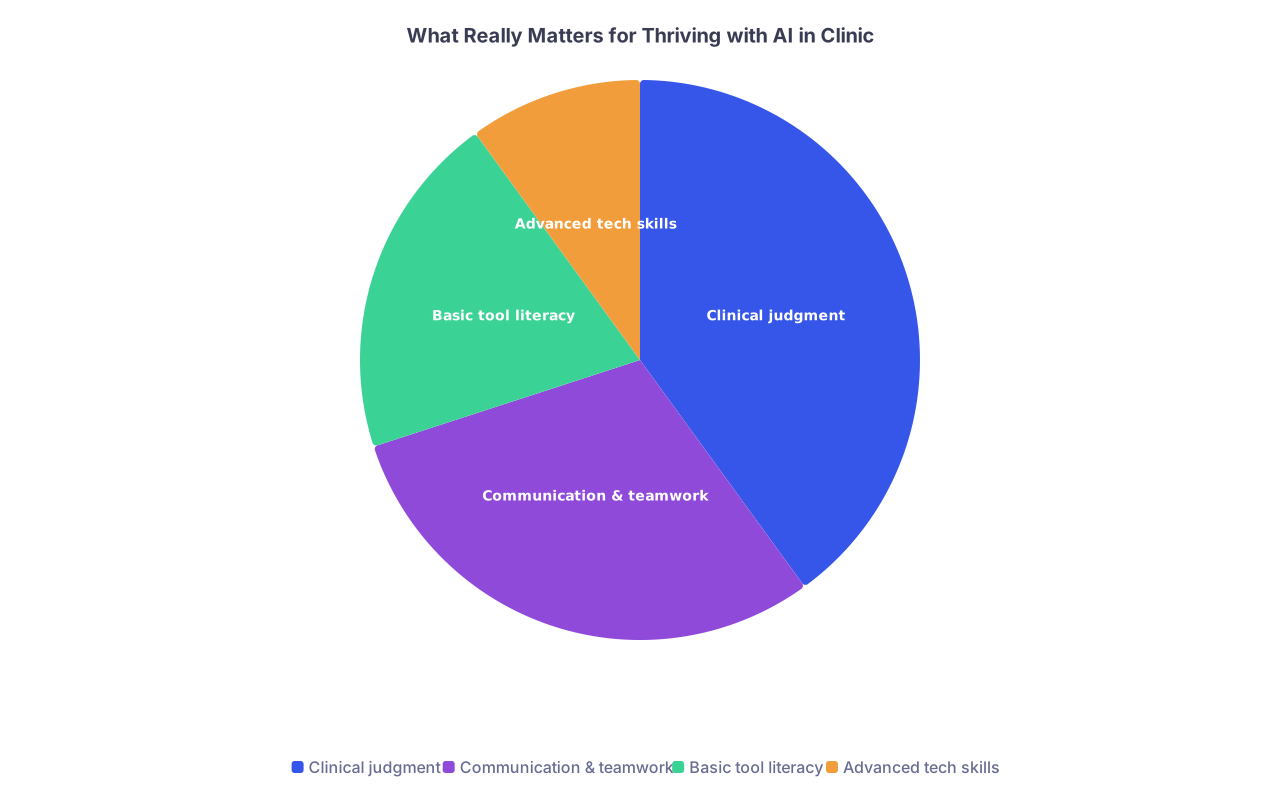
| Category | Value |
|---|---|
| Clinical judgment | 40 |
| Communication & teamwork | 30 |
| Basic tool literacy | 20 |
| Advanced tech skills | 10 |
What “Not Tech-Savvy” Actually Looks Like in Clinic
Let me paint the worst-case scenario bouncing around my head.
You’re on your first day in an outpatient clinic that advertises itself as “AI-enabled.” The website shows sleek dashboards and vaguely futuristic charts. You walk in and you’re still trying to remember all the EHR tabs.
The MA says: “We use an AI scribe that auto-generates notes. Just review and sign.”
Your brain: I barely trust myself to write a SOAP note. Now I’m supposed to trust a robot?
Here’s what “not tech-savvy” looks like in real life:
- You’re slower with new systems. You click around more. You have to ask, “Where is that button again?”
- You get flustered when there are three different logins and one of them randomly times out.
- You sometimes forget the “trick” that everyone else knows for auto-populating something.
- You’re terrified that one mis-click equals a medication error.
I’ve seen people like this thrive. And I’ve seen extremely “techy” residents make awful, dangerous decisions because they trusted the system too much.
The people who actually scare me? The ones who move fast and never question what the AI spits out.
You know who’s safer? The anxious one double-checking the med list and asking, “Can we confirm this dose? It looks off.”
Your anxiety can be an asset if you channel it correctly.

The Non-Negotiables: What You Actually Need to Function with AI
There are some things you can’t avoid. Even if you’re “bad with tech,” there’s a minimum bar you do have to hit to not feel like you’re drowning.
But that bar is way lower than “coding,” “ML models,” or any of that hype.
Here’s what you actually need:
Basic EHR competence.
Not mastery. Just: you can find prior notes, labs, imaging, med lists, and you can put in orders and write basic documentation without help 90% of the time. If the EHR is a mess for you, AI add-ons will just feel like extra chaos stacked on top of existing chaos.A mental “red flag” list.
You need an internal alarm for when AI output is especially dangerous if wrong: meds, doses, allergies, high-risk diagnoses, radiology impressions that don’t fit the story, anything that could change life-and-death decisions. Those areas get extra scrutiny. Always.The guts to say “I don’t trust this.”
This is huge. If an AI-scribed note says, “Patient denies chest pain” and you very much remember them describing chest discomfort, you need to feel comfortable saying: “No, I’m fixing this. I don’t care how fast this tool is.”Willingness to be the “slow one” for a while.
Everyone else might be hitting “Accept all” on AI drafts. You might be editing line by line. That’s fine early on. Your speed will grow. Your habit of checking details will stay.
That’s it. That’s the core.
You don’t need to build AI tools. You don’t need to understand neural networks. You need to understand where your name and license are attached. Because that’s where your responsibility is.
The Ethics Nobody Explains: You vs The Algorithm
The scary part of AI in clinic isn’t actually the tech. It’s the moral gray zone it creates.
Who’s responsible when something goes wrong?
Let me give you a real scenario I’ve watched play out.
Clinic starts using an AI triage tool. It flags some messages as “urgent,” others as “routine.” You’re the resident checking the inbox between patients. It’s 4:45 pm. You’re tired. There’s a message flagged as “routine” about shortness of breath that looks… borderline.
Your brain: “The system didn’t mark it urgent. I’m probably overthinking it. I’ll just respond with a generic ‘If symptoms worsen, go to the ER.’”
That is the ethical trap.
The AI is not responsible. You are. The system’s label is input, not absolution.
So ethically, thriving in an AI clinic means:
- You treat AI outputs like one more opinion in the room. Never the boss.
- You keep asking: “If I couldn’t see the AI suggestion, what would I think?”
- You don’t let AI make you lazy about reading the actual chart.
- You understand that “the system said so” will not protect you in front of a patient, a family, or a board.
And here’s the uncomfortable piece: AI will get things right most of the time. That’s what makes it dangerous. Because when it’s right 90–95% of the time, our brains stop questioning the 5–10% where it’s wrong in catastrophic ways.
Your job isn’t to be tech-savvy. Your job is to be the designated skeptic.
That’s an ethical stance, not a technical skill.
| Tool Type | What It Does Briefly | What You Actually Need to Do |
|---|---|---|
| AI scribes | Auto-generate visit notes | Edit for accuracy, tone, and legal risk |
| Decision support | Suggest diagnoses/orders | Cross-check with your own assessment |
| Triage systems | Prioritize messages/cases | Override when things feel off |
| Predictive models | Estimate risk, readmission etc | Use as one factor, never sole basis |
But What If I’m the “Dumb One” in a Tech-Obsessed Group?
Here’s the shame-filled thought you probably won’t admit out loud:
“What if everyone else on my team adapts fine and I’m the idiot who slows everything down?”
I’ve watched med students in clinic freeze up when the attending says, “Just use the AI template; it’s faster.” You see their faces go pale because they’re still hunting for where the vitals are stored.
Here’s how that actually plays out:
Most attendings do not want you to be lightning-fast with the new shiny tool. They want you to be:
- Safe
- Reliable
- Honest when you’re lost
If you say: “I’m still learning this system, but I want to make sure the note is accurate, so I’m going to review this carefully,” almost no sane attending will respond with, “No, go faster and be less safe.”
The real problem is when you pretend.
You click “accept” on everything because you’re too embarrassed to admit you don’t fully understand how the AI pulled information in. You assume, “Well, if it’s in there, it must be accurate.”
That’s where mistakes explode.
There’s a kind of quiet, boring competence that AI can’t replace: the person who knows when to slow down, ask, “Can you walk me through how this tool is supposed to be used?” and then actually listens.
Your goal is not “I’m the fastest AI note-writer.” Your goal is: “People trust me not to sign garbage.”

| Step | Description |
|---|---|
| Step 1 | AI Suggestion Appears |
| Step 2 | Reassess patient data |
| Step 3 | Double check with senior or guidelines |
| Step 4 | Use as supporting info |
| Step 5 | Override or modify AI output |
| Step 6 | Document reasoning |
| Step 7 | Does it match clinical picture |
| Step 8 | High risk decision |
Concrete Ways to Stop Feeling Doomed by AI
Let’s turn the anxiety into an actual plan. Not a 2-year curriculum. Just enough so you don’t walk into an AI-enabled clinic feeling like a fossil.
1. Learn the concepts, not the code
Ignore the ML math. Focus on these questions instead:
- What data does this tool use?
- Where does it show up in the workflow?
- What decisions does it influence?
- What are the worst-case failures?
If you can answer those for any AI tool you meet, you’re already ahead of half the people blindly clicking through.
2. Practice the sentence you’ll actually need
You will absolutely need this sentence one day:
“I’m not completely comfortable relying on this tool for this case. Can we double-check independently?”
You need to be able to say that out loud, in a room where people are tired, in a culture that loves efficiency. Practice saying it now, so later it doesn’t catch in your throat.
3. Build a tiny “AI skepticism” ritual
Before you accept an AI-generated note, diagnosis suggestion, or triage category, run through a 10-second check in your head:
- Does anything here contradict what I actually saw/heard?
- Is this decision high-risk if wrong?
- Is there any missing context the AI doesn’t know?
If the answer to any of those is “yes,” you slow down. That’s it. That’s your ritual.
4. Accept that you’ll make clumsy mistakes… with the software
You will click the wrong tab. You will lose a note draft. You will sign something with a typo in the social history that makes you cringe.
That doesn’t make you unsafe. That makes you a human being using a bad interface.
The real mistake would be ignoring a weird dose because “The system populated it, so it must be fine.”
The Quiet Truth: AI Needs Exactly the Kind of Person You Are
Here’s the irony that no one selling AI to hospitals will say:
AI actually requires people who are a little anxious, a little suspicious, and not dazzled by technology.
You, the “not tech-savvy” person who triple-checks doses and rereads discharge instructions? You are exactly who I want sitting between a black-box model and a vulnerable patient.
Thriving in an AI-driven clinic isn’t about who can use the fanciest tools.
It’s about:
- Who refuses to outsource their conscience
- Who is willing to say “This doesn’t feel right”
- Who keeps the focus on the patient instead of the dashboard
If that’s you, you’re not behind. You’re the safety system.
FAQ (Exactly 6 Questions)
1. If I’m bad with technology now, does that mean I’ll always struggle in an AI-heavy clinic?
No. “Bad with technology” usually just means “not familiar yet” and “easily flustered when rushed.” Both of those get better with repetition and good teaching. You don’t have some permanent deficit. Think about how EHRs felt the first week you used them versus the tenth week. Same thing will happen with AI tools, as long as you’re willing to ask questions and make awkward mistakes at the beginning.
2. Could I actually put patients at risk by not knowing how to use AI tools well?
You could put patients at risk by blindly trusting AI tools or by pretending you understand them when you don’t. That’s the real danger zone. If instead you move slowly, double-check anything high risk, and escalate when uncertain, you’re far safer than the overconfident person who speed-clicks through AI-generated content. Your humility protects patients more than fancy tech skills ever will.
3. Are programs going to expect me to be the “AI expert” just because I’m a younger trainee?
Some attendings will assume younger = tech support. That’s real. But there’s a very simple boundary you can set: “I’m still learning this system too, but I’m happy to help where I can.” You’re not obligated to be the unofficial IT department. Your job is clinical care and safe tool use, not debugging their latest pilot project. It’s okay to say, “I don’t know how that feature works yet.”
4. What if I’m slower than everyone else when using AI documentation tools? Will that tank my evaluations?
Early on, you probably will be slower, especially if you’re meticulously checking the AI note instead of just signing off. Most reasonable supervisors care a lot more about accuracy and thoughtfulness than note speed, especially for trainees. You can even frame it explicitly: “I know I’m a bit slower with this tool, but I’m prioritizing making sure the documentation is accurate.” That sounds conscientious, not incompetent.
5. Do I need to learn coding, machine learning, or do AI research to be competitive as a future clinician?
No. Those things are optional bonuses, not requirements. Having good clinical reasoning, communication, reliability, and a basic understanding of what AI tools do and don’t do will matter much more. If you’re interested in the tech side, great. If not, you won’t be obsolete. Most clinicians will interact with AI the way they interact with calculators or EHRs: as tools, not identity.
6. How can I ethically use AI without getting sucked into over-relying on it?
Make yourself a rule: AI can suggest, you must decide. Treat AI output like the opinion of a colleague with unknown training—sometimes brilliant, sometimes wildly wrong. You listen, you compare it to the story, exam, and your own reasoning, and you’re willing to ignore it completely when it doesn’t fit. Document when you intentionally go against AI suggestions, especially in high-stakes cases. That keeps you in the driver’s seat, where you ethically belong.
Key points, so you don’t leave more anxious than you arrived:
- You don’t need to be “tech-savvy”; you need to be clinically thoughtful and willing to question AI.
- Your anxiety about getting things wrong can be turned into a safety habit, not a weakness.
- AI is just another loud voice in the room—your judgment, not the algorithm, has to have the final word.