
The idea that you’ll be left behind because your med school doesn’t teach innovation or AI is wildly exaggerated. And yes, I’m saying that as someone who worries about this stuff way too much.
You’re not doomed. But you are right to feel uneasy.
Let’s unpack that panic in your chest and turn it into an actual plan instead of spiraling about being obsolete by PGY‑1.
The Fear: “Everyone Else Is Learning AI… I’m Learning Cranial Nerves”
Here’s the nightmare loop, right?
You’re seeing:
- Posts about “AI in Healthcare” tracks at fancy schools
- Programs bragging about “Innovation Labs,” “Digital Health Pathways,” “Machine Learning in Medicine” electives
- People on LinkedIn with “MD Candidate + AI Fellow + Startup Founder” in their headline
And then there’s your school:
- No AI course
- No innovation curriculum
- No digital health electives
- Maybe one grand rounds talk about ChatGPT where the speaker said, “Don’t use this to write your notes.”
So your brain goes:
“I’m going to graduate as the dinosaur intern who barely knows how to log into Epic while everyone else is building clinical decision support tools, publishing AI papers, and getting fast-tracked to leadership. I’ll never match competitive specialties. I’ll be the ‘just a regular doctor’ while the ‘AI doctors’ run the show.”
Here’s the blunt truth:
Med schools are massively behind the curve on AI. Almost nobody is getting a real, structured, high-quality AI education in medical school right now, even at brand-name places that talk like they are.
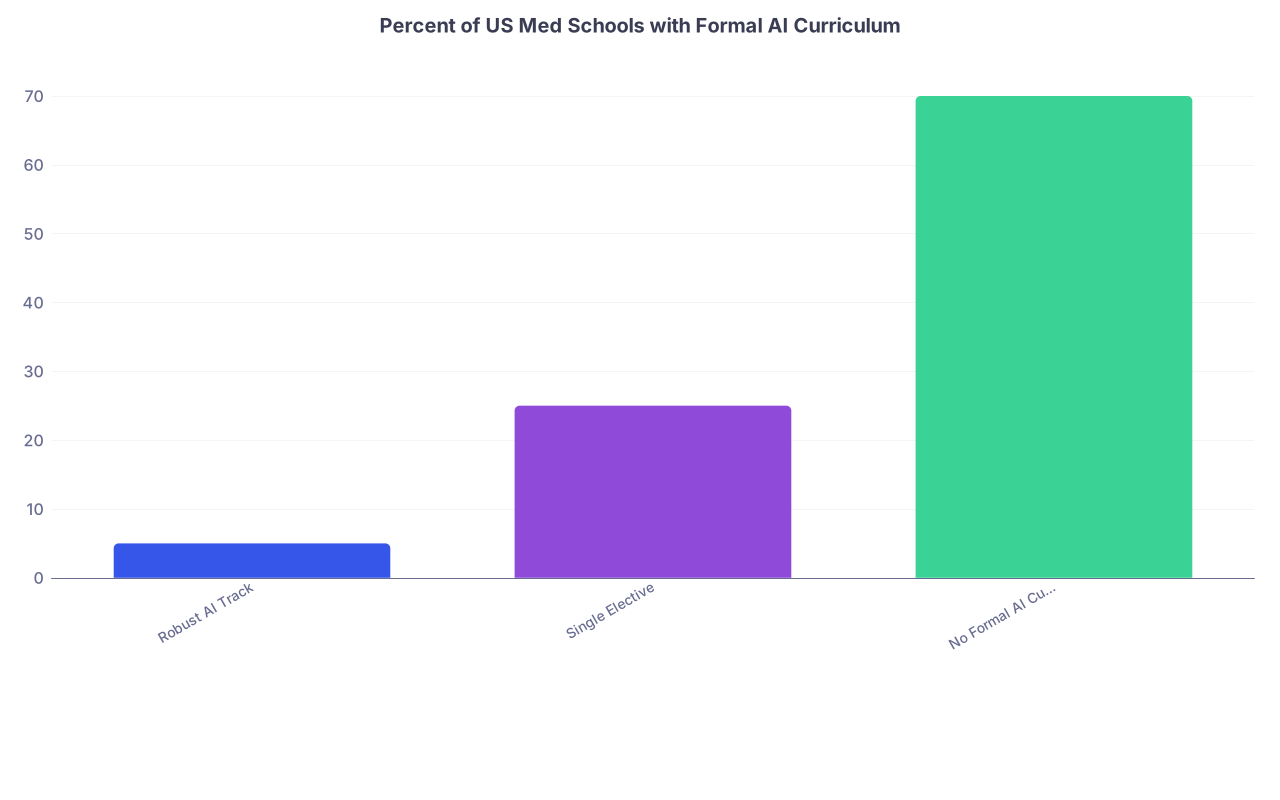
| Category | Value |
|---|---|
| Robust AI Track | 5 |
| Single Elective | 25 |
| No Formal AI Curriculum | 70 |
So if your school has nothing? You’re not an outlier. You’re the majority.
The fear feels real. The gap is mostly imagined.
What “Falling Behind” Actually Means (And What It Doesn’t)
Most of us catastrophize this into some weird sci‑fi hierarchy:
- Top tier: “Innovation MDs” who understand AI, do research, talk about ethics, get invited to panels
- Middle: Normal, competent clinicians who know AI is a thing but don’t touch it
- Bottom: You, supposedly, staring at the EHR like it’s DOS
Reality is a lot messier.
Residency program directors are not sitting around saying: “Reject this person, they didn’t do an AI certificate course.”
They still care about:
- Step scores / board performance
- Clinical evaluations and letters
- Research and sustained interests
- Professionalism and being not‑a‑nightmare to work with
AI and innovation exposure can help you stand out, but only as one flavor of “serious, engaged applicant.” It’s in the same bucket as:
- Health policy work
- Global health
- Quality improvement
- Bioethics
- Medical education research
It’s an angle, not a requirement.
What “falling behind” could mean, if you ignore this stuff completely, is:
- You graduate with zero literacy about tools you’ll actually see in hospitals (AI triage systems, radiology support tools, predictive models in the EHR).
- You feel powerless and lost when people talk about algorithmic bias, AI errors, and responsibility.
- You have no language to talk to administrators, researchers, or tech teams about what you see at the bedside.
That’s real. And yes, your school not teaching it makes that more likely.
But here’s the twist: you can fix all of that yourself. Without a formal curriculum. Starting in small, not‑that‑overwhelming ways.
Why Your School’s Lack of AI Curriculum Isn’t a Death Sentence
Let me be brutally honest: a lot of “AI in Medicine” courses are fluff.
I’ve seen syllabi from “cutting-edge” programs that are basically:
- “What is AI?”
- 2 papers about ChatGPT
- A panel of people who built nothing clinically scalable
- A final project that lives in someone’s Google Drive and never sees a patient
Does that look sexy on a brochure? Yup.
Does it always produce physicians who are deeply prepared to handle real AI tools in actual clinics? Not really.
You not having a formal AI track means:
- You’re not tied to a mediocre curriculum designed to check an accreditation box.
- You can chase the stuff that actually matters to you instead of doing a group project on a fake app no one ever uses.
- You have freedom to build a coherent narrative: “I cared about X problem in medicine, and here’s how I explored AI/innovation around it.”
And schools with innovation centers? They’re great if you use them. But there are students at top‑tier AI‑obsessed schools who graduate with:
- Zero AI projects
- No idea how a model is validated
- No clue how to question an AI‑generated recommendation
- The same “I just click buttons in Epic” energy as everyone else
What separates people isn’t the logo on the building. It’s whether they did the slow, boring, quiet work:
- Reading
- Asking annoying questions on rounds
- Joining real projects
- Reflecting on ethics and patient impact
You can do all of that from anywhere.
The Part You’re Actually Right to Worry About: Ethics and Power
Here’s the thing I won’t downplay: AI in medicine is not just about tech. It’s about power, bias, and who gets hurt when things go wrong.
If your school isn’t teaching:
- How training data can encode racism, sexism, and structural bias
- Who’s accountable when an AI tool misleads a clinician
- Why “the computer said so” is not an ethical justification
- How AI can widen gaps between wealthy, well-connected systems and under‑resourced settings
…then yeah, that’s a problem.
Because you’re going to be the one in the room when:
- An AI sepsis alert is firing nonstop and nurses are overwhelmed
- A risk score is mysteriously higher for certain patients and you’re not sure why
- An attending says, “The algorithm flagged this; we should admit,” and your gut says, “Really?”
You need ethical muscles, not coding skills.
Your school skipping innovation and AI doesn’t just risk you being “behind.” It risks you being unprepared to protect patients from bad tech decisions.
That fear you have? That you’ll just passively follow whatever black box the hospital buys?
Keep that. That fear is healthy. It’ll keep you from sleepwalking.
But instead of living in that anxiety, you can turn it into a small, specific, doable plan.
A Practical, Not-Overwhelming Plan To Catch Yourself Up
You don’t need to become an engineer. You don’t need to publish three AI papers.
You do need a baseline competence and a story that says:
“I took this seriously. I engaged. I asked hard questions.”
Here’s a realistic way to get there from a “no innovation curriculum” school.
1. Build the Bare-Minimum Literacy (Without Drowning in Math)
Goal: Understand enough to not be BS’d.
Over the next 2–3 months, aim for:
- 1–2 well-chosen books or long‑form resources on AI in medicine and ethics
- 3–5 key papers that people actually cite
- A working vocabulary: model, training set, bias, validation, overfitting, black box, etc.
Concrete starting points:
- One approachable book on AI in healthcare / ethics
- A few high‑impact papers from journals like NEJM, Nature Medicine, JAMA on clinical AI tools
- A short, physician-oriented online course (Coursera/EdX style) on AI in healthcare (even if you skim)
You’re not trying to become a data scientist. You’re trying to understand what’s reasonable and what’s hype.
2. Tie AI To a Real Clinical Problem You Actually Care About
Programs don’t care if you “like AI.” They care what you did with it.
Pick one problem that already bothers you or interests you:
- Misdiagnosis in ED
- Burnout and documentation burden
- Inequities in readmission rates
- Access to mental health care
- Overuse of imaging or antibiotics
Then ask:
“How could AI help here?” and just as crucial,
“How could AI make this worse?”
You can turn that into:
- A small QI idea
- A literature review
- A case-based ethics talk
- A reflection essay
- A poster on “Ethical Considerations of AI Tool X in Setting Y”
No lab. No fancy center. Just you, your curiosity, and some structure.
3. Manufacture Your Own “Mini-Curriculum”
Your school won’t do this. You can.
Think of it like a 6‑month self‑made track:
| Month | Focus |
|---|---|
| 1 | Basics & vocabulary |
| 2 | Read key papers |
| 3 | Choose a problem |
| 4 | Small project/essay |
| 5 | Share/present work |
| 6 | Reflect & refine |
That’s it. Not some 20‑hour‑a‑week monster. Just consistent, small steps layered on top of your existing life.
How To Turn “My School Has Nothing” Into an Asset
This is the part people completely miss.
If your school doesn’t have innovation / AI infrastructure, you can frame your story as:
“There was no path, so I built my own.”
Residency PDs actually like that. It signals:
- Initiative
- Self-direction
- Genuine interest, not just doing what was spoon-fed
Examples of how you could talk about this in interviews or essays:
- “Our school didn’t have a formal AI or innovation curriculum, but I kept seeing X problem on the wards, so I started reading about how AI tools were being used there. That turned into a small project where I…”
- “Because we didn’t have structured teaching, I organized a small journal club on AI and bias in medicine with a few classmates and a faculty mentor. We focused on cases where models worsened disparities…”
- “Without an innovation lab, I partnered with the hospital’s quality team to understand how they evaluated new AI tools. That’s where I learned…”
You’re not apologizing. You’re reframing:
“I wasn’t given this. I went after it.”

| Step | Description |
|---|---|
| Step 1 | No AI curriculum |
| Step 2 | Anxiety about falling behind |
| Step 3 | Learn basics independently |
| Step 4 | Pick one clinical problem |
| Step 5 | Small ethics or QI project |
| Step 6 | Share work and reflect |
| Step 7 | Coherent narrative for applications |
That’s a lot more compelling than:
“My school had an AI track and I took the elective like everyone else.”
What About Matching Into Competitive Specialties?
This is the lurking fear under all of this, isn’t it?
“If I don’t have innovation / AI experience, am I dead for derm, rad onc, ortho, neurosurg, IR, etc.?”
Short answer: no. Not even close.
But let’s be specific where AI can be a plus:
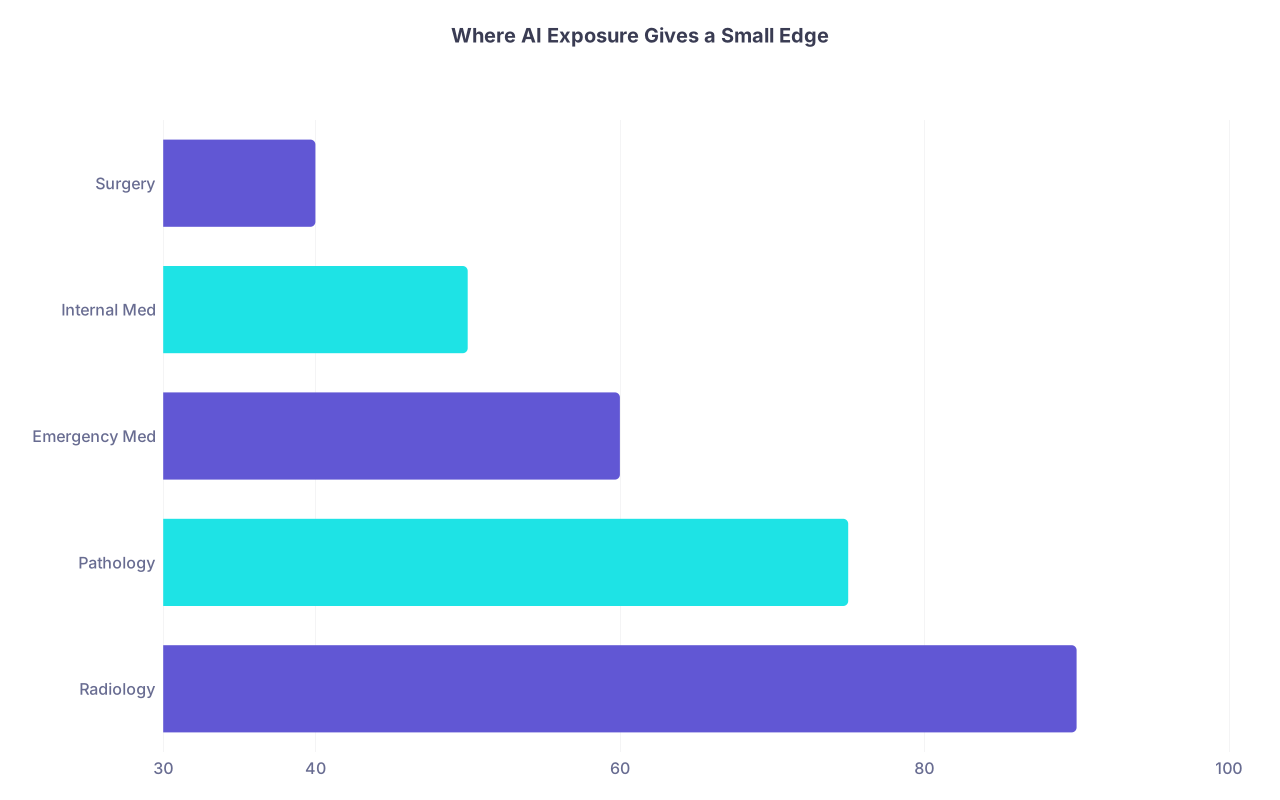
| Category | Value |
|---|---|
| Radiology | 90 |
| Pathology | 75 |
| Emergency Med | 60 |
| Internal Med | 50 |
| Surgery | 40 |
This doesn’t mean “90% required.” It means: these are fields where you can easily connect AI/innovation to day‑to‑day practice and come off as someone who thinks about the future of that specialty.
You can stand out by:
- Doing a small AI‑adjacent project with a radiologist or pathologist
- Writing or presenting on ethical or workflow implications of AI tools in that field
- Being the student who asks grounded, specific questions about existing AI tools used in that department
But none of this replaces the basics:
- Strong clinical performance
- Solid letters
- Consistent interest
- Not being a disaster on teams
AI is a bonus layer, not the cake.
How To Survive the Constant “I’m Behind” Feeling
I won’t pretend the anxiety just disappears because you understand the landscape better. The comparison trap is brutal.
You’ll still see:
- Someone your age on a panel titled “The Future of AI in Cardiology”
- LinkedIn posts about med students “co‑founding” an AI startup
- Press releases about “First AI Grand Rounds Series” at schools that aren’t yours
Here’s what I remind myself when my brain goes into “I’m nothing, they’re everything” mode:
A lot of public innovation is marketing
Schools, startups, and even hospitals hype things that are pilot‑stage, unvalidated, or never used clinically.Depth beats logos
Quiet, thoughtful work on a real problem is more impressive than a flashy, shallow affiliation.Most people are faking their understanding
I’ve listened to “AI in medicine” talks where the speaker could not explain, in plain language, how the model they were praising was validated. Don’t idolize what you haven’t inspected.You only need one strong, coherent story
Not 10 certificates. Not 6 hackathons. One real problem you cared about and kept coming back to.
And yes, you’re allowed to be scared that you’ll graduate into a system changing faster than your curriculum. You just don’t have to stay frozen there.
What You Can Do Today (Not Someday, Not “When Things Calm Down”)
You don’t need to redesign your life overnight. You just need one concrete move.
Do this today:
Open a blank document and title it: “My AI & Innovation In Medicine Plan – [Your Name].”
Then write three things in it:
One sentence:
“The part of AI in medicine that scares me the most is ________.”One narrow problem in medicine you actually care about (not “healthcare is broken,” something specific like “missed sepsis in ED triage” or “documentation burnout for residents”).
One tiny next step you commit to this week, such as:
- Read one article about AI in that problem area
- Email one faculty member asking, “Is anyone here working on AI or digital tools related to X?”
- Ask a resident or attending, “Do we use any AI‑based tools for [X] here? How do you feel about them?”
That’s it. Don’t design a 12‑month roadmap. Don’t promise yourself 10 hours a week.
Just those three lines.
You’re not falling behind because your school has no AI curriculum.
You only fall behind if you use that as an excuse to do nothing.
So open that document. Type those three things.
Then hit save.