
It is 10:47 p.m. You just uploaded the “final” version of your medical education grant proposal to the portal. You are exhausted, slightly proud, and already half-dreaming about data you will collect and sessions you will run. Two months later, you get the decision email: “We received many excellent proposals. Unfortunately…” You know the rest.
Most people blame “competitiveness” or “funding climate.” Convenient. Sometimes true. But in medical education, many grants die for boring, preventable reasons long before reviewers ever argue about impact.
Let me walk you through the mistakes that quietly kill medical education project proposals. So you do not repeat them.
Mistake #1: Writing a Project You Want, Not a Project the Funder Wants
This is the most common and the most fatal.
You fall in love with your idea: a longitudinal professionalism curriculum, a new simulation bootcamp, a resident-as-teacher certificate. Then you go hunting for “any” grant that will pay for it. You twist your project language to match the call, change some buzzwords, and convince yourself it fits.
Reviewers see through that in two minutes.
Common manifestations:
- Funder prioritizes multi-institutional work → you submit a single-site passion project
- Call emphasizes rigorous evaluation and scholarship → you submit “we’ll send a survey”
- Program wants work on equity or UIM learners → you mention DEI once in the last paragraph
Stop doing this. Start the other way around.
Read the RFA (request for applications) first. Slowly. Three times. Look at funded project lists from prior cycles. Then decide: “Do I have, or can I design, a project clearly inside this funder’s strike zone?”
If not, walk away. For that cycle, for that mechanism. Forcing a bad match is how you waste 40 hours and get a polite rejection that never explains the real problem: misalignment.
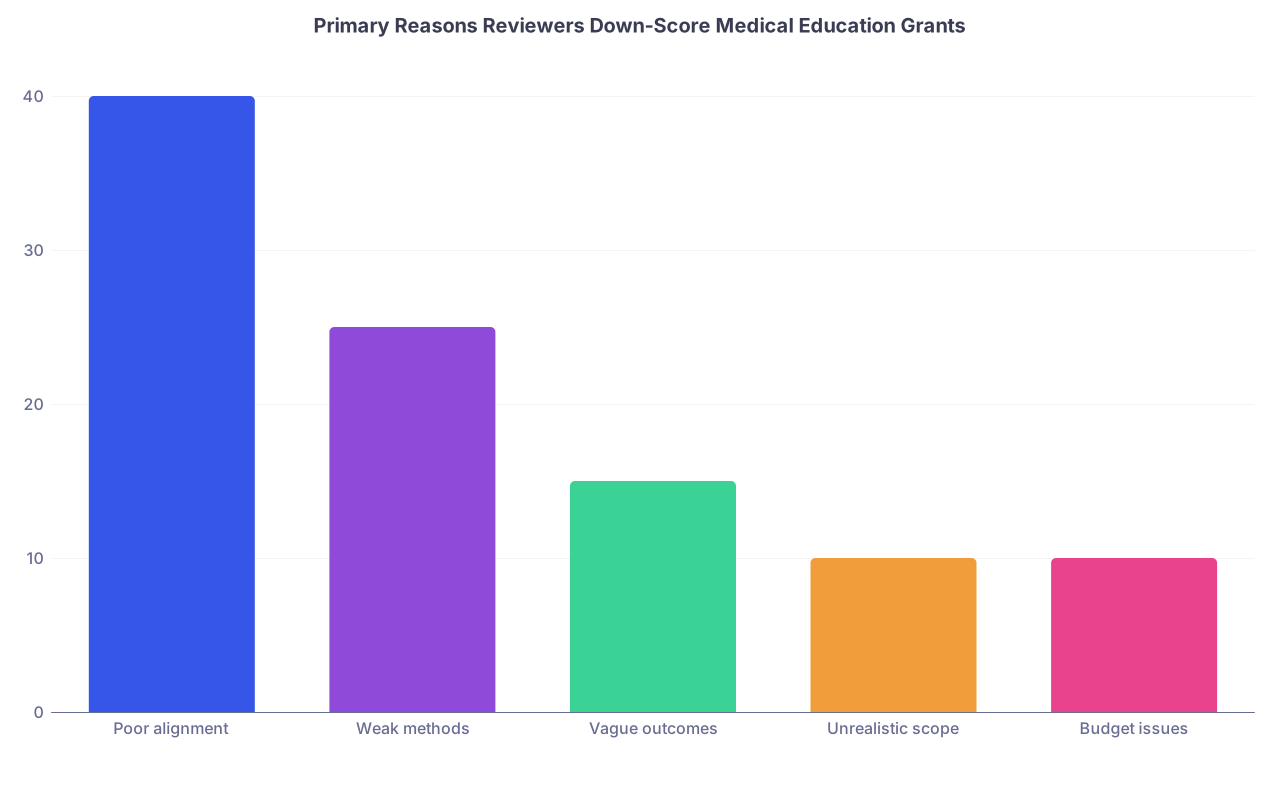
| Category | Value |
|---|---|
| Poor alignment | 40 |
| Weak methods | 25 |
| Vague outcomes | 15 |
| Unrealistic scope | 10 |
| Budget issues | 10 |
Mistake #2: Confusing “Good Teaching” With a Fundable Educational Intervention
Another classic. You describe what is essentially “I want to do better teaching” and expect funding.
Funders do not pay you to finally build the curriculum your department should have created 10 years ago as part of its basic educational responsibilities.
Red flags your proposal is just “good teaching in disguise”:
- Aim reads like: “To create a high-quality lecture series on…”
- Methods section is 80% about content and 20% about evaluation
- No conceptual framework, no hypothesis, no clear innovation
- Your outcome is “participant satisfaction” or “self-reported confidence”
I have seen entire proposals where the “innovation” was using Zoom. In 2024.
Turn teaching into a project by doing at least these things:
Anchor in a framework or theory
Kolb, self-determination theory, cognitive load, communities of practice. Pick one that actually fits what you are building, and show you know how it shapes design and evaluation.Make a testable, non-trivial claim
Example: “We hypothesize that team-based, spaced case discussions will improve residents’ diagnostic calibration more than traditional noon conferences, as measured by X.”Aim beyond your own learners
How will your work inform other institutions? Other specialties? Future guidelines? If impact stops at “our PGY-2s liked it,” it is not a competitive project.
Do not assume that being a beloved teacher means you have a fundable grant idea. Those are different skills. Overlap, yes. But not the same.
Mistake #3: Aims Pages That Try To Impress Instead of Being Obvious
If a reviewer cannot understand what you are doing and why within 60–90 seconds of reading your aims page, you are done. They won’t admit that. But you are.
Common aims-page killers:
- Buzzword salad: “We will leverage innovative, scalable, interprofessional, technology-enhanced pedagogies to reimagine…” Stop.
- Overstuffed aims: five aims, each with three sub-aims, all vague
- No real problem statement: you jump straight from “background” to “we will” with no focused gap in between
- Aims that do not match the rest of the proposal
Your aims page must do three things clearly:
- Name a real, specific, documented problem
- Define the gap in knowledge/practice
- State 2–3 concrete, feasible aims that logically address that gap
If Aim 1 is curriculum development, Aim 2 is evaluation, and Aim 3 is national dissemination, be careful. Reviewers will smell “overreach” if you are a first-time PI with limited support.
Here is the mistake: writing aims that sound grand but are structurally incoherent. You think reviewers will be impressed. Instead, they get suspicious and annoyed.
Mistake #4: Sloppy, Shallow, or Self-Serving Literature Reviews
Medical education literature is not that deep for many topics. Reviewers know that. They are not expecting a meta-analysis.
They are expecting that you did your homework.
The mistakes I see constantly:
- Citing only your institution’s prior work (or your own)
- Ignoring major systematic reviews or consensus papers in your area
- Cherry-picking evidence that your favorite intervention “works” without addressing mixed or negative findings
- No clear articulation of what is actually unknown or untested
If your background ends with “No studies have examined exactly our precise version of X at our institution,” the reviewer’s internal response is, “Of course they haven’t. That is not a real gap.”
You need to:
- Show that you understand the broader field
- Acknowledge where evidence is weak, conflicting, or methodologically limited
- Place your project as the next logical step—not the first and only bright idea
Do not use the literature section to prove your idea is perfect. Use it to justify why this question, this approach, at this time, makes sense compared to everything we already know.
Mistake #5: Weak, Hand-Wavy Evaluation Plans
This one kills more medical education grants than anything else.
Reviewers will forgive a modest budget. They will not forgive lazy evaluation.
Common sins:
- “We will use pre- and post-surveys” with no detail
- Vague outcomes like “improved communication skills” with no operationalization
- No alignment between aims and evaluation methods
- Treating Kirkpatrick levels like a to-do list instead of a starting point
- No plan for missing data, response rates, or bias
You must show that you will generate usable evidence, not just feelings.
At minimum, for each aim, specify:
- Exact outcomes (knowledge scores, behavior measures, patient-level outcomes if realistic, etc.)
- Instruments and their validity evidence (or how you will develop them)
- Timing of data collection
- Comparison conditions where appropriate (historical controls, cohorts, concurrent groups)
- Basic analytic plan (even if descriptive or simple inferential stats)
Do not promise RCT-level rigor if you have no biostatistical support and a N of 18 residents. Reviewers have seen this too many times.
But also do not insult them with “we will ask participants if they like it.” That is fine as a secondary measure, not as your primary endpoint.
Mistake #6: Overpromising Scope with Underwhelming Resources
Here is an easy way to earn a low feasibility score: Propose a national, multi-specialty, multi-year intervention with sophisticated longitudinal follow-up… and list 0.05 FTE for yourself and a volunteer medical student as your “team.”
Reviewers are not stupid. They know what it takes to run a serious education project on top of full clinical or teaching duties.
Typical red flags:
- Massive recruitment goals with no realistic plan (e.g., “We will enroll all 800 residents in the region”)
- Multiple complex sites but no site PIs or letters of support
- Heavy data collection but no data manager or analyst
- PI with no prior education project experience and no mentorship
If your resources are limited, scale the project down. A clean, focused pilot that you can actually complete and publish beats a grand vision that dies mid-year because everyone is on service.
| Aspect | Overpromised Version | Feasible Version |
|---|---|---|
| Sites | 10 academic centers | 1–2 committed sites |
| Participants | 500+ learners across all levels | 40–80 learners in defined programs |
| Duration | 5 years on a 1-year grant | 12–18 months with clear milestones |
| Team | Solo PI and volunteer student | PI, co-investigator, education specialist |
| Evaluation | RCT with multi-level modeling | Pre/post with matched controls |
The mistake is equating “ambitious” with “competitive.” Reviewers often prefer something narrower but bulletproof.
Mistake #7: Treating the Budget Like an Afterthought—or a Grab Bag
Your budget tells a story. Often a truer story than your narrative.
Two budget mistakes sink proposals:
Unrealistic underbudgeting
You try to look “efficient,” so you do not budget for your own time, for evaluation support, or for data management. Reviewers conclude either you do not understand the workload or you are not being honest about what it will take.Opportunistic overbudgeting
You ask for things only vaguely connected to the project: new laptops, broad software licenses, conference travel for three people, a high-end simulator for a tiny piece of the intervention.
Both signal lack of judgment.
Funders will pay for:
- Thoughtful PI and staff effort
- Evaluation support
- Reasonable participant incentives
- Essential materials or software directly tied to the intervention
They will not pay for your department’s chronic personnel gap or your new office computer.
If your narrative says “our simulation lab is well established and fully equipped” and your budget requests $70,000 in new sim equipment… you just failed the consistency test.
Mistake #8: Ignoring Sustainability and Dissemination Until the Last Paragraph
Every RFA loves the words “sustainability” and “dissemination.” Every weak proposal tosses them in the final paragraph with no substance.
Reviewers want to see:
- How your institution will maintain the intervention when the grant ends
- That you are not building something no one can afford or staff long term
- A realistic dissemination plan beyond “we will submit to a conference”
Lazy lines like “If successful, we plan to sustain the program through institutional support” are meaningless without evidence.
What actually helps:
- A letter from your chair or DIO committing personnel time or resources post-grant
- Integration into existing required curricula rather than stand-alone electives
- A plan for low-cost or open-access materials others can adapt
- Specific target journals or conferences that match your topic
The mistake is pretending “we hope” equals “we will.” Reviewers have seen too many one-off pilot programs that disappear the second funding ends.
Mistake #9: No Mentorship, No Track Record, and No Acknowledgment of Either
Everyone starts somewhere. You are allowed to be a first-time PI.
What you are not allowed to be, in a competitive grant, is a first-time PI with:
- No co-investigators experienced in education research
- No mentor with external funding experience
- No prior scholarship (even small stuff) in medical education
- No explanation of how you will get the help you obviously need
If your biosketch and environment section scream “solo effort,” reviewers flag risk.
Quick reality: Many funders in medical education are partially funding you as a person—your potential as an educator–scholar—just as much as they are funding the project. Give them a reason to believe you will deliver.
So do not skip:
- Identifying an education researcher or methodologist as a co-I
- Showing a mentor’s role and time
- Including at least some prior work (curriculum innovation, QI project, small publication) that proves you follow through
The mistake is projecting an image of “I can handle everything myself.” That is not competence; that is naivete.
Mistake #10: Sloppy Writing, Inconsistent Details, and Poor Formatting
This is the preventable, embarrassing layer on top of everything else.
I have seen:
- Two different numbers for the sample size in two sections
- Three spellings of the same co-investigator’s name
- Aims that do not match the methods section
- A timeline that mentions activities no one has described anywhere else
- Walls of text with no headings in a 10-page narrative
These errors do not just irritate reviewers. They create doubt: “If they cannot proofread, can they manage human subjects data? IRB? Reporting?”
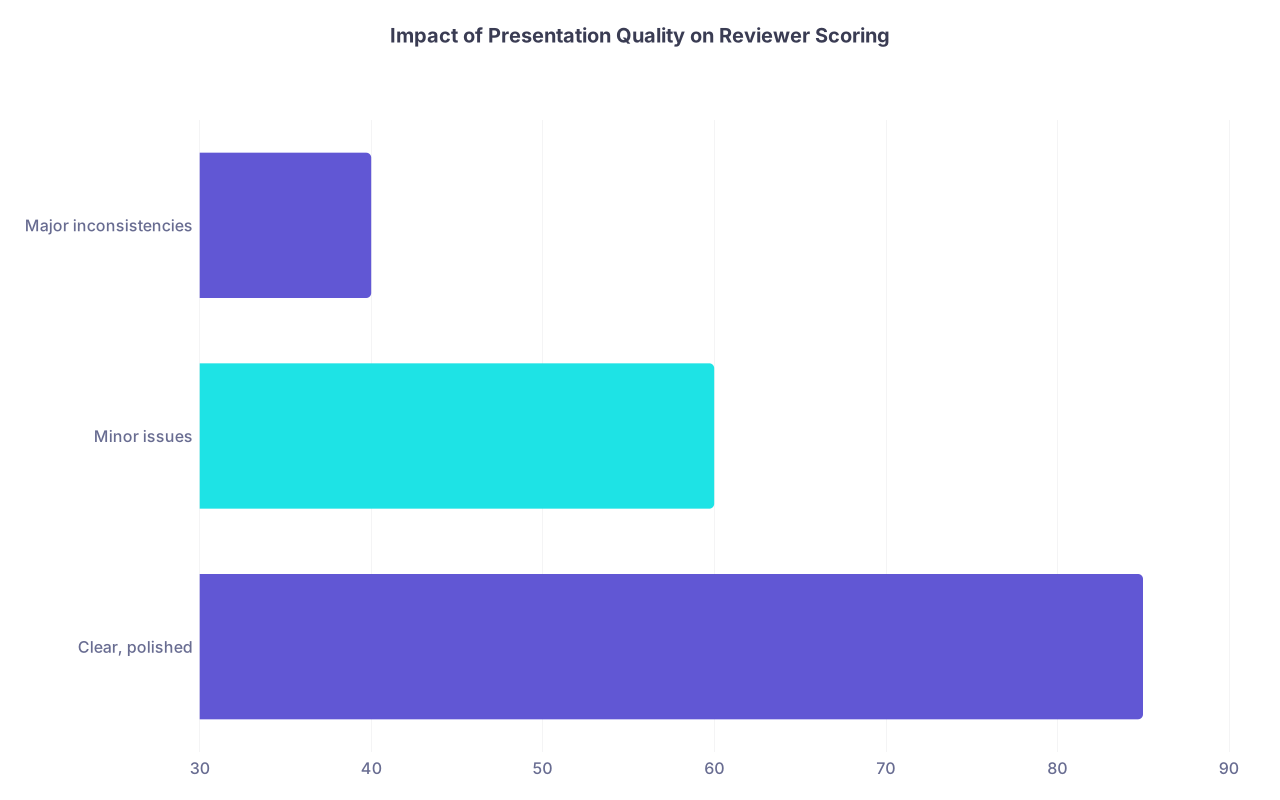
| Category | Value |
|---|---|
| Clear, polished | 85 |
| Minor issues | 60 |
| Major inconsistencies | 40 |
Fixing this is unglamorous:
- Leave at least 48 hours between “finishing” and “submitting”
- Print the proposal and read it on paper; you will catch different errors
- Have a colleague outside your content area read only the aims page and summary and tell you what they think the project is—if they are wrong, the writing is wrong
- Double-check every number, table, and figure against the text
Do not count on reviewers to “see past” sloppiness to the brilliance underneath. Many will not.
Mistake #11: Ignoring the Human Factors: Reviewers, Time, and Politics
Last one, and it matters more than you think.
Grants are not evaluated by an omniscient, patient entity. They are scored by busy humans reading too many proposals, often at night, with real biases and limited attention.
You make their job harder when you:
- Bury the key ideas in dense paragraphs
- Use jargon-heavy language from your narrow subspecialty
- Assume they know your institutional context or acronyms
- Refuse to repeat important information in more than one section because “it is already stated above”
You are also naive if you assume politics do not exist:
- Some funders like to “spread the wealth” across institutions and disciplines
- Some are quietly wary of pure “tech for tech’s sake” projects
- Some prioritize junior faculty; others want experienced PIs
You cannot game everything. But you can avoid mistakes like:
- Failing to identify and address likely reviewer concerns (e.g., recruitment challenges, competing demands)
- Not discussing institutional support in an era where burnout and workload are real
- Submitting without having anyone who has ever reviewed a grant read your draft
If you are the only person who has read the full proposal before submission, that is an unforced error.
FAQ (Exactly 3 Questions)
1. I am early-career and have never led a grant. Should I wait until I have more experience?
No, but you should not submit alone. Pair your idea with experienced co-investigators, a clear mentorship plan, and a right-sized project. Funders often like supporting early-career educators when the structure around them looks solid. The mistake is not being junior; the mistake is being junior and isolated.
2. Is it a deal-breaker if my project is single-site and relatively small?
Not necessarily. Many medical education grants fund pilot or single-site work, especially if the design is clean, the question is sharp, and there is a believable path to scale or dissemination. A focused, well-executed single-site project can be more fundable than an overextended “multi-site” project that is logistically impossible.
3. How many times should I revise a grant before submission?
More than you think. For a competitive proposal, expect at least 4–6 serious revision cycles with different readers: a content expert, an education methodologist, someone who reviews grants, and at least one person outside your field who can check clarity. If you are submitting something that has only been edited by you and your immediate collaborator once or twice, you are probably leaving obvious mistakes on the table.
Key takeaways:
First, do not force a misaligned project into the wrong funding call; match the funder before you fall in love with your idea. Second, treat evaluation, feasibility, and budget as core scientific components, not afterthoughts—you get scored on those as heavily as on the idea itself. Third, respect your reviewers’ time: clear aims, coherent story, and meticulous consistency across every section often make the difference between “not discussed” and funded.