
The hype about “AI will fix healthcare” is dangerously incomplete. Unchecked, it will quietly hard‑code your institution’s existing inequities into every decision support tool you deploy.
You are now in the phase of your career where you sign off on protocols, champion new tools, or become the person everyone blames when a model’s output harms a patient. This is where algorithmic bias in medical AI stops being theory and starts being your malpractice exposure.
Let me break this down specifically, using tools you already know: risk scores, sepsis alerts, imaging AI, readmission prediction, triage systems, and productivity tools.
1. What “Algorithmic Bias” Actually Means in Your Daily Practice
Forget the abstract definitions. On the ground, algorithmic bias in medical AI means:
- Systematic errors that disproportionately harm or underserve specific patient groups (by race, sex, language, disability, insurance, geography).
- Those errors are baked into the model’s design, data, or deployment, not just random noise.
- You often do not see the bias directly—only its clinical downstream: delayed diagnosis, under-triage, fewer consults, less monitoring.
In other words: the model “works” statistically, the AUROC looks pretty, the vendor’s slide deck is convincing—but certain groups consistently get worse recommendations.
The three usual culprits
Most biased behavior in clinical AI comes from some combination of:
Biased data
- Historical under-treatment or misdiagnosis in particular groups.
- Missingness: e.g., fewer labs, less imaging, less documentation for some patients.
- Sampling: development cohort from one health system or region that does not look like your population.
Biased labels and objectives
- Model learns to predict “who got ICU” instead of “who needed ICU”.
- Using “healthcare cost” as a proxy for “health needs”.
- Using diagnosis codes that are themselves influenced by structural racism or reimbursement games.
Biased deployment context
- Tool introduced only in certain clinics, on certain floors, or for certain payers.
- Alerts only visible in views used by some services, not others.
- Staff workflow that causes certain groups to have less complete data at prediction time.
You will see all three again and again in the examples.
2. Risk Stratification Tools: The Most Famous Failure Case
The poster child for this is the widely used commercial “population health” risk algorithm that targeted “high-risk” patients for extra care management using predicted future cost.
What happened? Black patients systematically received lower risk scores than white patients with the same disease burden, meaning they were less likely to be flagged for additional care.
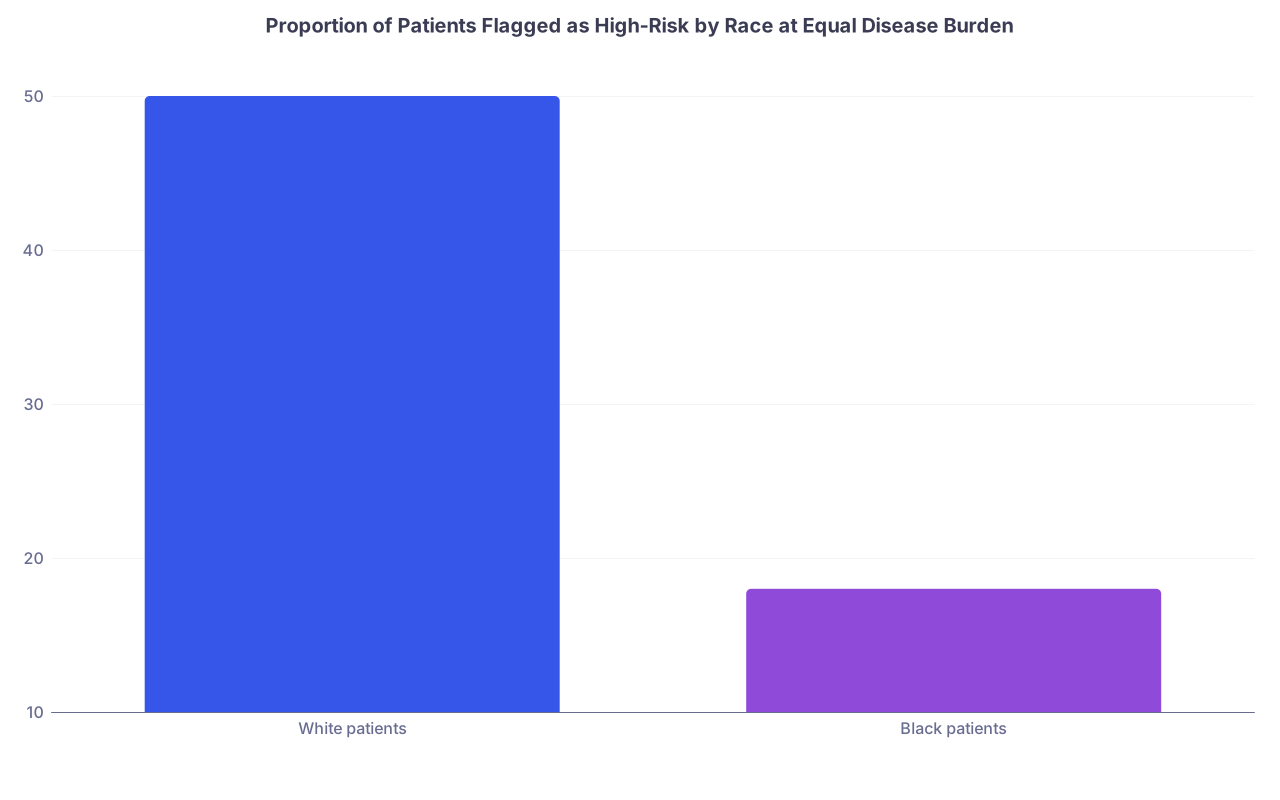
| Category | Value |
|---|---|
| White patients | 50 |
| Black patients | 18 |
Same illness, same comorbidities, radically different inclusion in outreach programs.
Mechanism of bias
The key error: using cost as a surrogate for health need.
- Historically, Black patients in the U.S. receive less care per unit of disease: fewer specialist visits, less aggressive workup, lower procedure rates.
- Less care ⇒ lower spending.
- The algorithm interprets lower spending as lower risk.
- So it “optimizes” away resources from exactly the people who need them.
If you are on a quality or population health committee and a vendor shows you a “high-risk” registry based on cost, ED visits, or utilization, your radar should now be screaming.
How this plays out in your job market world
Post-residency, you might be:
- A hospitalist whose panel for “care management follow-up” mysteriously underrepresents certain neighborhoods.
- A medical director approving outreach eligibility rules.
- A telehealth lead using a vendor’s “engagement risk” score to decide who gets proactive outreach.
The bias is subtle: your workflow “looks fair” because everyone is run through the same algorithm. But the algorithm is not seeing true need; it is seeing legacy inequity.
This is not a theoretical concern. You can end up in a meeting defending why your “equity initiative” actually worsened disparities.
3. Common Clinical AI Tools and How They Bias Patients
Let’s walk through specific categories you will actually be pitched, and where the bias sneaks in.
3.1 Sepsis and Deterioration Alerts
You already know the story: proprietary EHR-integrated sepsis scores with glossy dashboards. The issues are more than just alert fatigue.
Real patterns I’ve seen:
- Thresholds tuned on majority-white, insured populations → reduced sensitivity in:
- Non-English speakers (documentation delays).
- Under-imaged patients (fewer labs, vitals recorded at lower frequency).
- Using vitals + labs + orders as inputs:
- But some patients get fewer labs ordered due to bias or access.
- Model “thinks” they are lower risk, because there is less abnormal data.

If your institution historically orders lactate on every hypotensive white patient but not consistently on undocumented or uninsured patients, any model that uses lactate as a key signal is already skewed.
Mechanism of bias:
- Feature availability bias: A lab that is not ordered cannot be abnormal.
- Workflow bias: Some floors record vitals meticulously; others lag.
- Labeling bias: Sepsis “ground truth” pulled from diagnosis codes that differ by race/ethnicity and insurance.
Practically, in your role:
- Watch the differential performance by:
- Race/ethnicity
- Insurance class
- Language
- Unit type (safety-net vs private wings)
- If the vendor does not provide subgroup performance, that is a red flag.
3.2 Imaging AI: Radiology, Cardiology, Dermatology
Imaging models are sold as objective. Pixels don’t have race. That is the comforting lie.
Reality:
- Skin lesion classifiers trained on overwhelmingly light-skinned images underperform on darker skin.
- Chest X-ray AI models trained on specific devices and patient positions (VA corpora, ICU populations) fail on:
- Outpatient films
- Different vendor machines
- Different body habitus patterns
- Echocardiography tools struggle when image quality is lower in obese patients or when echo windows differ by sex and body size.
| Modality | Common Bias Source | Impacted Group |
|---|---|---|
| Dermoscopy | Lack of dark skin images | Under-detection of melanoma |
| Chest X-ray | Training on ICU inpatients | Missed findings in ambulatory pts |
| Mammo AI | Different density patterns | Younger / certain ethnic groups |
| Cardiac Echo | Poor windows, obesity bias | Women, obese, COPD patients |
Mechanisms:
- Training distribution mismatch: Your population ≠ training data.
- Scanner/device bias: Vendor trained on one manufacturer’s machines, you use another.
- Label bias: Pathology labels derived from historical reads, which already include human bias and under-calling in some groups.
As a new attending or service chief, you might first see this as:
- The dermatology AI app your hospital is piloting in primary care produces nonsense for darker-skinned patients.
- Cardiology echo auto-measurements that are “fine” in textbook hearts but unreliable in your real patients.
- Radiology AI that flags fractures accurately in thin trauma patients but misses subtle findings in obese or osteoporotic patients.
Your responsibility is not just “does this work overall?” but “who does this fail for?”
3.3 Readmission and Length-of-Stay Predictors
These tools decide:
- Who gets a discharge planning consult.
- Who gets home health.
- Who is flagged as “high readmission risk” and triggers extra paperwork or denials.
Bias patterns:
- Models that incorporate social determinants indirectly (zip code, insurance, prior ED use) end up:
- Accurately flagging structural risk, but
- Being used by payers to justify denials or by hospitals to avoid complex patients.
- Predicting readmission when readmissions partially reflect:
- Access to outpatient care
- Ability to return to the same hospital
- Willingness to use ED vs urgent care
So a “fair” risk prediction may still be used for unfair decisions.
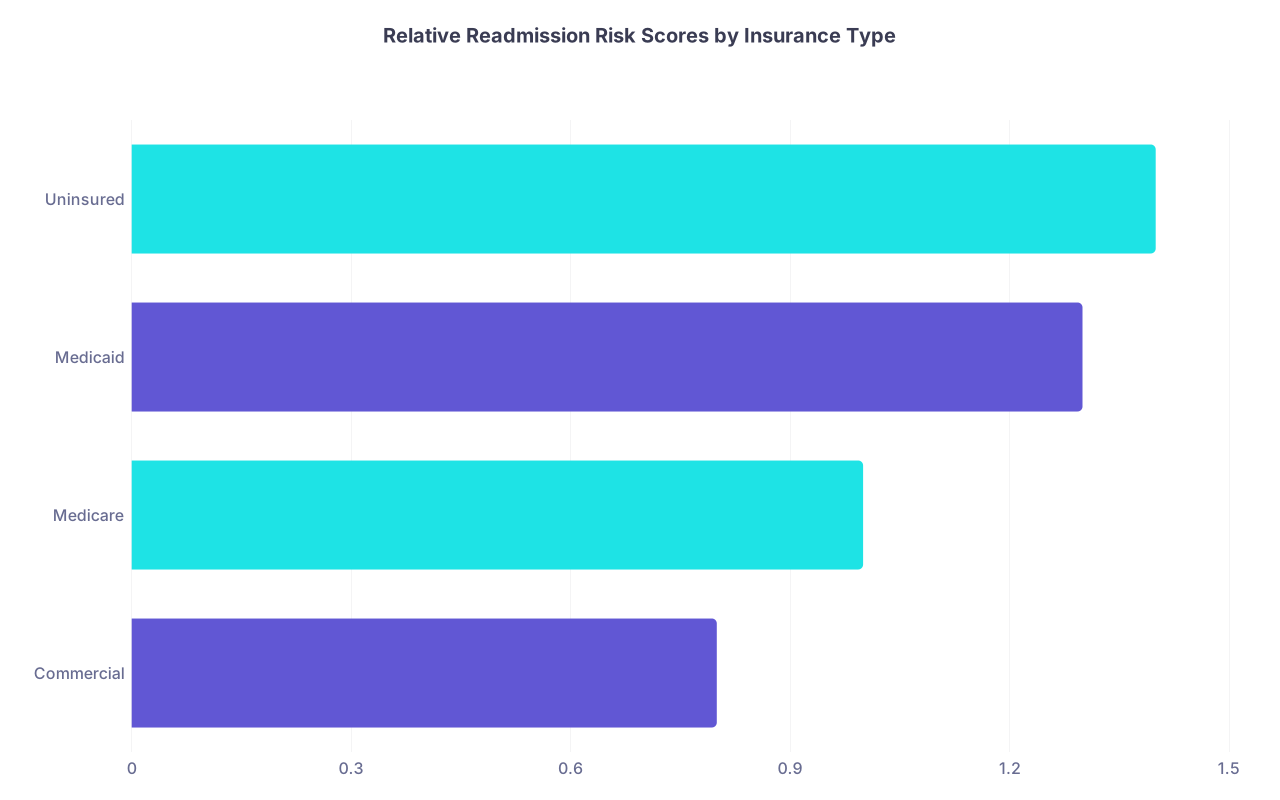
| Category | Value |
|---|---|
| Commercial | 0.8 |
| Medicare | 1 |
| Medicaid | 1.3 |
| Uninsured | 1.4 |
Mechanism:
- Objective-function misalignment: Predicting an outcome tightly coupled to structural disadvantage, then using it for rationing rather than support.
- Opaque downstream use: Your case management team and your payer use the same score for entirely different purposes.
In your role:
- If a tool flags Medicaid patients as “high risk” at 2x the rate of commercial patients, you must ask:
- Are we giving them more resources?
- Or just more surveillance and more blame?
3.4 ED and Virtual Triage Systems
Automated triage is exploding: chatbots, symptom checkers, ED risk screens, “who gets an in-person vs video visit”.
Classic bias features:
- Symptom language and description:
- Non-native speakers use different phrases; models trained mostly on native English descriptions misclassify urgency.
- Pain scales:
- Already biased by clinician interpretation and patient reporting norms.
- Prior utilization:
- People who avoid care due to mistrust or cost are labeled “low utilization” ⇒ “lower risk”.

| Step | Description |
|---|---|
| Step 1 | Patient arrival |
| Step 2 | High risk correctly flagged |
| Step 3 | Symptoms underrepresented |
| Step 4 | Lower risk score |
| Step 5 | Longer wait or fast track |
| Step 6 | Potential worse outcome |
| Step 7 | Triage tool used |
You end up with:
- Bilingual patients getting mis-routed to low-acuity tracks.
- Older, non-tech-savvy patients dropped by teletriage tools that assume smartphone literacy.
Mechanism:
- Language and culture bias in NLP (natural language processing).
- Interaction bias: Tools tested on volunteers, not on people under stress at 2 a.m. with chest pain and no childcare.
As you move into leadership roles, you must question:
- Has this chatbot or triage tool been validated on our language mix, literacy levels, and typical presenting complaints?
- Did anyone check whether “abdominal pain” in older women or in non-English speakers is being under-prioritized?
4. Coding, Documentation, and Productivity Tools: Quiet but Dangerous
AI is creeping into clinical documentation and revenue cycle. This is where bias becomes financially weaponized.
4.1 Auto-coding and Charge Optimization
Products that “suggest codes” based on notes, or auto-generate problem lists, are basically pattern matchers on prior billing data.
Historical bias:
- Some groups are systematically under-coded (fewer chronic diseases captured).
- Others are aggressively coded due to reimbursement incentives (e.g., certain Medicare Advantage populations).
AI trained on this mess learns:
- Who “looks like” a high-risk, high-HCC-score patient.
- Which phrases and demographics correlate with higher billing.
Effect:
- Vulnerable patients may still be under-coded, reducing risk adjustment payments for the services they need.
- Alternatively, AI may “optimize” coding for certain payers, drawing regulatory scrutiny and allegations of upcoding.
4.2 Clinical Documentation Assistants
Voice-to-text and note-generation tools are not neutral:
- NLP systems may have higher error rates for:
- Non-native English accents (including IMGs).
- Certain dialects.
- If your words are consistently mis-transcribed, your notes:
- Look sloppier.
- Get lower quality scores in internal reviews.
- Trigger more “clarification queries” from CDI teams.

Mechanism:
- Speech recognition bias in ASR (automatic speech recognition) models.
- Language model bias that assumes certain phrase patterns as “standard” documentation.
As an attending or telehealth physician, if your colleagues’ notes look pristine with little effort while yours always require heavy correction because of accent recognition errors, that is not “tech neutrality”. It is a biased tool affecting your productivity and evaluations.
5. How This Hits You on the Job Market and in Leadership Roles
You are no longer shielded by “I just follow attending orders.” This is your era of responsibility.
5.1 Employment, Productivity Metrics, and AI
Hospitals and large groups are already:
- Using AI to assess clinician productivity, documentation completeness, and “clinical variation”.
- Benchmarking your practice patterns against AI-identified “best practices”.
Risks:
- If AI mis-reads your population as “lower risk”, your conservative ordering patterns may be flagged as undertreatment.
- Or the reverse: your appropriately higher investigation rates in an underserved population may look like “wasteful outlier behavior”.
In blunt terms: algorithmic bias can make you look like a bad doctor on a dashboard.
5.2 Credentialing, Privileging, and Quality Metrics
As AI-derived quality metrics creep into:
- Mortality reviews
- Sepsis bundle compliance
- Readmission dashboards
You may be judged by tools whose errors cluster in your patient demographic:
- Safety-net hospitalists whose sepsis alerts under-fire for Black or undocumented patients.
- Rural clinicians where imaging AI overcalls everything on older CR machines, inflating “false positive” metrics.
If you are interviewing for leadership roles, start asking pointed questions:
- “How are your AI tools evaluated for fairness across demographic subgroups?”
- “Who owns model monitoring, and what happens when disparities are detected?”
- “Have you ever decommissioned a clinical AI tool due to inequitable performance?”
You will quickly see which organizations are naïve and which are serious.
6. Practical Ways to Push Back: What You Can Actually Do
You are not going to fix algorithmic bias alone. But you can stop blindly importing it into your practice.
6.1 Demand Subgroup Performance, Not Just Global AUROC
Any serious vendor or internal data science team should be able to show:
- Sensitivity, specificity, PPV, NPV by:
- Race/ethnicity
- Sex
- Age bands
- Insurance type
- Language preference
- Calibration plots stratified by these subgroups.
If they cannot, the message is clear: they have no idea who the model fails on.
6.2 Challenge the Objective Function
Whenever you hear:
- “We predict cost.”
- “We predict utilization.”
- “We predict readmission.”
Your automatic follow-up should be:
- “Is that what we actually want to optimize?”
- “How tightly is that tied to structural barriers versus true clinical need?”
In some cases, bias is not due to the model architecture at all. It is due to a lazy choice of outcome.
6.3 Insist on Human Oversight and Appeals
For any tool that materially changes care (triage, risk stratification, eligibility for programs), you need:
- A clear path for clinicians to override or appeal the model.
- A process to log and study override patterns:
- Are certain patients constantly “upgraded” by clinicians? That might signal systematic underestimation by the model.
6.4 Participate in Model Governance, Not Just Retrospective Complaints
Most hospitals now pretend to have “AI governance”. Many are weak. Join or shape them:
- Insist that performance reports always include disparity metrics.
- Push for pre-deployment pilot phases on your real patient mix.
- Ask for sunset criteria: how bad does performance need to be, or how unequal, before a tool is pulled?
| Domain | Key Question |
|---|---|
| Data | Does training data resemble our patients? |
| Objective | Is the outcome aligned with our goals? |
| Fairness | Subgroup metrics measured and acceptable? |
| Workflow | Who can override and how is it tracked? |
| Monitoring | How often is performance re-evaluated? |
7. Red Flags When Evaluating Vendors or Internal Models
You will see the same mistakes repeated. Some quick tells that a tool is not ready for responsible clinical use:
- “We do not collect race or social data, so we cannot be biased.”
- “We are HIPAA-compliant so the model is safe.” (Compliance ≠ equity.)
- “We validated this at our flagship center” (which serves an extremely narrow demographic).
- “Our model is proprietary; we cannot disclose features or performance by subgroup.”
Another classic line: “Human clinicians are biased too, so we are at least no worse.”
That is not the bar. You are importing machine-scaled bias that runs 24/7 and is hard to detect.
8. Where This Is Going: Regulatory and Legal Heat
You are entering practice at the moment regulators are waking up.
- FDA is moving toward more explicit considerations of real-world performance and subgroup safety for Software as a Medical Device (SaMD).
- FTC and HHS OCR have made clear that algorithmic bias can violate non-discrimination laws, especially when it affects protected classes.
- Plaintiffs’ attorneys are already circling cases where AI-influenced decisions led to worse outcomes in specific groups.
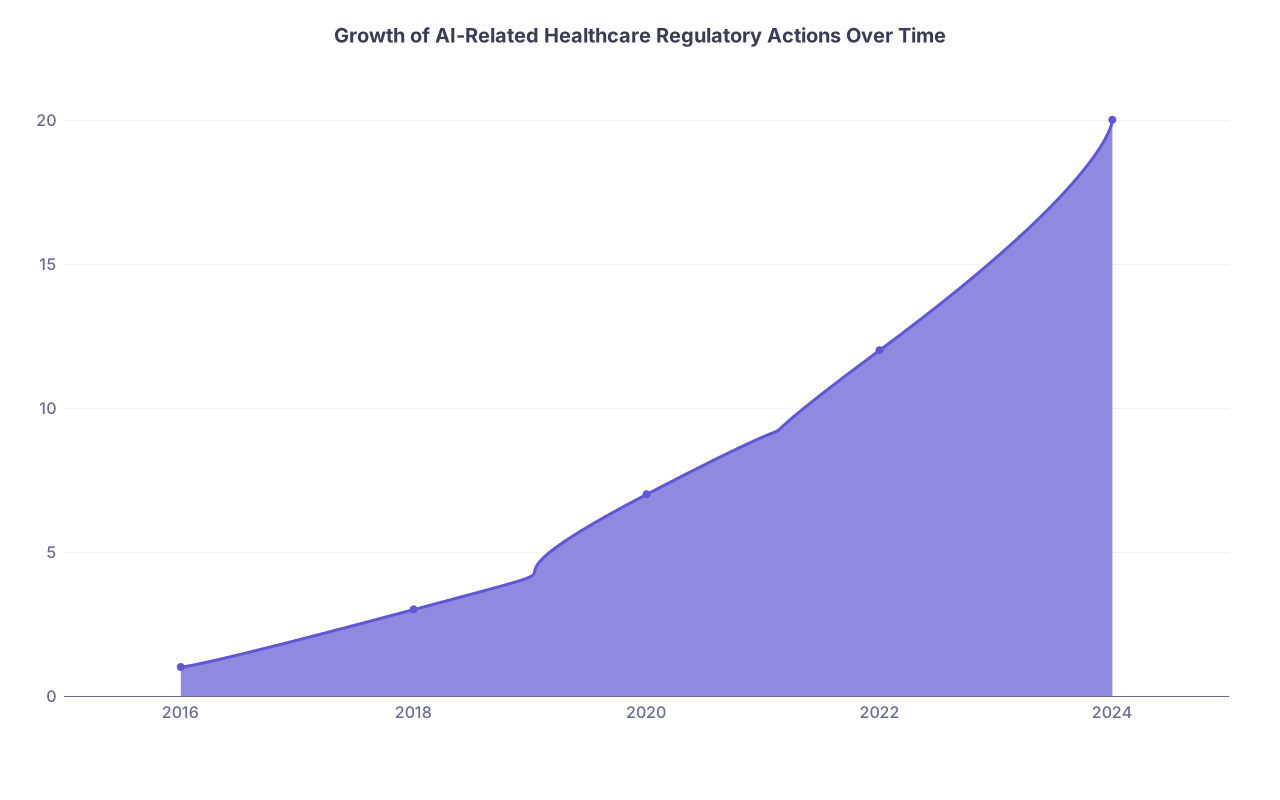
| Category | Value |
|---|---|
| 2016 | 1 |
| 2018 | 3 |
| 2020 | 7 |
| 2022 | 12 |
| 2024 | 20 |
You do not want to be the attending who said on email, “The model says she is low risk, so I discharged,” when that model is later proven biased against her demographic.
Your best legal protection is the same as your ethical protection:
- Understand the limits of the tools.
- Document your independent clinical reasoning.
- Participate in fixing or discontinuing tools that you know are unsafe for certain groups.
FAQs (Exactly 6)
1. Is using race as a feature in a medical AI model always wrong or illegal?
Not always, but it is often mishandled. Using race as a crude biological proxy is usually scientifically weak and ethically problematic. However, race can sometimes function as a marker of exposure to structural inequities that affect outcomes. If race is included, you must be explicit about why, how it is used, and how it affects predictions. You should also test performance with and without it, and examine whether it is acting as a shortcut that lets the model ignore more meaningful clinical or social features.
2. How can I quickly tell if a sepsis or deterioration model is likely to be biased at my hospital?
Look at two things. First, does your institution have historically unequal ordering of key labs (like lactate, cultures, arterial blood gases) or vital sign documentation across units or patient groups? If yes, a model that depends heavily on those inputs will inherit that inequality. Second, demand sensitivity and PPV by race, insurance, and unit type. If you see significant drops in sensitivity for particular subgroups, you already have a bias problem, no matter how pretty the overall AUROC is.
3. Are open-source clinical AI models less biased than commercial black-box ones?
Not automatically. Open-source models are usually more transparent—you can inspect the code, training data sources, and evaluation—but they are still often trained on narrow, convenience datasets (MIMIC, single health systems, or specific countries). The advantage is that you or your data science partners can retrain, recalibrate, or audit them. With proprietary models, you are largely at the mercy of the vendor’s honesty and competence. Transparency does not guarantee fairness, but opacity is a strong risk factor for hidden bias.
4. What is the minimal due diligence I should insist on before my group adopts an AI tool?
At minimum: (1) A written description of the training data (sites, time period, patient mix). (2) Clear specification of the prediction target and time horizon. (3) Performance metrics overall and stratified by key subgroups relevant to your population. (4) A pilot phase where you track overrides and adverse events. (5) A governance plan that states who owns ongoing monitoring and under what conditions the tool will be retrained, recalibrated, or retired. If any of these are missing, you are flying blind.
5. How do I push back against leadership who say equity concerns will “slow innovation”?
Be blunt: biased AI is not “innovation”, it is operational risk. You can cite that biased tools have already drawn regulatory and legal scrutiny, and that inequitable performance can torpedo value-based contracts and community trust. Offer a constructive alternative: limited pilots with explicit fairness checks, clear go/no-go criteria, and targeted use cases where benefit is clear and harms can be monitored. Position fairness work as risk mitigation and reputation protection, not ideological friction.
6. As an individual clinician, can I be held liable for following a biased AI recommendation?
Yes, potentially. AI does not replace your duty of care. If a “reasonable clinician” would be expected to question a tool’s output given the clinical picture, you remain responsible for your decision, not the algorithm. Courts are unlikely to accept “the computer told me so” as a defense. Document your reasoning, especially when AI-influenced tools are involved in high-stakes decisions. And if you see consistent unsafe behavior in a tool for specific patient groups, report it through formal channels; doing so both protects patients and establishes that you did not blindly accept flawed automation.
Key points:
- Algorithmic bias in medical AI is not abstract; it is already embedded in sepsis alerts, risk scores, imaging tools, triage systems, and documentation assistants you are using or will be sold.
- Most bias stems from bad objectives (cost, utilization), skewed data, and blind deployment without subgroup testing—problems you can and should push back on as a post-residency clinician.
- Your job now is not just to “use AI” but to demand transparency, insist on fairness metrics, and keep your clinical judgment independent enough to override tools that treat your patients unequally.