
The belief that “younger doctors are automatically better with medical tech” is lazy thinking dressed up as common sense. The data does not actually support that cliché—and in some important ways, it contradicts it.
Younger physicians are more comfortable with technology. That is not the same as being better with it. Comfort breeds speed and experimentation; it also breeds click-happy errors, overreliance on decision support, and blind trust in whatever pops up on the screen.
Let me walk through what the research actually shows, not what people repeat in meetings when they want to justify hiring “digital natives.”
What “better with medical tech” should actually mean
People toss this phrase around without defining it. Let’s be precise. Being “better with medical technology” should involve at least four things:
- You can use the system efficiently without creating chaos.
- You make fewer tech-related errors (ordering, documenting, interpreting).
- Your use of tech improves patient outcomes or at least does not worsen them.
- You understand when not to trust the software.
Most conversations stop at: “The new attending is fast on Epic and types really fast.” That’s not competence. That’s keyboard speed.
When you read the literature, generation-based differences in “technology skill” flatten out quickly once you look beyond superficial measures like “self-reported comfort” or “number of apps used.”
What the data actually says about age and digital tools
Younger physicians do score higher on perceived tech proficiency and usage frequency. No surprise. They grew up with phones in their hands and EMRs in their clerkships.
But when you dig into harder outcomes—efficiency, error rates, and patient-level impact—the story is much less flattering.
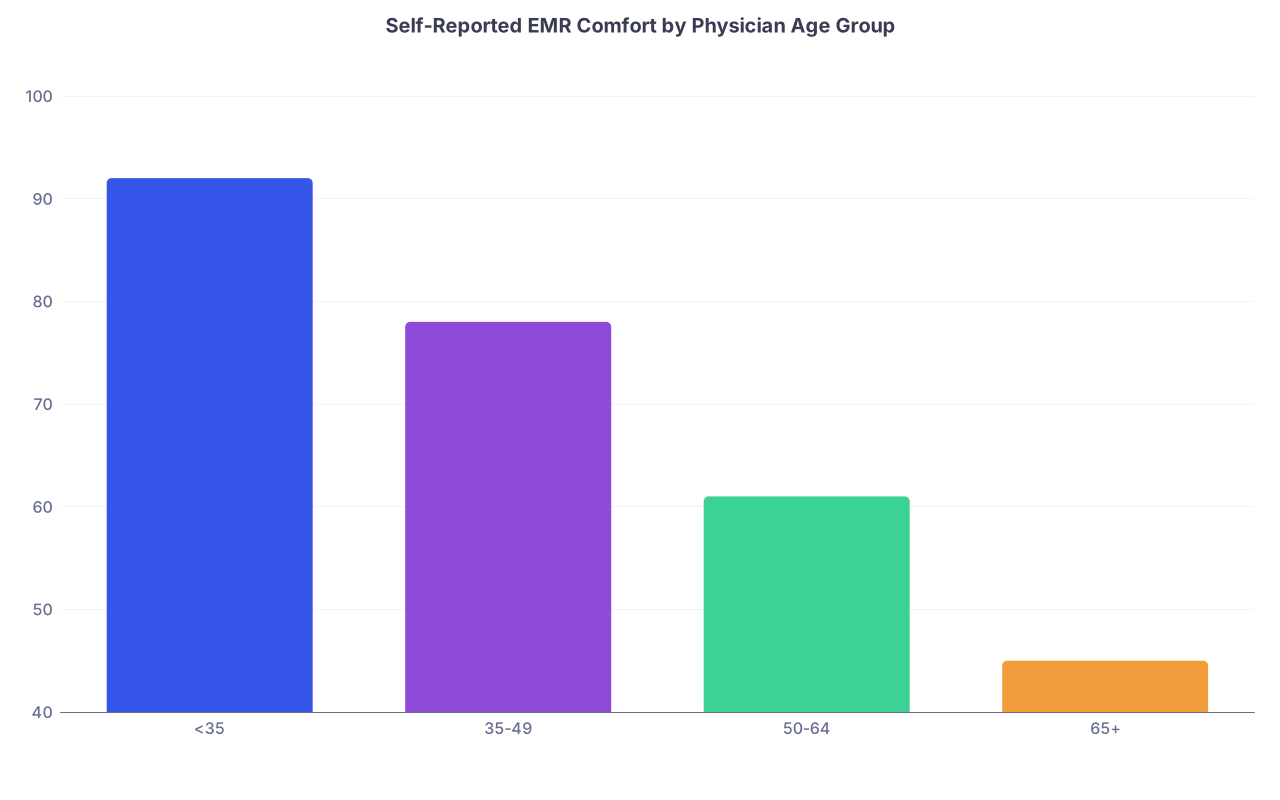
| Category | Value |
|---|---|
| <35 | 92 |
| 35-49 | 78 |
| 50-64 | 61 |
| 65+ | 45 |
Studies from large health systems show roughly this pattern: younger clinicians are more likely to use advanced EMR features, patient portals, messaging, and decision support tools. That’s the “yes, they use the stuff more” part.
But here are a few uncomfortable findings you do not hear at digital health conferences:
- EMR order entry error rates aren’t clearly lower for younger physicians. In some computerized provider order entry (CPOE) evaluations, residents and younger attendings click wrong doses or wrong frequencies more often because they move faster and rely more on autocomplete and order sets.
- Overreliance on decision support is more common among less experienced clinicians. That often correlates with age only indirectly, through training stage.
- Time spent in the EMR outside scheduled hours (the infamous “pajama time”) is not dramatically different by age once you adjust for panel size, specialty, and leadership roles.
I have sat in optimization sessions where a 62-year-old cardiologist quietly built smart phrases and structured templates that would put most 30-year-olds to shame. And I have watched interns, who are supposedly “digital natives,” still document a chest pain admission in a free-text blob that might as well have been written in 1994.
Younger ≠ automatically more effective.
The real drivers: training, incentives, and exposure—not birth year
Most of what people attribute to age is actually about three things: the environment you trained in, what your job really demands from you, and whether anyone ever bothered to teach you properly.
You want to know who is actually best with tech in most hospitals? It is not some magic age group. It is the people who:
- Trained in systems where EMR use was enforced and taught as a real skill, not “click around until it works.”
- Work in practice settings that live or die on data: complex chronic care, oncology, critical care, high-volume primary care.
- Have had to repeatedly adapt to new platforms and upgrades rather than fighting every change.
A 45-year-old hospitalist who survived three EMR transitions and learned from each one is almost always more effective than a 29-year-old who has only ever used one system and has no idea what’s going on behind the interface.
There’s a nice parallel from outside medicine: user experience research consistently shows that “tech-savvy” is highly task-specific. Someone can be phenomenal with social media and terrible with spreadsheets. Medicine is just worse, because the stakes are high and the software is often terrible.
Where younger physicians actually do have an edge
I am not going to pretend age never matters. It does. But the advantage is narrower and more nuanced than people think.
Younger physicians are typically better at:
- Adopting new tools quickly. You roll out a new secure messaging app or digital dictation system, and the under-40 crowd will usually jump in faster.
- Multimodal workflows. They are more comfortable flipping between smartphone, tablet, desktop, and telehealth platform without pausing to think about it.
- Patient-facing tech adoption. They tend to push patient portals, remote monitoring apps, and digital follow-up more often—sometimes because they use similar tools in their own lives.
Where they are not clearly better:
- Information triage. Separating signal from noise when the EMR vomits labs, consult notes, alerts, and inbox messages constantly.
- Knowing when to ignore the algorithm. A lot of “clinical decision support” is designed with idealized data and average patients. Knowing when to override it comes with clinical mileage, not just with tech familiarity.
- Safe use under stress. Under heavy workload, speed and comfort can easily turn into “clicking past safety checks” and missing subtle warnings.
There’s a phrase I have heard more than once on wards: “Just ignore that alert; it always fires.” The person saying it is almost never the oldest person in the team.
The flip side: where tech hurts younger—and older—physicians differently
Everyone pays a price for bad health IT, but the currency is different by career stage.
Younger physicians often get hit hardest by:
- Alert fatigue early in their careers, before they have internal heuristics to spot nonsense alerts.
- Inbox overload from being the “default” digital contact—patients and staff default to messaging the younger doc who “answers faster.”
- Overdocumentation pressure. They are more likely to be told, “Just use the template” without understanding the billing, regulatory, and medico-legal logic behind the clicks.
Older physicians, by contrast, struggle more often with:
- Cognitive overhead of switching from paper- or dictation-heavy workflows to structured, coded documentation.
- Rudimentary, under-resourced training. I have seen “training” for senior attendings that consists of a 90-minute slideshow and “here’s a tip sheet.”
- The politics of change. They are more likely to be in leadership, which means they are trying to use the tool while also fielding complaints, redesigning workflow, and surviving half-baked rollouts.
In both groups, burnout is closely tied to how the tech is implemented, not to age. Burnout correlates with click counts, after-hours EMR time, chaotic inbox management, and poorly configured decision support—none of which are inherently age-related.
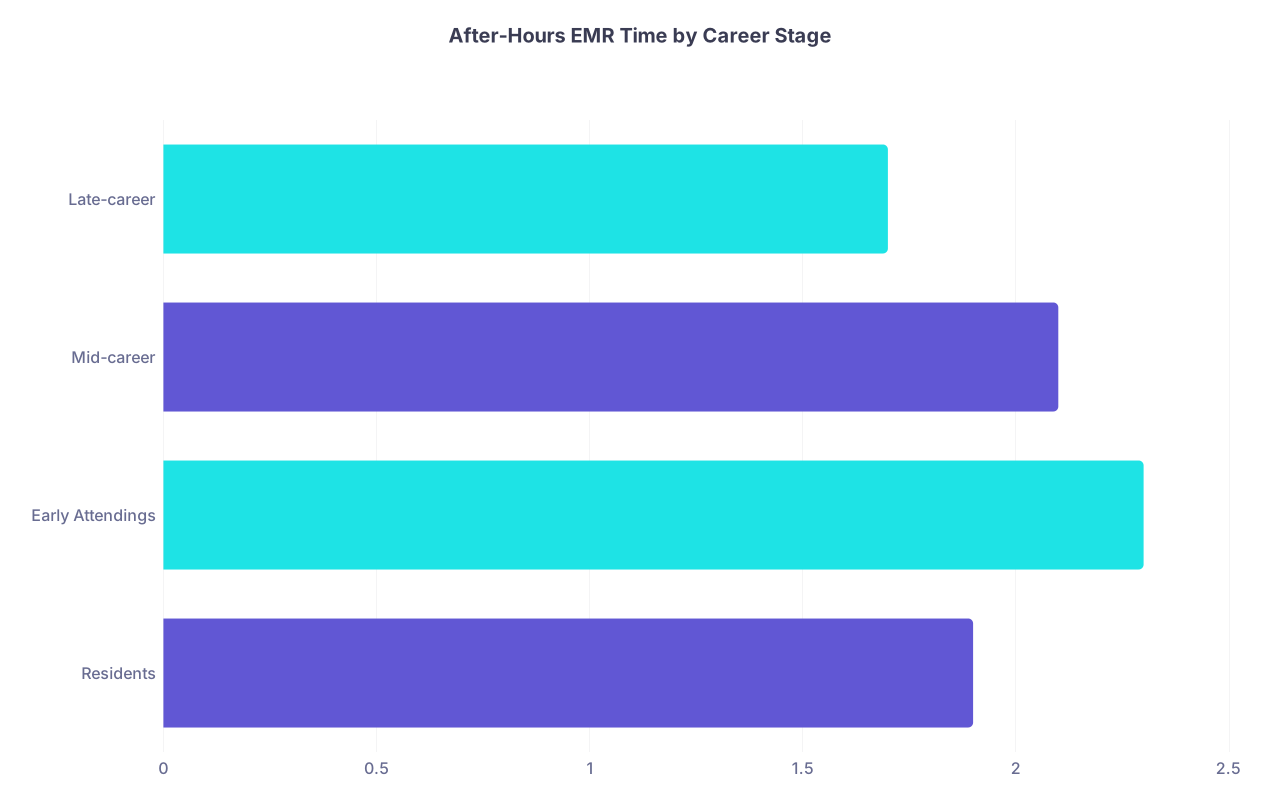
| Category | Value |
|---|---|
| Residents | 1.9 |
| Early Attendings | 2.3 |
| Mid-career | 2.1 |
| Late-career | 1.7 |
Notice: the differences are modest. And this is per day. Everyone is getting dragged into the digital swamp.
The dangerous myth of the “tech-native” doctor
The “younger doctors are better with tech” story is not just wrong; it is harmful. It gives administrators and groups an excuse not to invest in real training or sane system design.
You see it play out like this:
- A new EMR module goes live. Minimal training.
- People complain. Leadership shrugs. “The younger attendings will adapt.”
- The younger attendings adapt by working longer hours and inventing questionable workarounds.
- Those workarounds spread informally, often breaking data quality, safety rules, or billing integrity.
Then, six months later, everyone wonders why quality reporting is a mess and near-misses are up.
Younger physicians are also more likely to get dragged into unofficial “super-user” roles simply because they click fast and do not visibly balk at change. That is not the same as deep understanding, and it certainly is not a substitute for properly designed workflows.
If you design health IT assuming one generation will just absorb the pain, you are building fragile systems that will fall apart as soon as that group burns out or leaves.
Specialty, not age, is the strongest tech predictor
If you really want to predict who will be “good with technology,” look at specialty and practice model long before you look at age.
Specialties that live and breathe structured data, imaging, or device integration—like radiology, cardiology, critical care, anesthesiology, oncology—tend to produce physicians who are much more technically sophisticated at every age.
Compare a 60-year-old interventional cardiologist who reads their own echo measurements, uses structured reporting, and understands device firmware updates… with a 32-year-old low-volume, paper-heavy outpatient doc in a small clinic that barely uses decision support. The cardiologist will run circles around them technologically, every single day.
| Factor | Relative Impact on Tech Skill |
|---|---|
| Specialty | High |
| EMR training quality | High |
| Practice setting volume | Moderate to High |
| Age | Low to Moderate |
| Personal interest | High |
Age lands in the middle of the pack. Not irrelevant, but absolutely not deterministic.
AI, CDS, and the next wave: who will actually use it well?
Everyone wants to talk about AI in medicine now. The same lazy assumption is already leaking over: “Younger physicians will be better with AI tools.”
Again—no.
The people who will use AI and advanced decision support well will:
- Understand enough statistics and clinical epidemiology to know what “70% sensitivity on external validation” really means.
- Be comfortable challenging algorithm output when it contradicts what they see in front of them.
- Have enough clinical seasoning to recognize when bias, missing data, or edge cases are derailing the model.
That usually describes a clinician with a decade or more of real experience who has stayed intellectually curious, regardless of age.
A 28-year-old attending might be more willing to open the AI tool. That does not mean they are better at spotting when it is dangerously wrong.
We have already seen this in radiology studies: junior readers may lean too heavily on AI suggestions, while senior radiologists use AI more as a second opinion, rejecting bad suggestions more confidently.
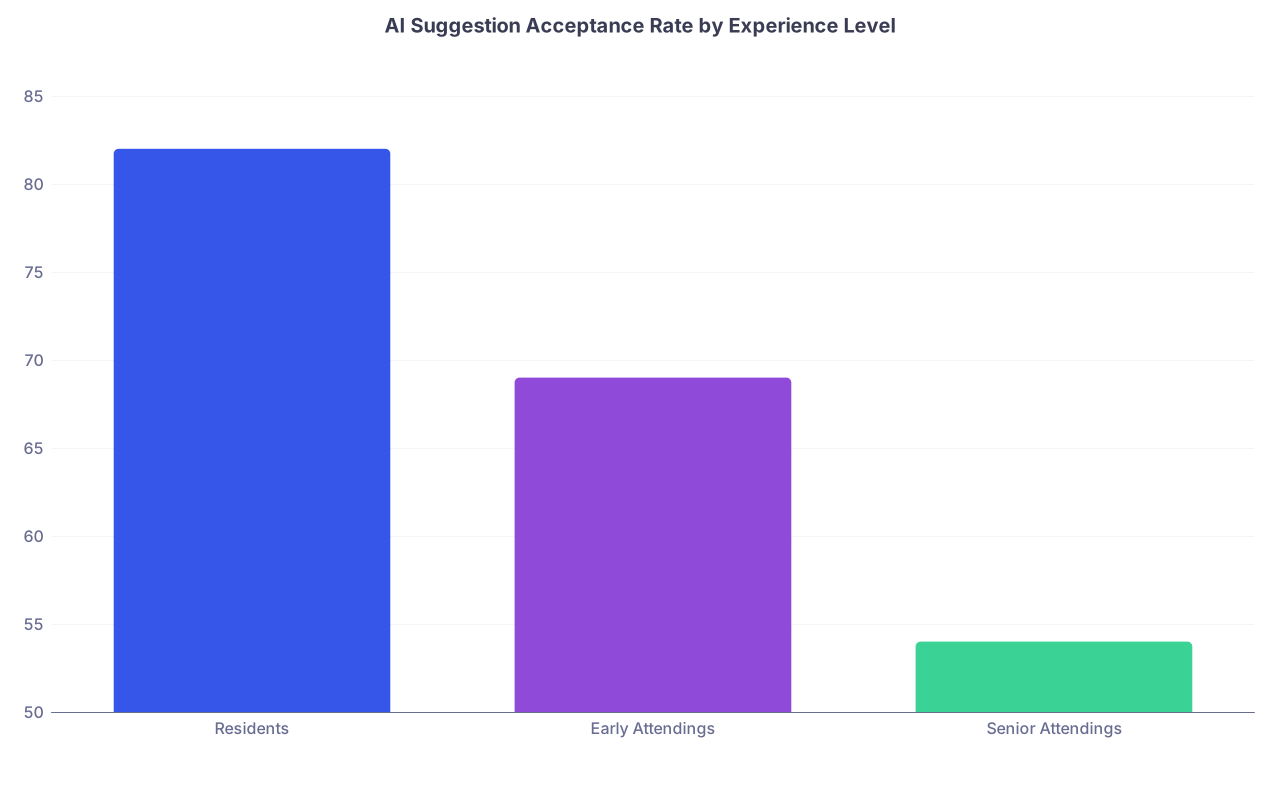
| Category | Value |
|---|---|
| Residents | 82 |
| Early Attendings | 69 |
| Senior Attendings | 54 |
Higher acceptance is not automatically better. It often just means more blind trust.
Post-residency job market: how this myth warps hiring and careers
Now we get to the part that actually affects your career after residency.
I have sat through hiring conversations where someone says, “We need younger physicians; they’re better with tech.” That sentence is doing a lot of sloppy work:
- It’s used as a proxy for “willing to tolerate our broken EMR and insane inbox load.”
- It conveniently avoids confronting the fact that the system is badly designed or under-supported.
- It sidelines excellent older candidates who have already adapted to multiple tech waves.
For you, as a post-residency physician, here is the real question to evaluate when you are job hunting:
Are you walking into a place that blames age for tech struggles—or a place that takes IT seriously as a shared professional skill?
A serious group:
- Offers structured, role-specific EMR training to everyone, not just new grads.
- Has real super-user time and informatics leadership, not “ask the young person.”
- Tracks EMR time, click burden, and inbox load and actually changes workflows.
A lazy group leans on the myth. You’ll hear phrases like “the younger people don’t seem to mind” or “our older docs just aren’t tech people.” That’s code for: “We don’t fix root problems; we just wait for more ‘digital natives’ to show up.”

| Step | Description |
|---|---|
| Step 1 | Interview at Practice |
| Step 2 | Myth-driven culture |
| Step 3 | Serious improvement culture |
| Step 4 | High burnout risk |
| Step 5 | Better long term fit |
| Step 6 | How is tech pain handled |
If you are young, do not let them stick you in the “tech mule” role indefinitely. If you are older, do not buy the story that your age is the barrier. The barrier is almost always lousy design, rushed rollouts, and superficial training.
So, are younger physicians truly better with medical tech?
No. They are different with medical tech. Not inherently better.
They are faster to adopt, more comfortable experimenting, and more willing to live inside digital systems. That can be an asset. It can also generate new types of errors, burnout patterns, and blind spots.
The physicians who are genuinely “good with technology” are the ones who:
- Have had to adapt multiple times and actually learned from it.
- Understand medicine and data deeply enough to question what the system shows them.
- Work in environments that treat health IT as a real part of clinical practice, not a generational quirk.
If you remember nothing else, take this:
- Age is a weak predictor of meaningful tech competence; training quality, specialty, and mindset matter more.
- The “younger = better with tech” myth lets organizations avoid fixing bad systems—and that hurts everyone, including the youngest doctors.
- In the post-residency job market, look for places that invest in all physicians’ digital skills instead of outsourcing the problem to the “tech-native” generation.