
Last month a hospitalist texted me at 11:47 pm from the call room: “They flipped the EHR build tonight without warning, my notes are twice as slow, and admin just told us to ‘be patient during the transition.’ I’m drowning.” You know this feeling. The “upgrade” that was supposed to streamline your work just blew up your week, your clinic flow, and your patience.
If that’s where you are—post-residency, finally attending, and suddenly buried under tech-driven changes—you are not overreacting. You’re in a real, specific situation. And there are concrete moves you can make to negotiate the scope and pace of these changes before they burn you out.
Let’s get into the “what do I actually do on Monday” version of this.
1. Recognize the Pattern: This Is Not “Just You”
Most physicians I talk to describe almost the same tech-change arc:
- Announcement: Some upbeat email about “enhancing clinical efficiency” or “aligning with best practices.”
- Sudden go-live: New EHR workflows, devices, order sets, or documentation requirements dropped in the middle of already full clinics or service weeks.
- Silent suffering: People just work later, chart at home, cut corners, or skip breaks to keep up.
- Burnout: Irritability, dread before shifts, emotional exhaustion, errors creeping in.
You are not failing to “adapt.” The system is offloading the cost of its tech decisions onto your nights and your nervous system.
Here’s how to sanity-check whether tech changes are materially contributing to your burnout:

Ask yourself, over the last 2–3 months since the change:
- Are your days routinely running 1–3 hours later?
- Are you doing more charting at home than before?
- Are you spending more time on screens than with patients?
- Are error messages, logouts, or device issues frequent enough to interrupt flow several times a day?
- Are you hearing phrases like “just for now while we adjust” with no actual end date or rollback?
If the answer is yes to several of these, you don’t need resilience training. You need to negotiate the work itself—both the scope (what exactly you’re being asked to do) and the pace (how fast and how much change at once).
2. Map the Problem Before You Argue
You cannot negotiate what you cannot describe. Admin and IT speak in metrics, not vibes. So before you push back, you gather ammunition.
Step 1: Document impact for two weeks
Do this quietly and consistently. Not a manifesto. Just data.
Track:
- Start and end of clinical day (including after-hours charting).
- Number of patients seen.
- How many clicks/screens for a few common tasks before vs after change (e.g., admit order set, discharge summary, refills).
- Number of tech disruptions per day (system down, device failure, login issues).
- Any care delays directly tied to the tech (e.g., “CT order delayed 45 min due to CPOE error”).
A simple rough comparison table helps:
| Metric | Before Change | After Change |
|---|---|---|
| Average patients per clinic day | 16 | 16 |
| Average workday length (hrs) | 9 | 11 |
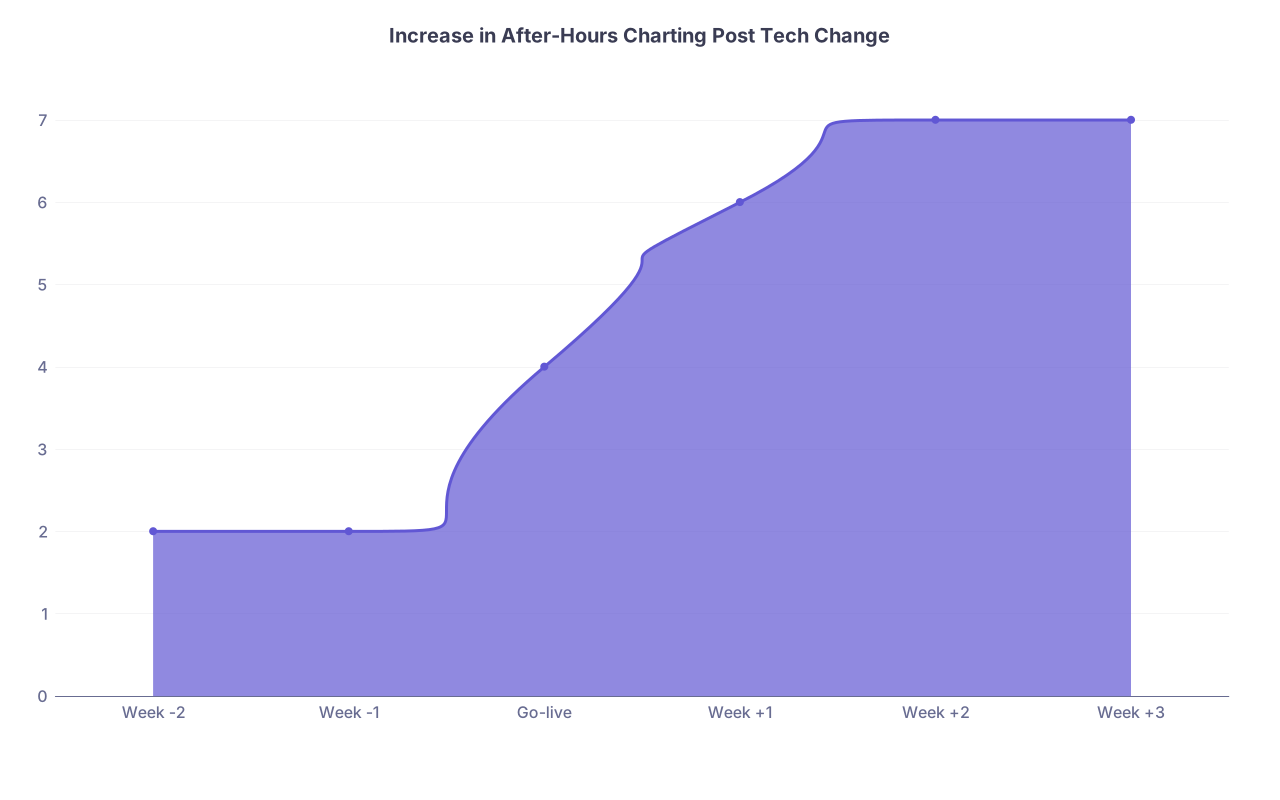
| After-hours charting (hrs/week) | 2 | 7 |
| Clicks to complete discharge | 25 | 40 |
| Tech disruptions per week | 1–2 | 8–10 |
You do NOT need perfect numbers. You need believable numbers.
Step 2: Identify what is actually negotiable
You’re not going to get “turn the EHR off” as a win. Focus on components that realistically move:
- Extra documentation fields or checkboxes tacked on “for quality.”
- Mandatory new templates or smart phrases that slow note-writing.
- Extra workflows added to your plate (e.g., managing portal messages through a clunky new interface).
- New devices (tablets, scanners, badge swipes) that add steps without clear benefit.
- Training expectations—being told to “self-learn” complex new tools in your “spare time.”
Circle 2–3 of these that are the biggest time sinks. Those are negotiation targets.
3. Know Who Actually Controls What
You can waste months venting to the wrong person.
Typical players:
- CMIO / Physician informatics lead – Often your best ally. They translate physician pain into system language.
- IT/EHR vendor team – They control the build, templates, and order sets.
- Service line director / department chair – Controls staffing, clinic templates, RVU expectations, and sometimes protected time.
- Practice manager / clinic manager – Controls local workflows, support staff, scheduling tweaks.
You need to connect the tech problem to the person who can change that specific lever.
Example: EHR order set garbage → CMIO / informatics committee. Clinic template too full to absorb slower workflows → department chair or medical director. No training time, only at-home videos → practice manager + chair.
4. Negotiate Scope: What You Will and Will Not Take On
Scope creep is where burnout hides. Every “just add this one screen” or “include this checklist” gets dumped on you without changing your patient volume or schedule.
Your job is to push the question back:
“If you want to add X, what are we removing or adjusting to make room for it?”
Tactic 1: Pair every new task with a trade-off
You never say “No” in a vacuum. You say, “If you want this, we need to do that instead.”
Examples you can literally copy:
- “With the new discharge workflow adding 10–15 minutes per patient, I can’t safely discharge the same daily volume without extending clinic hours. Either we reduce the number of discharges I’m expected to process per day or we build in discharge blocks with no new admits.”
- “If we’re now required to complete this new 15-field quality form for every diabetic patient, we need to remove the older redundant flowsheet or reduce my panel size for diabetes visits.”
- “The portal message tool is slower and more complex. If you want me to handle all messages in this way, my in-person visit load will need to drop by 1–2 patients per half-day, or we need dedicated message time.”
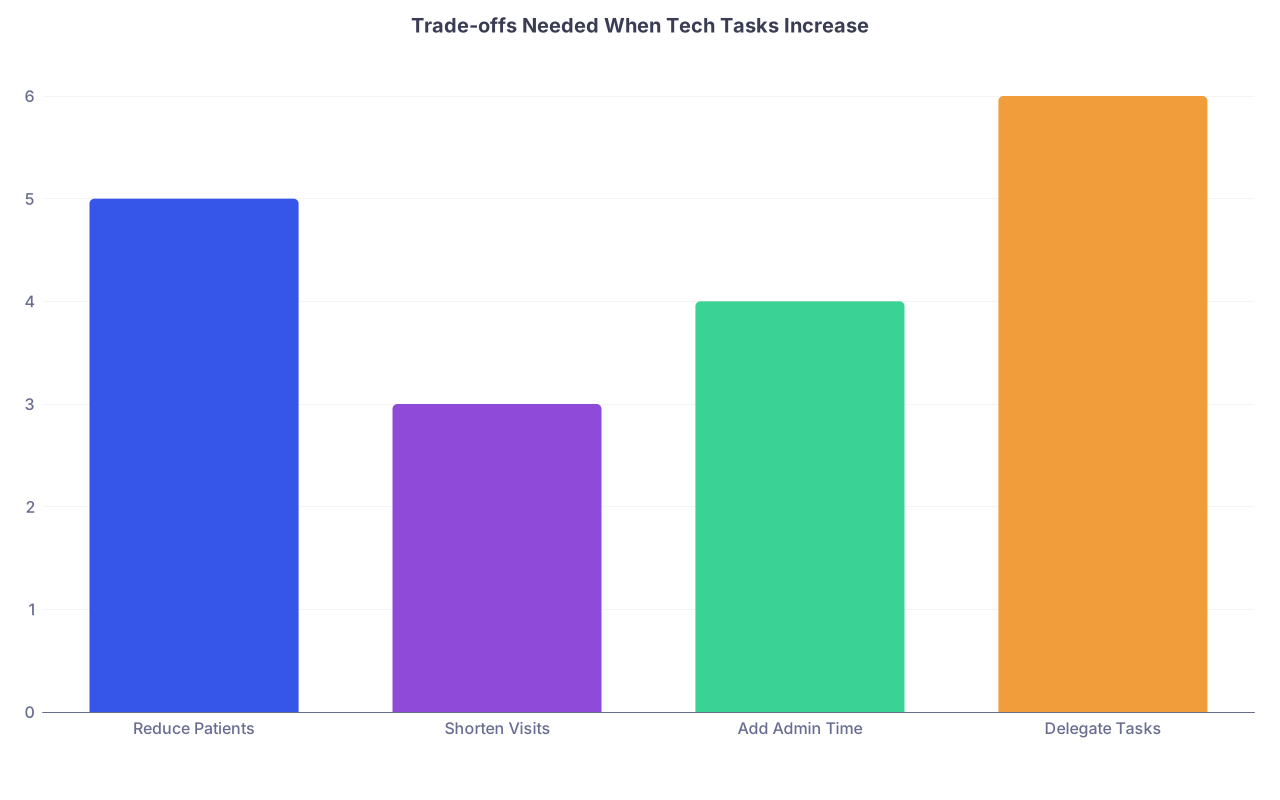
| Category | Value |
|---|---|
| Reduce Patients | 5 |
| Shorten Visits | 3 |
| Add Admin Time | 4 |
| Delegate Tasks | 6 |
The exact numbers above are illustrative, but the message is: more steps = something else must give.
Tactic 2: Push non-clinical tasks off your plate
Tech changes often sneak in non-physician work as “just clicks”:
- Demographic verification screens.
- Reconciliation steps that could be done by RN/MA.
- Pre-charting tasks for things support staff used to prep.
Your language:
- “This step does not require physician licensure. It’s appropriate for support staff. Let’s reassign this to MA pre-visit workflows and remove it from the physician view.”
- “This new intake screen is doubling my rooming time. We should build it into the MA workflow or nursing assessment instead.”
If they push back with “we don’t have staff,” you push back with “then we are redefining my scope, and my RVU or productivity expectations must change accordingly.”
Tactic 3: Set hard boundaries on “training time”
If they expect you to learn new tech on your own nights and weekends, that’s scope creep masquerading as professionalism.
Try:
- “I’m happy to adopt this change, but I can’t absorb training time on my personal hours. We need blocked, paid time during the workday or a temporary reduction in clinical volume for that first week while I get up to speed.”
And then shut up. Let the silence sit. Most admins are not used to physicians calmly saying, “My time is not free.”
5. Negotiate Pace: How Fast and How Much at Once
Sometimes you cannot stop the tech change. But you can slow it down, phase it, or reduce the chaos.
This is where a simple, visual “alternative plan” helps a lot.

| Step | Description |
|---|---|
| Step 1 | Current Overload |
| Step 2 | Phase 1 - Pilot Group |
| Step 3 | Refine Build |
| Step 4 | Phase 2 - Partial Rollout |
| Step 5 | Add Support and Training |
| Step 6 | Phase 3 - Full Adoption |
| Step 7 | New Tech Required |
You propose this instead of the “everyone all at once on Monday” disaster.
Tactic 1: Propose pilot groups
You say:
- “This is too big a shift to go live across the entire department on one date. Let’s pilot with a small group of volunteers for 4–6 weeks, fix the build based on their feedback, then roll out more broadly.”
Volunteering can actually be protective if you:
- Negotiate lower clinical volume while piloting.
- Influence the build to be less horrible before it hits everyone.
- Get formal recognition or protected time as a “physician champion.”
If you don’t want to be in the pilot, at least demand that one exists.
Tactic 2: Time-bound “transition phase” expectations
What kills people is open-ended “just while we get used to it.”
You say:
- “For the first 4–6 weeks after go-live, we should reduce templates by 2–3 patients per half-day and suspend some non-urgent quality metrics. After that, we reassess based on actual data.”
Make them put a date on the “transition” period. With a plan to re-evaluate.
6. Turn Burnout Into a Safety and Retention Argument
Admin ears perk up for two things: risk and retention. Use both.
Do not go in saying, “I’m burnt out, this feels bad.” Go in saying, “Here is how this affects patient safety, throughput, and the odds your attendings quit.”
Examples:
- “My workday is routinely 2 hours longer due to the new documentation requirements. That level of fatigue meaningfully increases error risk, especially at the end of the day when I’m handling critical results.”
- “We lost two physicians last year citing burnout and documentation burden. This implementation, as-is, is pushing us in that direction again. Retaining one attending saves you far more than these incremental metrics generate.”
- “This alert fatigue is causing us to ignore all popups, including the rare but important ones. We need to trim them or the system will make us less safe, not more.”
Attach burnout to their business and safety goals. Because that’s how you get movement.
7. Use Hard Numbers and Visuals in the Meeting
You’re in medicine. You know data wins arguments. Even if it’s rough.
Go into the meeting with one simple 1-page handout or a couple of key visuals.
| Category | Value |
|---|---|
| Week -2 | 2 |
| Week -1 | 2 |
| Go-live | 4 |
| Week +1 | 6 |
| Week +2 | 7 |
| Week +3 | 7 |
“This is how my after-hours charting changed with the rollout. This is not sustainable. We have three knobs we can turn: change the build, adjust my workload, or increase support. I’m here to figure out which combination makes sense.”
Keep it dispassionate, specific, and short.
8. Scripts You Can Use Tomorrow
Some physicians like language to copy-paste. Here you go.
Email to request a meeting
“Hi [Name],
Since the new [EHR module/device/process] went live on [date], my documentation time and after-hours charting have both increased significantly while patient volume has remained constant.
I’ve tracked the impact over the last two weeks and would like to review:
- Which elements of the new workflow are mandatory vs modifiable, and
- What temporary or permanent adjustments we can make to volume, staffing, or the build to keep this sustainable.
Can we schedule 30 minutes in the next 1–2 weeks to discuss some concrete options?
Thanks,
[Your name]”
In-meeting opener
“I’m not here to argue against modernization. I’m here because the way this was implemented shifted a lot of invisible work onto the clinicians, and right now it’s unsafe and unsustainable. I’ve brought specific examples and some realistic proposals to address scope and pace.”
When they say “Everyone else is managing”
“The colleagues I talk to are coping by working significantly more off-the-clock hours, which hides the true cost. That’s not a sustainable or fair expectation. I’m asking that we make the workload visible and then align expectations with reality.”
When they offer more training instead of structural fixes
“Training will help me use the tool more efficiently, but it doesn’t remove the additional steps built into the workflow. We still need to decide what we’re removing or adjusting to make room for those steps.”
9. Protect Yourself While You Push
You’re probably still worried: “If I push on this, will I be labeled ‘difficult’?”
Sometimes, yes. But there are ways to reduce the risk:
- Anchor your asks in patient safety, quality, and retention, not personal preference.
- Bring 1–2 colleagues if possible—groups are harder to dismiss.
- Volunteer reasonable compromises: “We’ll adopt the new module, but phased and with temporary volume reduction.”
- Document discussions via follow-up email: “Per our talk today, we agreed to trial X for four weeks and then review.”
And if they refuse everything—no scope adjustments, no pace modifications, no staff support, no listening—that’s data too.
It tells you something important about the culture you’re in and how seriously they actually care about physician wellbeing versus performance metrics. I’ve seen that realization push people to find better jobs. That is sometimes the sanest move.
10. If You’re Absolutely at the Edge Right Now
If you’re already in deep burnout from tech changes, the negotiation has to run in parallel with damage control on your own life.
Very short list:
- Immediately cut non-essential extras (committees, optional projects) for 3–6 months. You say, “I need to step back while we stabilize the workload from the recent tech changes.”
- Start a very blunt conversation with your direct supervisor: “I’m close to not being able to continue like this. I want to stay, but we need concrete changes.”
- Use any available PTO strategically right after heavy go-live periods. Not two years from now. Now.
- If your contract allows, explore part-time or reduced FTE while the system settles—especially if they won’t adjust volume but you need breathing room.
Self-preservation is not unprofessional. It’s the only way you’ll have a career longer than a few scorched years.