
The idea that you’ll be blacklisted for questioning tech decisions isn’t just exaggerated — it’s backwards in a lot of places.
You’re not crazy for worrying though. I’ve seen residents whisper to each other after an EMR meeting: “Don’t say anything, you’re going to be staff soon.” I’ve watched new attendings mute themselves in Zoom town halls while some awful “AI triage” tool gets announced, because they’re terrified of being labeled “difficult.”
Let’s actually untangle what’s real risk, what’s in your head, and where the landmines actually are.
The Fear: “If I Push Back, I’ll Lose My Job”
You’re hearing variations of the same internal monologue I hear from almost everyone in your position:
- “If I question this AI tool, admin will think I’m anti-innovation.”
- “If I email IT about safety concerns, they’ll remember my name when contracts are renewed.”
- “If I refuse to use a sketchy device, they’ll say I ‘don’t fit the culture.’”
- “What if another job Googles me and sees I was ‘the problem doctor’ about the EMR?”
Here’s the harsh, annoying truth: your fear has a kernel of reality, but it’s aimed at the wrong target.
You won’t lose jobs for asking reasonable questions about tech.
You might lose jobs for:
- Being sloppy about how you raise concerns.
- Turning every tech decision into a public crusade.
- Making it personal instead of about patient safety and workflow.
- Documenting things in a way that makes leadership feel exposed rather than supported.
I’ve watched people torpedo their own reputations not because they cared about safety or usability, but because they didn’t understand the politics around how to speak up.
So, no, you’re probably not going to get fired for saying, “Hey, this new CDS rule is firing dangerous alerts.”
But could you get labeled as “a pain” if you send a 3-paragraph angry reply-all at 11 pm? Yes. Absolutely.
Reality Check: What Actually Gets You in Trouble (And What Doesn’t)
Let’s separate out the stuff you’re scared of from the stuff that really bites.
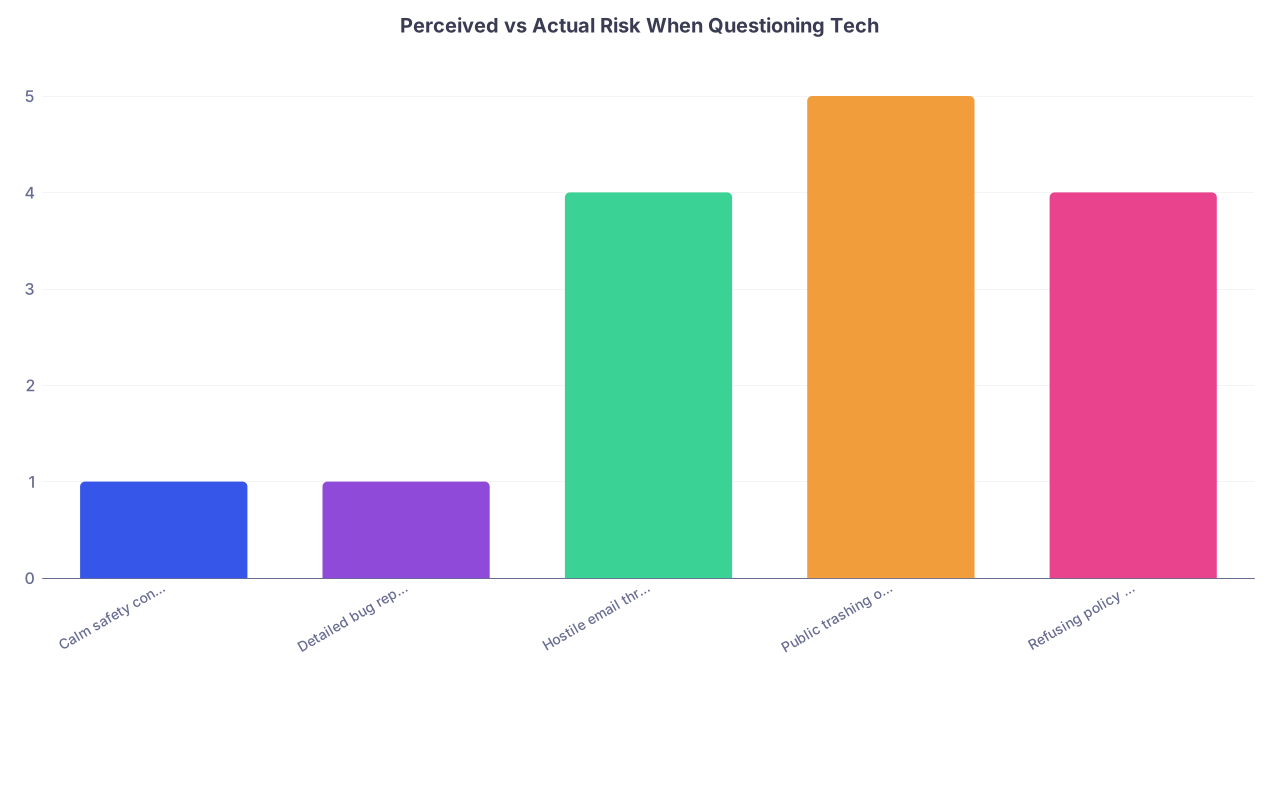
| Category | Value |
|---|---|
| Calm safety concern | 1 |
| Detailed bug report | 1 |
| Hostile email threads | 4 |
| Public trashing on social media | 5 |
| Refusing policy with no backup | 4 |
On a 1–5 risk scale, here’s how it usually plays out in the real world:
Low risk stuff:
- Asking “Can you walk me through the safety review of this AI tool?” in a meeting.
- Sending a concise email: “I’m seeing X pattern with Y feature; here are 3 examples; seems risky for Z reason.”
- Volunteering to help test or pilot changes and then giving honest but calm feedback.
- Using internal incident reporting systems with factual, non-inflammatory language.
Moderate to high risk:
- Posting on Twitter/LinkedIn that your hospital’s new device is “dangerous” or “a joke” before internal escalation.
- Embarrassing leadership in public forums (“I don’t know who thought this was a good idea but…”).
- Refusing to comply with mandatory tech use without documenting a safety or legal rationale and proposing alternatives.
- Making it about “the idiots in IT” or “bean counters” rather than systems and outcomes.
Career suicide territory:
- Ignoring hospital policy and harming a patient and leaving a trail of angry, biased comments about the same system.
- Leaking internal documents/EMR screenshots with PHI to “prove your point” online.
- Going rogue with unapproved tech to “show them how it should be done.”
It’s not “raising concerns” that hurts careers. It’s how and where and what tone you use.
You’re not going to be rejected from a job at Mayo or Kaiser because you once wrote a clear, professional email saying Epic’s med rec workflow is confusing and risky. I promise you they’ve seen worse.
How This Actually Plays Out in Hiring
Here’s what’s keeping you up at 2 am: “Will future employers see me as a troublemaker if I question tech right now?”
Short answer: only if your current behavior gives them easy evidence.
Most hiring processes don’t have a checkbox for “complained about EMR.” They do have:
- Background checks (legal issues, licensure, board actions)
- Reference checks (would your PD / chair / CMIO hire you again?)
- Reputation in the regional community (especially for subspecialties)
Let’s be blunt: programs and hospitals absolutely talk about “culture fit.” When they say “culture fit,” sometimes they do mean “won’t constantly fight every change we try to roll out.” That’s real.
But they also value:
- People who can identify and fix broken workflows
- Clinicians who understand how tech intersects with safety, billing, and regulation
- Early adopters who aren’t naive about bias, safety, or patient harm
I’ve literally heard this in a hiring discussion:
“We need someone who isn’t going to scream at IT every time something changes. But also not someone who blindly clicks through every alert.”
So, where does that leave you? You’re trying to be the person who:
- Sees the risks and articulates them clearly
- Documents concerns in reasonable channels
- Doesn’t torch bridges for sport
If your PD or supervisor can truthfully say: “They raised valid tech concerns in a professional way and were constructive”… you’re fine. That’s neutral-to-positive for your career.
If your PD says: “They refused to use the system, fought everything, and escalated everything to the CMO with emotional language”… that follows you.
Ways to Question Tech Decisions Without Setting Yourself on Fire
There is a safer way to push back. It’s not perfectly safe — nothing is — but it’s far from career-ending.
1. Anchor everything to patient safety, quality, or compliance
Don’t make it “I hate this interface.” Make it “Here’s how this impacts patients and safety.”
Bad:
“This new AI documentation thing is trash and slows me down.”
Better:
“Since we implemented the AI template, I’m seeing critical sections getting auto-filled incorrectly — like normalizing abnormal vitals. I’ve attached 3 de-identified examples. I’m worried this could lead to missed sepsis or mis-documentation if people trust the AI output too much.”
Admins tune out opinions. They pay attention to documented risk.
2. Use internal channels first, external last
You don’t start with a LinkedIn rant. You start with:
- Direct feedback to the CMIO, clinical informatics, or IT liaison
- Incident reporting systems, if there’s actual or near-miss harm
- Specialty or department meetings where changes are being discussed
If you’ve escalated reasonably through internal paths and still see harm, then yes, there are whistleblower routes, professional societies, boards. But this is the nuclear route, and yes, that can affect future jobs. Not saying “never.” Just saying: that’s a different level than “I don’t like this order set.”
3. Write like every email will be forwarded
Because it might. To the CMO. To legal. To a future HR team if there’s an investigation.
Your future self wants to be able to read your own email and think: “I sound measured. I sound like I care about patient safety and clear documentation. I don’t sound unhinged.”
Test yourself: if that email showed up as an exhibit in a malpractice or regulatory case, would it make you look:
- Calm and thoughtful?
- Or angry and reckless?
Aim for the first one.
4. Don’t be the person who fights everything
You know this person. New EMR release? They hate it. New secure messaging requirement? They hate it. New consent form? They hate that too.
If you push back on literally every tech decision, no one can tell which of your alarms are real. You become background noise.
Pick your battles:
- Actual or near-miss safety issues
- Legal/compliance problems (HIPAA, billing, documentation accuracy)
- Situations that push you toward unsafe practice (too many clicks, impossible workflows, hidden orders)
You don’t have to die on the hill of “I don’t like this font in the EMR.”
The Quiet Upside: Questioning Tech Can Help Your Career
This is the part you probably don’t believe, but it’s true in a lot of systems: smart, constructive tech skeptics are extremely valuable.
Who ends up on:
- EMR optimization committees
- Device selection panels
- AI governance boards
- Safety and quality groups
Not the silent people. Not the ones who just rage in call rooms and group texts. The ones who can actually say, “Here’s what’s broken, here’s why it matters, and here’s a path forward.”
| Behavior | How It Usually Lands |
|---|---|
| Calm, documented safety concerns about tech | Neutral to positive |
| Participation in EMR/IT committees | Positive, shows leadership |
| Pattern of public complaining without solutions | Negative |
| Refusal to use mandated tools without rationale | Negative |
| Helping improve workflows and training | Strong positive |
Every hospital I’ve been around is desperate for clinicians who:
- Actually understand what the tech is doing
- Aren’t blindly pro- or anti-technology
- Can explain risks in English, not just vibes
Those people end up with:
- Chief roles (CMIO, medical director of quality, etc.)
- Extra side gigs (consulting, vendor advisory boards)
- More leverage when negotiating jobs
You do not get there by pretending everything is fine.
Realistic Worst-Case Scenarios (And How Likely They Actually Are)
Let’s feed your anxiety properly and then deflate it.
Scenario 1: “I send a professional email about an unsafe AI feature and get fired.”
Is it possible? In a toxic, authoritarian system with weak leadership? Maybe. But it’s rare, and the legal risk for the institution is huge if they fire someone for raising documentable safety concerns in good faith.
More common: you get ignored or placated. Annoying, but not career-ending.
Scenario 2: “My PD tells future employers I’m ‘difficult with tech.’”
This happens sometimes — but usually if:
- You truly fight every tech change
- You vent aggressively in meetings
- You refuse to use required systems without trying to address them first
If your “difficulty” is “they asked good safety questions and participated in EMR improvement,” that’s not the same thing. You can even preempt this in interviews:
“I care a lot about the safety impact of new technology, so I’ve spent time working with IT to improve alert fatigue and documentation workflows.”
Scenario 3: “My name gets associated with a tech complaint and I never get hired anywhere big.”
Extremely unlikely unless:
- You go fully public, loudly, and personally attacking individuals
- You involve media/social without trying internal routes
- There’s actual litigation and your name is in legal documents
Can that still be the right thing to do? Sometimes, yes. But that’s whistleblower territory. That’s not “I asked if this AI is FDA-cleared.”
How To Keep Your Anxiety From Running The Show
Because underneath all of this, your brain’s whispering: “Just stay quiet. It’s safer.”
Except staying quiet has its own risks:
- You participate in systems that harm patients
- You burn out from constantly working around bad tech
- You become complicit in workflows you know are unsafe
Here’s a saner middle path you can actually follow.

| Step | Description |
|---|---|
| Step 1 | Notice tech problem |
| Step 2 | Collect 2-5 specific examples |
| Step 3 | Check policy and existing workflows |
| Step 4 | Draft calm, factual summary |
| Step 5 | Send to local lead or CMIO |
| Step 6 | Offer to help or pilot fixes |
| Step 7 | Document and decide whether to escalate |
| Step 8 | Response? |
Your goal isn’t to be fearless. It’s to be deliberate.
- You document patterns, not just vibes
- You speak up first in smaller, safer rooms
- You check your own tone before pressing send
- You remember that “reasonably cautious” is different from “paralyzed by fear”
You don’t have to become the Poster Child for Physician Informatics overnight. You just have to not let fear bully you into complete silence.
FAQ (Exactly 5 Questions)
1. Can questioning tech decisions actually help me in job interviews?
Yes, if you frame it right. Saying “I’ve been involved in identifying risks and working with IT to improve our EMR / AI / device workflows” makes you sound engaged and thoughtful. Employers like people who can spot problems and help fix them. What hurts is describing yourself as “the only one brave enough to say this EMR is garbage” with zero examples of constructive work.
2. Should I ever refuse to use a tech tool I think is unsafe?
You can, but you shouldn’t do it impulsively. First, document specific risks and examples. Raise them through internal channels. If you’re still being forced to use a tool that you genuinely believe is unsafe, you may need to: a) document in writing why you’re deviating from standard workflow, b) involve risk management or legal, and c) accept that this might escalate into a bigger conflict. That’s a serious step, not something you do over annoyance.
3. Will future employers find out if I filed internal safety reports about tech?
They almost never see the contents of internal incident reports in routine hiring. Those systems are usually protected and separate from HR files. What they will hear is the overall story your current leadership tells about you. If their story is “They care about safety and were proactive with tech issues,” you’re fine. If it’s “They constantly escalated minor tech annoyances like they were federal crimes,” that’s a different problem.
4. Is it safer to just wait until I’m a few years out before speaking up about tech?
Waiting doesn’t magically make it safe; it just postpones the discomfort. New attendings get labeled too. Honestly, residents sometimes have more protection because programs expect them to be outspoken learners. If you start practicing how to raise concerns professionally now, you’ll be much better at it later when the stakes feel higher and you have more to lose.
5. What’s one concrete way to test if I’m being “constructive” or just “complaining”?
Look at your last tech-related email or comment and ask: “If someone read only this, could they identify: a) the specific problem, b) why it matters for patients/safety/compliance, and c) at least one possible next step?” If the answer is no and it mostly says “this sucks” in different words, that’s complaining. If the answer is yes, you’re probably on the constructive side of the line.
Open your email right now and draft (don’t send yet) a short, calm note about one tech issue that actually affects patient care. Read it out loud and ask yourself: “Would I be okay if this got forwarded to my future employer?” Adjust until the answer is yes. Then decide, consciously, whether to send it — instead of letting fear decide for you.