

Mindfulness will not fix serious compassion fatigue on its own. But it can be a powerful tool—if you understand its limits and when to add therapy.
Let me be blunt. A lot of institutions are trying to slap “mindfulness” on top of structural problems and calling it wellness. That’s garbage. No 10‑minute breathing exercise is going to undo years of understaffing, moral injury, and emotional overload.
But. Writing mindfulness off completely is just as wrong. Used correctly, it can meaningfully reduce your distress, increase your emotional stamina, and keep you from sliding into full burnout. You just have to know where mindfulness ends and where real psychological treatment needs to begin.
This is your decision framework.
1. First, get clear: is this compassion fatigue, burnout, or depression?
You’re not going to pick the right tools if you call everything “stress.”
Very short definitions:
- Compassion fatigue – Emotional and physical exhaustion from caring for suffering people, often with:
- Feeling numb or detached from patients
- Irritable, cynical, or “out of empathy”
- Harder to connect with patients’ stories
- Burnout – Chronic workplace stress with:
- Emotional exhaustion
- Cynicism/depersonalization
- Feeling ineffective or like nothing you do matters
- Depression / anxiety / PTSD – Clinical conditions that:
- Affect all areas of life, not just work
- Come with persistent low mood, loss of interest, sleep/appetite changes, intrusive memories, panic, etc.
They overlap. A lot. Most clinicians don’t walk in saying, “I have DSM‑5 criteria for X, Y, or Z.” They say, “I’m done. I have nothing left to give. I don’t care if this patient lives or dies, and that scares me.”
Use this quick rule of thumb:
- If your distress is mostly tied to patient suffering and your emotional response to it, think compassion fatigue.
- If your distress is mostly tied to workload, politics, documentation, leadership, think burnout.
- If your distress is everywhere (home, work, social), think depression/anxiety/trauma.
Why this matters: Mindfulness is helpful across all three, but it’s core treatment for none of them. It’s an adjunct. Therapy is often necessary when the symptoms go beyond “tired and jaded” into “not functioning and scaring myself.”
2. What mindfulness actually does (and what it doesn’t)
Strip away the apps and the buzzwords. Mindfulness is basically:
- Training your attention to return to a chosen anchor
- Noticing internal experience (thoughts, feelings, body sensations)
- Relating to that experience with less reactivity and more curiosity instead of judgment
For compassion fatigue, here’s what that looks like in real life:
- You walk into yet another room where someone is in pain.
- Your chest tightens. Part of you wants to bolt.
- Instead of shutting down or powering through on autopilot, you:
- Notice the tightness.
- Take one slow, deliberate breath.
- Name quietly: “This is sadness” or “This is overwhelm.”
- Then choose how to respond, instead of being swept away or checking out.
That small pause is not magic. But over time, it:
- Reduces automatic emotional flooding
- Makes you less likely to dissociate or snap at people
- Lets you stay present without drowning in your patients’ experiences
Here is what mindfulness does not do:
- It does not fix a toxic workplace.
- It does not replace trauma therapy.
- It does not make you “okay” with being chronically overworked and under-supported.
- It does not mean “accept abuse calmly.”
If anyone is using mindfulness as a way to tell you to tolerate the intolerable, they’re misusing it.
3. A simple decision tree: mindfulness vs therapy vs both
You want a clear answer. Here it is.
If you answer YES to any of the following, you need therapy (or at least a professional evaluation), not just mindfulness:
- You’re having frequent intrusive images or memories from work you can’t turn off.
- You’re avoiding certain patients/units/procedures because they trigger you.
- You’re emotionally numb at home too (with family, friends, hobbies).
- You’ve thought, “If I got in an accident on the way to work, that might be easier.”
- You’re using alcohol, benzos, or other substances to get through shifts or sleep.
- Your sleep is wrecked most nights (insomnia, nightmares, multiple awakenings).
- You’ve had any suicidal thoughts, even passive ones like “My family would be better off without me.”
In those situations, mindfulness is supportive, not sufficient. Use it to stabilize and cope, while you get proper help.
If instead your reality looks more like this:
- Once or twice a week you go home empty and drained.
- You catch yourself thinking “ugh, another train wreck” about patients and don’t like that version of yourself.
- You can still enjoy some things outside work, but they feel dulled.
- You know you’re taking charting shortcuts or emotional shortcuts because you’re tired.
- You’re not in crisis, but you’re afraid you’re headed there.
Then:
- Mindfulness plus some concrete boundary changes is a very reasonable first step.
- Add therapy if things don’t improve within 4–6 weeks, or if they worsen.
4. Concrete mindfulness practices that actually help clinicians
Not all “mindfulness” is equally useful for compassion fatigue. Generic “just breathe” advice tends to bounce off people who are drowning in codes, consults, and moral distress.
Focus on three categories that fit into medical life:
1) Micro-practices during work
These are 10–60 second practices you weave into your day.
- One-breath resets between rooms
Before you touch the next door handle:- Feel your feet on the ground.
- Inhale for 4, exhale for 6.
- Name one word: “Arriving.” Then enter.
I’ve seen residents use this to avoid carrying frustration from a difficult family meeting into the next patient’s well-child visit.
- Hand sanitizing as a cue
Every time you foam in:- Notice the sensation on your skin.
- Relax your jaw and shoulders intentionally.
- Let one exhale be 1 second longer.
You’re already doing the behavior. You’re just turning it into a reset button.
- Micro-body scan at the computer
While a note loads:- Scan head to toe in 5–10 seconds.
- Find one area of tension and soften it by 10%.
- Let that be “enough” for now.
2) Short formal practice (5–10 minutes)
Doable on call days, not just on fantasy vacation days.
Pick one for 3–5 days a week:
5-minute breath/anchor practice
Sit. Eyes closed or soft gaze.
Notice the breath at the nostrils or chest.
Mind wanders? You notice. Label “thinking” and come back. Over and over. That’s the training.Compassion practice toward yourself
Especially after a hard shift.
Hand on chest or forearm. Quietly say:- “This is hard.”
- “Others feel this too.”
- “May I be kind to myself in this moment.”
This isn’t self-pity. It’s preventing you from turning your frustration inward as self-hatred.
- After-work transition ritual
Before you enter home:- Sit in your car for 3 minutes.
- Notice three sounds.
- Take three deliberate breaths.
- Mentally say, “My workday is ending. My home time is beginning.”
This helps your nervous system stop dragging the hospital into your living room.
3) Mindful reflection on cases
Once a week, pick one case that stuck with you. Take 5–10 minutes:
- Write: “What did I feel in my body during this encounter?”
- “What story did I tell myself about this patient? About me?”
- “What was hardest for me emotionally?”
- “What did I need in that moment that I did not get?”
This is mindfulness plus meaning-making. It turns raw exposure into processed experience, which is exactly what reduces compassion fatigue over time.
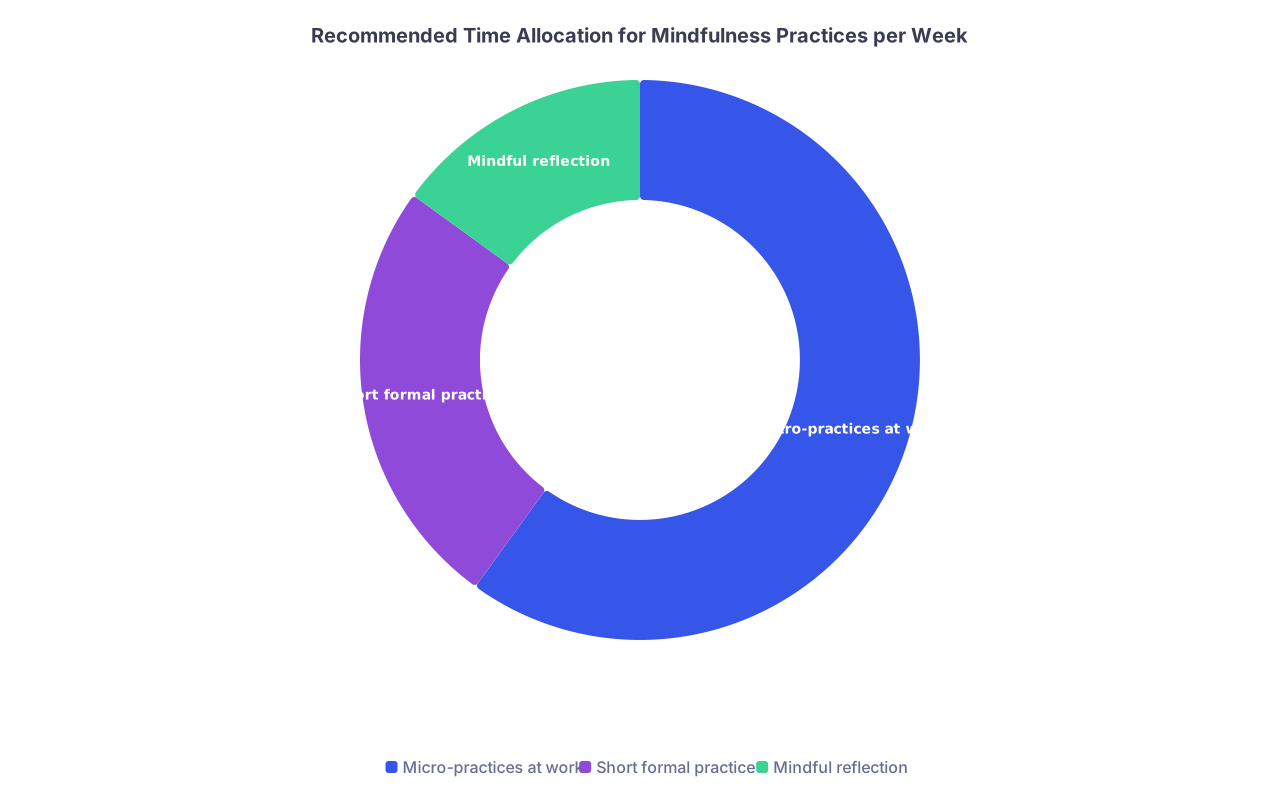
| Category | Value |
|---|---|
| Micro-practices at work | 60 |
| Short formal practice | 25 |
| Mindful reflection | 15 |
5. When therapy becomes non‑negotiable
Mindfulness can be self-guided. Therapy should not be.
You need a therapist who understands healthcare work, trauma exposure, or at least high-responsibility professions. Someone who doesn’t say “have you tried journaling?” after you describe holding a dying teenager’s hand at 3 a.m. for the third time this month.
Here are the situations where I’d stop debating and just say: start therapy.
- You feel unsafe in your own mind. Intrusive images, panic, or rage that feels out of proportion.
- Your relationships are suffering because you’re emotionally unavailable, irritable, or shut down.
- You’re making errors or near-misses you know are connected to being mentally wiped out.
- You’ve had stacked losses (multiple deaths, bad outcomes, or a major personal loss on top of work) in a short time.
- You tried mindfulness, exercise, time off… and nothing moved the needle.
Therapy does what mindfulness can’t:
- Helps you unpack moral injury and guilt (“I did everything and it still wasn’t enough” or “I followed policy and it violated my values.”)
- Treats trauma responses, not just stress.
- Addresses old wounds that your current patient load is ripping back open.
- Gives you a relationship where you’re the one being cared for, not the other way around.
Mindfulness is like learning to swim better. Therapy is like treating the broken leg you got when someone pushed you into the pool in the first place.
You often need both.
6. How mindfulness and therapy can work together (best-case scenario)
The best outcomes I’ve seen, especially with residents, nurses, trauma surgeons, ICU folks, look like this:
They use mindfulness to regulate in the moment:
- Stay a little more present with one hard conversation.
- Catch irritability before it becomes cruelty.
- Notice early signs of overload (headache, chest tightness, zoned‑out feeling).
They use therapy to work on the deeper patterns:
- Old beliefs: “If I can’t save everyone, I’m a failure.”
- Unprocessed grief from the first patient death that really shattered them.
- Family-of-origin stuff that makes “being the helper” compulsive and self-erasing.

| Step | Description |
|---|---|
| Step 1 | Notice distress at work |
| Step 2 | Start micro mindfulness practices |
| Step 3 | Add 5 to 10 min practice most days |
| Step 4 | Continue and adjust boundaries |
| Step 5 | Start therapy |
| Step 6 | Combine therapy and mindfulness |
| Step 7 | Severity |
| Step 8 | Improvement in 4 to 6 weeks |
The point: you don’t have to choose sides. This is not “therapy or mindfulness.” It’s, “What do I start with now, and what do I add next?”
7. Practical next steps: what to do this week
Here is a concrete, realistic plan you can actually follow while still working full clinical time.
Today or tomorrow:
- Pick one micro-practice from above. Do it 3 times in one shift. That’s it.
- Do a 5‑minute guided mindfulness recording (any reputable app or free hospital resource) once before bed.
This week:
- After one particularly emotional case, take 5 minutes to write the four questions from the mindful reflection section. Don’t overthink it.
- Pay attention: Are you more numb? More flooded? Do you feel a tiny bit more choice in how you respond?
Within 2 weeks:
- If you recognize any of the red flags from the therapy section, book a session with a therapist. Not “someday.” Put a date on the calendar.
- If it feels awkward, tell them directly: “I think I have compassion fatigue or early burnout and I’m trying to not let it get worse.”
You’re in medicine. You’d never tell a septic patient to “try breathing exercises first and see how it goes.” Don’t do that to yourself either.
| Situation | Best First Step |
|---|---|
| Mild emotional exhaustion, still functioning | Mindfulness + boundaries |
| Growing cynicism, early disconnection | Mindfulness, then eval |
| Intrusive memories, avoidance, hyperarousal | Therapy + mindfulness |
| Everywhere feels gray, joyless, heavy | Therapy (add mindfulness) |
| Active substance use to cope | Therapy/addiction support |
| Suicidal thoughts or unsafe behaviors | Emergency care + therapy |
FAQs
1. If I start mindfulness, will it make me too “soft” or less efficient at work?
No. That fear is common, especially in high-acuity fields. Mindfulness doesn’t erase your edge; it sharpens it. You’re less lost in mental noise, so you catch subtle patient cues faster, make fewer impulsive comments, and recover quicker after tough encounters. You may actually become more decisive because you’re not hijacked by unmanaged emotion.
2. How much mindfulness do I realistically need for it to help compassion fatigue?
You do not need 45 minutes twice a day on a cushion. For clinicians, a realistic target that still moves the needle is:
- Micro-practices during work (10–20 times per shift, 10–30 seconds each)
- 5–10 minutes of formal practice at least 4–5 days per week
If you maintain that for 4–6 weeks, you’ll know whether it’s helping. If nothing changes by then and you’re doing it consistently, you likely need therapy or bigger system/boundary changes too.
3. What if mindfulness makes me feel worse or brings up more emotion?
That can happen, especially if you’ve been suppressing feelings for years. When you finally sit still, the backlog hits. If you feel temporarily more sad, angry, or tearful but still safe, that’s often part of thawing out. If it feels overwhelming—panic, flashbacks, out-of-control crying—stop the formal practice and talk to a therapist. That’s a sign you need contained processing, not solo self-exposure.
4. Are meditation apps enough, or do I need a trained teacher?
Apps are a completely reasonable starting place. Many hospital wellness programs also offer short, clinician-tailored mindfulness sessions; those are even better. A teacher becomes more important if:
- You have trauma history
- You feel stuck or confused in practice
- You’re using mindfulness to work with strong emotions, not just to “relax”
A good teacher or therapist who knows mindfulness can help you adjust practice so it supports you instead of destabilizing you.
5. What if my institution is pushing mindfulness but ignoring staffing and workload?
That’s not wellness; that’s PR. Practice mindfulness for your own nervous system, not as an endorsement of broken systems. You’re allowed to:
- Use mindfulness to cope and stay centered
- Simultaneously advocate for better staffing, schedules, and support
Mindfulness should help you see more clearly where the harm is and give you enough stability to push for change, not make you passively accept bad conditions.
6. I’m afraid therapy will go on my record or affect my license. Should I still go?
In most places, getting outpatient therapy is treated like getting any other medical care. Many boards and credentialing bodies are moving away from invasive mental health questions and focusing on current impairment. You need to check your specific jurisdiction and employer, but let me be blunt: untreated compassion fatigue and depression are far more likely to lead to errors, complaints, or real impairment than discreet, proactive therapy. Your patients are safer—and your career is safer—when you’re getting the help you need.
Key points: Mindfulness can absolutely help with compassion fatigue, but it’s a tool, not a cure. Use it early and consistently, and if red flags show up—intrusions, numbness everywhere, substance use, suicidal thoughts—stop debating and add therapy. You’re allowed to care for the caregiver, even if that caregiver is you.


