

It is July 3rd. You have just survived your first 72 hours as an attending. Your inbox is a mess, residents are already saying “let me run this by my attending,” and you are realizing nobody is coming to save you from your pager. This is the point where bad habits harden. Or where you deliberately build practices that keep you from burning out before Labor Day.
We are going to treat your first month as a project. Four weeks. Each week with a specific mindfulness focus, broken down into concrete, time-stamped actions. No crystals. No vague “self-care.” Just structured mental hygiene in the middle of a very real clinical grind.
Overview: Your First 4 Weeks as an Attending
At this point, your main risk is overload by accumulation. Decisions. Messages. Interruptions. Emotional residue from patients. You will not “power-through” your way out of this. You need a plan that:
- Fits into existing workflow (rounds, notes, sign-out)
- Can be done in 1–5 minute blocks
- Directly supports ethical practice and judgment
Here is the month at a glance.
| Week | Core Goal | Primary Focus |
|---|---|---|
| 1 | Notice | Awareness & Autopilot |
| 2 | Anchor | Breath & Body |
| 3 | Protect | Boundaries & Values |
| 4 | Sustain | Reflection & Repair |
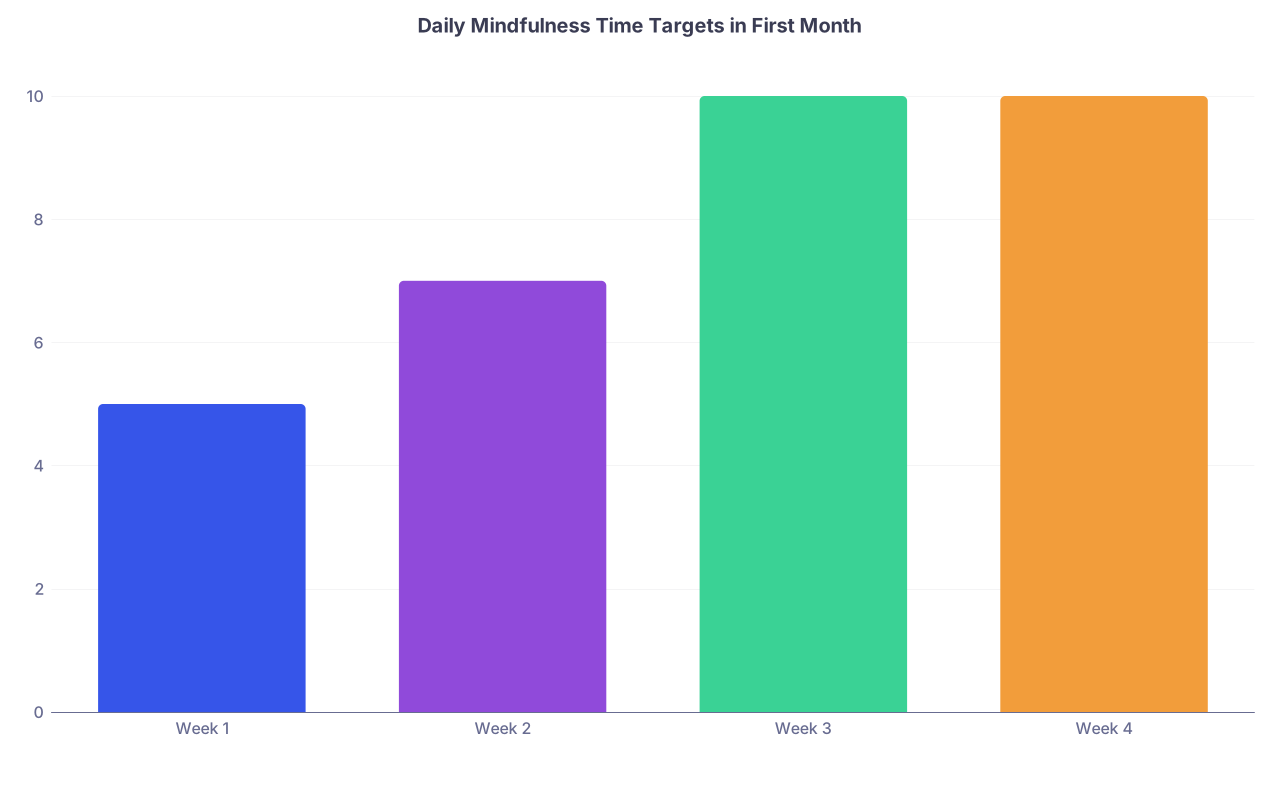
| Category | Value |
|---|---|
| Week 1 | 5 |
| Week 2 | 7 |
| Week 3 | 10 |
| Week 4 | 10 |
You are not trying to become a meditation monk. You are trying to:
- Reduce cognitive overload
- Make fewer impulsive decisions under pressure
- Preserve empathy without drowning in everyone else’s pain
- Hold onto your ethical standards when you are exhausted
Let’s walk week by week, then day by day for Week 1 and sample days later.
Week 1 (Days 1–7): Notice Before You Drown
You are here: early July, first week as attending on service. You feel like an intern with a bigger name badge. This week’s job is simple: notice. No fixing yet.
Weekly Mindfulness Goal
At this point you should:
- Learn your overload “signature”: how your body, thoughts, and behavior change when you are stressed.
- Insert 3–5 brief “check-in” moments per day.
- Start separating signal from noise in your mental chatter.
Daily Micro-Structure (Week 1)
Use this skeleton. It totals about 5 minutes per day.
Start of day (before first patient / first case) – 1 minute
- Stand or sit somewhere semi-private.
- Ask three silent questions:
- What is the main thing I am worried about today?
- Where do I feel that in my body?
- What is actually under my control in the next 2 hours?
- Name one “anchor” for the day: e.g., “Listen fully to the first patient before interrupting.”
Mid-morning (after 3–4 patient encounters) – 60 seconds
- Step into a stairwell, hallway, or bathroom.
- Do: 3 slow breaths. Inhale for 4, hold 1, exhale for 6.
- Ask yourself: “On a 0–10 overload scale, where am I?” Just notice.
Post-lunch (even if lunch is 6 minutes) – 1 minute
- Before opening your inbox again, close your eyes.
- Scan from head to toe in ~20 seconds: jaw, shoulders, chest, stomach, hands.
- Wherever you feel tension, exhale into it.
End of day (before going home) – 2 minutes
- Sit with your note list / task list closed.
- Ask:
- What was one moment I am proud of today?
- Where did I feel rushed and not fully present?
- Pick one sentence to carry to tomorrow: “Tomorrow I will slow down when ___.”
Does this feel too basic? Good. Week 1 is about consistency, not depth.
Day-by-Day Focus (Week 1)
Day 1–2: Baseline and Awareness
At this point you should:
- Identify 1–2 recurring triggers (e.g., EMR alerts, certain consultants, family meetings).
- Notice one physical cue of overload (e.g., jaw clenching, shallow breathing).
Concrete tasks:
- On your phone, create a very short note called “Overload Log.”
- When you feel overloaded, jot:
- Time
- Situation (1 phrase)
- Body cue (1 word: “tight chest,” “headache,” “hot face”)
Day 3–4: Emotional Labeling
You will still be in survival mode. Add one thing: name the emotion.
When something spikes you (angry family, passive-aggressive email):
- Silently add a label: “Anger,” “Guilt,” “Fear,” “Imposter,” “Annoyance.”
- Do this while you keep functioning. Residents do not need to know.
- The goal is not to fix the emotion; just to prevent fusion with it. “I am angry” shifts to “I am noticing anger.”
Day 5–7: Noticing Autopilot and Ethical Drift
By now you will feel patterns:
- Interrupting patients faster
- Snapping at staff
- Ordering more tests “just to be safe” because thinking is hard by 4 p.m.
At this point you should:
- Catch one moment per day where you almost compromised your own standard due to fatigue, pressure, or fear.
- Mentally tag it: “Ethical friction.”
End-of-day, ask:
- Did I override my better judgment? Why? (time pressure, fear of missing, conflict avoidance)
- What would I have done with a 5-minute pause?
This is the seed of ethical mindfulness. You are building a habit of noticing drift before it becomes your default.
Week 2 (Days 8–14): Anchor Your Attention to Your Body
You are here: the novelty of being “attending” is fading. The paperwork is not. You are making 200+ decisions a day, many of them on autopilot. This week you build a simple, repeatable anchor: breath and body.
Weekly Mindfulness Goal
At this point you should:
- Have 2–3 reliable “anchors” to come back to when your mind is spinning.
- Use your body as an early warning system for overload.
- Interrupt at least 2 spirals per day (catastrophic thinking, ruminating about a mistake, replaying a conflict).
Here is a simple timeline for Week 2:
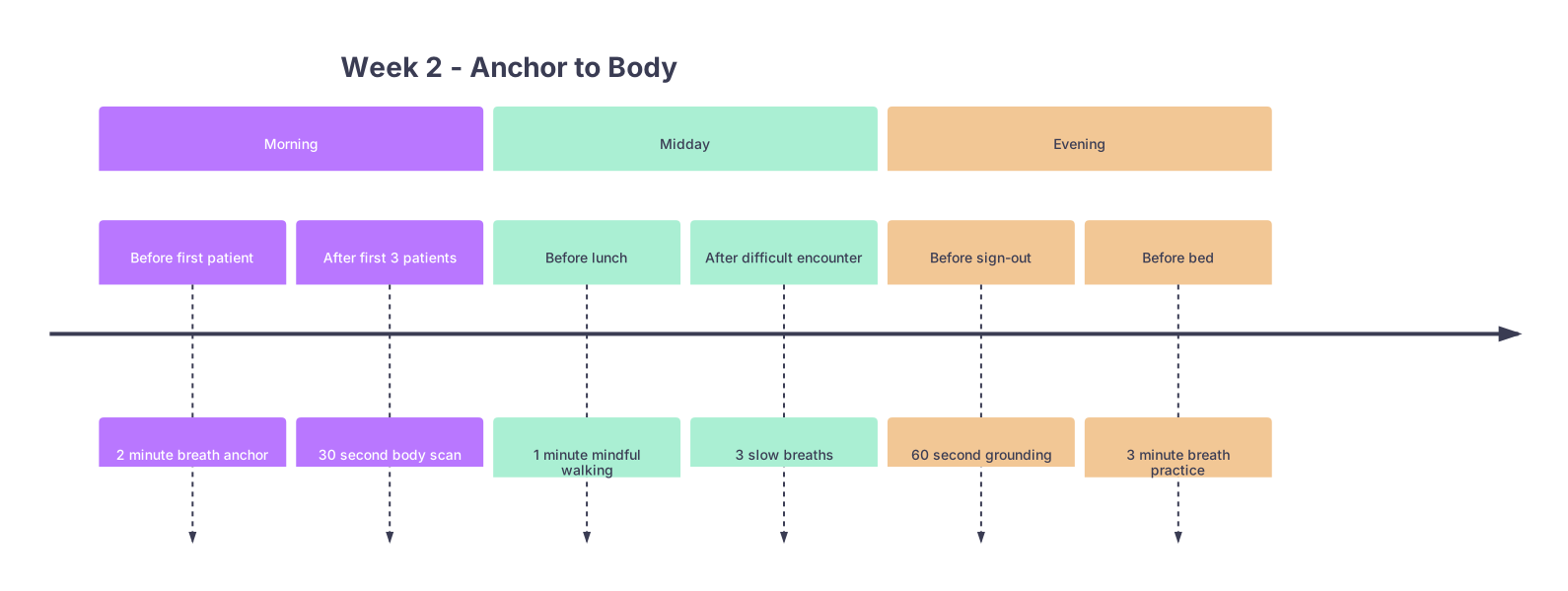
| Period | Event |
|---|---|
| Morning - Before first patient | 2 minute breath anchor |
| Morning - After first 3 patients | 30 second body scan |
| Midday - Before lunch | 1 minute mindful walking |
| Midday - After difficult encounter | 3 slow breaths |
| Evening - Before sign-out | 60 second grounding |
| Evening - Before bed | 3 minute breath practice |
Core Practices for Week 2
2-Minute Morning Breath Anchor
- Sit at your desk before opening the EMR.
- Set a 2-minute timer.
- Attention on:
- Air at the nostrils, or
- Rise/fall of the chest, or
- Feel of your feet in your shoes
- Each time your mind jumps to your to-do list, quietly mark “thinking” and return.
10-Second Reset Before Entering Each Room (or at least the first 5)
Before your hand hits the door:
- One slow inhale.
- One longer exhale.
- Mentally say the patient’s name once.
- Intention: “For the next 3 minutes, this person gets my full attention.”
This does more for patient trust than another canned empathy phrase. I have watched entire family meetings shift because the attending arrived mentally, not just physically.
Mindful Walking Between Tasks (30–60 seconds)
Anytime you walk from one place to another:
- Put phone away.
- Notice 3 steps: heel–toe, heel–toe.
- Notice one sound.
- Notice one color.
- Then back to the chaos.
You are training yourself to drop out of your head and into your senses for very brief windows. This is what cuts the feeling of being “stuck on fast-forward” all day.
Week 3 (Days 15–21): Protect Your Boundaries and Your Ethics
You are here: mid-month. Fatigue has accumulated. People are getting used to you being “the doc who says yes.” This is when attendings start making quiet, corrosive compromises: skipping breaks, avoiding hard conversations, extending work hours “just for now” until it becomes permanent.
Week 3 is about protective mindfulness: boundaries as an ethical duty, not a luxury.
Weekly Mindfulness Goal
At this point you should:
- Define 2–3 non-negotiable boundaries.
- Practice mindful pausing before saying “yes” or “no.”
- Use brief reflection to keep your actions aligned with your stated values.
Step 1: Define Your Non-Negotiables (10–15 minutes once)
One evening this week, sit down and write three lists:
Clinical non-negotiables
- Example: “I will not sign orders I do not understand.”
- “I will not ignore a resident’s safety concern because it is inconvenient.”
Time/energy non-negotiables
- “I will leave by X time on at least 3 weekdays.”
- “I will take 10 uninterrupted minutes to eat something each shift.”
Ethical red flags
- Situations where you know you are likely to drift:
- Feeling pressured by administration metrics
- Angry at a “noncompliant” patient
- Exhausted at the end of a string of codes
- Situations where you know you are likely to drift:
You need these explicitly written, not just floating in your head. Because in the moment, fatigue will win.
Step 2: The 5-Second Boundary Pause
For the rest of Week 3, whenever someone asks you to do something extra (add-on patient, extra meeting, committee, “quick curbside” that is actually a consult):
- Feel your feet on the ground.
- Inhale once.
- Ask silently: “If I say yes, what gives?”
- Then respond.
Sometimes you still say yes. But at least it is a chosen yes, not a reflex.
Step 3: Daily 3-Question Ethical Check (2 minutes, end of day)
At this point you should be doing this 4–5 days this week:
- Pull up your “Overload Log.”
- Ask:
- Where did I act against my own stated values today?
- What was the pressure? (time, fear, conflict, ego)
- What would a 1-minute pause have changed?
You are not confessing sins. You are training pattern recognition, the same way you learned to read EKGs.
Week 4 (Days 22–30): Sustain, Reflect, and Repair
You are here: the end of your first month. The adrenaline of “I am finally the attending” has worn off. The system will not get kinder. Week 4 is about building sustainable habits and integrating repair: with yourself, with patients, with colleagues.
Weekly Mindfulness Goal
At this point you should:
- Solidify a personal “mindfulness minimum” for clinical days.
- Establish a weekly reflection ritual.
- Practice repair: apologizing, debriefing, and resetting when things go badly.
Establish Your “Mindfulness Minimum”
Decide what you will commit to on any clinical day, including the worst ones:
- Morning: 2 minutes breath anchor at desk
- Midday: 1 body scan + 3 breaths once
- Evening: 2-minute reflection or journaling
That is 5 minutes. If you cannot give yourself 5 minutes, you are lying to yourself about sustainability.
Weekly 15-Minute Reflection (Pick a Fixed Day)
Choose a consistent slot: Sunday night, or the last day of your service week.
Structure:
Scan the week (3–4 minutes)
- Skim your “Overload Log.”
- Mark with a star any entries that repeat (same time, same trigger, same person).
Pick 1–2 “Case Studies” (5–7 minutes)
- A moment where you showed up the way you want.
- A moment where you did not. For each, ask:
- What state was I in? (tired, rushed, regulated)
- What helped/hurt my ability to act ethically?
Choose 1 focus for next week (3–4 minutes)
- Example: “Respond more slowly to email” or “Protect one 10-minute break.”
- Write it somewhere you will actually see (sticky note on monitor works better than a “productivity app” graveyard on your phone).
This is the difference between drifting through your attending years and actually growing.
Repair: When You Screw Up (Because You Will)
By Week 4, something has already gone wrong:
- You snapped at a nurse.
- You rushed a consent.
- You dismissed a resident question that later turned out to be valid.
Mindful repair sequence:
Pause and own it internally
- “I am feeling shame / embarrassment / defensiveness.”
- Three slow breaths. Notice the urge to justify.
If appropriate, brief, direct apology
- “I was short with you earlier. That was not acceptable. I appreciate you speaking up about X.”
- No long self-explanations. No “but I was tired.”
Micro-debrief for yourself later
- What were the precursors? (time, hunger, previous conflict)
- What early signals did I ignore? (tight chest, racing thoughts)
This is mindfulness in the context of medical ethics, not just personal peace. It keeps you from sliding into the cynical attending who blames “the system” for everything while replicating its worst habits.
Sample Day: Putting It All Together (End of Month)
By the last week, a reasonable “mindful attending” day may look like this:
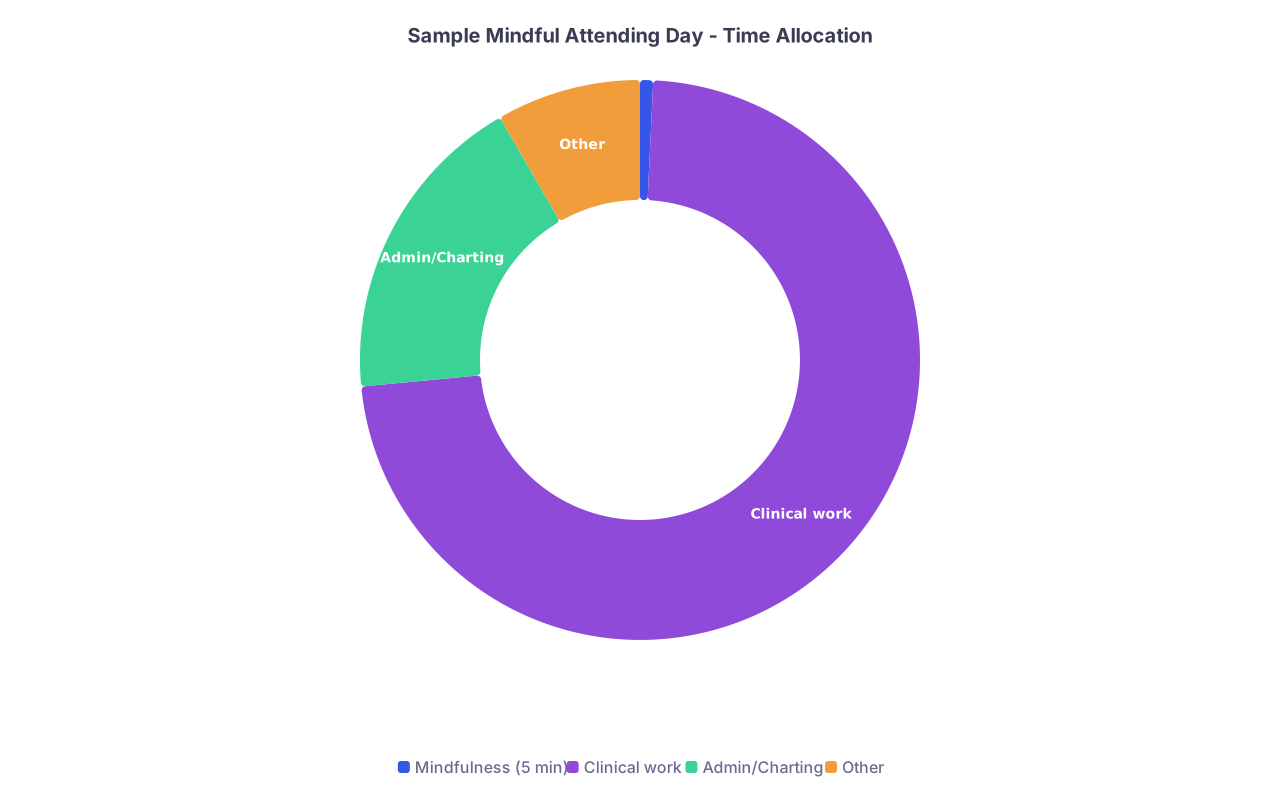
| Category | Value |
|---|---|
| Mindfulness (5 min) | 5 |
| Clinical work | 480 |
| Admin/Charting | 120 |
| Other | 55 |
06:55 – In car or walking in (1 minute)
Three breaths, set intention: “Today I will pause before giving bad news.”
07:50 – Before opening EMR (2 minutes)
Breath anchor. Notice worry about the new consults. Label “anxiety.” Return to breath.
09:30 – After difficult family meeting (30 seconds)
In hallway, hand on railing, feel contact. One full inhale, one full exhale. Silently, “That was hard.” Then move.
12:10 – First bite of food (60 seconds)
Put phone face down. Taste the first three bites. Notice your shoulders. Drop them.
16:45 – Before last new admission (10 seconds)
Hand on doorknob. Inhale, exhale. Say patient’s name once in your head. Enter.
19:15 – At home, before opening laptop again (2 minutes)
Sit. Ask:
- One moment of integrity today?
- One moment of drift? One sentence for tomorrow.
That is it. Not fancy. But if you actually do this most days, it changes how the month feels.
Quick Reference: Weekly Goal Summary
| Week | Primary Goal | Key Practice |
|---|---|---|
| 1 | Notice | Overload Log + daily check-ins |
| 2 | Anchor | Breath/body before each session |
| 3 | Protect | 5-second boundary pause |
| 4 | Sustain & Repair | Weekly reflection + micro-repair |

FAQ (Exactly 2 Questions)
1. What if my service is so busy that I genuinely do not have time for this?
Then you do not have time not to do it. I have seen attendings on trauma, transplant, and ICU services work these practices into 10–30 second gaps: at the sink scrubbing, waiting for the elevator, while the EMR loads. If you aim for 10 minutes, you will fail. Aim for 10–30 seconds, repeated. Start with the door-handle breath and the end-of-day 2-minute reflection. If you cannot protect 2 minutes, your issue is not mindfulness, it is boundaries and system structure—which you will not change by sacrificing your last bit of clarity.
2. How does this actually relate to medical ethics and not just “feeling better”?
When you are overloaded, three things reliably degrade: judgment, empathy, and courage. You order more tests instead of thinking. You distance from patients who scare you or frustrate you. You avoid hard conversations about prognosis or futility. Mindfulness in this context is not about serenity; it is about preserving your capacity to see clearly, stay connected, and act according to your values even when you are under pressure. That is ethics in practice. A distracted, depleted attending is an ethical risk. A present, self-aware one is far less likely to drift.
Open tomorrow’s schedule right now. Pick three specific times you will insert a 30–120 second mindfulness pause (for example: before first patient, after lunch, before last note). Write them down. That is your first real test as an attending: do you actually follow through on this tiny contract with yourself.


