
Most disability insurance advice for residents is bloated with riders you do not need.
Let me be blunt: your attending who “just signed whatever the agent recommended” overpaid. The agent who insists you need seven different riders “for protection” is chasing commission. As a resident, you have 3–4 riders that actually move the needle. The rest are nice-to-have at best, expensive noise at worst.
Let’s clean this up.
The Core Reality: What Disability Insurance Is Really Doing For You
You are not trying to build the perfect, indestructible contract. You are trying to do two very specific things as a resident:
- Protect your future earning power while you are still young and insurable.
- Lock in the right to buy more insurance later, when your income is high and your health might be worse.
Everything else is commentary.
The base policy matters: own-occupation definition, non-cancellable/guaranteed renewable, a reasonable base benefit (usually $4–6k monthly in residency). But once you have a solid base, the riders are where people get lost.
Think of riders as “contract modifications” that tweak:
- When benefits start
- How benefits grow
- How much more you can buy later
- What counts as disability
- Miscellaneous bells and whistles (some useful, some garbage)
Most residents are sold too many riders because they do not know how to prioritize. So let me rank them for you in real-world resident terms.
The Big Three Riders Residents Should Actually Care About
These are the non‑negotiables I push for when I review resident policies. If you have limited budget, you protect these before anything else.
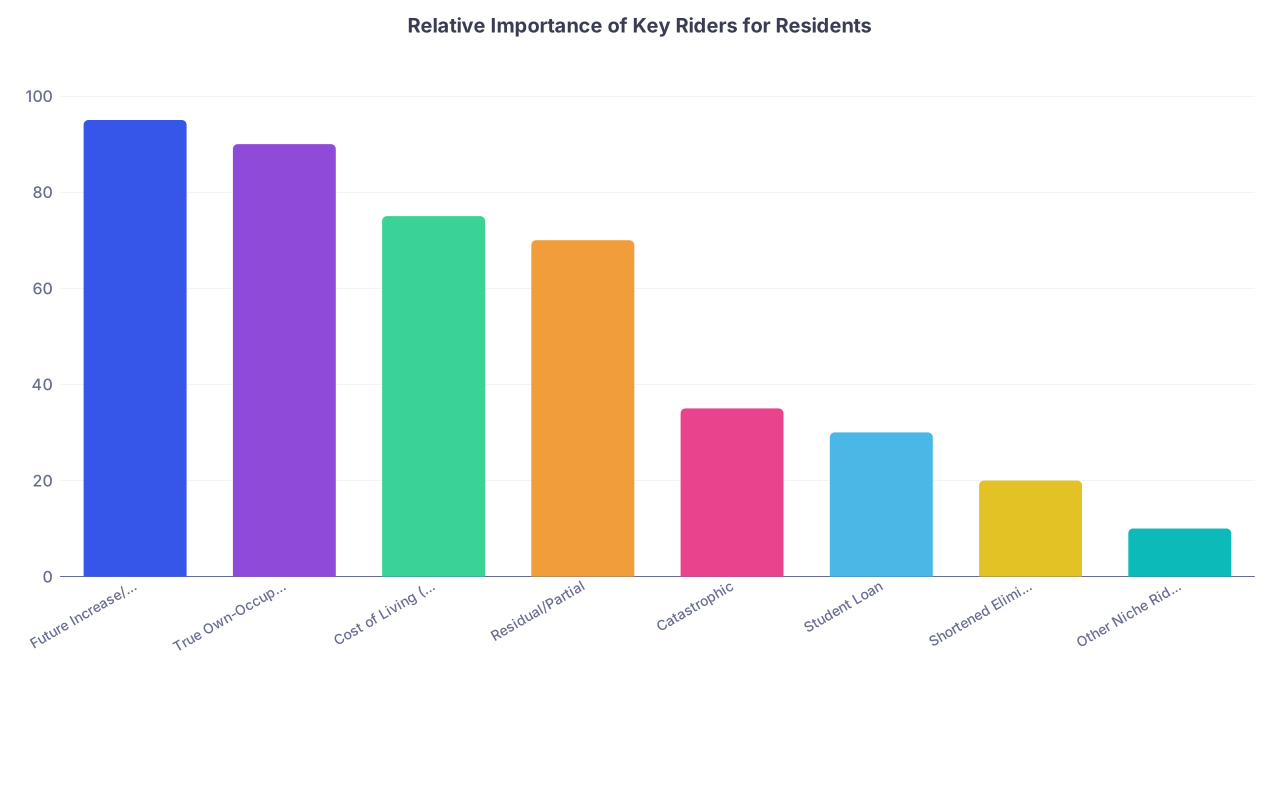
| Category | Value |
|---|---|
| Future Increase/Benefit Update | 95 |
| True Own-Occupation | 90 |
| Cost of Living (COLA) | 75 |
| Residual/Partial | 70 |
| Catastrophic | 35 |
| Student Loan | 30 |
| Shortened Elimination | 20 |
| Other Niche Riders | 10 |
1. Future Increase Option / Benefit Update Rider (The One You Cannot Fix Later)
If you remember nothing else from this article, remember this:
The right to buy more coverage in the future, regardless of your health, is the most important feature of a resident’s disability policy.
Carriers call it different things:
- Future Increase Option (FIO)
- Benefit Update Rider
- Future Purchase Option
- Benefit Increase Rider
The details vary, but the concept is the same:
As your income increases, you can buy more monthly benefit up to a preset cap (e.g., $15–20k/month) without new medical underwriting.
Why this matters:
You are insurable now. You may not be in five years. I have seen this too many times:
- PGY-2 buys no future increase rider because “I’ll revisit this as an attending.”
- During fellowship: new diagnosis—Crohn’s, MS, severe depression, or even just a back surgery.
- Tries to buy more coverage: declined or heavily excluded.
- They are stuck with a $5k/month benefit for life in a $400k specialty.
That is not theoretical. I have sat in call rooms with people telling that story, usually with a mix of anger and resignation.
With a strong increase rider, the future looks different. You finish residency, your income jumps from $70k to $350k, and:
- Company sends an offer letter every 3 years (or when your income changes)
- You show proof of income/contract
- They let you increase coverage—sometimes doubling or tripling it—without asking a single question about your health
You will pay more premium as you buy more coverage (obviously), but you will not be re-underwritten. That is the entire point. You are pre‑qualifying your future self.
What to look for as a resident:
- Cap: Aim for at least $15k/month total future benefit, $20k is better. Surgical subspecialties should lean to the higher side.
- Activation: Does it automatically offer increases every few years, or do you have to request? Automatic is better, but either is fine if you are not lazy.
- Conditions: Some riders terminate if you decline offers too many times; some shrink the remaining amount. Read that fine print.
If you can only afford one powerful rider beyond base coverage, this is the one.
2. True Own-Occupation / Specialty-Specific Definition (Technically Part of Base, But Often Sold as a Rider)
Many carriers bundle this into the core contract; others treat “enhanced own-occupation” as a rider. Functionally, you must treat it as essential.
You want language that says, in effect:
You are disabled if you cannot perform the material and substantial duties of your own occupation, and you can work in another occupation without losing your benefit.
For physicians, you want it specialty specific. If you are an orthopedic surgeon who loses fine motor skills, you want:
- Full benefit because you cannot operate
- The ability to go work urgent care, telemedicine, admin, or even consulting
- No reduction of benefit because of that new income (under pure own-occupation, not “transitional” or “modified” nonsense)
Contrast that with weaker language:
- “Any occupation” — you only qualify if you cannot work in any reasonable job given your training and education. Brutal for physicians.
- “Modified own-occupation” — benefits stop if you are working elsewhere, even if you cannot do your specialty.
- “Transitional own-occ” — they offset benefit as new income rises; okay, but weaker.
If your policy lists this as an “Enhanced Own-Occupation Rider” or “Specialty Own-Oc Rider,” consider it in the must-have group.
Residents often underweight this for one reason: “I’m young, what are the odds I get disabled enough that this definition matters?”
Wrong question. You are insuring a high-value, skill-specific career where partial disabilities are common:
- Loss of vision in one eye
- Essential tremor that worsens
- Radiculopathy after a spine injury
- Chronic migraines with aura making procedures unsafe
You might still be able to do some work, but not your specialty. The definition is what decides whether you are covered or not.
3. Cost-of-Living Adjustment (COLA) Rider (Critical If You Are Young)
This is the boring, actuarial rider that quietly saves your future self. Many residents skip it to shave premium. That is usually a mistake.
COLA does not raise your benefit every year while you are healthy. It only kicks in after you are disabled and on claim, usually after 12 months of benefits. Then it increases your monthly payout every year, typically based on:
- Fixed percentage (e.g., 3% compound annually), or
- CPI-based (tied to inflation, often with a cap like 3–6%)
Why it matters in residency:
You may be 28, disabled in a car crash during PGY-3. Suddenly your $5,000/month benefit has to last 40–50 years. Without COLA, that $5k becomes a joke by the time you are 50.
Quick simplified example:
- Initial benefit at age 30: $5,000/month
- Inflation: 3% per year
- Time on claim: 30 years
Without COLA, in today’s dollars, that benefit is roughly cut in half over time. A COLA rider keeps it closer to real purchasing power.
Is COLA mandatory for everyone? Almost.
I think COLA is strongly indicated when:
- You are under 40 (you are)
- Your policy is designed to last to age 65 or 67 (it should be)
- You are not planning to stack this on top of a massive government pension (most U.S. residents aren’t)
People near the end of career sometimes reasonably drop COLA or buy a policy without it. Residents should very rarely do that.
If you absolutely cannot afford the premium right now, fine—start without it and add it during early attending years if your company allows you to attach riders later without new underwriting (many do not). More often, you just bite the cost and move on.
Strongly Recommended: Residual / Partial Disability Rider
This is not quite in the “Big Three,” but pretty close. Many high-quality physician policies now include residual benefits by default or at very low rider cost. You want it.
What it does:
You get benefits when you are partially disabled, not just totally disabled. Partial disability is usually defined by:
- Loss of income (e.g., 15–20%+ drop), and
- Either loss of time or duties, depending on policy language
Typical scenario:
- You develop a condition that forces you to cut back to 50% clinical time
- Or you lose ability to do procedures, but can still do clinic
- Your income drops from $350k to $200k
Without a residual rider, you might not qualify as “totally disabled” and get nothing.
With it, you could receive a proportional benefit:
- If your income loss is 40% and your full benefit is $10k/month, you might receive ~$4k/month on top of your new income, depending on formula.
This maps to real life easily:
- A neurosurgeon who can no longer take call or do complex cases
- An anesthesiologist limited to day shifts, no nights, no high-risk cases
- An interventional cardiologist converted to non-invasive clinic
Those people work. They also lose 30–60% of previous pay. Residual coverage plugs that gap.
I have seen residents disable their shoulder, spine, or hand in some random non-work accident (skiing, car crash, gym). They can still “work,” but not in the same role. Residual is what prevents the all-or-none cliff.
My stance:
If your company offers good residual/partial coverage, you get it. If it is expensive and weakly written, we at least analyze it—but skipping it entirely is rarely smart.
Nice to Have but Situational: Riders That Sometimes Make Sense
Now we get to the gray zone. These riders can be useful, but they are not universal must-haves.

Catastrophic Disability Rider
This kicks in only for very severe disabilities—think inability to perform 2 or more activities of daily living (ADLs) or severe cognitive impairment.
It typically adds an extra $2–5k per month on top of your normal benefit if you are catastrophically disabled.
Pros:
- If you are truly devastated (spinal cord injury, severe brain injury, advanced neurodegenerative disease), long-term care needs are massive. This extra money is not trivial.
- It is often relatively cheap per $1,000 of extra catastrophic benefit.
Cons:
- It only pays in those most extreme scenarios. Many physician disabilities do not reach that ADL threshold.
- It is still more premium, and residents are not made of money.
My take for residents:
- If your budget is tight, prioritize FIO/own-occ/COLA/residual first.
- If those are covered and a catastrophic rider is inexpensive, add it.
- If you have family history of neurodegenerative disease or worry about high-cost care, it becomes more appealing.
Student Loan Protection Rider
Highly marketed to residents with $300k+ in loans. The sales pitch is:
“If you are disabled, we will make your student loan payments for you (or pay off the loans) in addition to your regular benefit.”
Mechanics vary:
- Some policies reimburse up to a set monthly amount for loans
- Some provide an extra pool of benefit earmarked for student loan repayment
The question you should ask:
Why do I need this if my main disability benefit is sized correctly?
If your base policy is big enough to cover living expenses and loans, you do not need a separate loan rider. It is often redundant.
I have also seen carriers price these riders at a premium that essentially replicates what you could do yourself by just buying a slightly larger base benefit.
But there are edge cases where it can be defensible:
- Your max allowable base benefit is capped (resident income is low), and the student loan rider lets you squeeze out a bit more total dollar protection.
- You want the psychological comfort of “my loans are separately handled” if disabled.
I am not morally opposed to it. I just find it oversold. For most residents, I would rather see you:
- Push for the largest base benefit they will issue, plus
- Strong future increase rider, then
- Worry about loan riders only if still needed.
Commonly Oversold or Low-Yield Riders for Residents
Here is where I see the most fluff. Agents love these because they sound comforting and generate extra commission. Not all are useless, but they are much lower priority.
| Rider Type | My Verdict for Most Residents |
|---|---|
| Shortened Elimination Period | Usually skip; too expensive for what you get |
| Initial Benefit Increase (auto step-ups while healthy) | Mildly useful; budget-dependent |
| Retirement Contribution / Lump-Sum Riders | Low priority as a resident |
| Accident-Only Enhancements | Generally not worth it |
| Return of Premium | Usually bad math; skip |
Shorter Elimination Period (e.g., 30 or 60 Days vs. 90 Days)
Elimination period = waiting period before benefits start. Standard is 90 days.
Resident hears “90 days with no income” and panics. Agent offers a 30-day or 60-day elimination rider.
The premium jump is usually large for risk that you could easily self-insure with a small emergency fund or a few months of living lean.
As a resident:
- You should aim to hold at least 1–2 months of expenses in cash by PGY-3 or so.
- Many programs have some short-term disability/sick pay (imperfect, but not zero).
- Truly long-term, career-ending disabilities are what ruin you. That is what you buy private DI for, not the first 4 weeks of injury.
I almost always tell residents: stick with 90 days. Use the saved premium to get the right riders that matter for decades.
Automatic Benefit Increase Riders (Not To Be Confused with Future Purchase Riders)
Some policies include an “automatic increase” rider:
- Your benefit rises a small percentage (e.g., 3–4%) annually for the first 5–6 years while you are healthy.
- Premium rises accordingly.
- Often aimed at combating income growth/inflation early on.
This is not the same as the future purchase rider that lets you dramatically increase benefit with higher attending income. This is a slow creep.
Is it evil? No. But I rank it low for residents:
- You are in low-income years. The real jump comes when you become an attending, not by 3% per year in residency.
- If premium is tight, this is precisely the type of rider you trim.
If your company includes it by default and the cost is marginal, fine. But I would not chase it if it sacrifices FIO or COLA.
Retirement Contribution Riders / Lump-Sum Disability Riders
These try to solve a real issue: if you are disabled early, you cannot build retirement savings. So some carriers sell:
- Riders that pay an extra amount into a pseudo-retirement account while you are on claim, or
- Riders that pay out a big lump sum at a certain age if you have been on claim
The catch:
- They are expensive.
- The design is often clunky and not as flexible as building your own investment portfolio.
- As a resident, you are busy trying to pay rent and moonlighting for grocery money, not optimizing retirement DI riders.
I have yet to see a PGY-2 where I thought, “Forget COLA, you really need that retirement contribution rider.”
Would it be nice in some perfect world? Sure. But that is not where you are.
How This Plays Out in a Real Resident Scenario
Let me give you a typical case I see:
Internal med resident, PGY-2. Age 29. $280k federal loans. Married, one child. Total income: $68k. Partner makes $40k.
Agent quote #1 (bloated):
- Base benefit: $5,000/month
- Riders:
- Future Increase Option (to $17,000/month)
- True own-occ specialty definition
- COLA 3% compound
- Residual/Partial
- Catastrophic benefit $5,000/month
- Student loan rider $2,000/month
- 60-day elimination
- Automatic benefit increase
- Retirement contribution rider
Total premium: absurd for a resident budget.
What I would strip it down to:
Essential:
- Base: $5,000/month
- True own-occupation, specialty-specific
- Future increase/benefit update to at least $17–20k/month
- COLA 3% compound
- Residual/partial disability
Then budget permitting:
- Catastrophic: maybe $2–3k/month, not $5k
- Student loan rider: maybe, if the premium is modest and base benefit already maxed
And I would:
- Drop the elimination period back to 90 days
- Kill retirement contribution rider
- Likely ditch automatic benefit increase rider if it hikes cost too much
This trims the monthly premium often by 25–40% while preserving the actual risk protection that matters: what happens if this person is partially or totally disabled at 32 and can never practice internal medicine at full salary.
That is the exercise you should walk through with your own quotes.
Timeline: When Residents Should Lock This In
Most residents wait too long. They intend to “do it sometime during PGY-3” and then suddenly it is fellowship match season and they have not done it.
Here is a more realistic timeline.
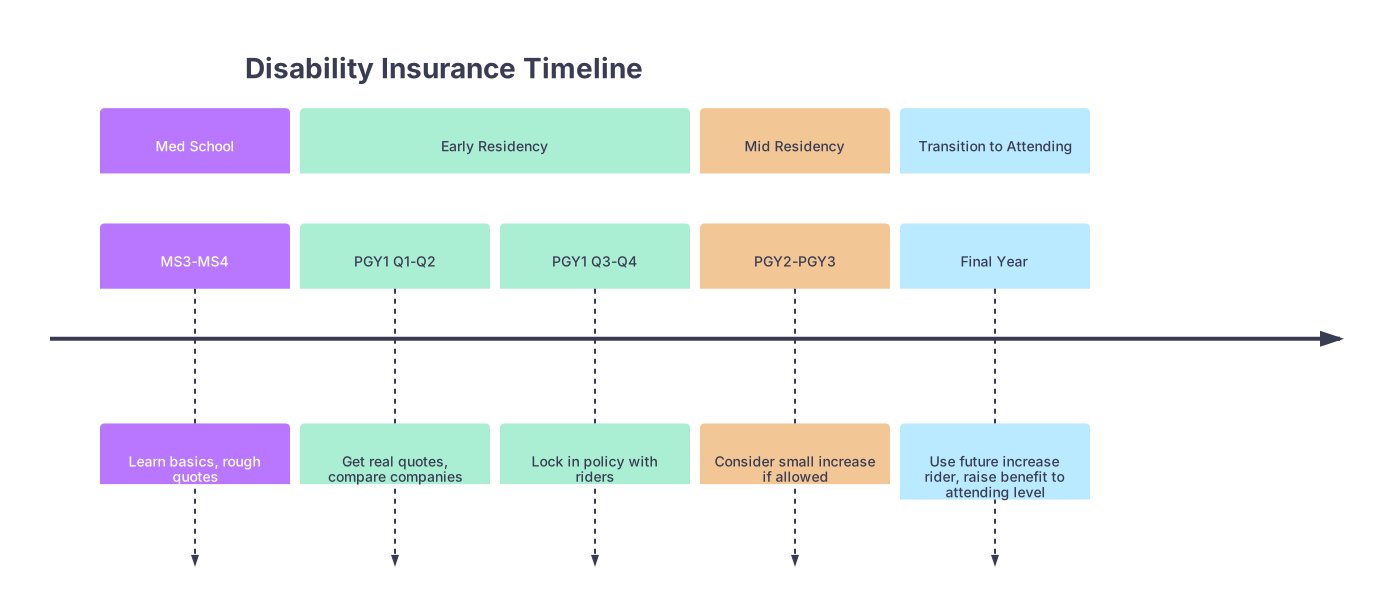
| Period | Event |
|---|---|
| Med School - MS3-MS4 | Learn basics, rough quotes |
| Early Residency - PGY1 Q1-Q2 | Get real quotes, compare companies |
| Early Residency - PGY1 Q3-Q4 | Lock in policy with riders |
| Mid Residency - PGY2-PGY3 | Consider small increase if allowed |
| Transition to Attending - Final Year | Use future increase rider, raise benefit to attending level |
Key points:
- You do not need a perfect policy MS4, but if you have a chronic condition emerging, earlier can be better.
- For most, early PGY-1 or PGY-2 is ideal: you know your specialty trajectory, and your health status is usually still clean.
- The earlier you buy, the cheaper your age-based premium, which you might lock in for decades.
Waiting until you are three months from finishing fellowship is how you end up:
- Older (higher premium)
- With a few more health “dings”
- And sometimes facing coverage exclusions or declines
Quick Visual: Rider Priorities for Most Residents
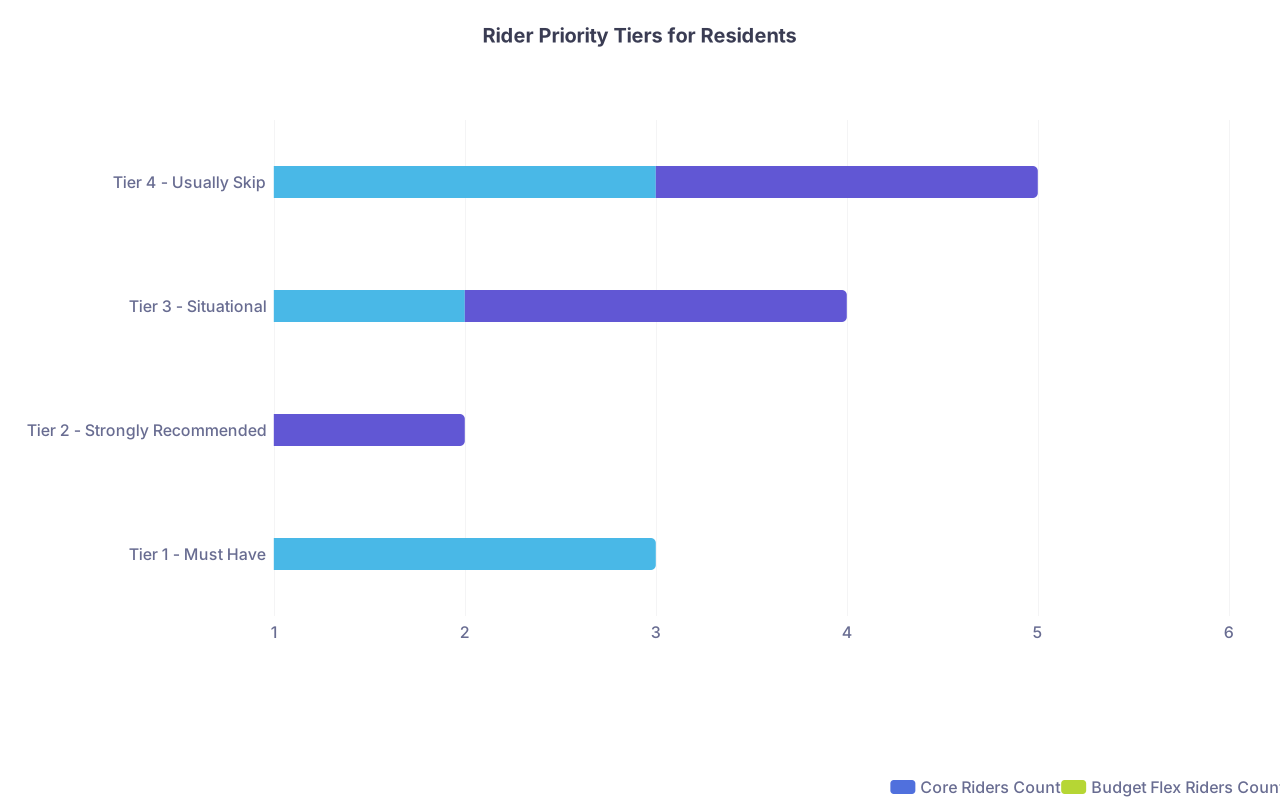
| Category | Core Riders Count | Budget Flex Riders Count |
|---|---|---|
| Tier 1 - Must Have | 3 | 0 |
| Tier 2 - Strongly Recommended | 1 | 1 |
| Tier 3 - Situational | 2 | 2 |
| Tier 4 - Usually Skip | 3 | 2 |
Tier 1 – Must-Have:
- Future increase / benefit update
- True own-occupation, specialty-specific (whether base or rider)
- COLA
Tier 2 – Strongly Recommended:
- Residual/partial disability
Tier 3 – Situational:
- Catastrophic
- Student loan rider (selectively)
Tier 4 – Usually Skip:
- Shortened elimination period
- Retirement contribution riders
- Return of premium and other gimmicky add-ons

How To Audit Your Existing Resident Policy in 10 Minutes
If you already bought something (maybe in a rush, or at a lunch talk), grab your policy and look for:
Definition of Disability
- Look for “own occupation” and preferably “specialty.”
- If you see “any occupation” without an own-occ rider, that is a problem.
Benefit Amount and Period
- Benefit: Typically $4k–6k for residents.
- Benefit period: Want to see “to age 65” or “to age 67,” not “5-year benefit” unless you consciously chose a short benefit to save money.
Riders Section
Scan for names like:- “Future Increase Option / Benefit Update / Future Purchase”
- “Cost of Living Adjustment”
- “Residual Disability”
- “Catastrophic Disability”
- “Student Loan”
- “Return of Premium”
- “Automatic Increase Benefit”
- “Shortened Elimination Period”
Mark them into 3 buckets:
- Critical keepers: FIO, own-occ, COLA, residual
- Nice but nonessential: catastrophic, sometimes student loan
- Probably on the chopping block: shortened elimination, return of premium, retirement contributions
If you are stuck, that is the time to get an independent advisor who actually knows physician contracts and is not married to one company.

FAQs
1. If I can only afford some riders as a PGY-1, which should I prioritize first?
Start with:
- Strong own-occupation definition (preferably specialty-specific),
- Future increase/benefit update rider, and
- COLA.
If residual is not automatically bundled, I would try very hard to include it. Catastrophic, student loan, and shorter elimination can all wait or be skipped if budget is tight.
2. Does it ever make sense to drop COLA later in my career?
Sometimes. If you are in your late 50s, close to financial independence, and premiums feel high, you can reasonably consider dropping COLA at a policy review. But as a resident, planning to strip COLA “later” is fine; skipping it now and planning to “add it later” does not always work, because some carriers require underwriting to attach new riders.
3. How big should my future increase option be as a resident?
As a simple rule of thumb:
- Non‑procedural specialties: at least $15k/month target total benefit capacity.
- Procedural or high-paying subspecialties (ortho, neurosurg, IR, cards): $20k/month or more if the carrier allows it.
You will not buy that much immediately. You just want the contractual right to get there without new medical underwriting.
4. I am going into hospitalist work, not surgery. Do I still need specialty own-occupation?
Yes. True own-occupation is not just for surgeons. Plenty of IM, EM, and hospitalist physicians end up with conditions that let them work in low-stress, nonclinical, or admin roles but not in their preferred practice model. Own-occupation gives you the freedom to pivot without losing your disability benefit.
5. My program gives me “long-term disability” as a benefit. Is that enough?
Usually not. Employer policies are often:
- Taxable (because employer-paid)
- Capped at a low maximum (e.g., 60% of your resident salary, sometimes with a dollar cap)
- Any-occupation or watered-down definitions
- Not portable when you leave
They are a base layer at best. Your private, individual policy—with solid riders—is what follows you to fellowship and attending life.
6. Can I change riders later without new medical underwriting?
Sometimes, but not always. Increasing base coverage under an existing future purchase rider usually does not require new health questions. But adding new riders (like COLA if you skipped it) or changing certain core features often triggers underwriting again. That is exactly why you want the critical riders in place while you are young and healthy, even if the benefit amount itself is modest.
Key takeaways:
- As a resident, your disability policy’s value lives in a few core riders: future increase, strong own-occupation, COLA, and residual. Get those right first.
- Most of the shiny, emotionally appealing riders—shorter elimination, return of premium, overbuilt student loan or retirement riders—are lower yield and often not worth your limited training-budget dollars.