
The way your call is structured will matter more to your actual life than a 5–10% swing in base salary. People obsess over RVUs and completely ignore call design. That is backwards.
Let me break this down specifically: “1:4 call” is almost meaningless unless you know three things—where you sleep, what you must do when the phone rings, and how (or if) you are paid for it. That’s the core of in‑house, home call, and backup models.
We are going to dissect those structures like a procedure: indications, technique, complications, and billing. Because this is where a lot of otherwise smart physicians get quietly exploited.
1. The Three Call Archetypes: What They Actually Mean
Most groups label their call vaguely, rely on tradition, and hope you do not ask hard questions. So start with a precise vocabulary.
In‑House Call
This is the simplest conceptually and often the hardest physically.
You are physically in the hospital (or affiliated facility) for a defined window, usually:
- Overnight (e.g., 5 p.m.–7 a.m.)
- 24‑hour weekend blocks
- “Short call” evening shifts leading into night float
During this period you:
- Are on-site continuously
- Have guaranteed clinical tasks (admissions, cross‑cover, emergent consults, rapid responses, codes, procedures)
- Typically have a minimum workload; it is rarely “if they need you.” They will need you.
Real example: A busy community hospitalist model where nights are true shifts. You are in the building 7 p.m.–7 a.m., you get a flat rate per shift plus differential, and you are admitting 10–16 patients plus cross-cover.
Key point: In‑house call behaves more like shift work than intermittent “call.” If you are in house, you are trading contiguous blocks of your life for money and/or schedule flexibility.
Home Call
Home call is where people get misled.
You are not required to be physically in the hospital. But you are:
- Expected to be continuously reachable
- Obligated to respond within a defined time
- Often required to come in for certain triggers (OR cases, critical consults, procedures)
Two sub‑flavors:
- “Soft” home call: Mostly phone advice, occasional telemedicine, rare returns to the hospital. Common in certain outpatient specialties or quiet subspecialties.
- “Hard” home call: You will be dragged in frequently—often several times a night on bad rotations. Trauma, OB, many surgical subspecialties, and some cardiology services do this.
If your response time is short (e.g., must be at bedside in 20–30 minutes) you are functionally tethered geographically. That is a lifestyle cost whether or not the hospital labels it “non‑burdensome.”
Backup Call (Second/Third Call)
Backup call is the underappreciated piece of the puzzle.
You are not the first person to be paged. But you are:
- Next in line if primary call is overwhelmed, in the OR, or has duty hour limits
- Often activated for complex cases, surges, or cross‑coverage across sites
- Sometimes expected to cover if someone calls out sick
There are three main structures:
- Formal scheduled backup: Named on the schedule as second call, with clear rules for activation and pay.
- Informal “can you help us out?”: Technically voluntary but heavily pressured. This is where resentment grows.
- Disaster or surge backup: Predesignated lists for pandemics, mass casualty, or seasonal spikes.
Backup call can be low‑burden or utterly toxic, depending on whether it is respected as real work or treated as invisible “professionalism.”
2. The Core Variable: What Is Being Purchased?
Forget the labels for a moment. Every call model is buying some combination of three commodities from you:
- Your time (exclusive control over some chunk of your life)
- Your availability (the right to interrupt or summon you)
- Your risk absorption (medical‑legal exposure, patient outcomes, reputational risk)
The more of each they buy, the more you ought to be paid. Simple.
Time: Contiguous vs Fragmented
In‑house call:
- Takes large contiguous blocks (12–24 hours).
- Predictable for scheduling, brutal for recovery.
- Better compensated per unit time in many moonlighting setups because it is obvious you are working.
Home call:
- Fragments your day and night.
- Unpredictable; you may get no calls or be hammered from midnight to 4 a.m.
- Much easier for administrators to undervalue because “you are at home.”
Backup call:
- Lowers your ability to commit to other work (moonlighting, locums, side gigs).
- Often undercompensated because utilization looks low on paper, even though the “option” they’re buying from you has real value.
Availability: Geographic and Cognitive Lock‑In
Geographic lock‑in:
- 20–30 minute response time means no movie, no drinks, no trip 45 minutes away, no long run.
- Even if you are never actually called, your day is constrained.
Cognitive lock‑in:
- You cannot fully disengage. That constant low‑level vigilance (phone on loud, half‑asleep, thinking about sick patients) is its own form of work.
- It erodes sleep quality even on “quiet” nights.
This is why home call “that rarely requires you to come in” is still not free. Your life that night is not your own.
Risk: Who Holds the Bag?
On‑call risk is not theoretical. If something catastrophic happens at 2 a.m. while you are covering three hospitals by phone, it will not matter that the call stipend was “just a token.”
Situations that magnify risk:
- Thin staffing models (you + 1 intern covering 80–100 inpatients)
- Multi‑hospital coverage with no APPs or residents
- Weak triage systems (every patient becomes “urgent”)
- Long commutes combined with short mandated response times
Any call pay model that ignores risk is incomplete. If your signature and license are holding the system together overnight, that should show up in your compensation.
3. Pay Models: How Call Actually Gets Monetized
Now to the money. Call is typically paid in one of four ways:
- Embedded in base salary (no explicit differential)
- Fixed stipends per call period
- Hourly shift‑based models
- Production‑tied (RVUs / collections) overlays
Most real‑world setups are hybrids.
Embedded Call (“It’s Just Part of the Job”)
Academic centers and some employed models love this. “Everyone takes call; it balances out.”
Red flags:
- No difference in pay between someone taking 1:6 call and someone taking 1:3.
- No explicit credit for weekends vs weekdays.
- “Shared” call burdens that in reality are not equal across age/seniority.
This structure is tolerable only if both are true:
- Call is light and genuinely non‑burdensome.
- The base salary is high enough to justify the invisible burden.
If you are doing high‑intensity in‑house or pseudo‑in‑house home call under a fully embedded model, you are subsidizing the system.
Fixed Stipends
Classic hospital‑employed or group‑contract setup. Examples:
- $500 per 24‑hour in‑house call
- $250 per weekday home call, $400 per weekend day
- $150 for backup call, activated or not
The key questions:
- Is the stipend indexed to intensity?
- Does it differentiate weekday vs weekend vs holiday?
- Is activation for backup call compensated differently than standby?
| Call Type | Weekday Range | Weekend Range | Typical Structure |
|---|---|---|---|
| In-house 24 hr | $800–$2,000 | $1,200–$2,500 | Flat per shift |
| Home call | $150–$600 | $300–$1,000 | Flat + per-case fees |
| Backup call | $50–$250 | $100–$400 | Standby, low activation |
Low‑end numbers are where you see abuse—especially when the call is essentially a second full workday.
Hourly Shift Models
More common in ED, hospitalist, anesthesia, critical care. Call is replaced by:
- Night shifts with a clear start and end
- Differential pay for nights and weekends
- No expectation of additional “free” availability
Moonlighting usually falls here:
- $130–$200+/hr for in‑house night coverage
- Defined cap on admissions or clearly stated expectations
- No pretense that “this is just call”; it is work.
This is the cleanest structure from a fairness standpoint. Time traded for money, directly.
Production‑Tied Models
Here is where things get subtle.
Several variants:
No call stipend, all RVU/collections
You get paid only for what you do. Night admits, procedures, consults all generate RVUs. The argument: “If nights are busier, you earn more.”Problem: You still carry the baseline availability burden for variability and risk without guaranteed compensation if the night is slow.
Small call stipend + RVU “bonus”
Example: $200 per night of home call, plus standard RVU credit for anything you do. Works decently if night work codes are valued fairly.Complex pool models
Call work generates extra RVUs that go into a group pool, then are distributed based on some opaque formula. Expect fights and distrust unless the rules are transparent.
If you are in a heavy‑call specialty (cards, GI, trauma, OB, neurosurgery), pure productivity models can actually be lucrative—if the payer mix is good and you have enough autonomy to shape your call schedule. In employed settings with poor payer mix, it can become pure exploitation.
4. In‑House vs Home vs Backup: Lifestyle and Financial Tradeoffs
Let’s lay out the real tradeoffs the way people feel them on the ground.
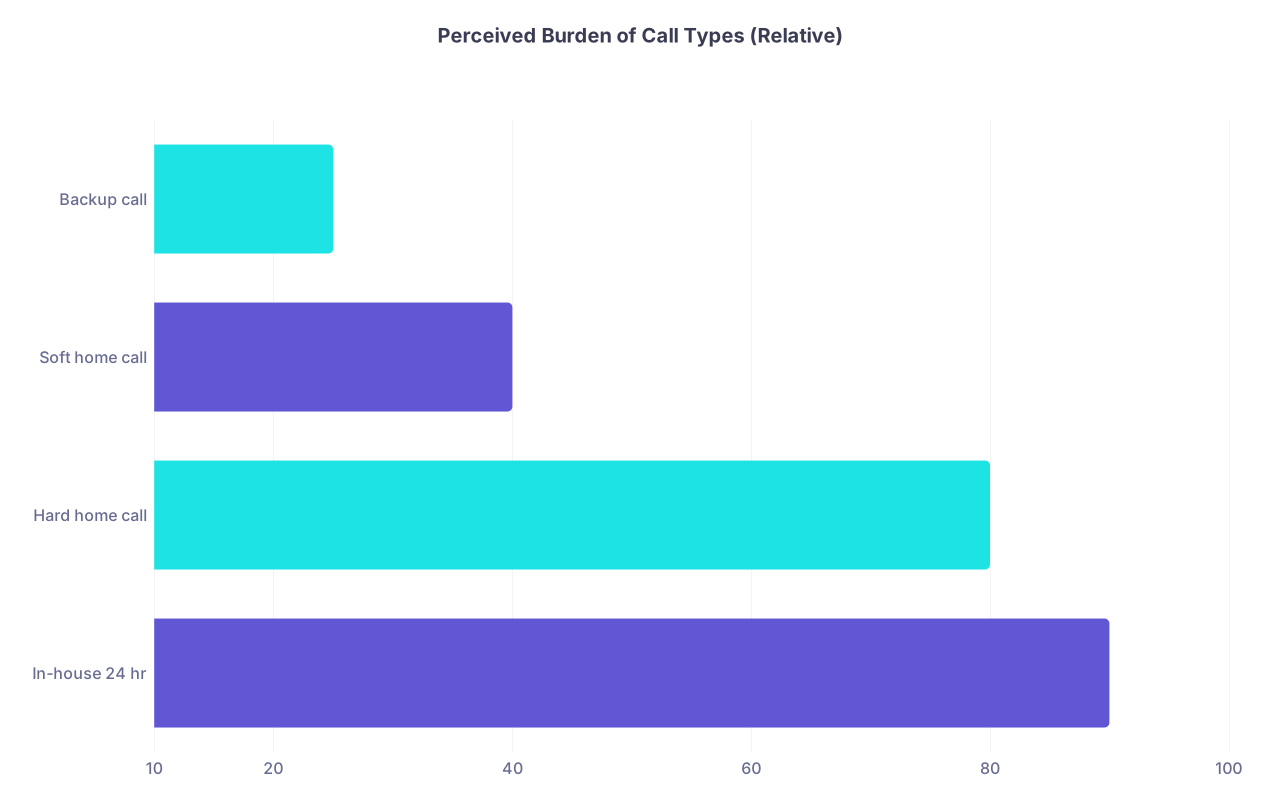
| Category | Value |
|---|---|
| In-house 24 hr | 90 |
| Hard home call | 80 |
| Soft home call | 40 |
| Backup call | 25 |
In‑House Call: High Pain, High Clarity
Upsides:
- Predictable. You know when you are in and when you are off.
- Easier to value in contracts and moonlighting.
- Often better for pure earnings per month if you stack extra shifts.
Downsides:
- Recovery cost is real, especially after 24s or serial nights.
- Family and social life take obvious hits.
- Older physicians burn out faster on in‑house models; many will angle for home call as they age.
As a moonlighter, in‑house is often where the best hourly rates live. You are the warm body that makes some unstable staffing model “work.”
Home Call: Sneaky Fatigue, Often Undervalued
Upsides:
- You sleep in your own bed.
- Some nights truly are quiet.
- With good hospital systems, much can be handled by phone or telemedicine.
Downsides:
- Sleep fragmentation; you never get a deep, unbroken night on busy weeks.
- You are pseudo‑imprisoned by the response radius.
- Your family lives on eggshells—dinners cut short, events missed, trips cancelled.
I have seen “home call” OB models where the physician is in the hospital until midnight three nights a week, then back at 6 a.m., plus full office the next day. Labeled as “home call” for contract purposes, but in practice in‑house without the pay.
If you are evaluating home call, ask current physicians bluntly: “How many nights a week do you get a full, uninterrupted 6–7 hours of sleep while on call?”
Backup Call: The Tax on Your Freedom
Upsides:
- Many nights you are never activated.
- Feels “lighter” psychologically on quiet rotations.
- Can be used to smooth fairness across groups (e.g., younger partners do more first call, seniors do more backup).
Downsides:
- Blocks you from taking external moonlighting unless permitted.
- Often not paid at all, or paid minimally.
- When invoked, it is almost always for high‑stakes, difficult situations.
Backup call is where groups either show their integrity or their true colors. If partners treat it as “just what you do for the team” while they quietly avoid equal burden, beware.
5. Moonlighting: How Call Structures Create or Kill Opportunity
This is a “Moonlighting and Benefits” category topic, so let us talk about the intersection.
Your primary job’s call structure will determine how much legitimate moonlighting you can safely do, and at what price.
In‑House Primary, In‑House Moonlighting
The classic resident reality: you are already on some flavor of night float or 24‑hour calls, and then you add moonlighting.
Strategies that I’ve seen work reasonably:
- Protect at least one call‑free, moonlighting‑free night per week.
- Avoid stacking more than 2–3 night stretches without a recovery day.
- Weight pay heavily: a $90/hr moonlighting gig where the ED is packed is not worth torching your baseline performance.
If your primary gig has heavy in‑house call, any extra in‑house moonlighting is a straight trade of health for money. That may still be rational in short bursts (paying off high‑interest debt, building an emergency fund), but be honest about what you are spending.
Home Call Primary, In‑House Moonlighting
This is where scheduling gets complicated.
Issues:
- Backup/primary home call may conflict with moonlighting. If your primary contract says you must be available within 30 minutes, you cannot legitimately be 45 minutes away moonlighting in another facility.
- Some employers explicitly forbid outside work while on any form of call, including backup.
- Malpractice coverage and credentialing may clash if something goes wrong while you are “technically on call” elsewhere.
Smart structure:
- Cluster your primary home call on defined weeks and keep those weeks moonlighting‑free.
- Use your non‑call weeks for in‑house moonlighting with clear boundaries.
- Get any dual‑commitment scenarios cleared in writing with risk management and your employer.
Call‑Light Primary, Call‑Heavy Moonlighting
This is the dream scenario for some people: cushy day job with minimal call, high‑pay in‑house night moonlighting on the side.
Watch for:
- Accumulated fatigue. The body does not care that your primary call is light if you are doing 8–10 night shifts a month elsewhere.
- Professional conflict. If your primary employer feels you are more energized for external work than your own clinic or OR, friction will follow.
But purely from a financial standpoint, this is how many hospitalists, ED docs, and anesthesiologists quietly add $50–150k per year to income for a few years.
6. Negotiating and Diagnosing Call Deals
Most physicians never systematically “audit” their call deal. They just accept what the last person did. That is lazy.
Here is a simple diagnostic pass you can run on any offer.
Step 1: Quantify the Load
Ask for hard numbers for the past 12 months:
- Average number of:
- Weekday calls per physician per month
- Weekend calls per physician per month
- Holidays per physician per year
- For home/backup:
- Average activations per call night
- Average in‑person trips to the hospital
- Typical range (quietest vs worst weeks)
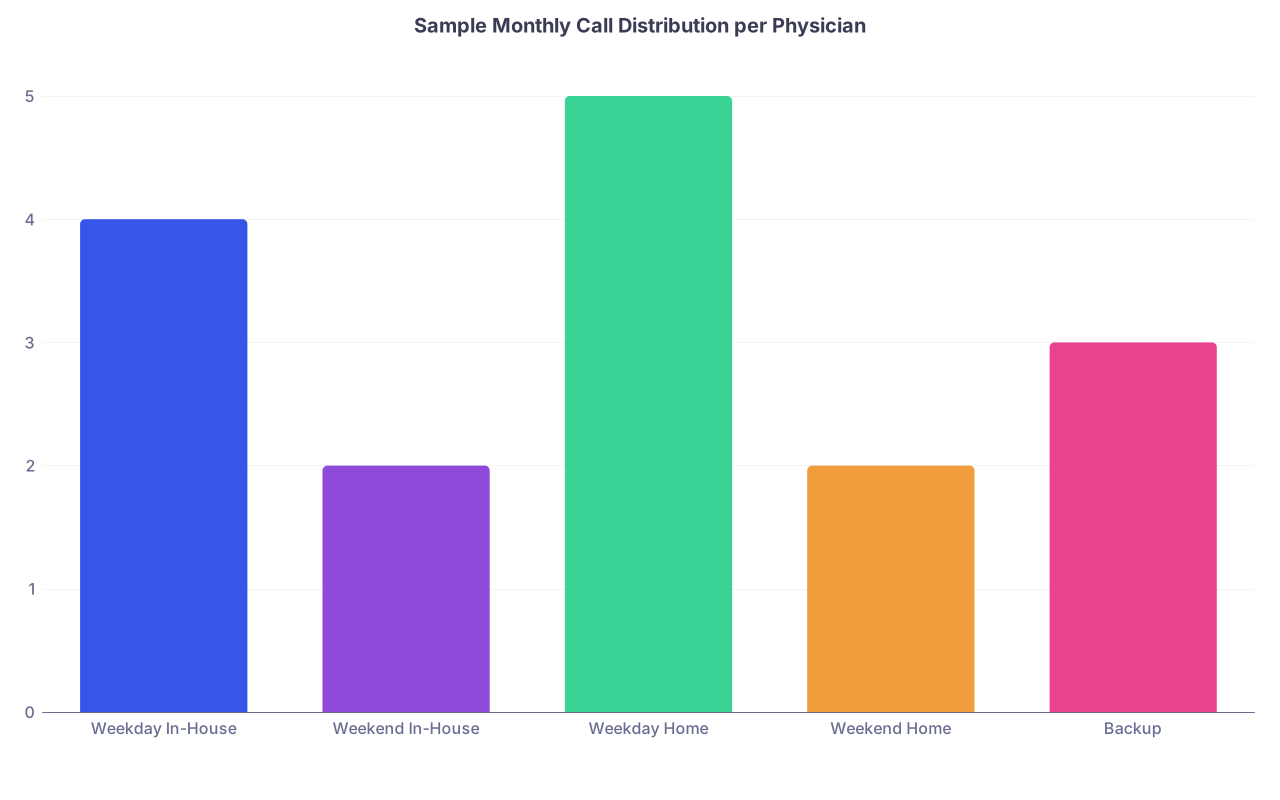
| Category | Value |
|---|---|
| Weekday In-House | 4 |
| Weekend In-House | 2 |
| Weekday Home | 5 |
| Weekend Home | 2 |
| Backup | 3 |
If they cannot produce data and only hand‑wave (“varies a lot”), assume it is worse than they are admitting.
Step 2: Estimate Effective Hourly Rate
For each call type, estimate:
- Total hours of restricted availability
(e.g., 24 hours of in‑house, or 14 hours of home call from 5 p.m.–7 a.m.) - Realistic active work hours during that period
- Associated pay (stipend + extra RVUs/collections you keep)
Then compute:
- Pay per hour of total restricted time
- Pay per active hour (if you want to sanity check)
You will quickly see outliers. The classic: weekday home call that works out to $10–20/hr of restricted time once you factor in all trips and calls.
Step 3: Compare Across Models
This is where you actually see what you are trading.
Example:
- Job A: $300,000 base, 1:4 in‑house nights (no stipend)
- Job B: $260,000 base, 1:6 in‑house nights + $1,000 per night stipend + optional extra paid nights
Over a year, the extra $40k base in Job A might be more than eaten by the invisible “free” call, while Job B’s explicit night stipend plus optional extra shifts could net you higher take‑home with less average sleep deprivation.
Step 4: Identify Negotiation Levers
Levers exist at several levels:
- Frequency: Reduce number of calls per FTE (hire nocturnists, APPs, residents).
- Structure: Shift from embedded to explicit stipends.
- Differential: Add premiums for weekends, holidays, and truly burdensome calls.
- Load‑balancing: Senior partners not permanently shielded from hard call while juniors drown.
If you are interviewing, your leverage is highest before you sign. Do not waste that window mumbling “I’m sure this is standard.”
7. Where This Is Going: Future of Call and Pay Models
Call is not static. Technology, regulation, and market pressures are changing it, sometimes faster than leadership can keep up.
Telemedicine and Remote Coverage
Tele‑ICU, tele‑stroke, tele‑psychiatry, tele‑hospitalist—remote models are moving responsibility away from the bedside and onto screens.
Implications:
- True geographic flexibility for home call; you might cover hospitals in other states.
- Stronger differentiation between cognitive and procedural roles. The remote doc handles triage and decisions; someone local executes procedures.
- New hybrid pay structures: per‑encounter rates for teleconsults plus modest standby stipends.
If you are in a cognitive specialty, this can be a way to extend your career and reduce physical burden while maintaining income.
Regulation and Duty Hour Spillover
ACGME duty hour rules, EU work‑time directives, increasing attention to burnout—these all push institutions away from unsustainable in‑house 36‑hour marathons.
We are seeing:
- More nocturnist models to absorb night work justly.
- Shift‑based ED and hospitalist structures dominating over traditional “call.”
- Pressure to quantify and mitigate burnout, which begins with counting calls honestly.
This will not eliminate call, but it will make laughably undercompensated heavy call politically more difficult to sustain.
AI and Decision Support
Let us be blunt: AI decision support is not going to erase your call. But it will modify it.
Realistic trajectories:
- Better triage filters: Fewer “nurse insecure” calls escalated to you at 3 a.m. because the system can sort benign vs dangerous scenarios more accurately.
- Protocolization of common issues: Order sets and guardrails that reduce the cognitive load of routine night orders.
- Faster remote review of imaging and labs: You may finish the same volume of charts and decisions in less time per call.
If your compensation remains purely time‑based (stipends) while your effective workload falls because of better tools, you may see pressure from administrators to cut rates. That is the next negotiation frontier: tying compensation not just to time, but to responsibility and risk that persist even when some tasks are automated.
With all of this on the table, you are now in a different position than most physicians reading standard contracts. You can look at an offer and immediately ask:
- What exactly is this call buying from me—time, availability, risk—and at what price?
- Am I being paid more for “home call” that feels like in‑house, or is the label hiding an imbalance?
- Could restructuring call—adding nocturnists, carving out tele‑roles, formalizing backup pay—improve both my life and the group’s stability?
Once you learn to analyze on‑call structures with that level of precision, the next logical step is using that insight to re‑engineer your own schedule and income streams—aligning moonlighting, primary duties, and long‑term goals instead of letting tradition dictate your nights.
That is where the real leverage lives, and where your future practice will either grind you down or quietly compound in your favor. How to redesign that entire ecosystem—call, moonlighting, and long‑term career capital—is the next layer of strategy. But that is a story for another day.