
It is 10:45 p.m. You just finished a brutal MICU shift, and you are scrolling through a moonlighting contract that pays real money for once. You hit the “Professional Liability” section and see it: “Employer will provide claims‑made malpractice coverage. Tail coverage responsibility: physician.”
You pause. You know that might be expensive. You also know you are too tired to pretend you really understand claims‑made vs occurrence. But this clause can turn your “easy $15k” moonlighting year into a $12k year once the dust settles.
Let me break this down specifically, the way I would for a PGY‑2 sitting in the workroom at 1 a.m.
First: What Are We Actually Comparing?
Malpractice insurance is not one thing. For moonlighting, there are three moving parts you must keep straight:
The coverage form:
Claims‑made vs occurrenceThe policy owner:
Your residency program / hospital, the moonlighting site, or you personallyThe time window that is actually protected:
When you did the work vs when the claim gets filed
The whole fight between claims‑made and occurrence is basically a fight about time alignment.
- Occurrence = covers you if the incident occurred during the policy period, no matter when the claim comes in.
- Claims‑made = covers you only if the claim is made (and reported) while the policy is active (and after the retroactive date starts).
If you do not anchor that in dates on a calendar, this topic never stops feeling fuzzy.
Core Definitions in Real‑World Terms
Occurrence Coverage – The “One and Done” Policy
Occurrence coverage protects you for any event that happens while the policy is in force, even if the lawsuit is filed years later.
Say you moonlight from July 2026 to June 2027 under an occurrence policy.
- You admit a patient in February 2027.
- Something allegedly negligent happens during that admission.
- They file a lawsuit in 2031.
If the policy was occurrence form and active in February 2027, you are covered. You do not need to buy anything else later. The insurer is on the hook because the occurrence was in the covered period.
For moonlighting physicians, this is the “no tail required” path. Once the moonlighting job ends, the coverage for work you already did is locked in.
Claims‑Made Coverage – The “Keep the Policy Alive” Model
Claims‑made coverage only protects you if:
- The incident occurred after the policy’s retroactive date, and
- The claim is first made and reported while the policy is active (or during a valid extended reporting period, i.e., tail).
Example:
- You moonlight from July 2026 to June 2027 under a claims‑made policy with a retroactive date of July 1, 2026.
- You see a patient in January 2027.
- Claim is filed in 2029.
If your claims‑made policy ended in June 2027 and you did not buy tail or transfer coverage to a new policy that honors the same retro date, you are exposed. No active coverage when the claim is made = no defense, no indemnity.
That is where tail coverage comes in.
Tail Coverage, Nose Coverage, and Why Moonlighters Get Burned
You cannot talk claims‑made intelligently without understanding these two:
Tail coverage (Extended Reporting Endorsement)
Lets you report claims after the policy ends, for incidents that occurred while it was active.Nose coverage (Prior Acts Coverage)
A new policy that picks up your prior exposure by adopting your original retroactive date.
Most moonlighting residents first encounter tail when a contract quietly says:
“Employer provides claims‑made coverage. Physician responsible for tail.”
Translation: When you leave this job, any claims that come in later for care you provided here will only be covered if you buy an extra policy (tail), usually for a one‑time, non‑refundable fee. That fee can be 150–250% of the mature annual premium.
For a low‑volume urgent care moonlighting gig, that might still be thousands of dollars you did not budget for.
Why So Many Moonlighting Jobs Use Claims‑Made
Let me be blunt. Employers default to claims‑made because:
- It is cheaper for them in the short and medium term.
- It is easier for them to swap carriers or close shop without long‑tail obligations.
- They can offload the tail liability to you in the contract if you are not paying attention.
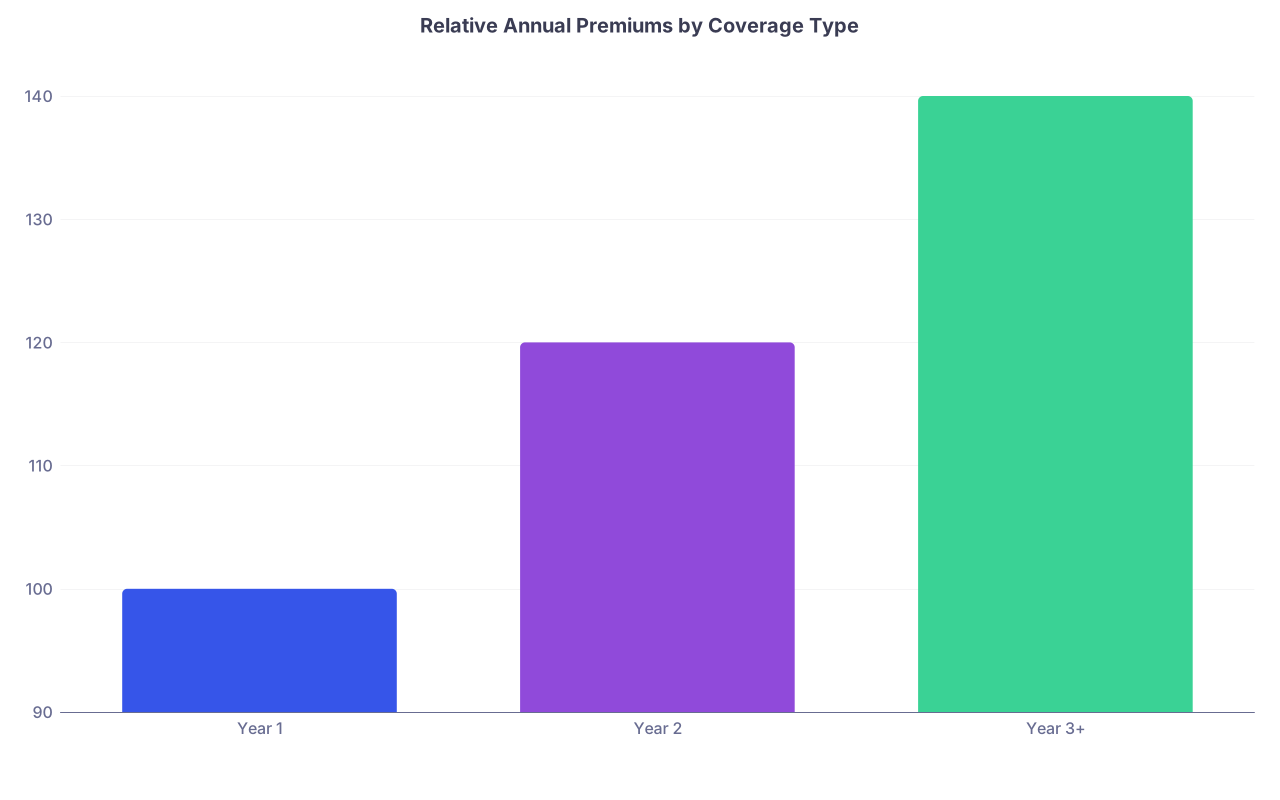
Occurrence policies are more expensive per year because the insurer is committing to defend and indemnify claims for years into the future.
| Category | Value |
|---|---|
| Year 1 | 100 |
| Year 2 | 120 |
| Year 3+ | 140 |
Think of it this way (rough ballpark, varies widely by specialty and state):
- Occurrence: You might pay “140” units every year, and that is it. No tail.
- Claims‑made: Year 1 might be “40–60” units, Year 2 “80–100”, and after a few years the premium “matures” to “100”. Then, when you leave, tail costs another “150–250” units once.
For full‑time attending work, that can be managed with negotiation. For short‑term moonlighting (6–18 months), claims‑made with no employer‑paid tail is often a bad deal for you.
Common Moonlighting Scenarios: How the Coverage Actually Plays Out
Let’s walk through real patterns I see over and over.

Scenario 1: In‑House Hospital Moonlighting, Covered Under the Same Policy
You are IM PGY‑3 at a large academic center. They let you moonlight as a hospitalist on extra shifts, but you are still an employee of the same institution, credentialed the same way.
Often, the hospital’s large self‑insured or blended policy covers all clinical work you do within their walls. You are not buying a separate moonlighting policy. You are just generating more RVUs for them.
In this case:
- Coverage form: Whatever your institution uses (often self‑insured + claims‑made excess).
- Tail: Usually not your problem as a resident; it is the institution’s long‑tail liability.
- Key check: You want written confirmation that extra moonlighting shifts are covered under the existing program and are not being treated as “independent contractor” work.
Worst case, I have seen programs say “Yes, you are covered,” while credentialing paperwork for the moonlighting role lists you as “independent contractor” under a separate entity with its own claims‑made policy and you pay tail when you leave. That is sloppy risk management. Do not tolerate that.
Scenario 2: Independent Contractor ER/Urgent Care Moonlighting
This is where residents and fellows get surprised.
Example:
- You moonlight at a free‑standing ED as a 1099 independent contractor.
- The group provides malpractice insurance. It is claims‑made.
- Contract says: Tail is the physician’s responsibility.
You work there 12 months and earn $40,000. Premium for your slot is, say, $8,000 per mature year. Your 12‑month exposure is pro‑rated, but the carrier treats the risk similarly.
Tail quote: 1.5–2.0 times mature premium → $12,000–$16,000. One time payment, due when you leave or when group switches carriers.
Now your net moonlighting gain might be $24–$28k pre‑tax, not $40k. If you did not know to ask about tail, you will be furious later.
Claims‑Made vs Occurrence: Side‑by‑Side for Moonlighters
| Feature | Claims-Made | Occurrence |
|---|---|---|
| What triggers coverage? | Claim is made and reported while policy active (after retro date) | Incident occurred during policy period |
| Need tail coverage when you leave? | Yes, unless new policy carries prior acts | No |
| Typical annual premium cost | Lower early, rises to mature level | Higher from day one |
| Common in moonlighting gigs? | Very common, especially 1099 | Less common but ideal if you can get it |
| Risk if you do not understand contract | High – unexpected tail bill, uncovered gap | Lower – simpler time alignment |
If you plan to moonlight in multiple short stints, occurrence‑form coverage (or claims‑made with the employer paying tail) is usually far better. It decouples your career trajectory from a string of landmines every time you switch jobs or carriers.
The Time Problem: Why Residents Are Specifically Vulnerable
Claims can take years to surface. In many states, the statute of limitations for adults is 2–3 years from discovery of the injury. For minors, much longer.
Imagine this very standard path:
- PGY‑3: You moonlight at a community ED under a claims‑made policy. No tail provided.
- Fellowship: You move out of state. New institution gives you coverage starting this year only. They do not pick up prior acts.
- Attending year: Now at a different system with another claims‑made policy, retroactive only to your hire date.
- Year +4: A patient from that ED moonlighting job sues.
If you did not buy tail from the ED group, nobody covers you. The ED group might have closed, switched carriers, or changed their retro dates. Their current policy does not necessarily protect you personally for your past work.
This is why every single moonlighting contract you see must be read with three questions:
- What is the coverage form? (Claims‑made vs occurrence)
- Who pays for tail if the coverage is claims‑made and my relationship ends?
- Does any future policy I am likely to have pick up prior acts? (Very often, no.)
If the contract is claims‑made and you are responsible for tail, you must mentally subtract a realistic tail estimate from your projected moonlighting income. If the math still works, fine. At least you went in with eyes open.
How to Read the Malpractice Section of a Moonlighting Contract Like an Adult
Stop skimming this paragraph. This is where they hide the landmines.
You want clear answers to:
What are the policy limits?
Typical numbers: $1M / $3M or $2M / $4M (per claim / aggregate). If they are much lower than what is customary in your state and specialty, that is a red flag.Is coverage occurrence or claims‑made?
The contract should use these specific words. If not, ask in writing.Who owns the policy?
- Employer group policy naming you as an insured
- Policy in your own name (you purchase)
- Hospital blanket coverage for employees
Who is responsible for tail?
This might be in a separate “termination” or “professional liability” clause, not obviously labeled.
Wording to watch for:
“Group will maintain claims‑made policy during the term of this Agreement. Upon termination, Physician shall be responsible for purchasing any necessary tail coverage.”
→ You pay.“Group shall purchase, at its sole expense, extended reporting endorsement (tail) covering Physician for services provided under this Agreement.”
→ Group pays. Better.Silence about tail under a claims‑made policy
→ Assume they will argue it is your problem.
Practical Strategies for Residents and Fellows
1. Prefer Occurrence When Moonlighting Is Short‑Term
If you are doing 6–24 months of moonlighting and then moving on:
- Occurrence coverage is cleaner. No tail mess as you bounce between states and employers.
- Many urgent cares and telemedicine outfits actually offer occurrence because it simplifies their own vendor churn.
You can explicitly ask:
“Is the malpractice coverage occurrence or claims‑made? If claims‑made, do you cover tail upon termination?”
You will be shocked how often a recruiter pauses and says, “Let me check,” because many groups do not expect residents to know what to ask.
2. If Claims‑Made Is Non‑Negotiable, Make Tail Explicit
If they insist on claims‑made, you should insist on one of three outcomes:
- They pay 100% of tail.
- They pay a prorated portion based on tenure.
- They increase the hourly rate enough that you can self‑fund tail and still come out ahead.
A reasonable modification clause:
“Upon termination, Group shall purchase, at its sole expense, an extended reporting endorsement providing coverage to Physician for claims arising from services rendered during the term of this Agreement.”
If they refuse to commit in writing, you should assume you will eat the tail bill.
3. Do Not Assume Your Residency Program’s Policy Covers External Moonlighting
Most do not.
Your GME malpractice typically covers you only when:
- You are working within the scope of your training program, at approved sites, on assigned duties.
Once you sign an independent contract with an outside entity, that is a separate professional role. Your program’s coverage will not bail you out for that work.
Get this clarified in writing by GME or Risk Management if you are at all unsure.
4. Pay Attention to “Retroactive Date”
On a claims‑made certificate, the retroactive date is the start point for covered incidents.
If you eventually get your own individual claims‑made policy (for example, as a new attending), and your new carrier is willing to adopt an earlier retroactive date that encompasses your moonlighting years, that can function as nose coverage and spare you from buying tail.
Caveats:
- Not all carriers will do this.
- Some will, but only if prior coverage was from an “admitted” carrier and the risk profile aligns.
- You must explicitly negotiate this; it does not happen automatically.
For most residents, especially those changing states or employers, I would not count on nose coverage later to magically solve moonlighting tail gaps.
Special Cases: Telemedicine, Locums, and Multi‑State Work
Telemedicine and locums moonlighting are a bit more complex because of multi‑jurisdiction risk.
Common patterns I see:
- Telemedicine companies heavily use claims‑made coverage.
- Some bundle a group policy and tell you “You are covered under us; do not worry.”
- Some expect you to bring your own policy.
You must verify:
- Coverage type (claims‑made vs occurrence)
- Jurisdictions covered (all states where you are licensed and seeing patients)
- Who pays for tail on termination
For multi‑state telemedicine, the tail bill later can be ugly, because the insurer is pricing in cross‑state defense costs. Again, check the math: is that $12k–15k you make over a year of sporadic tele‑shifts still worth it if you owe $7k in tail later?
Locums companies vary. Some:
- Provide occurrence coverage for every assignment. Very clean.
- Provide claims‑made but commit in writing to pay all tail. Also acceptable.
- Shift tail to the physician quietly. Unacceptable in my opinion if you are a trainee.
A Simple Risk‑Management Flow for Moonlighting Physicians
When someone dangles a moonlighting gig at you, run it through this mental flow:

| Step | Description |
|---|---|
| Step 1 | Offered Moonlighting Job |
| Step 2 | Who Provides Malpractice? |
| Step 3 | What Form? Claims vs Occurrence |
| Step 4 | Get Independent Quote |
| Step 5 | Check Limits and Sites |
| Step 6 | Who Pays Tail? |
| Step 7 | Estimate Tail Cost |
| Step 8 | Is Net Income Still Worth It? |
| Step 9 | Decline or Renegotiate |
| Step 10 | Confirm in Writing Before Starting |
You want to be at node D or J with your eyes open, not tripping into node F after you have already worked the shifts.
Quick Numeric Example: How This Changes Your Effective Hourly Rate
Say:
- Moonlighting rate: $130/hour
- You work 300 hours in a year → $39,000 gross
- Claims‑made coverage; you are responsible for tail
- Tail quote when you leave: $9,000
Your real pre‑tax effective rate:
- Net pay = $39,000 − $9,000 = $30,000
- $30,000 / 300 hours = $100/hour
Still solid money. But not what you thought you were signing up for.
If you instead had occurrence coverage or employer‑paid tail, your effective hourly rate would be the full $130 (ignoring taxes and benefits). This is why being picky about coverage form matters.
Frequently Asked Questions (FAQ)
1. As a resident, can I get my own individual occurrence policy just for moonlighting?
Sometimes, but it is rarely optimal. Most carriers will either:
- Decline to write a separate moonlighting‑only policy for a trainee without clear volume and defined scope, or
- Price it high enough that it eats heavily into your moonlighting income.
More importantly, many moonlighting employers will insist that you be covered under their group policy for credentialing and risk‑management reasons. If they allow you to bring your own, occurrence form is indeed cleaner, but you still must confirm in writing that they accept that arrangement and that their contract does not obligate you to buy their tail on top of your own policy.
2. If my moonlighting job is only 6 months, do I really need tail?
Yes, if:
- The coverage is claims‑made;
- There is more than trivial volume / acuity; and
- You are not absolutely certain a future policy will pick up prior acts starting from your moonlighting start date.
The law does not care that you “only” worked 6 months. If the statute of limitations allows a claim four years later and you had no tail, you can be bare for that exposure. The dollar amount for tail might be somewhat lower for short stints because the risk period is shorter, but it is still material.
3. How can I estimate what tail will cost before I sign?
Ask directly:
- “What carrier do you use?”
- “What was the premium last year for my role?”
- “Can you provide an estimate from the carrier for extended reporting endorsement cost, expressed as a percentage of mature premium?”
Typical tail factors are 1.5–2.0 times mature premium, sometimes up to 2.5 in high‑risk lines. If they will not give you numbers or at least rough percentages, that is a red flag. You can also call the named carrier independently and ask, in general terms, what tail multipliers look like in your specialty and jurisdiction.
4. Does my future attending job’s malpractice ever cover my old moonlighting work?
Only if the new policy explicitly includes prior acts coverage with a retroactive date that predates your moonlighting work. Many hospital‑based jobs set the retro date to your hire date or the start of that policy. They are not volunteering to insure your prior employers’ risk. You can negotiate this in some private practice or multi‑hospital system settings, but you must see it on the declarations page: same retro date spanning back to your earliest work you want covered.
5. I already left a moonlighting job with claims‑made coverage and did not buy tail. Can I fix this now?
Maybe, but it gets harder the longer you wait.
Options:
- Ask the old group if the policy is still in force and if you can still purchase tail. Sometimes yes, but they may have changed carriers or structure.
- Ask your current malpractice carrier if they will extend your retroactive date back to cover those prior acts. They may require proof of continuous prior coverage and review the old claims history.
- If there have already been gaps with no coverage at all, some carriers will simply refuse to pick up that retro date.
This is why you want to address tail at the time of leaving, not years later when a claim appears.
6. Is occurrence coverage always better for moonlighting physicians?
Not always, but it is usually simpler and safer for short‑term, geographically mobile trainees. Claims‑made can be perfectly fine if:
- Tail is clearly and fully paid by the employer, or
- You expect to stay with the same employer/carrier long enough that they will carry prior acts forward as you transition to full‑time.
For classic resident moonlighting—6–18 months at an outside ED or urgent care—claims‑made with physician‑paid tail is usually a bad trade unless the pay rate is substantially higher to compensate. If you cannot get occurrence, the next best thing is explicit, employer‑paid tail in writing.
Key takeaways:
- Always identify the coverage form (claims‑made vs occurrence) and who pays for tail before accepting a moonlighting job.
- For short‑term moonlighting, occurrence coverage or employer‑paid tail typically protects you best and keeps your effective rate honest.
- Put every malpractice detail—coverage form, limits, tail responsibility—in writing; do not rely on verbal assurances from recruiters or chiefs.