Most residents are making unsafe moonlighting decisions without realizing it – and their programs quietly let them.
Let me break this down specifically: “internal vs external moonlighting” is not just about who signs your check. It changes your malpractice coverage, your immigration risk, your duty hours exposure, and whether your PD can end your side gig with one email. If you treat internal and external moonlighting the same, you are the problem in your own risk profile.
We are going to dissect this like a hostile policy review: definitions, ACGME rules, pay structures, malpractice, tax, and the failure points I see residents walk into every year.
1. Internal vs External Moonlighting: Clean Definitions, Messy Reality
The jargon gets thrown around casually. HR, GME, and faculty often use “moonlighting” and “extra shifts” interchangeably. They are not the same.
Core definitions
Internal moonlighting:
- You work for your own institution or its affiliates.
- Examples:
- Extra night float shifts at your own hospital, separately compensated.
- Admitting shifts in your own ED/obs unit as a moonlighting resident.
- Hospitalist coverage at the community site that is contractually part of your system.
External moonlighting:
- You work for a completely different entity that is not part of your GME sponsoring institution.
- Examples:
- Urgent care shifts for a regional chain.
- Locums weekend coverage at a rural hospital 2 hours away.
- Telemedicine shifts for a national virtual care company.
Here is the part people routinely miss: Internal vs external is about the employer of record and malpractice coverage source, not just geography. You can be at “your” hospital on paper but legally working for an external staffing group. That is external moonlighting.
| Factor | Internal | External |
|---|---|---|
| Employer | Your hospital/university | Outside group/hospital/telemed |
| ACGME duty hours | Must be counted | Must be counted |
| Malpractice source | Usually GME/hospital policy | New policy via outside employer |
| J-1 visa impact | High risk if unsanctioned | Very high risk |
If you cannot clearly answer: “Who is my legal employer for this extra work?” then you have not done your homework.
2. ACGME, Duty Hours, and Contract Landmines
Residents routinely say, “It’s moonlighting so it doesn’t count for duty hours.” That is wrong. ACGME has been explicit.
Duty hours: the non-negotiable rule
ACGME language is simple:
- All moonlighting hours—internal and external—count toward the 80-hour work week and other duty hour limitations.
- Moonlighting cannot interfere with your ability to achieve the goals of the educational program.
- PGY-1 residents are not allowed to moonlight, period, across all specialties.
So if you are PGY-2 in IM:
- You work 60 hours on service this week.
- You do three 8-hour urgent care shifts externally = 24 hours.
- Total = 84 hours. You are now out of compliance. If your program knows, they are out of compliance.
I have seen this exact scenario trigger:
- ACGME site visit issues.
- GME mass email banning moonlighting “for the remainder of the academic year.”
- Quiet “curbside” from the PD: “You need to stop or we will not renew your contract.”
You can think that is unfair. It does not matter. The rule is not subtle.
Policy differences: internal vs external in contracts
Most residency contracts now have explicit moonlighting language. Common patterns:
Internal moonlighting:
- Often “allowed with prior approval.”
- Sometimes positioned as “exclusive opportunity for senior residents.”
- Hours usually capped per month or limited to specific rotations.
External moonlighting:
- Frequently prohibited for PGY-2 and allowed only at senior levels with GME sign-off.
- May require:
- Written PD approval.
- Proof of malpractice coverage.
- List of sites and schedules.
- Some systems outright ban external moonlighting for all residents. They do not want the liability or duty-hour headache.
The key point: you are not a free agent. You are still primarily an employee-trainee with contractual limitations. The more external independence you chase, the harder your program will try to regulate or shut it down.
3. Pay Structures: Internal = Stable; External = Higher but Dirtier
The money is why you are even reading this. Fine. Let us talk numbers and nuance.
Typical pay ranges
Assuming U.S. market, mid-tier city, 2024-ish numbers:
Internal moonlighting:
- IM/FP inpatient or ED admits: $80–$150 per hour.
- Night float extra shifts: often flat rates ($400–$1000 per 12-hour shift).
- Subspecialty coverage (stroke pager, rapid response, etc.): broad range, sometimes insulting.
External moonlighting:
- Community hospitalist weekend coverage: $120–$200 per hour.
- Urgent care: $90–$150 per hour.
- Telemedicine: $60–$120 per hour, but often no-show gaps, per-visit pay, or weird productivity models.
- Rural ER (for EM, FM with ER experience): $180–$300 per hour, sometimes more.
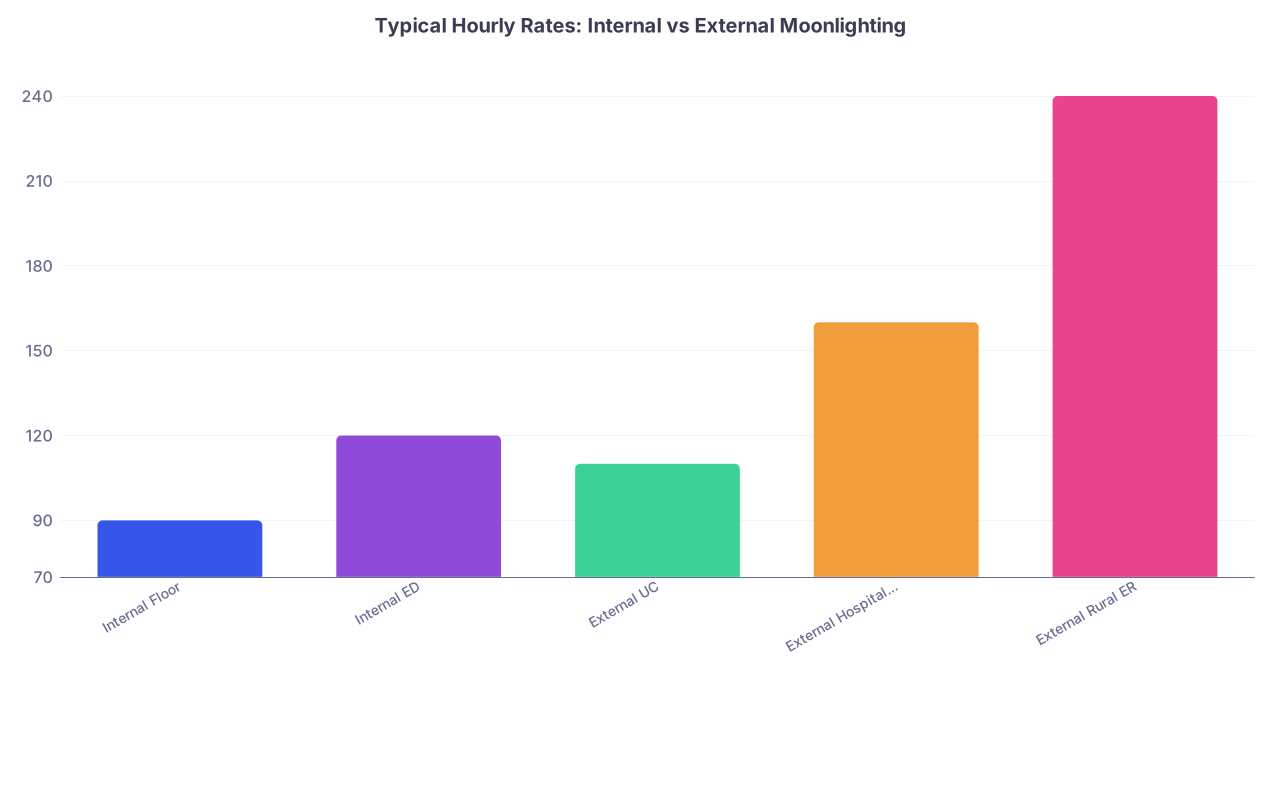
| Category | Value |
|---|---|
| Internal Floor | 90 |
| Internal ED | 120 |
| External UC | 110 |
| External Hospitalist | 160 |
| External Rural ER | 240 |
Internal shifts usually come with:
- Simpler onboarding.
- No independent credentialing at a new institution.
- Less negotiation. You take their rate or you do not work.
External shifts often come with:
- Better pay per hour.
- Independent contractor status (1099) with higher tax complexity.
- Delayed payment cycles (30–90 days after shift).
- Hidden unpaid admin time (credentialing paperwork, orientation calls, modules).
Internal moonlighting pay traps
Internal arrangements can be exploitative under the guise of “learning opportunities” or “loyalty.” Red flags I have seen:
- Pay well below market (e.g., $50/hour for attending-level responsibility).
- Unclear role definition—are you a “resident plus” or essentially the attending?
- Ambiguous supervision: “You can call the nocturnist if you need to.” Translation: you are the nocturnist until things go bad.
If the work is faculty-level responsibility, the pay should be closer to faculty-level compensation. No, you do not get equal pay as a PGY-3, but $60/hour to run an SCU alone is not “fair;” it is budget padding.
External pay traps
External moonlighting can look attractive on an hourly basis, but:
1099 contractor means:
- No benefits.
- You owe self-employment tax (~15.3% on top of income tax on that income).
- You must handle quarterly estimated tax payments or get wrecked at tax time.
Locums agencies:
- Often quote “$220/hour” but bury that in 12-hour shifts with odd census, mandatory unpaid charting, and “call ins.”
- May not reimburse travel or lodging in smaller gigs.
Telemedicine:
- Per-visit rates that sound fine but collapse if volume is low.
- Shifts where you sit logged in for hours and see three patients.
More pay on paper does not mean more net value. You should be calculating your real effective hourly rate including:
- Commute.
- Pre-credentialing and onboarding time.
- Documentation backlogs.
- Administrative meetings.
4. Malpractice and Liability: Where People Get Burned
This is the biggest conceptual error I see: “I’m a resident, so I’m covered.” No. You are covered in very specific contexts by very specific policies.
Internal moonlighting coverage
Internal moonlighting is usually covered by your institution’s existing malpractice policy, but only if:
- The work is formally recognized as part of an approved moonlighting program.
- The services you provide are within the scope the policy defines for residents (or for that moonlighting role, if they treat it as an attending role).
You must clarify:
- Are you covered as “resident only,” or as “physician” performing independent attending-level care?
- Does the coverage extend to all sites where they send you internally (e.g., that outlying community hospital)?
If you are PGY-3 in IM:
- Moonlighting as “nocturnist” on a floor service.
- Attending nominally available by phone, sitting at home.
- Your badge still says “Resident.”
If a bad MI gets missed and there is a suit, the plaintiffs lawyer will:
- Name you individually.
- Name the attending.
- Name the hospital.
The hospital’s malpractice and risk management team will happily throw you under the bus if you were functioning beyond your defined scope. They may argue you were not properly credentialed to be independent. That is where language in your moonlighting agreement matters.
External moonlighting coverage
For external work, it is binary: either you have a separate malpractice policy, or you are naked.
Common setups:
Employer-provided malpractice:
- W-2 employee urgent care or hospitalist group.
- Claims-made or occurrence policy in their name that extends to you.
Employer requires you to carry your own:
- They may insist on $1M/$3M or $2M/$4M limits.
- You purchase an individual policy, often $2–5K per year depending on specialty and state.
Telemedicine companies:
- Often provide malpractice, but read the exclusions.
- Many exclude:
- Prescribing controlled substances.
- Crossing state lines without that license.
- Certain high-risk chief complaints.

Key malpractice details you should actually check:
Policy type:
- Occurrence: covers claims from services performed in the coverage period, regardless of when the claim is filed.
- Claims-made: covers claims filed while the policy is in force. If you leave, you may need tail coverage.
-
- One of the most neglected issues by moonlighting residents.
- If your external gig uses claims-made and you leave, you need either:
- Employer-paid tail coverage.
- A written nose policy with your next employer that picks up prior acts.
- Tail can be expensive (often 150–250% of annual premium).
If you cannot answer, “Do I need tail coverage when I stop this gig?”, you are operating on blind faith.
5. Policy Nuances: Immigration, Licensure, and GME Power
Here is where things become career-threatening instead of just annoying.
Visa and immigration risk
For J-1 and H-1B residents, external moonlighting can be lethal to your status if not processed correctly.
J-1 (ECFMG-sponsored):
- J-1 residents are generally limited to approved training activity at approved training sites.
- “Unauthorized employment” is a serious violation.
- External moonlighting is almost always prohibited unless:
- Very tightly structured and explicitly approved by ECFMG (rare).
- Internal moonlighting might still be a problem if it is not clearly tied to the program’s educational objectives.
H-1B:
- Employment authorized only for the specific employer, site(s), and job description in the H-1B petition.
- External moonlighting = unauthorized employment unless you have:
- Concurrent H-1B sponsorship (a second H-1B) from the moonlighting employer.
- Which is paperwork-heavy and often not worth it for them.
I have seen:
- H-1B residents quietly doing telemedicine for cash.
- J-1s doing weekend urgent care with a local clinic that “needed help and would pay cash.”
This is how you get:
- Immediate termination.
- Loss of status.
- Ugly conversations with immigration attorneys about “unlawful presence” and future visa ineligibility.
If you are on a visa, treat external moonlighting as presumptively banned unless cleared by:
- Your institution’s legal/immigration office.
- Your visa sponsor (ECFMG for J-1).
- Competent immigration counsel.
Licensure issues
Most residents moonlight on:
- Full unrestricted license (some states).
- Limited training license (many states).
You need clarity on:
- Does your training license allow independent practice outside your training program?
- Often the answer is no.
- Does your full license have any restrictions tied to your training program?
- Are you licensed in the state where you are moonlighting? Telemed included.
And yes, telemedicine across state lines without a license in the patient’s state is still an easy way to end up with a complaint or action.
GME and PD control
Internal moonlighting:
- Program leadership has full visibility and control.
- They may:
- Offer it only to residents “in good standing.”
- Pull it for any remediation, unprofessional behavior, or marginal performance.
- Condition future fellowship letters on compliance.
External moonlighting:
- They cannot stop you from working a second job as a citizen, but they can:
- Prohibit it via contract language.
- Make external employment a professionalism issue.
- Decline to renew your contract if they deem it interfering with training.
I have seen PDs say:
- “You are too tired on rounds; you must stop external moonlighting or we will report this to the CCC.”
- “Your duty hour logs do not match; stop lying or stop moonlighting.”
They hold the keys to:
- Your contract renewal.
- Your board eligibility attestations.
- Your final summative evaluation.
You are not negotiating from equal leverage.
6. Practical Strategy: When Internal vs External Actually Makes Sense
Now to the question that matters: which should you choose, and how?
Good use cases for internal moonlighting
Internal makes sense when:
- You are earlier in training (senior resident, but not yet fully independent).
- You want:
- Lower onboarding friction.
- Known systems and EMR.
- Consistent supervision backup.
Best fits:
- Extra hospitalist or ED shifts where there is a real attending on-site or immediately available.
- Subspecialty call work where you are the first call but not the final word.
Advantages:
- Easier duty hour tracking within one system.
- Less risk of licensure/immigration problems.
- Malpractice mostly under one umbrella.
Disadvantages:
- Lower pay ceiling.
- Potential for role confusion—resident vs attending.
- Can worsen politics if you pick “easy” moonlighting over “hard” rotations.
Good use cases for external moonlighting
External makes sense when:
- You are late PGY-3/PGY-4, chief, or in fellowship with near-attending competence.
- You hold a full license that allows independent practice.
- You understand your malpractice exposure and have it covered.
Best fits:
- High-need community sites where your skill set is sufficient, and support is realistic.
- Urgent care or low-acuity EDs where your risk tolerances and resources match.
Advantages:
- Higher pay.
- Exposure to how community medicine actually runs.
- Potential future job pipeline.
Disadvantages:
- Multi-institution duty hour tracking nightmare.
- Complex tax situation (1099).
- Much higher risk of isolated practice with thin backup.
A structured decision checklist
When a resident asks me, “Should I take this gig?” I ask:
- Who is the legal employer?
- What license am I using? Training vs unrestricted? State?
- Who is providing malpractice? Type? Do I need tail?
- What is my supervision/backup structure at 3 a.m.?
- How are hours being tracked and reported relative to ACGME cap?
- Does my contract allow this? Do I need PD/GME approval?
- Am I on a visa, and has this been cleared with immigration counsel?
If you cannot cleanly answer those seven, you do not understand the risk profile yet.
7. The Future: Telemedicine, AI, and Shifting Moonlighting Landscapes
This is the “future of medicine” category, so let us be honest about where this is heading.
Telemedicine moonlighting
Telemedicine is already a major external moonlighting channel:
- After-hours tele-urgent care.
- Behavioral health follow-ups.
- Chronic disease management check-ins.
Attractive because:
- No commute.
- Flexible scheduling.
- Often work-from-home.
But:
- Licensure across multiple states is expensive and administratively heavy.
- Many companies treat moonlighting residents as cheap coverage with limited support.
- Liability can be significant if triage is sloppy and documentation is thin.
Regulators are catching up:
- States are tightening telemedicine prescribing rules.
- Boards are more willing to investigate care that “feels” rushed or shallow.
AI-augmented workflows and productivity pressure
You will see:
- External telehealth groups pushing AI scribe tools, diagnostic suggestions, triage algorithms.
- Pressure to see more patients per hour because “the AI helps with efficiency.”
The danger:
- You are still the one with the license on the line.
- Malpractice carriers will look at whether you over-relied on non-human tools.
Moonlighting where AI tools drive volume expectations can turn into:
- Unsafe throughput.
- Burnout.
- Poor documentation quality if you do not meticulously correct AI-generated notes.

| Step | Description |
|---|---|
| Step 1 | Moonlighting Offer |
| Step 2 | Check GME Policy |
| Step 3 | Check License and Visa |
| Step 4 | Confirm Malpractice Coverage |
| Step 5 | Consider Pay and Supervision |
| Step 6 | Reject or Adjust Shifts |
| Step 7 | Negotiate or Buy Tail |
| Step 8 | Accept with Documentation |
| Step 9 | Internal or External |
| Step 10 | Duty Hour Compliance |
| Step 11 | Tail Coverage Needed |
Moonlighting will not disappear. It will just move more remote, more fragmented, and more legally complex. Residents who are sloppy about internal vs external boundaries will get burned harder in that environment.
FAQ (Exactly 6 Questions)
1. Is internal moonlighting always safer than external moonlighting?
No. It is usually simpler, not automatically safer. Internal gigs can:
- Underpay you for near-attending responsibility.
- Put you in ambiguous roles with weak supervision.
- Still violate duty hours and trigger ACGME trouble.
The only thing that is reliably better internally is alignment of EMR, systems, and institutional malpractice. You still need to scrutinize the role and pay.
2. If my PD “verbally approves” external moonlighting, is that enough?
No. You want written documentation. At minimum:
- An email from PD clearly acknowledging the nature of the work.
- If required, formal GME committee approval.
Verbal approval evaporates when there is a complaint or a lawsuit. Your contract, institutional policy, and email trail are what matter when things go sideways.
3. Do all moonlighting hours really have to be reported as duty hours?
Yes. ACGME’s position is explicit: all moonlighting (internal and external) counts toward duty hour limits. Residents under-report all the time, but that does not make it legal or safe. If your program “suggests” you not log them, your program is asking you to lie to protect them from citations.
4. Can I moonlight externally on a training license if the site does not care?
Generally no, and this is where people get into serious trouble. Training licenses are typically:
- Restricted to sites and functions approved by your GME program.
- Not valid for independent practice detached from your training.
If an outside site says, “We will just bill you as a resident,” that is their billing problem. The licensing board will not be sympathetic when your practice falls outside license scope.
5. How do I compare two moonlighting offers beyond just the hourly rate?
You calculate an “effective risk-adjusted hourly rate”:
- Include:
- Real hours (including commute and admin time).
- Taxes (especially if 1099).
- Cost of malpractice and tail, if not provided.
- Subtract:
- Any significant career or immigration risk.
- The sleep/education cost if shifts clash with heavy rotations.
A $220/hour external rural shift can be “worse” than $120/hour internal if the former adds tail costs, travel, and serious medico-legal exposure.
6. What one document should I absolutely insist on before any external moonlighting?
A written agreement (contract or offer letter) that clearly specifies:
- Your status (W-2 vs 1099).
- Malpractice coverage details (limits, claims-made vs occurrence, who pays tail).
- Site(s) of practice and expected duties.
- Compensation structure and payment terms.
If someone wants you to work external shifts “informally” with no contract, you are volunteering to be the most exposed person in the room when anything goes wrong.
Key takeaways:
- Internal vs external moonlighting is fundamentally about who employs and insures you, not just where you physically work.
- All moonlighting hours count for ACGME duty limits, and malpractice/visa/licensure details will hurt you if you ignore them.
- Higher hourly pay often hides tax, tail, and risk costs; you should be calculating the true effective rate before saying yes to anything.