
The biggest lie in physician compensation is that your “salary” is what matters. It is not. The real money lives in call pay, stipends, and RVU structure. Ignore those, and you will leave six figures on the table every single year.
Let me break this down specifically.
Most residents and even a lot of young attendings walk into contracts focused on the base number: “$260k base, seems decent for hospitalist in the Midwest.” Meanwhile, buried on page 7 is a call schedule that will wreck your life for free, or an RVU threshold that guarantees you are subsidizing the hospital. I have watched people do this. More than once.
You are in the Moonlighting and Benefits world now. This is where the “miscellaneous” line items become your actual lifestyle.
We will go through three pillars:
- Call pay – how you are paid (or not paid) for being on call, in-house or from home.
- Stipends – money that looks like a gift but is usually paying you to be responsible for something at all times.
- RVUs – the “productivity” currency that administrators worship and physicians often pretend to understand while nodding in meetings.
By the end, you should be able to look at any offer and say, out loud: “This is a terrible call structure” or “This RVU conversion factor is a joke” and know exactly why.
1. Call Pay: The Silent Workload Multiplier
Call is where a lot of young attendings get exploited because they do not price it out.
Call has three main dimensions:
- Type of call
- Frequency of call
- Compensation model
Let me walk through each.
1.1 Types of Call
Broadly you see three categories.
- In-house call
You are physically in the hospital, obliged to respond immediately. Common in:
- Surgery, OB/GYN, anesthesia, ICU, EM (though EM usually shifts, not “call”)
- Many academic services
This is functionally a night shift. If you are in-house for 12–24 hours, you should think of it like any other worked shift and compare the hourly rate.
- Home call with frequent call-backs
You are technically at home but are effectively tethered to your phone and car. Trauma surgery, ortho, OB in some places.
You might be called in multiple times per night to operate or deliver.
This behaves like a hybrid: part stipend/retainer, part per-call or per-hour in-house pay.
- Home call with low-intensity coverage
Primarily phone management, rare physical call-backs. Think neurology in some markets, certain subspecialties, or backup call tiers.
This is where administrators love to say “everyone on the team just rotates call, we do not pay separately.”
That is where you stop them.
If call meaningfully restricts your life or adds meaningful workload, that is labor. Labor should be compensated.
1.2 Common Call Pay Models
You will usually see one or more of these:
Flat per-call stipend
Example: $500 per 24-hour weekday, $800 per 24-hour weekend/holiday. Sometimes different rates for primary vs backup.Hourly in-house rate
Example: $150/hour for in-house night coverage, regardless of clinical volume. Could be on top of, or instead of, RVU credit.Per-encounter or per-call-back pay
Example: $200 per OR case after 7 pm, $100 per come-in consult from home.“Included in salary”
This is code for: “We are paying you a base salary and pretending call is part of your core job description.”
Sometimes reasonable if:- Call is infrequent and light
- Call distribution is truly fair
- Base salary is meaningfully above market
Usually not reasonable if: - Call is 1:3 or worse
- Nights/weekends are intense
- You are covering multiple hospitals or high-acuity services
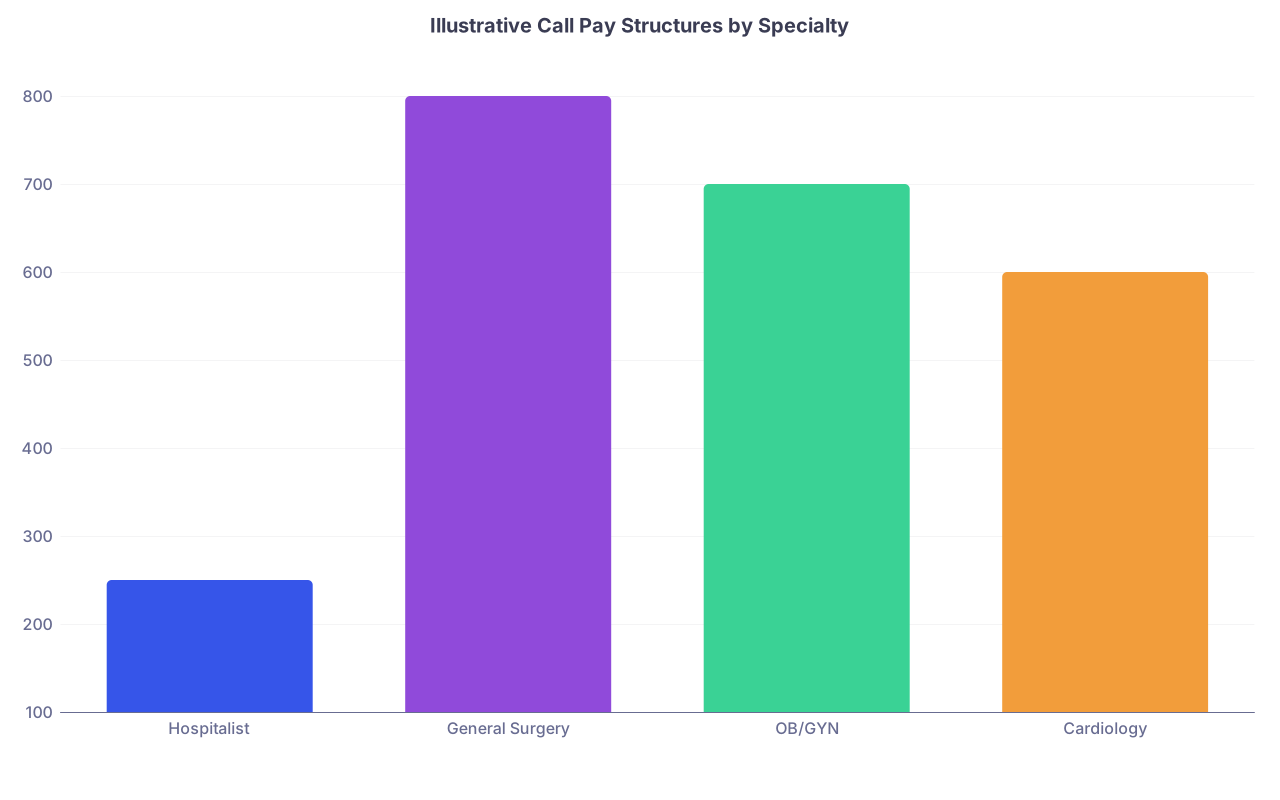
| Category | Value |
|---|---|
| Hospitalist | 250 |
| General Surgery | 800 |
| OB/GYN | 700 |
| Cardiology | 600 |
(Values above are hypothetical 24-hour weekend call stipends in dollars, just to give a sense of range people actually negotiate. I have seen numbers lower and higher than this.)
1.3 How to Actually Value Call
You cannot judge call pay without doing the math. Here is how you do it.
Step 1: Calculate annual call burden
Example:
- 1:4 primary call
- 7 days per month on call (roughly)
- Includes 1 weekend per month
That is 84 call days per year, about 12 full weekends.
Step 2: Compute effective hourly rate
Say you get $500 per 24-hour call day, regardless of volume.
That is $500 / 24 = $20.83 per hour before taxes. For being tied to your phone and liable for malpractice if you miss something. That is garbage.
Now imagine you are getting $800 for a 24-hour weekend call and you usually get called in 3 times for 1–2 hours of real work each call. Let’s say 6 hours of active work total.
- Effective pay per “active” hour: $800 / 6 = $133/hour
- If you would otherwise be on your couch with your kids, you decide if that is worth it.
Step 3: Price out the “hidden” call that is baked into salary
If the group or hospital says call is included, push them.
Example scenario:
- You are offered $300k base as general surgeon, 1:3 call, no call stipends.
- A similar market offers $280k base with $800 per 24-hour primary call. You are on call 1:3 there too.
Let’s assume ~121 call days per year (365/3).
- In second job: 121 × $800 = $96,800 in call pay.
- Total comp: $280k + $96.8k ≈ $376.8k.
So Job A at “higher base” $300k with “included” call is actually $76k less per year for the same call burden.
A lot of people never run this comparison.
1.4 Moonlighting and Call: Where It Blurs
Moonlighting frequently is call.
Common arrangements:
- Internal moonlighting: Extra in-house call shifts at an hourly rate
- External moonlighting: On-call coverage for a small community hospital that needs occasional subspecialty backup
These can pay very well, but you must watch:
- Malpractice coverage (tail, scope, who is named)
- Competing obligations with your primary employer (some forbid outside call)
- Fatigue and patient safety if you stack primary call plus moonlighting call
If you are doing extra nights for $125/hour as an IM hospitalist, but losing your sanity and making mistakes, you are underpricing your risk.
2. Stipends: “Free” Money That Is Usually Not Free
Stipends look friendly. A number stuck onto the contract in a separate line. But every stipend has strings.
Broad categories:
- Medical directorship stipends
- Call availability stipends
- Administrative/committee stipends
- Rural coverage or “recruitment/retention” stipends
2.1 Medical Directorship Stipends
This is the big one.
Hospitals will pay physicians to serve as “Medical Director” of:
- ICU
- ED
- Hospitalist service
- Cath lab
- Stroke program
- Service lines (e.g., Oncology, Neuroscience)
Typical structure:
- Monthly fixed stipend: $3,000–$8,000/month, sometimes higher
- Expected time: 5–20 hours/week, depending on scope
- Duties: meetings, protocol development, quality metrics, staffing, etc.
| Role | Monthly Stipend | Expected Hours/Week |
|---|---|---|
| ICU Medical Director | $6,000 | 8–10 |
| Hospitalist Director | $4,000 | 5–8 |
| Stroke Program Director | $3,500 | 4–6 |
| ED Medical Director | $7,500 | 10–15 |
This looks fantastic on paper. But do the hourly math.
Example: ICU Director
- $6,000/month = $72,000/year
- Realistic hours: 10/week = 520 hours/year
- Effective rate ≈ $138/hour
Now compare to your clinical rate:
- If you generate $450k on 1.0 FTE clinical work at ~40 hrs/week → roughly $215/hour clinical.
- You just agreed to trade time for 60–70% of your usual rate…for meetings and emails.
Sometimes it is worth it—for career building, leadership goals, or shaping your practice environment. But do not pretend it is free money.
Red flags:
- “Unlimited” undefined responsibilities
- Stipend not adjusted for massive increases in scope (adding a second ICU, new hospital, etc.)
- No protected time; you are expected to do admin work on top of full clinical load
2.2 Call Availability Stipends (Without Per-Call Pay)
This one is slippery.
Example:
- Cardiology group gets $10,000/month as a group to provide 24/7 call coverage to a community hospital.
- Divided among 5 cardiologists: $2,000/month each.
- Each cardiologist takes call 1:5.
Sounds like you are getting $24,000/year “just for existing.” Reality:
- For 1:5 call, you are on ~73 days/nights per year.
- $24,000 / 73 ≈ $328 per day of being on the hook.
Now if those nights are light and you are okay being tied down for that rate, fine. But in many places, these “availability” stipends subsidize intense workloads.
I have seen orthopedic surgeons covering level II trauma centers, on 1:3 call, for group stipends that boil down to ~$400–500 per 24-hour period. That is malpractice exposure plus real work for less than many moonlighting hospitalist shifts.
2.3 Administrative and Committee Stipends
These are smaller but add up.
Examples:
- $500 per month for chairing the Pharmacy & Therapeutics committee
- $250 per month for residency program interview coordination
- $150 per hour for attending quality meetings beyond your contracted work
Not every institution pays for these. Some just expect “citizenship.” If your hospital pays, decent. But make sure:
- Time is capped
- Documentation of hours is clear
- You are not slowly absorbing open-ended responsibilities for fixed pennies
2.4 Recruitment, Retention, and Rural Stipends
Rural or underserved areas often sweeten the pot with:
- “Sign-on stipend” spread over 1–3 years
- Monthly retention bonuses
- Additional stipends for outreach clinic coverage
These are real money but usually come with:
- Multi-year commitments (clawback if you leave early)
- Heavy call burdens
- Lower base salaries that rely on RVU overproduction to “catch up”
Make sure you read the fine print on repayment. Many retention or recruitment stipends require repayment of prorated amounts if you leave before 2–5 years. That can be a nasty surprise when you try to exit a toxic job.
3. RVUs: The Currency Behind Your “Productivity”
If you do not understand RVUs, somebody else will use them against you. Usually finance.
RVU = Relative Value Unit.
More accurately: wRVU = work RVU, which is what your labor is judged on.
There are three RVU components in Medicare:
- wRVU – your professional work
- Practice expense RVU – overhead, supplies, non-physician costs
- Malpractice RVU – cost of insuring the service
Physician comp usually keys off work RVUs.
3.1 The Basic Mechanics
You generate wRVUs every time you bill a CPT code.
- 99213 (established outpatient visit, low-moderate) ≈ 0.97 wRVU
- 99214 (established outpatient, moderate) ≈ 1.50 wRVU
- 99223 (initial hospital care, high complexity) ≈ 3.50 wRVU
- 99291 (first 30–74 minutes critical care) ≈ 4.50 wRVU
Hospitals or groups then tie your compensation to:
- A wRVU target (e.g., 5,500 wRVU per year)
- A conversion factor (e.g., $50 per wRVU)
Two big structures:
- Pure productivity: you earn $X per wRVU from the first unit. Low base, high upside.
- Base + productivity: you get a guaranteed salary tied to a floor of wRVUs, then a bonus above that.
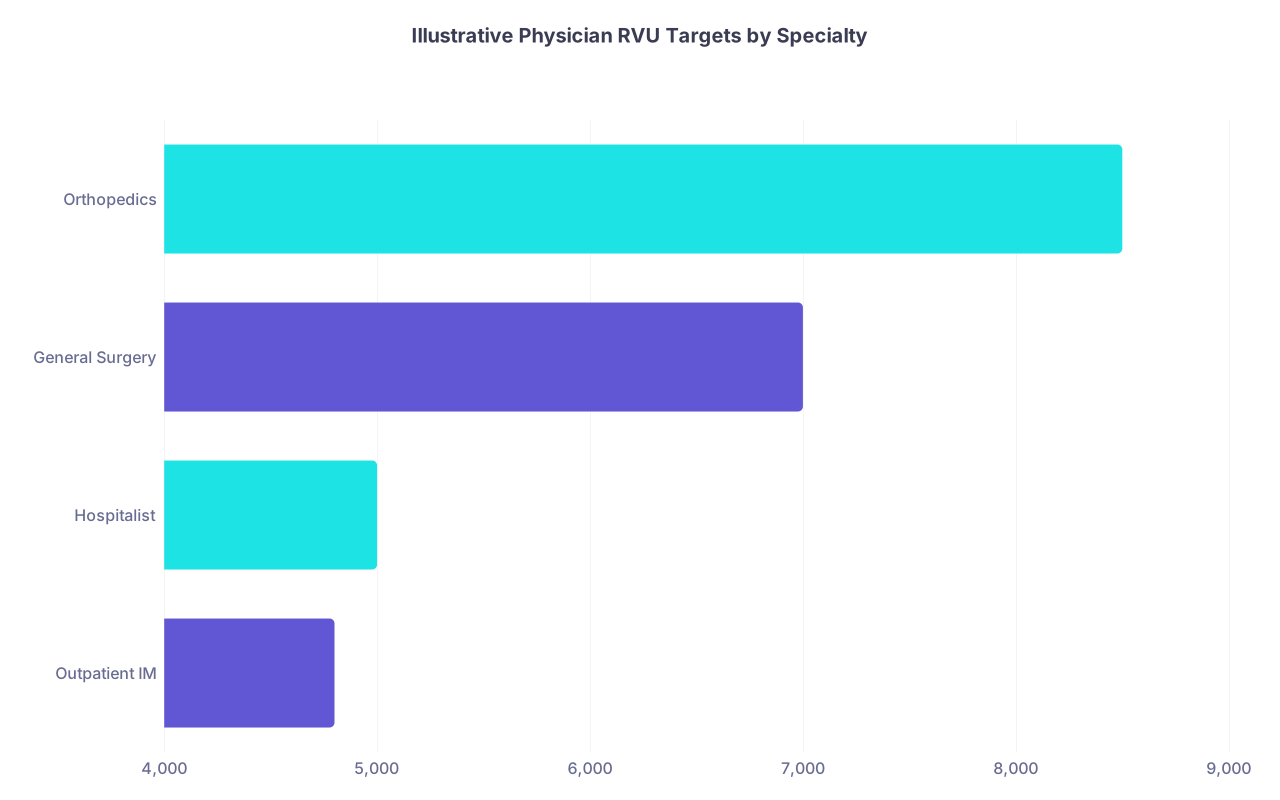
| Category | Value |
|---|---|
| Outpatient IM | 4800 |
| Hospitalist | 5000 |
| General Surgery | 7000 |
| Orthopedics | 8500 |
Those target numbers are not fake. You will actually see 7,000–9,000 wRVU targets for proceduralists.
3.2 How to Read a Compensation Clause
Example contract language:
- Base salary: $260,000
- Expected productivity: 5,500 wRVU per year
- wRVU conversion factor: $50
- Bonus: 100% of wRVUs above 5,500 × $50, paid quarterly
Let’s decode it.
First, what is your “base-equivalent” per RVU?
- If they withhold for underperformance, then $260,000 / 5,500 = $47.27 per wRVU embedded in your base.
- Bonus wRVUs pay an additional $50 each.
So above threshold you are effectively at ~$97 per incremental wRVU? No. That is a common mental trap.
You are not getting paid $47.27 + $50 = $97 for extra work. The $260k is for fulfilling your “normal/expected” productivity. The extra RVUs only earn $50 each above the 5,500 line.
So your actual marginal pay for the extra work is $50 per wRVU. That is the number that matters for additional effort.
Now look at what happens if you underperform.
Some contracts explicitly say:
- If you produce less than 80% of the wRVU target for two consecutive years, your base may be adjusted downward proportionally.
Example: Only produced 4,000 wRVUs instead of 5,500.
- 4,000 / 5,500 ≈ 0.73.
- They may decide your new base should be 0.73 × $260,000 ≈ $189,800.
You need to know if there is downside adjustment language.
3.3 Typical RVU Conversion Factors
Market ranges (these move over time, numbers here are directional, not fixed):
- Outpatient IM / FM: $45–$60 per wRVU
- Hospitalists: $45–$75 per wRVU (depending on nocturnist, intensity, staffing)
- General Surgery: $55–$80 per wRVU
- Ortho / Neurosurgery: $60–$100+ per wRVU
| Specialty | Low Range | High Range |
|---|---|---|
| Family Medicine | $45 | $55 |
| Hospitalist | $50 | $70 |
| General Surgery | $55 | $80 |
| Cardiology | $60 | $85 |
| Orthopedics | $70 | $110 |
If your offer is:
- At the bottom of the range
- With a high wRVU target
- And heavy uncompensated call
You are subsidizing the system.
3.4 RVUs and Moonlighting
Here is where it gets interesting.
Many internal moonlighting gigs inside your own hospital system are:
- Flat hourly pay with no RVU credit
- Or RVU credit but no additional pay if you are “on salary”
You need to ask explicitly:
- “If I cover extra shifts, do I get additional wRVU credit toward my bonus?”
- “If I exceed my RVU target by working these extra shifts, is the bonus still paid on those incremental RVUs?”
I have watched hospitalists do a string of extra nights for $130/hour, unaware that the wRVUs from those nights were being counted against their core target without additional bonus. That is double-dipping by the hospital.
If you are doing extra work, you should be paid twice: hourly + RVUs toward bonus, or a significantly higher hourly rate with agreement that RVUs are not counted.
Not both against you.
4. How These Pieces Interact: Real-World Scenarios
Compensation is not siloed. Call, stipends, and RVUs intersect. I will give you a few actual composites I have seen.
4.1 Scenario: The “High Salary” Hospitalist Who Is Underpaid
Offer:
- $290k base for 7-on/7-off, days only
- 18–20 patients per day, no cap
- No separate call; nights covered by nocturnists
- RVU-target neutral – “we do not track RVUs for compensation, just for internal benchmarking”
Sounds clean. Until you see:
- Your typical census and documentation generates ~5,500–6,000 wRVUs per year per FTE
- National MGMA median hospitalist comp might be $300–320k for that productivity
So yes, they “do not track RVUs for pay,” but they are setting your base assuming you are working like a high-productivity doc, using their internal benchmarks, but giving you no upside if you outproduce.
You could moonlight 4 extra shifts per month at $150/hour at a neighboring hospital, and make another $86k–$100k per year. But your current employer pays you nothing extra if you stretch and cover more discharges or do extra documentation that boosts wRVUs.
4.2 Scenario: The Surgeon With Call-Stipend Illusion
Offer:
- $400k base
- 1:4 call, with “call stipend” of $500 per 24-hour primary call
- wRVU conversion factor: $60, threshold 7,500 wRVU
On paper:
- 1:4 call ≈ 91 call days/year
- Stipend = 91 × $500 ≈ $45,500/year
You think you are at $445k + any RVU bonus.
Reality:
- Call days are your busiest operative days; you rack up a ton of wRVUs on them
- Those RVUs are still counted toward your 7,500 threshold; the stipend is just a retainer
- Your true marginal compensation per extra case on call is still just $60/wRVU above threshold
Now compare to another group down the street:
- $375k base
- 1:4 call, but $1,000 per 24-hour call
- Same RVU conversion factor and similar OR block times
There you are making ~$91k in call stipends instead of $45.5k, on top of similar base and bonus. Over a 5-year contract, that is ~$225k difference in just call stipends.
People sign the first one because the base looks bigger.
4.3 Scenario: The Medical Director Who Is Paying to Lead
Offer:
- Hospitalist base: $260k for 15 shifts/month
- Hospitalist Director stipend: $5,000/month
- Responsibilities: scheduling, quality metrics, recruitment, quarterly hospital meetings
- Time expectation: “about 10% admin FTE” (i.e., 4 hours/week on paper, 8–10 in reality)
Key details:
- No protected clinical time – still expected to work 15 shifts/month
- Stipend = $60,000/year
- Realistic admin time = 400–500 hours/year
You are effectively at $120–150/hour for admin work. Not awful.
But if your 15 clinical shifts generate ~4,500 wRVUs/year, and your system uses an internal comp benchmark of $60/wRVU, your clinical value alone could justify $270k in salary. You are being paid $260k for clinical work that is probably worth more, and then $60k for admin.
Net: $320k for a role whose total productivity and responsibility might justify $350k–380k elsewhere.
This is what I mean: the system often gets a bargain because physicians underprice their time and attention.
5. How to Actually Evaluate an Offer
You are not going to get a perfect deal. You want a transparent, internally consistent structure that does not punish you for doing good work.
Here is the checklist I use with people.
5.1 For Call
- What type of call? In-house vs home, primary vs backup, expected call-backs.
- Exact call frequency per year. Not “typically 1:4–1:5,” but actual numbers.
- Is call paid separately? If so:
- Flat daily rate or hourly?
- Different rates for weekday vs weekend vs holiday?
- Does call generate RVUs that count toward productivity bonuses?
- Is call evenly distributed among partners, or do junior docs eat more?
If call is “included” in salary, ask:
- “What would my base be if there were no call?”
- “What is the market rate for this level of call coverage in this region?”
If they cannot answer, that should bother you.
5.2 For Stipends
For each stipend:
- What exactly am I being paid to do?
- How many hours per week or month are realistically expected?
- Is there protected time in my schedule, or is this on top of clinical work?
- When is the stipend paid (monthly, quarterly)?
- Under what circumstances can it be revoked or reduced?
Compute the effective hourly rate. Then ask yourself bluntly: would I work an extra half-day in clinic per week for that rate? If not, why am I taking the stipend?
5.3 For RVUs
Ask for:
- The expected annual wRVUs for your role
- The median and 75th percentile wRVUs of current physicians in your group
- The wRVU conversion factor and bonus structure
- Any downside adjustments if you underperform
- How non-RVU work is treated:
- Teaching
- Admin
- Quality projects
Then do two things:
Compare the expected wRVUs × conversion factor to your base.
- If 5,500 × $50 = $275k and your base is $230k, then you are under market or admin heavy.
- If 5,500 × $50 = $275k and your base is $260k, you are about in line.
Ask: what happens at 25% above target?
- If target is 5,500 and you hit 7,000, does the $50 apply to all 1,500 extra wRVUs cleanly?
- Is there a cap? I have seen caps that stop bonuses after 120% of target.
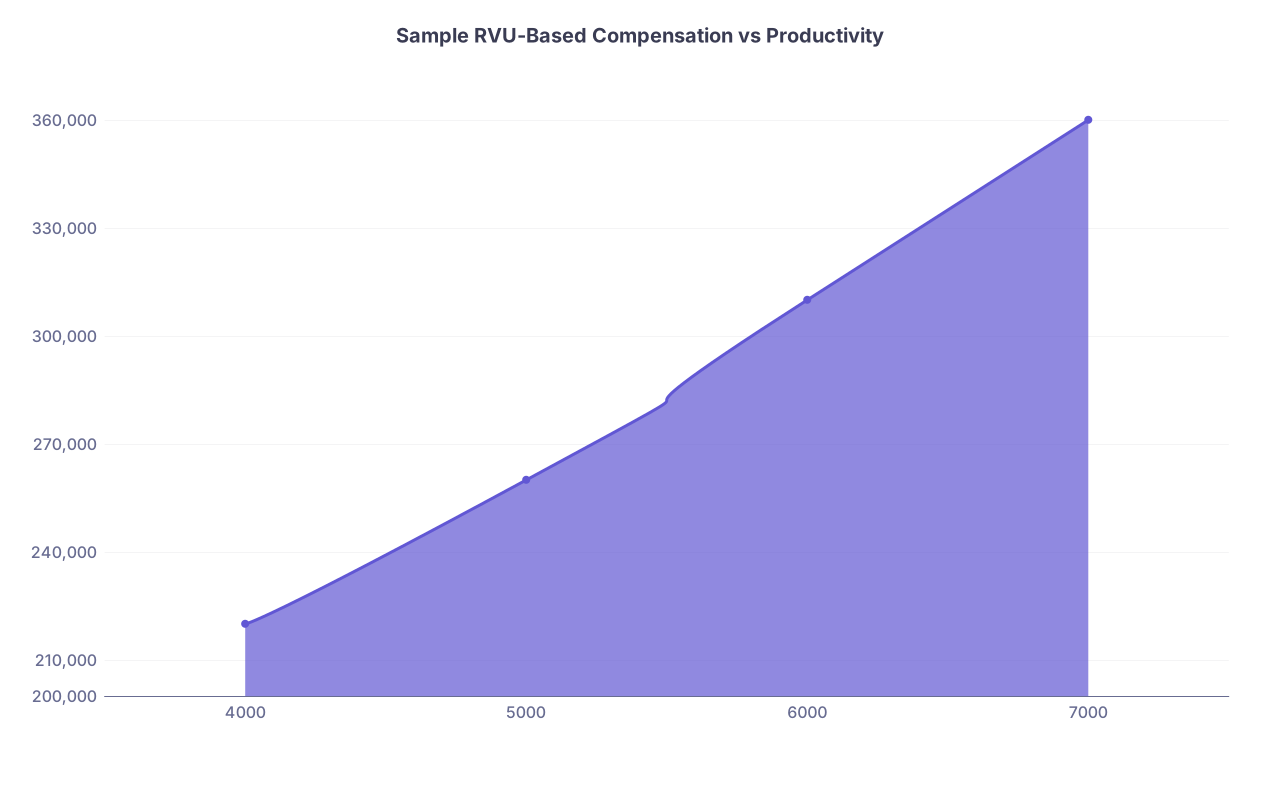
| Category | Value |
|---|---|
| 4000 | 220000 |
| 5000 | 260000 |
| 6000 | 310000 |
| 7000 | 360000 |
(Simplified example: base $260k tied to 5,000 wRVUs, $50 per wRVU bonus for anything above 5,000. You can see how upside flattens or grows depending on structure.)
6. Where This Is Headed: Future of Compensation
You are in the “Miscellaneous and Future of Medicine” phase for a reason. The compensation world is shifting under your feet.
Three directions I am watching.
6.1 Blended RVU + Quality + Panel-Based Pay
Pure RVU models incentivize volume. Payers and systems know this. So you will see more:
- Panel-based stipends for primary care (“you manage 2,000 lives”)
- Quality metric bonuses (A1c control, readmission rates, documentation completeness)
- Care coordination stipends for managing complex patients and telehealth follow-ups
That sounds lovely until you realize:
- Quality metrics are often poorly risk-adjusted
- Data lags are huge
- You carry the burden of non-face-to-face work without clear time credit
Stipends for “panel management” will appear, but you need to examine them the same way: hours, expectations, and whether they cannibalize your chance to bill RVU-generating visits.
6.2 Call and Stipends Getting More Formalized
Hospitals are increasingly nervous about fair market value (FMV) and Stark/AKS issues.
Translation: they will:
- Tie call pay to external FMV surveys (MGMA, SullivanCotter, etc.)
- Put tighter language around eligibility for stipends
- Document expectations for every stipend role
This cuts both ways. It can:
- Protect you from being randomly underpaid compared to peers
- Limit your ability to negotiate “above market” in a high-demand situation
The people who win here are the ones who actually read these FMV documents and know where their specialty and region land.

| Step | Description |
|---|---|
| Step 1 | Job Offer |
| Step 2 | Quantify Call Burden |
| Step 3 | Review Call Stipend |
| Step 4 | Compare to Market Call Pay |
| Step 5 | Check Target and Rate |
| Step 6 | Flat Salary Model |
| Step 7 | Assess Upside and Risk |
| Step 8 | Calculate Effective Rate |
| Step 9 | Decide on Offer |
| Step 10 | Call Included? |
| Step 11 | RVU Based? |
| Step 12 | Stipends Offered? |
6.3 Moonlighting Shifting to Telehealth and Remote Coverage
Future moonlighting and call will not always mean driving to a hospital.
You will see more:
- Tele-ICU coverage shifts, with per-hour or per-shift pay
- Telestroke call with structured per-encounter fees
- Virtual urgent care shifts with RVU-equivalent or per-visit pay
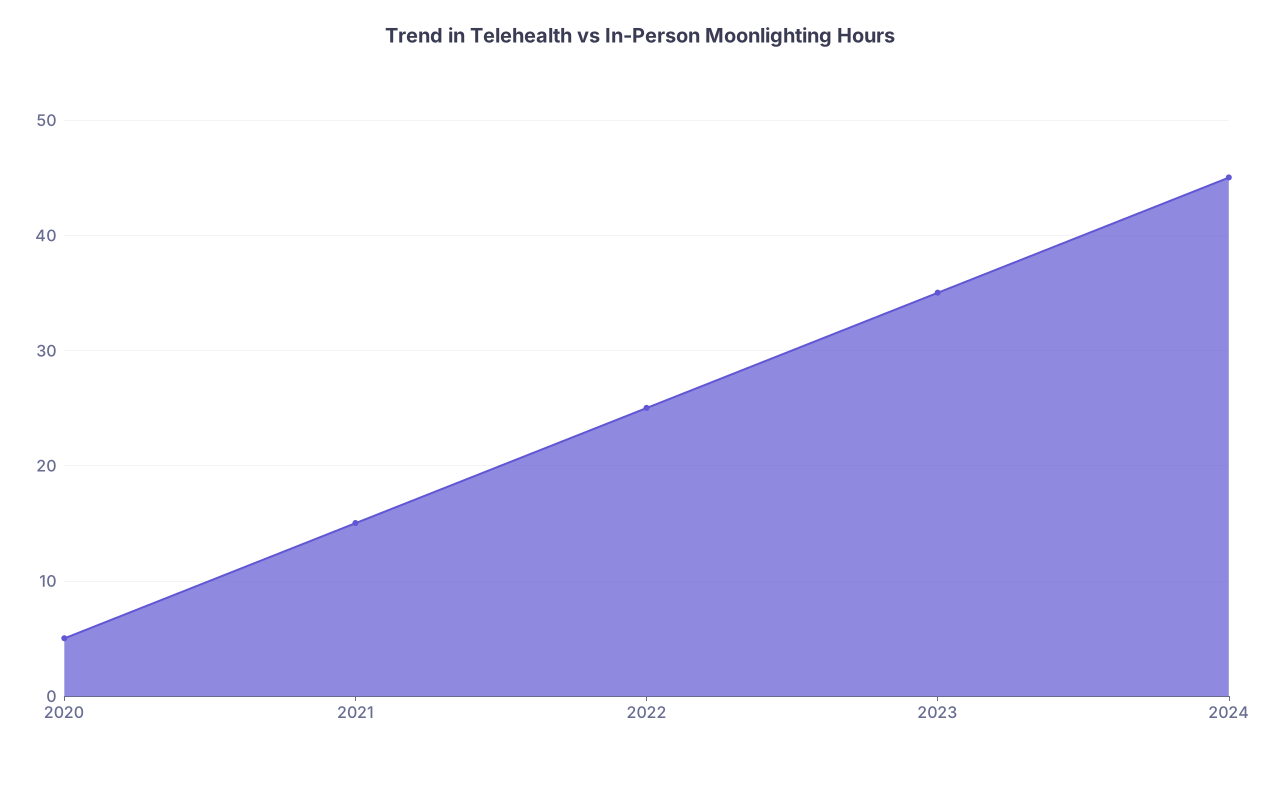
| Category | Value |
|---|---|
| 2020 | 5 |
| 2021 | 15 |
| 2022 | 25 |
| 2023 | 35 |
| 2024 | 45 |
(Think of those as percent of total moonlighting hours that are telehealth-based. This is the direction, not exact data.)
The upside:
- No commute
- Flexible geography
- Often better hourly rates than low-end in-person call
The downside:
- Blurred work–life boundary
- More pressure to be “always on” with home office setups
- RVUs becoming even more abstracted as you bill from a laptop in your kitchen
You will need to apply the same discipline: hourly rate, volume expectations, malpractice coverage, and how these shifts interact with your main job’s RVUs and fatigue.
You should not walk into your next contract meeting thinking “What is my salary?” You should walk in thinking:
- What is my total call burden worth?
- What am I actually being paid for every significant responsibility?
- How is my productivity measured, and what is the marginal dollar on my extra effort?
Get those three right, and you can shape a career where the money matches the work instead of being an afterthought.
With that foundation in call pay, stipends, and RVUs, you are positioned to read contracts like a grown-up, not a desperate PGY-3. The next step is learning how to actually negotiate these numbers without blowing up the relationship—competing offers, timing, and language. But that is a separate fight, and we will tackle that another day.