Most physicians sign FTE offers they barely understand—and it quietly costs them tens of thousands in benefits.
Let me break this down specifically: the difference between 0.8 and 1.0 FTE is not just “one day less a week.” It is a structural shift in how your employer treats you for salary, health insurance, retirement, CME, disability coverage, and moonlighting flexibility. If you treat FTE as just a schedule number, you will get burned.
This is squarely in the gray zone where HR jargon collides with the realities of call schedules, RVUs, and burnout. And yes, the details vary by institution—but the patterns do not.
What FTE Actually Means (And What It Does Not)
FTE—Full-Time Equivalent—is an HR construct. It is not a schedule. It is a billing unit.
In plain English: 1.0 FTE means “this person is considered full-time” under that employer’s definition. Everything else (0.9, 0.8, 0.6) is a fraction of that full-time standard.
Key points most physicians miss:
- FTE is defined per employer, not universally.
- 1.0 FTE might mean 36 hours/week in one system and 40 in another.
- Clinical hours vs total hours vs RVUs are often blurred on purpose.
Typical examples I have seen in hospital contracts:
- Academic hospitalist: 1.0 FTE = 7 on / 7 off, 12-hour shifts (i.e., 168 hours per 28 days).
- Outpatient IM: 1.0 FTE = 36 clinical hours/week + “reasonable non-clinical duties” (code phrase for meetings, inbox, documentation).
- ED: 1.0 FTE = 120–140 clinical hours/month.
Then HR slaps a label:
- 0.8 FTE might be 4 days clinic/week instead of 5.
- 0.8 FTE might be 10 shifts/month instead of 14.
- 0.5 FTE might be 2.5 clinic days/week.
But the benefits logic is often binary: above a threshold (e.g., ≥0.8) vs below. Not linear.
So your first mental shift: FTE is the “benefit tier key.” Pay attention less to “how many days” and more to “what benefit tier does this unlock or close.”
How 0.8 vs 1.0 FTE Changes Core Benefits
Now to the part that actually hurts: what changes when you drop from 1.0 to 0.8 FTE?
I will walk through the main categories: salary, health insurance, retirement, paid time off, CME/malpractice, disability/life, and then the hidden financial effect.
| Benefit Area | 1.0 FTE Typical | 0.8 FTE Typical | Below 0.75 FTE Typical |
|---|---|---|---|
| Health Insurance | Full benefits | Usually full | Often reduced/none |
| Retirement Match | Full match | Pro-rated match | May lose match |
| PTO | Full accrual | Pro-rated | Steeply reduced |
| CME Allowance | Full amount | Pro-rated or full | Often none |
| Disability/Life | Full coverage | Pro-rated by salary | Sometimes excluded |
These are patterns, not guarantees. But they are common enough that assuming “pro-rated everything” is naive.
1. Salary and RVUs
This part is straightforward in theory, messy in practice.
Base salary:
- 1.0 FTE: 100% of quoted base (e.g., $260,000).
- 0.8 FTE: Typically 80% of base (e.g., $208,000).
That is the easy math. Where people get blindsided is with productivity expectations:
- Some groups scale RVU targets with FTE. Good.
- Some quietly expect near-full productivity from 0.8 FTE clinicians “because the clinic is slammed.” Bad.
- Some adjust shifts but not panel size—your inbox volume and mental load remain near full-time despite the pay cut.
If your contract is RVU-heavy:
- Confirm in writing that RVU thresholds, quality metrics, and bonus tiers are pro-rated to your FTE.
- If you are 0.8 FTE and your bonus tiers are still set at the 1.0 FTE thresholds, you just took a silent pay cut twice: lower base and lower bonus probability.
2. Health Insurance: Where Thresholds Matter
This is often the biggest fear when physicians consider dropping to 0.8: “Will I lose health insurance?”
Reality in many large systems:
- Full medical, dental, and vision eligibility often starts around 0.5–0.75 FTE.
- 0.8 vs 1.0 usually does not change eligibility.
- What can change is your premium share or access to certain plan tiers.
Common patterns:
- 1.0 FTE: Employer covers 75–85% of premium.
- 0.8 FTE: Same plan options, but employer covers slightly less (e.g., 70–80%).
- Below threshold (e.g., <0.5): No benefits or expensive employee-only plans.
You need to explicitly ask HR:
- At my proposed FTE, am I eligible for:
- Employee-only coverage?
- Spouse/dependent coverage?
- Does my payroll premium amount change at 0.8 vs 1.0?
- Are there any benefit tiers where only 1.0 FTE qualifies? (Better plans, HSA contributions, wellness bonuses, etc.)
Do not assume your insurance is safe just because another attending “thinks it is the same.”
Retirement: The Quiet Compounding Loss
This is where 0.8 FTE hurts more than people realize.
Two moving parts:
- Your own contribution (401(k)/403(b)/457)
- Employer contribution and/or match
Your own contribution:
- IRS yearly limits (e.g., $23,000 for 401(k)/403(b), not FTE-linked).
- You can usually still max contributions at 0.8 FTE if your salary is high enough.
- The limiting factor becomes cash flow, not rules.
Employer contribution:
- Often calculated as a percentage of your pay.
- So 80% salary = 80% employer dollars.
Illustrative example:
- 1.0 FTE salary: $260,000, 5% employer match
- Employer contributes: $13,000/year.
- 0.8 FTE salary: $208,000, 5% employer match
- Employer contributes: $10,400/year.
Difference: $2,600 / year. Over 20 years at 6% return: roughly $95,000–$100,000 lost.
And that is a conservative example. In some academic centers, employer contributions are 8–10%. Or there is a fixed dollar contribution for full-time only.
Crucial questions for HR/benefits:
- Is the match/contribution available at 0.8 FTE?
- Is it strictly proportional to salary?
- Are there any full-time-only retirement perks (e.g., pension credit, cash balance plan)?
The red flag: positions where dropping below 1.0 means losing pension accrual or a defined benefit entirely. I have seen people torpedo decades of pension credit chasing a 0.7 FTE “lifestyle” role.
PTO, Holidays, and Leave: Where Your Life Actually Changes
This is the day-to-day reality. Not just math.
PTO (vacation, sick, personal days) is usually:
- Accrued based on FTE.
- E.g., 1.0 FTE = 25 PTO days/year, 0.8 FTE = 20 days/year.
What many physicians forget: your underlying schedule changes too.
Outpatient example:
- 1.0 FTE: 5 days clinic/week, 25 days PTO → 5 full weeks off.
- 0.8 FTE: 4 days clinic/week, 20 days PTO → still 5 full weeks off from your work schedule.
So for some outpatient roles, 0.8 FTE does not reduce weeks off, just the total days in the HR system. That is not necessarily a loss.
Hospitalist example:
- 1.0 FTE: 15 shifts/month, 21 days non-working by design (7-on, 7-off type).
- 0.8 FTE: 12 shifts/month.
- Formal PTO may exist or be baked into your shift count.
You have to look at:
- Is PTO truly paid “time away” or just a different shift accounting?
- Are holidays folded into shifts or separate buckets?
Parental leave and FMLA-type protections:
- Often require a minimum number of hours worked per year or a minimum FTE.
- Some systems explicitly restrict paid parental leave to ≥0.75 or ≥0.8 FTE.
If you are planning a family, dropping to 0.8 FTE right before pregnancy or adoption can unexpectedly reduce or delay your eligibility.
Ask:
- Is paid parental leave available at 0.8 FTE?
- Is the amount of pay during leave pro-rated?
- Will my FMLA eligibility be affected by lower annual hours?
CME, Malpractice, Licenses, and “Professional Stuff”
This part is usually less dramatic but still relevant.
CME allowance:
- 1.0 FTE: e.g., $3,000 per year + 5 CME days.
- 0.8 FTE: Some employers pro-rate ($2,400 and 4 days), others keep it full for ≥0.8 FTE.
If it is pro-rated, not catastrophic. But over a few years, the difference can buy a national conference or a board review.
- Almost always fully covered at any FTE at or above “benefits-eligible” thresholds.
- If you drop below that or carve out part-time independent work, tail coverage and policy limits get complicated.
Licenses, board fees, societies:
- Some employers pay these only for 1.0 FTE.
- Others pay for any clinician with “privileged” status.
The reality: you should assume licenses and board fees are your responsibility if not explicitly written as covered in your contract, regardless of FTE.
Disability and Life Insurance: The Most Underappreciated FTE Impact
This is the piece most physicians only understand after they are denied a claim.
Group long-term disability (LTD) and term life insurance are usually:
- Offered automatically at ≥0.75 or ≥0.8 FTE.
- Coverage amounts based on a percentage of base salary.
- Sometimes with enhanced options (buy-up levels) for 1.0 FTE.
If you drop to 0.8 FTE:
- Your “covered earnings” shrink. So your LTD benefit shrinks.
- If your base salary is lower, a disability event while 0.8 FTE permanently locks in a lower insurance payout.
Example:
- 1.0 FTE salary: $260,000, 60% LTD benefit → $156,000/year if disabled.
- 0.8 FTE salary: $208,000, 60% LTD benefit → $124,800/year.
That $31,200/year difference, sustained over years after a disabling event, dwarfs the short-term “lifestyle” benefit of 0.8 FTE if you do not have strong individual disability coverage.
Group life insurance:
- Often something like 1–3x salary as a baseline.
- Lower salary = lower payout for beneficiaries.
If you value part-time work, you absolutely need to fill gaps with individual disability and term life policies that are not tied to FTE or employer.
Moonlighting: How FTE Status Helps or Hurts
Now we get to the moonlighting angle, which is why many of you are reading this.
Physicians drop to 0.8 FTE for two reasons:
- Actual lifestyle and burnout mitigation.
- To free up space for higher-paying moonlighting shifts.
The interaction between 0.8 FTE and moonlighting is not trivial.
Internal vs External Moonlighting
Internal moonlighting:
- Shifts within the same health system.
- Often restricted for full-time hospitalists or ED docs unless you hit certain productivity metrics.
- Some employers pay internal moonlighting at a higher rate only for ≤0.9 or ≤0.8 FTE clinicians to fill coverage gaps.
External moonlighting:
- Locums, telemedicine, urgent care, other hospitals.
- Can be restricted by:
- Non-compete clauses.
- Duty hours policies (residents/fellows).
- “Outside employment” approvals in some large systems.
Here is where 0.8 FTE can help:
- You reduce your base schedule from, say, 14 to 11 shifts/month.
- You retain full or near-full benefits if your system’s threshold is 0.8.
- You add 3–4 high-paying moonlighting shifts per month at a better hourly rate than your primary job.
But you must check:
- Does your contract require employer approval for outside work?
- Is there any clause tying benefits eligibility to “total clinical hours” rather than strict FTE?
- Are there malpractice implications if you exceed certain working-hour thresholds?
For residents and fellows, duty hour rules complicate this further, but that is another discussion.
The Real Calculation: Is 0.8 “Worth It”?
Let us put some numbers together in a clean comparison between 1.0 and 0.8 FTE, not as theory but as a decision framework.
Assume:
- 1.0 FTE salary: $260,000
- 0.8 FTE salary: $208,000
- Employer 401(k) match: 5%
- Health insurance: same eligibility at both FTEs, minimal premium difference
- PTO: essentially pro-rated
- LTD benefit: 60% of base salary
- You plan to do moonlighting at $200/hour
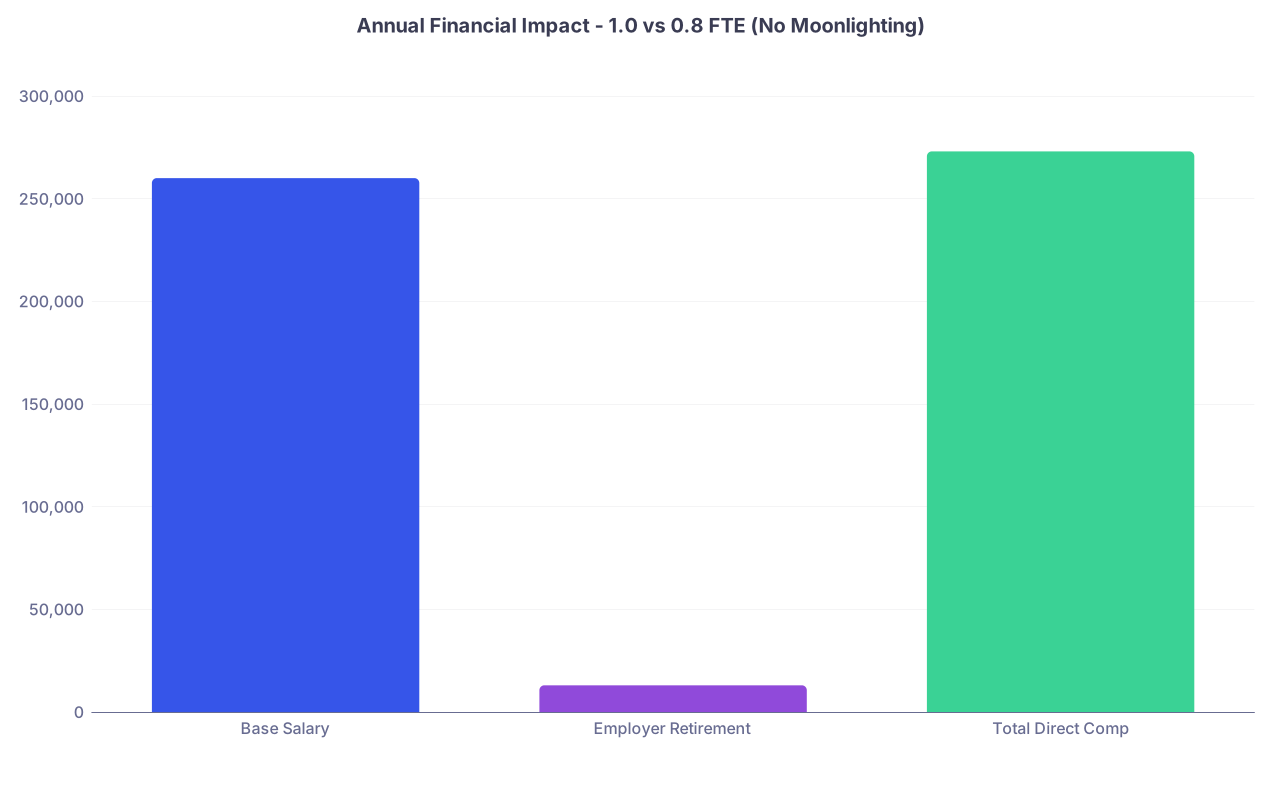
| Category | Value |
|---|---|
| Base Salary | 260000 |
| Employer Retirement | 13000 |
| Total Direct Comp | 273000 |
If you drop to 0.8 FTE and do not moonlight:
- Salary loss: $52,000/year.
- Employer retirement loss: $2,600/year.
- LTD / life benefit base drops by 20%.
Is that worth one fewer clinic day or a few fewer shifts a month? For some people, absolutely. Burnout is expensive too.
But if you plan to moonlight:
Let us say you pick up:
- 4 moonlighting shifts/month.
- 10 hours/shift.
- $200/hour.
That is 40 hours/month x 12 months = 480 hours/year → $96,000 gross.
Now your total income:
- Base job (0.8 FTE): $208,000
- Moonlighting: $96,000
- Total: $304,000
Versus full-time base $260,000.
So you could:
- Work fewer “core” hours.
- Potentially control when and how you moonlight.
- Increase total income if you are willing to trade stability for more variable work.
You still lose:
- Some employer retirement contributions.
- A portion of disability and life coverage base.
- Some institutional seniority “optics” of being full-time.
You gain:
- Schedule control.
- Diversified income streams.
- A test drive of partial independence (which matters if you are eyeing locums, telehealth, or entrepreneurial work in the “future of medicine” space).
Where FTE Fits Into the Future of Physician Work
Let me zoom out for a moment.
Hospitals and large groups are quietly shifting more physicians into “partial FTE” arrangements:
- 0.8–0.9 FTE “core” clinician + per-diem or moonlighting work to flex coverage.
- More telehealth, urgent care, and after-hours coverage built around fractional employment.
- Hybrid arrangements where academic time or admin time is carved out as a slice of FTE.
At the same time, more physicians are rejecting the classic 1.0 FTE employed model:
- They want portfolio careers: part-clinical, part-telemedicine, part-education, part-innovation.
- They do not want all risk tied to one employer, one chair, one RVU formula.
In that world, understanding FTE is not optional. It is foundational.
You will see more offers like:
- 0.6 clinical FTE + 0.2 admin FTE + 0.2 research FTE.
- 0.7 hospitalist FTE + 0.3 telemedicine contractor work.
- 0.8 academic FTE + 0.2 startup consulting or advisory work.
If you treat FTE as a simple hours question, you will miss the structural leverage. You want to design your FTE in a way that:
- Keeps you in the benefit tier you care about (health, retirement eligibility, disability).
- Maximizes your ability to add higher-value side work.
- Protects downside risk (disability, job loss, policy changes).
The physicians who will thrive in the next decade are the ones who read their FTE clauses as carefully as they read their base salary.

| Step | Description |
|---|---|
| Step 1 | Start - Considering FTE Change |
| Step 2 | Consider Independent or Spouse Plan |
| Step 3 | Calculate Lost Salary vs Moonlighting Income |
| Step 4 | Weigh Lifestyle Gain vs Direct Pay Cut |
| Step 5 | 0.8 FTE Reasonable |
| Step 6 | Stay 1.0 FTE or Negotiate Hybrid |
| Step 7 | Need Full Health Benefits |
| Step 8 | 0.8 FTE Eligible for Same Plan |
| Step 9 | Plan to Moonlight |
| Step 10 | Still Above Target Income |
| Step 11 | Burnout Risk High |
Practical Checklist Before You Drop from 1.0 to 0.8 FTE
Use this as a brutal, no-excuses checklist. If HR or your department cannot answer these, you have a problem.
Health Insurance
- At 0.8 FTE, am I eligible for the same plans as 1.0?
- How exactly do my payroll premiums change?
Retirement
- Is the employer match/contribution percentage unchanged at 0.8?
- Is there any full-time-only retirement component or pension credit?
PTO and Leave
- How many days of PTO, CME days, and holidays at 0.8?
- Is paid parental leave still available and at what pay rate?
Disability and Life
- How are group LTD and life insurance calculated (percentage of which income)?
- Is there any FTE threshold where I lose eligibility?
Moonlighting and Outside Work
- Are there restrictions on external clinical work at 0.8?
- Are internal moonlighting/banked shifts allowed or paid differently?
Performance Expectations
- Are RVU/clinic volume/quality metrics pro-rated explicitly in writing?
- Will my panel size or administrative load truly drop to match FTE?
If you do not like the answers, you have three realistic moves:
- Stay at 1.0 FTE and negotiate schedule flexibility, scribe support, or admin time instead.
- Accept 0.8 FTE but aggressively shore up independent disability and retirement savings.
- Leave for a system that structures 0.8 FTE logically and fairly.
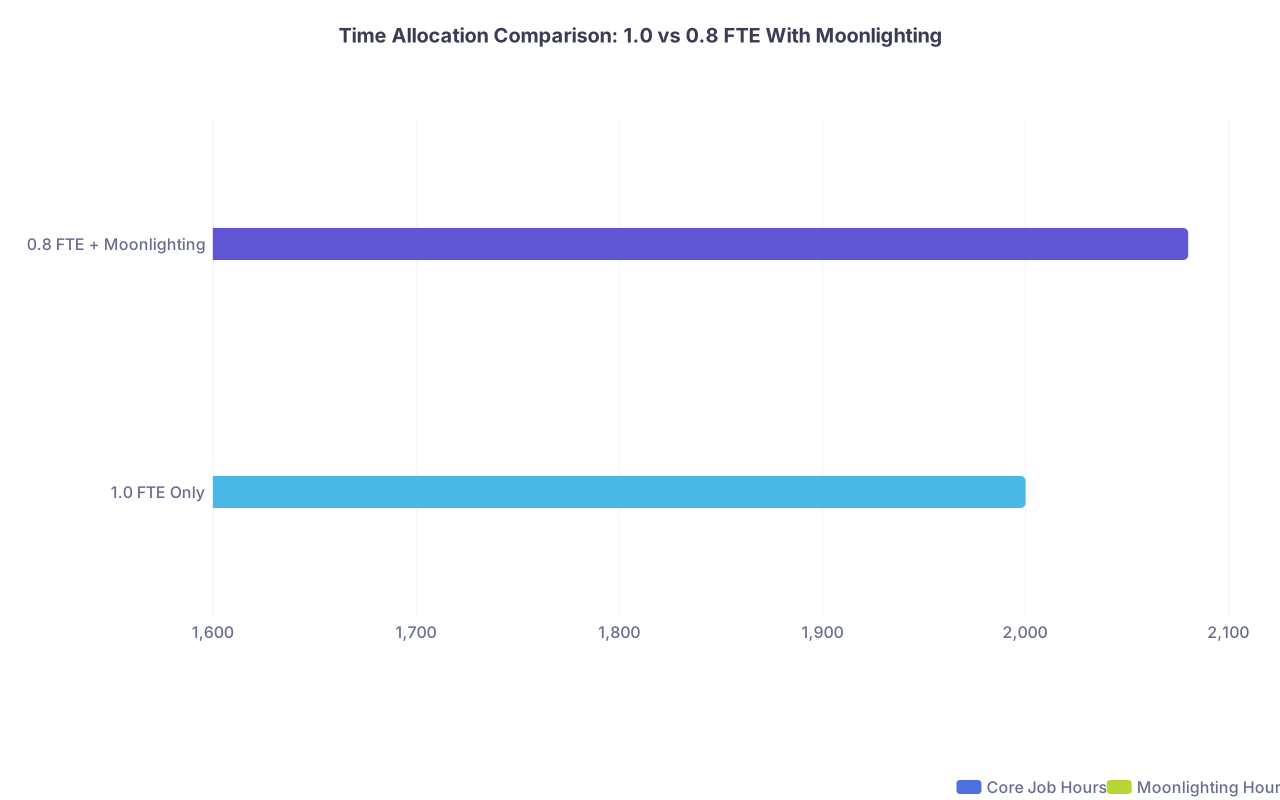
| Category | Core Job Hours | Moonlighting Hours |
|---|---|---|
| 1.0 FTE Only | 2000 | 0 |
| 0.8 FTE + Moonlighting | 1600 | 480 |
FAQ (Exactly 5 Questions)
1. Is 0.8 FTE always considered “full-time” for benefits?
No. Many systems treat ≥0.8 as full benefits-eligible, but others use 0.75 or even 0.9 as the cutoff. You have to ask for the written policy for your specific employer. Never assume 0.8 automatically equals “full-time” in HR language.
2. Does my malpractice coverage change if I go from 1.0 to 0.8 FTE?
Usually not, as long as you remain in an employed, benefits-eligible role. Your coverage is tied to your role, not your FTE fraction. Where you can get into trouble is when you add external moonlighting—then you must confirm whether the employer’s malpractice extends (it usually does not) and ensure the moonlighting entity provides appropriate coverage.
3. If I drop to 0.8 FTE and later go back to 1.0, do my benefits fully restore?
Typically yes, prospectively. Your salary, retirement contributions, and LTD base will increase with the new FTE. What does not come back is what you lost during the 0.8 period—smaller retirement contributions, lower disability base during that time, and any missed pension credit. Think of 0.8 FTE as creating a permanent gap in your long-term compounding, even if you later go back up.
4. Can I still max my 401(k) or 403(b) at 0.8 FTE?
In most physician jobs, yes. The IRS limit is not tied to FTE; it is tied to dollar amounts and your actual earned income. With a 0.8 FTE physician salary, you will almost always have enough income to hit the maximum elective deferral if you choose. The real constraint is whether you can afford the monthly cash flow hit, not a rule barring you from contributing.
5. Is going to 0.8 FTE a good strategy to allow more moonlighting income?
It can be, but only if you do the math and understand the risks. For many physicians, a 0.8 core job plus strategic moonlighting yields higher total income and better lifestyle control. For others, it becomes “two jobs, no real rest” and erodes the very burnout relief they were chasing. The smart move is to model one full year of 0.8 + projected moonlighting hours, including tax impact and benefits changes, before you sign anything.
Key Takeaways
- FTE is not just about hours. It is the lever that determines your salary, benefits tier, disability coverage, and retirement compounding.
- The 0.8 vs 1.0 decision only makes sense when you quantify all effects: base pay, employer retirement, insurance thresholds, and realistic moonlighting income.
- The future of physician work will be built around fractional FTEs and portfolio careers. Those who understand the fine print of FTE will have more control, more options, and fewer nasty surprises.