
Hospitalist vs Clinic Compensation Models: RVU vs Salary Hybrids
It is 6:45 p.m. You are finishing a 12‑hour hospitalist shift, signing your sixth discharge summary of the day. Your friend texts from clinic: “Just finished my last add‑on, stayed an extra hour, zero extra pay. FML.”
You both make “around 250k.” On paper. But the way those dollars are generated, what is required to earn them, and how much upside or downside you actually have? Completely different games.
You hear phrases on interviews like “RVU‑based with a strong base,” “salary plus productivity kicker,” “wRVU with conversion factor adjustment annually,” and “guaranteed for year one.” Half the time, the recruiter cannot really explain it. And a lot of physicians sign contracts without understanding they just agreed to a comp model that quietly shifts risk from employer to doctor.
Let me walk this out cleanly: how hospitalist and clinic compensation models actually work, with a focus on RVU vs salary hybrids, where people get burned, and how to evaluate offers without needing a JD and an MBA.
The Core Difference: Hospitalist vs Clinic Reality
Before we talk RVUs and “hybrids,” you need the basic economic reality clear.
Hospitalist world:
– Revenue tied mostly to admissions, daily E/M, procedures, and hospital throughput.
– Work is chunked into shifts.
– Coverage is non‑optional: bodies must be on the schedule, or the hospital shuts down admissions.
– Programs need predictable coverage more than they need “peak performance from each doctor.”
Clinic world:
– Revenue tied heavily to visit volume and acuity, plus procedures, chronic care management, etc.
– Work is spread across 5 days, panel‑based, less “binary coverage” and more “productivity and access.”
– A full schedule is a revenue engine; an empty schedule is lost money.
– Admins care intensely about how many butts you put in chairs per day and how fast.
That difference drives the comp philosophy:
Hospitalist comp tends to be shift‑based and/or base‑heavy with milder RVU exposure. They are paying you to be there and keep the hospital open.
Clinic comp tends to be RVU‑heavy or visit‑volume‑heavy with a lower base. They are paying you to produce billable encounters.
The “salary hybrid” is the attempt to balance stability with productivity incentives. Sometimes it works. Often it is marketing camouflage for “you take the risk if volumes tank.”
Quick RVU Primer (Without the Fluff)
You can not dissect comp models without understanding what an RVU actually is. I will keep this to what matters.
There are three RVU types:
- Work RVU (wRVU) – your labor and expertise. This is what almost all comp models use.
- Practice expense RVU – overhead (staff, space, supplies).
- Malpractice RVU – professional liability component.
Compensation uses wRVUs. You do work, you generate wRVUs. Those get multiplied by a “conversion factor” (dollars per wRVU) to create your pay.
Basic formula for the productivity portion:
Productivity pay = (Your wRVUs) × (Conversion factor $/wRVU)
Then you add base salary/shift pay, quality bonuses, etc.
Core problems:
- Most physicians do not know how many wRVUs they actually generate.
- Many do not know their contract’s dollar per wRVU.
- Even fewer understand how “targets” and “thresholds” interact with their base salary.
So they think: “I get 260k base, plus RVU bonus.” Reality might be: “I get a 260k guarantee that disappears unless I hit 5,500 wRVUs, and above that I get peanuts.”
Typical Hospitalist Compensation Structures
Think about hospitalist comp in four buckets. You will see variants of these over and over.
| Model Type | Stability | Productivity Pressure | Typical Use Case |
|---|---|---|---|
| Pure Shift Rate | High | Low | Community hospitals |
| Shift + Small RVU | High | Mild | Larger systems |
| Base + RVU Heavy | Moderate | High | Academic hybrids, HMOs |
| Nocturnist Premium | High | Low-Mild | Night coverage programs |
1. Pure Shift‑Based (No Meaningful RVU Component)
Example:
– $2,100 per 12‑hour day shift × 15 shifts/month × 12 months = 378k.
– Census expectation: up to 16–18 encounters/day.
– No productivity bonus worth mentioning.
This is the simplest. You are paid for being present and covering the service. If census is light, you win. If census is insane, you lose (time and sanity), but your paycheck is the same.
Common where:
- Smaller community hospitals.
- Groups that value coverage predictability and provider retention over squeezing every RVU.
- Intensivist or closed ICU models often similar.
Pros:
– Income is predictable.
– You are not pressured to “upcode” or cram in pointless documentation for a few extra RVUs.
– Easier to moonlight elsewhere because baseline comp is clear.
Cons:
– If you are efficient and high‑output, you are subsidizing your slower colleagues.
– No upside if you bust through volumes; only downside (burnout).
For hospitalists who value sanity and predictability, this is often underrated.
2. Shift‑Based + Modest RVU Bonus
Example:
– $2,000 per shift base.
– Target 4,500 wRVUs per year.
– Above target, $45 per wRVU.
So if you generate 5,500 wRVUs, you are 1,000 over target:
→ 1,000 × $45 = 45k productivity bonus.
This is the most common “hybrid” hospitalist model in larger systems. Coverage is guaranteed. They add an RVU carrot to push:
- More discharges before 11 a.m.
- Squeezing in late admissions.
- Taking on higher census without formally increasing shift count.
Pros:
– Tolerable pressure. Your core income is still shift‑anchored.
– Some real upside if you are efficient and the system supports your workflow.
Cons:
– Targets can be quietly adjusted yearly.
– Documentation and coding support matter enormously. Bad coders = lost money.
– Politics of “who gets the extra admissions” suddenly impact your pay.
If you are a hospitalist, you want this structured so at your expected census and shifts, you are at or slightly above target without heroic measures.
3. Base Salary + Heavy RVU Component (Hospitalist Version)
Less common but creeping in, especially in academic or hybrid roles.
Example:
– 220k base.
– 5,000 wRVU minimum expectation.
– $50 per wRVU for all wRVUs, but base counts as “prepaid” RVUs.
Here is how the math actually behaves:
- 220k ÷ $50 = 4,400 “prepaid” wRVUs.
- If you generate 5,000 wRVUs, you generated 600 “bonus” wRVUs.
- 600 × $50 = 30k.
- Total comp: 250k.
There is your “250k hospitalist job.” But if volumes dip, or they add non‑billable tasks?
- 3,500 wRVUs → less than “prepaid” 4,400.
- Contract might say they can claw back or reset your base after year one.
This model pushes hospitalists toward clinic‑style productivity pressure in an environment where much of your work is non‑billable: family meetings, care coordination, admission phone calls, system meetings. That is why this kind of structure, when pushed hard, is usually bad for physicians.
4. Nocturnist Premium Models
Usually an overlay on any of the above:
- +20–40% per shift vs days.
- Sometimes extra “admission RVU” bumps.
- Often pure shift‑based to sweeten the nights.
You rarely see heavy RVU exposure on nocturnists, since the value is pure coverage and safety. If they start tying nocturnist pay tightly to RVUs, I start getting suspicious: they want a warm body at night but do not want to pay the real market premium.
Typical Clinic Compensation Structures
Now, clinic. Very different story. Here productivity truly drives the business.
1. Straight Salary (Declining in Pure Form)
You still see this in:
- Some academic general internal medicine or pediatrics.
- FQHCs and safety‑net clinics.
- Large integrated systems where salary is standardized, and RVUs are “monitored” but not tightly tied to pay.
Example:
– 210k base, 8 half‑days clinic/week, 1 admin half‑day, minor quality bonus.
– Panel size expectations, but no explicit RVU tie.
Pros straightforward: stability. No direct dollar impact for doing 18 vs 24 patients a day.
Cons: in practice, expectations creep. Admins push access, but your comp stays flat. So the work escalates with no financial recognition.
2. Salary + RVU Bonus (Clinic Hybrid)
This is the typical private or employed multispecialty clinic model.
Example:
– 220k base.
– 4,800 wRVU annual target.
– Above 4,800, you get $40 per wRVU.
If you hit 6,000 wRVUs:
– 6,000 – 4,800 = 1,200 extra.
– 1,200 × $40 = 48k bonus.
– Total: 268k.
On paper: nice. In reality, you must ask three specific questions:
- What patient volume equates to 4,800 wRVUs in this clinic’s actual coding habits?
- Who controls your schedule templates (15 vs 20 vs 30 min slots)?
- Are you inheriting a robust panel or starting from near zero?
If it takes you 24+ patients per day to reach that target, and you currently tolerate 18–20, you are signing up for more work for marginal pay. Especially if support staff is thin.
3. Pure RVU‑Based with Draw (Clinic “Eat What You Kill”)
This is the full productivity model.
Example:
– No true base. You get a monthly “draw” (advance) against your expected earnings, e.g., 18k/month.
– Contract: $50 per wRVU, no threshold.
– At year’s end, they reconcile:
– Earned = your wRVUs × 50.
– If earned > draw × 12, you get the difference.
– If earned < draw, you might owe, or they reduce next year’s draw.
This is essentially private‑practice style comp under an employed umbrella.
Pros:
– If you are high‑output and have demand, ceiling is high.
– Very transparent: you know your conversion factor and can do the math weekly.
Cons:
– You carry volume risk. Summer dips, pandemics, system schedule screwups—your problem.
– Early years (panel building) can be rough unless they front‑load with guarantees.
Primary care in pure RVU models often burns out unless panel maturity, staff support, and workflow are excellent.
RVU vs Salary Hybrid: Where the Traps Live
The word “hybrid” gets thrown around loosely. Let me break down the specific ways these models are engineered to shift risk.
The “Guarantee” That Expires
Common pattern:
- Year 1–2: guaranteed base regardless of RVUs (“ramp‑up”).
- Year 3+: comp tied to RVU production with lower or no guarantee.
If you see this, assume:
- Year 1 is fantasy. They will keep you happy while you build panel/volume.
- Year 3 shows their real expectation of your sustainable output.
So when someone says: “270k guaranteed for two years, then productivity model with target of 6,000 wRVUs,” your mental response should be:
“Ok, so the real job is a 6,000 wRVU job. What volume does that mean, and is that feasible here?”
For hospitalists, this shows up as:
- First year: flat per‑shift rate.
- Renewal: they slide in wRVU thresholds and bonus structures that effectively lower your guaranteed per‑shift equivalent.
Thresholds vs True Multipliers
Two key RVU designs:
- Tiered threshold bonus:
- No pay on first 4,500 wRVUs (“baked into salary”).
- $40 per wRVU from 4,501–5,500.
- $50 per wRVU > 5,500.
- True multiplier model:
- All wRVUs paid at $50 each, but your base is just an advance.
The tiered model almost always underpays your actual productivity. Especially if the threshold is set high relative to the base.
You need to reverse‑engineer:
Base ÷ $ per wRVU = implied RVUs “covered” by the base.
If that implied number is very close to (or higher than) the stated “target,” you are not really getting a meaningful productivity upside.
Side‑by‑Side: Hospitalist vs Clinic Hybrid Math
Let us put some numbers to a comparison.
Say you are choosing between:
- Job A: Hospitalist, 15 shifts/month, shift+RVU hybrid.
- Job B: Outpatient internal medicine, 8 clinic sessions/week, RVU hybrid.
Here is a reasonable schematic:
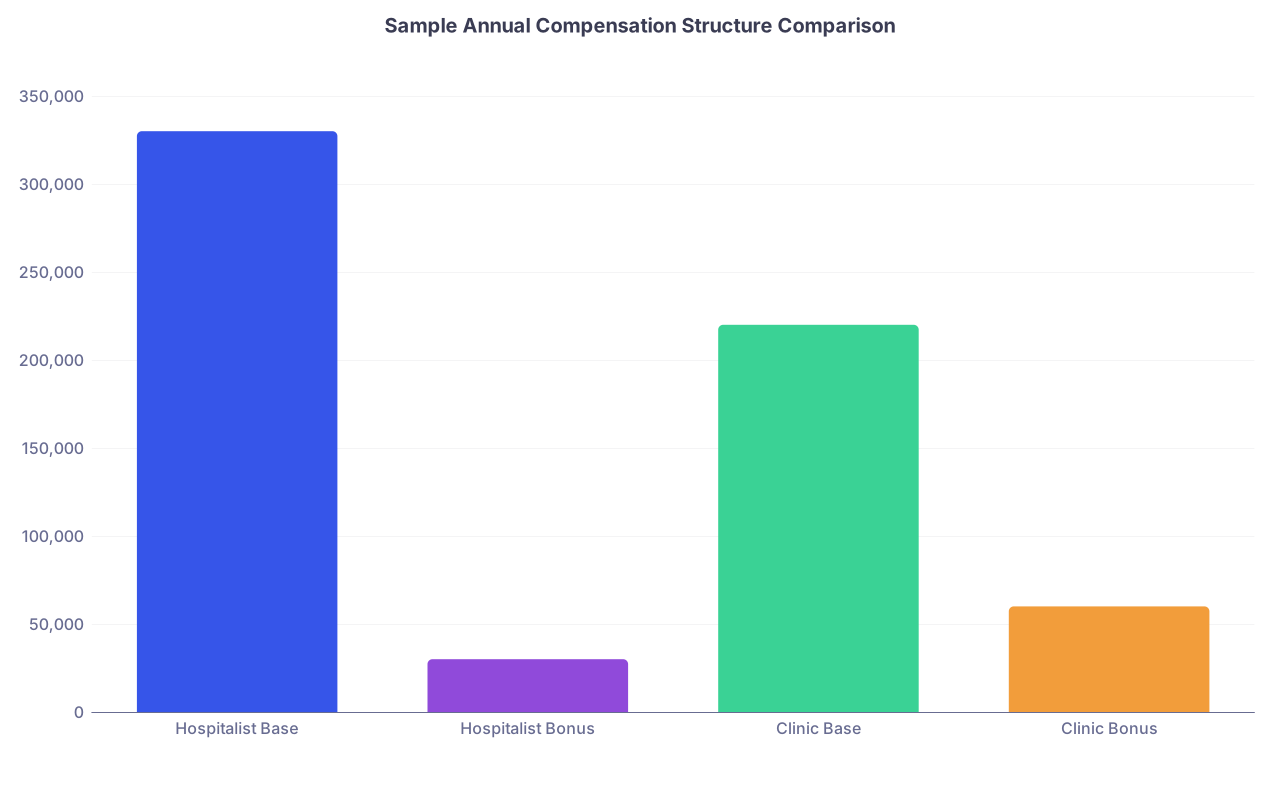
| Category | Value |
|---|---|
| Hospitalist Base | 330000 |
| Hospitalist Bonus | 30000 |
| Clinic Base | 220000 |
| Clinic Bonus | 60000 |
Job A – Hospitalist:
– $1,833/shift × 180 shifts/year ≈ 330k base.
– Target 4,500 wRVUs. You typically produce 5,000.
– $60 per RVU above target:
– 500 × 60 = 30k.
– Typical total: ~360k for 15 shifts/month.
Job B – Clinic:
– 220k base.
– Target 4,800 wRVUs. You expect 6,300.
– $40 per RVU above target:
– 1,500 × 40 = 60k.
– Total: 280k.
Now add reality:
Hospitalist: compressed time, intense days, 15 days “on,” 15 “off” (not really fully off, but no clinical duty). Work is high‑stress but bounded in time.
Clinic: 5 days/wk, 45+ weeks/year, with inbox, refills, messages, and unpaid patient communication time nights/weekends. You will generate those 6,300 wRVUs by living in your EMR.
If you hate inpatient chaos and love continuity, you might still pick clinic. But from pure compensation‑per‑unit‑pain perspective, the hybrid clinic model here is worse.
Where Moonlighting Fits into This
Category is moonlighting and benefits, so let us be direct about how these comp structures interact with side gigs.
Hospitalist Side
If your primary job is:
Pure shift‑based, predictable schedule, minimal RVU tie → ideal for moonlighting. You know your income, and any extra shifts elsewhere are true incremental dollars.
Heavily RVU‑based hospitalist job → every extra shift you pick up at a lower RVU value cannibalizes potential productivity at your main site. You might be better off adding an extra “core” shift if possible.
Moonlighting pay is almost always:
- Flat per shift.
- No RVU count toward your main job.
- Sometimes 1099 (independent contractor) with no benefits.
So hospitalists with stable base comp models often use moonlighting to:
- Hedge against future comp changes.
- Test other systems for potential future job switches.
- Boost income without RVU spreadsheets hanging over them.
Clinic Side
Clinic jobs tied heavily to RVUs create two problems:
- Time: Your work bleeds outside clinic hours. Moonlighting means compressing even more charting and inbox into nights/weekends.
- Fatigue: High‑volume clinic work plus hospital shift moonlighting is where people end up joining physician wellness committees ironically.
That said, some clinic physicians:
- Moonlight as hospitalists/EDs/urgent care 2–4 times per month.
- Use that income to offset relatively weaker base pay.
But make no mistake: an RVU‑heavy clinic job plus moonlighting is often a recipe for long‑term burnout unless you ruthlessly control panel size and template insanity.
Non‑RVU Hybrid Tweaks You Will See
RVUs are not the only lever. Some systems dress up comp with “hybrids” that are really just extra hoops.
Quality / Value‑Based Components
Common add‑ons:
- 5–15% of comp variable based on:
– Readmission rates.
– HEDIS / ACO quality metrics.
– Patient satisfaction scores.
– Documentation completeness (problem lists, med rec).
For hospitalists, this is often team‑based. So your pay is linked to the weakest link. For clinic, more individual.
These metrics are often:
- Opaque.
- Subject to data problems you do not control.
- Not nearly as lucrative as the recruiter’s glossy brochure implies.
I treat quality money as “nice if it appears, but I do not count on it to pay my mortgage.”
Panel‑Size Adjusted Salaries (Clinic)
Some clinics fuse panel size, RVUs, and salary:
- Base pay tied to number of attributed lives.
- RVU and quality pay on top.
This can be good if:
- Panel size truly limits how much they can overload your schedule.
- System buys into value‑based care and supports robust team‑based management.
It is bad if:
- They assign a massive panel, then still expect 22–24 patients a day and full RVU targets. You are getting double‑counted.
How to Evaluate a Specific Offer (Without Getting Played)
Here is the sequence I use when residents and fellows send me contracts.

| Step | Description |
|---|---|
| Step 1 | Get Offer Details |
| Step 2 | Identify Base Pay Type |
| Step 3 | Check Shifts per Year |
| Step 4 | Check FTE Expectations |
| Step 5 | Ask About RVU or Bonus Layer |
| Step 6 | Get RVU Targets and Rate |
| Step 7 | Estimate Realistic RVUs |
| Step 8 | Calculate Total Pay Range |
| Step 9 | Compare to Workload and Lifestyle |
| Step 10 | Shift or Salary? |
Concrete checklist:
Ask explicitly: “Is my primary compensation based on shifts, base salary, or RVUs?”
Get the exact numbers in writing:
– For hospitalist: dollars per shift, shifts per year, nocturnist differential, and any RVU thresholds and rates.
– For clinic: base salary, expected sessions/week, expected wRVUs, conversion factor, and any guarantees/expiration dates.Reverse‑engineer the base:
– Base ÷ $/wRVU = implied RVUs covered.
– Compare that to the “target.” If they are nearly the same, your RVU “bonus” is thin.Ask for real production data for similar physicians:
– Median and 75th percentile wRVUs for hospitalists in the group.
– For clinic: what do their average internists/family docs actually generate? 4,500? 6,000? 7,500?Do the math on three scenarios:
– Conservative (low volume year).
– Typical (mid‑volume).
– High‑volume (you pushing hard).
If your conservative scenario does not cover your basic financial needs, you are assuming risk that the employer should be bearing.
Where This Is Headed: Future of RVU vs Hybrid Models
We are in a messy transition era. Fee‑for‑service is not dead. Value‑based care is not fully born. Compensation models are band‑aid hybrids trying to make conflicting incentives coexist.
Trends I see:
Hospitalist comp:
– More shift‑based or panelized (e.g., dedicated SNFist/hospitalist hybrids) with mild RVU tweaks.
– Gradual increase in non‑RVU quality or throughput bonuses tied to LOS, readmissions, etc.
– Systems realizing too‑aggressive RVU pressure on hospitalists backfires in burnout and turnover.Clinic comp:
– Slow movement from pure RVU to panel + quality + moderate RVU.
– More team‑based bonuses (PCMH, ACO shared savings), though these checks are often sporadic and opaque.
– Telehealth, e‑visits, and asynchronous care getting formalized into RVU or “visit‑equivalent” buckets.
The bad news: hybrids can absolutely be weaponized to reduce employer risk at your expense. The good news: once you understand the mechanics, you can see it coming in the contract.
Three Key Takeaways
Hospitalist compensation is usually coverage‑anchored with RVUs as a side dish; clinic compensation is usually productivity‑anchored with salary as the cushion. Do not confuse the two.
Any “salary + RVU hybrid” must be reverse‑engineered: base ÷ $/wRVU to see what you are really being paid for and how much true upside exists.
For moonlighting and long‑term sanity, a predictable shift‑based hospitalist model is usually more compatible than an RVU‑heavy clinic job. If you accept high RVU exposure, you should be paid noticeably above guaranteed/shift‑based peers or you are trading stability for nothing.