
It is 11:30 p.m. You just finished a brutal 12‑hour hospitalist shift. Your phone buzzes: an email from a lucrative telehealth platform and another from a local private group offering a part‑time gig. Perfect moonlighting opportunities. Then you remember: your current contract has a “non‑compete” and some vague “geographic restriction” language you skimmed during onboarding.
Now you are wondering: Can you take these moonlighting jobs without blowing up your current employment? Can they stop you from working in this city if you ever leave? And what happens to your side gigs when you finish residency or move states?
Let me break this down specifically.
1. What Non‑Competes and Geographic Restrictions Actually Are
Most physicians and advanced practice clinicians hear “non‑compete” and think “I cannot work anywhere near here if I leave.” That is only half true and often overstated.
At its core:
- A non‑compete (restrictive covenant) = limits what you can do and often where you can do it after leaving an employer.
- A geographic restriction = defines the radius or area in which you are restricted (sometimes for moonlighting, sometimes post‑employment).
Paired together, they control:
- Whether you can work for a “competing” entity.
- How far away you must go to avoid violating the clause.
- For how long you are bound after you leave.
You will typically see these in three contexts:
- Full‑time employment contracts (hospitalist, ED, outpatient practice).
- Residency/fellowship contracts (less common but increasingly present in hospital‑employed GME).
- Moonlighting and locums agreements (subtler, often hidden in “exclusivity” language).
The dirty secret: many of these clauses are drafted absurdly broadly. They stay that way because physicians sign them.
2. Key Legal Landscape: Where Non‑Competes Actually Stand
I am going to be blunt: you cannot argue with a contract based on vibes. You need to know the law where you practice.
There are three main variables:
- State law
- Federal agency moves (FTC, NLRB)
- Type of worker (employee vs independent contractor; physician vs NP/PA vs other)
2.1 State Law Buckets
States fall into rough categories.
| Approach Type | Example States |
|---|---|
| Strongly restrict/ban | CA, CO (new), MN, ND |
| Physician-specific limits | TX, TN, WI, MA |
| Generally enforceable | FL, OH, NC, GA, VA |
| Mixed/nuanced | NY, IL, PA, MI |
Notice California and a few others: they basically kill non‑competes for employees. Colorado and Minnesota have recently tightened rules. Other states (Texas is a classic example) allow physician non‑competes but impose specific conditions like buy‑outs or access to patient lists.
If you do not know your state’s stance, you are negotiating blind.
2.2 The FTC’s Proposed Non‑Compete Ban (And Why You Should Not Rely on It)
The FTC proposed a near‑total ban on non‑competes. Hospitals responded about as you would expect. Litigation followed. Even if a ban kicks in in some form, it will likely be:
- Challenged.
- Narrower than you are hoping.
- Unevenly applied to high‑earning professionals.
Do not base your career plans on “the FTC will save me.” Negotiate like your contract will be enforceable.
2.3 Employees vs Independent Contractors
Non‑compete enforceability and scope differ if you are:
- W‑2 employee (hospitalist employed by a big health system).
- 1099 independent contractor (locums, telehealth, many moonlighting positions).
Courts often scrutinize employee non‑competes more closely, but they will still enforce them if “reasonable.” Contractor agreements sometimes slide in uglier restrictions because companies assume you will not litigate.
3. The Mechanics: What These Clauses Actually Say (And What They Mean)
Let’s dissect a typical clause. You might see something like:
“For a period of two (2) years following termination of this Agreement for any reason, Physician shall not directly or indirectly provide professional medical services that are competitive with Employer within a twenty (20) mile radius of any facility at which Physician provided services during the final twelve (12) months of employment.”
Hidden landmines in that one sentence:
- Duration: two years
- Geographic scope: 20‑mile radius of “any facility” you worked at
- Scope of activity: “professional medical services that are competitive”
- Trigger: “termination for any reason” (including them firing you without cause or you resigning for good cause)
Now translate it into your life.
If you are a hospitalist working at three campuses across a metropolitan area, a 20‑mile radius from each might wipe out your entire city and all nearby suburbs. If you are a general internist, “competitive” will be interpreted very broadly.
4. How This Interacts With Moonlighting Specifically
You are here for moonlighting and benefits. This is where everybody gets into trouble.
4.1 Common Contract Language That Quietly Kills Moonlighting
Your main employment contract may include any of the following:
- “Physician shall not engage in any outside clinical practice without prior written consent of Employer.”
- “Physician shall not provide professional services for any other hospital, health system, group, or telehealth platform that competes with Employer.”
- “All professional services shall be performed exclusively for Employer during the term of this Agreement.”
These are not classic “post‑employment” non‑competes. These are in‑term exclusivity or geographic restrictions. Violating them while still employed can justify termination for cause, repayment of sign‑on bonuses, and more.
Then the moonlighting contract you are eyeing may have:
- “Contractor agrees not to provide telemedicine services through any competing telehealth platform for the duration of this Agreement and for one (1) year thereafter.”
- “Contractor shall not solicit or accept employment or engagement from any client or facility introduced by Company for two (2) years.”
Put them together, and you may be:
- Violating your primary contract by moonlighting at all.
- Locking yourself out of other moonlighting options in the region or via other platforms.
4.2 Geographic Overlap Traps
Example scenario:
- You work as a W‑2 hospitalist for BigHealth System at Hospital A and B.
- Your contract bans you from moonlighting “within 25 miles of any hospital owned or affiliated with Employer.”
- BigHealth has 18 satellites you never step foot in, scattered across a 70‑mile radius.
That clause essentially blocks you from:
- Local ED shifts at an “unaffiliated” community hospital that is actually in a management contract with BigHealth.
- SNF coverage for an independent group that rounds at a facility where BigHealth owns a minority stake.
- Urgent care shifts for a chain in the same city, depending on how “compete” is defined.
I have seen residents sign this kind of language with no idea it even hits their weekend moonlighting gig.
5. Evaluating Reasonableness: Time, Distance, and Scope
Courts care (in most states) about “reasonableness” of a non‑compete. Employers exploit the fact that physicians rarely push back.
Three levers:
- Time – how long does the restriction last?
- Distance – how far does it reach?
- Scope – what kind of work and context does it cover?
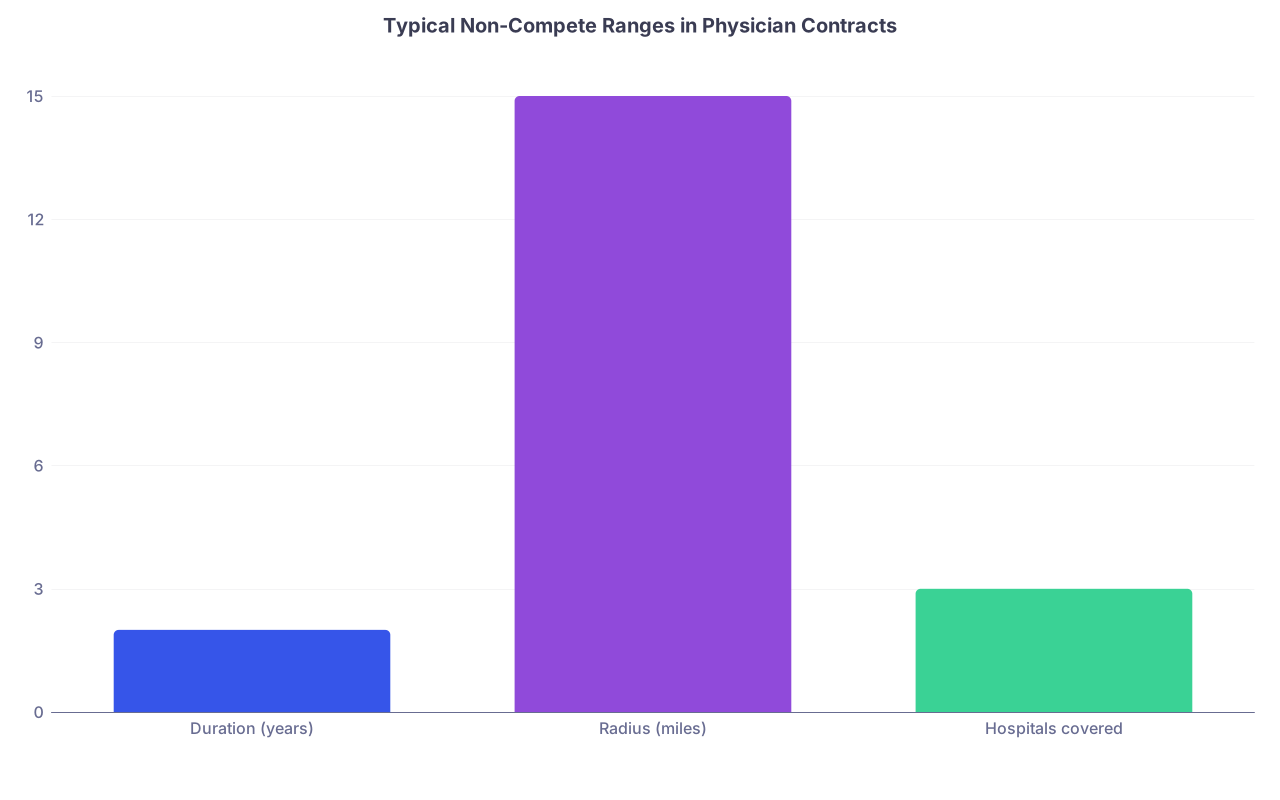
| Category | Value |
|---|---|
| Duration (years) | 2 |
| Radius (miles) | 15 |
| Hospitals covered | 3 |
Those numbers are close to what I routinely see: 1–3 years, 10–25 miles, and a radius around multiple sites.
5.1 Duration
- < 12 months: often considered reasonable.
- 12–24 months: common; borderline depending on specialty and region.
- > 24 months: starts to look punitive, easier to attack.
For moonlighting, any restriction that extends after the moonlighting relationship ends is almost always overreaching, especially for 1099 contractor work.
5.2 Distance
Context matters. A 20‑mile radius in rural Wyoming is not the same as 20 miles in Manhattan.
As a rough heuristic:
- Urban: 5–10 miles around a specific site is usually more than enough.
- Suburban: 10–15 miles.
- Rural/regional: 25+ might pass, but it should be tied to actual practice draw.
If the contract defines the radius from “any facility of Employer,” ask for it to be limited to each facility where you personally provide services at least X days per month.
5.3 Scope of Practice
The most dangerous phrase: “any practice competitive with Employer.”
You want it narrowed by:
- Specialty (hospitalist medicine, not all internal medicine).
- Setting (inpatient vs outpatient; telehealth vs in‑person).
- Service line (e.g., cardiology vs all internal medicine).
Hospitales love to draft clauses that would bar you from unrelated practice settings simply because they fall under the same corporate umbrella.
6. Typical Moonlighting Setups and How Non‑Competes Hit Each One
Let us walk through common moonlighting scenarios and exactly where the landmines are.
6.1 In‑House Moonlighting (Same Employer, Extra Shifts)
Example: You are a PGY‑3 resident moonlighting as an ED physician in the same system.
Risk profile:
- Low external non‑compete risk, because it is all within the same employer umbrella.
- But you may inadvertently become subject to the same non‑compete or geographic restrictions that attendings have.
What to check:
- Are moonlighting shifts governed by your residency contract, a separate addendum, or a distinct employment agreement?
- Does that add you as “medical staff” under broader health system policies with non‑compete language?
You need the scope clearly defined and ideally siloed from full attending non‑compete restrictions.
6.2 External Hospital or ED Moonlighting
Example: You are a hospitalist employed by Health System A and moonlight at a non‑affiliated community hospital 15 miles away.
You must cross‑check:
- Your primary contract: Does it ban outside clinical work without permission?
- Does it define competitors as “any hospital or health system within a 30‑mile radius”?
- Does it prohibit you from working for any entity that bills for the same CPT codes in the same catchment area?
If yes to any of those, you need written approval, or you are gambling with your main job.
6.3 Telehealth and Virtual Moonlighting
This is where people get cocky: “It’s video visits. It doesn’t count.”
Incorrect.
Non‑competes often care about:
- The location of the patient (state where patient is sitting).
- The location of the employer (telehealth company HQ, or where they credential).
- The defined market (if your employer runs its own telehealth service, you could be “competing” regardless of where you sit physically).
If your employment contract prohibits you from “providing virtual or telemedicine services through any platform other than Employer,” they mean it. Some systems explicitly tether this to any patient licensed in the state where their patients are, regardless of physical site.
7. Geographic Restriction Clauses Beyond Classic Non‑Competes
Non‑competes are only one part of the geography story. There are quieter, sneakier clauses that affect where and how you can work.
7.1 Non‑Solicitation of Patients and Referrals
These typically read:
- “Physician shall not solicit or attempt to solicit any patient of Employer for a period of 18 months within a 30‑mile radius.”
- “Physician shall not solicit any referral sources (PCPs, specialists) with whom Physician interacted during employment for 24 months.”
These can restrict your ability to:
- Advertise your new practice locally.
- Contact referring docs you used to work with.
- Market direct‑care or concierge side practices.
7.2 Non‑Solicitation of Employees
Common language:
- “Physician shall not solicit or hire any employee or contractor of Employer for a period of 24 months.”
This becomes relevant when:
- You start building a side telehealth or consulting business and want to recruit an MA, NP, or administrator you know.
- You join or start a competing practice that wants to hire nurses or coordinators from your old team.
7.3 Confidentiality + Trade Secrets as Functional Geographic Limits
You may see:
- “Physician shall not use or disclose any confidential information, including patient lists, payor contracts, billing methodologies, or practice development strategies.”
In practice, these clauses are used to scare you away from joining a competitor down the street, especially if you know where all the high‑RVU payors and referrers are.
8. Concrete Negotiation Strategies Before You Sign
You cannot fix a bad non‑compete after the fact. You fix it now, before signing, or you live with it.
8.1 Ask These Three Direct Questions
Do it in writing if you can:
- “How does this non‑compete apply to moonlighting and telehealth work during my employment?”
- “What are the specific facilities and addresses that define the geographic restriction?”
- “Can you provide a redline that limits this to my specialty, my primary practice site, and no more than X miles for no more than Y months?”
Watch how they answer. Hesitation or hostility is a red flag.
8.2 Specific Edits You Should Push For
Concrete examples:
- Change “any facility of Employer” to “the primary facility where Physician devotes at least 60% of clinical FTE.”
- Reduce distance from 25 miles to 10 or 15.
- Reduce duration from 24 months to 12 months.
- Tighten “competing practice” to “inpatient adult hospitalist medicine” rather than “practice of medicine.”
For moonlighting, insist on something like:
“Nothing in this Agreement shall prohibit Physician from providing professional services on a part‑time basis to other entities, including telehealth platforms or other hospitals, provided such activities do not materially interfere with Physician’s duties hereunder and do not involve disclosure of Employer’s confidential information.”
And then get specific written permission for any ongoing side gig.
8.3 Buy‑Out Clauses (Especially in States Like Texas)
Some states allow or require a “buy‑out” for physician non‑competes. If offered, do not just accept whatever number they throw in.
You want:
- A fixed, reasonable buy‑out (e.g., 3–6 months of base salary, not 2 years).
- Clarity that if you are terminated without cause or you resign for specific defined “good cause” (unpaid comp, unsafe staffing, etc.), the non‑compete and buy‑out both vanish.
9. Multi‑State Practice, Telehealth, and the Future of Restrictions
The future of medicine is not single‑site, single‑state, 9‑to‑5 outpatient. Your non‑compete should not be written like it is 1995.
Telehealth, multi‑state licensure, and compact licenses (IMLC, NLC) make geographic lines fuzzy. Employers respond by trying to claim:
- “Any state in which Employer operates” as the restricted area.
- Blanket bans on working for any telehealth platform for patients in the same states where they operate.
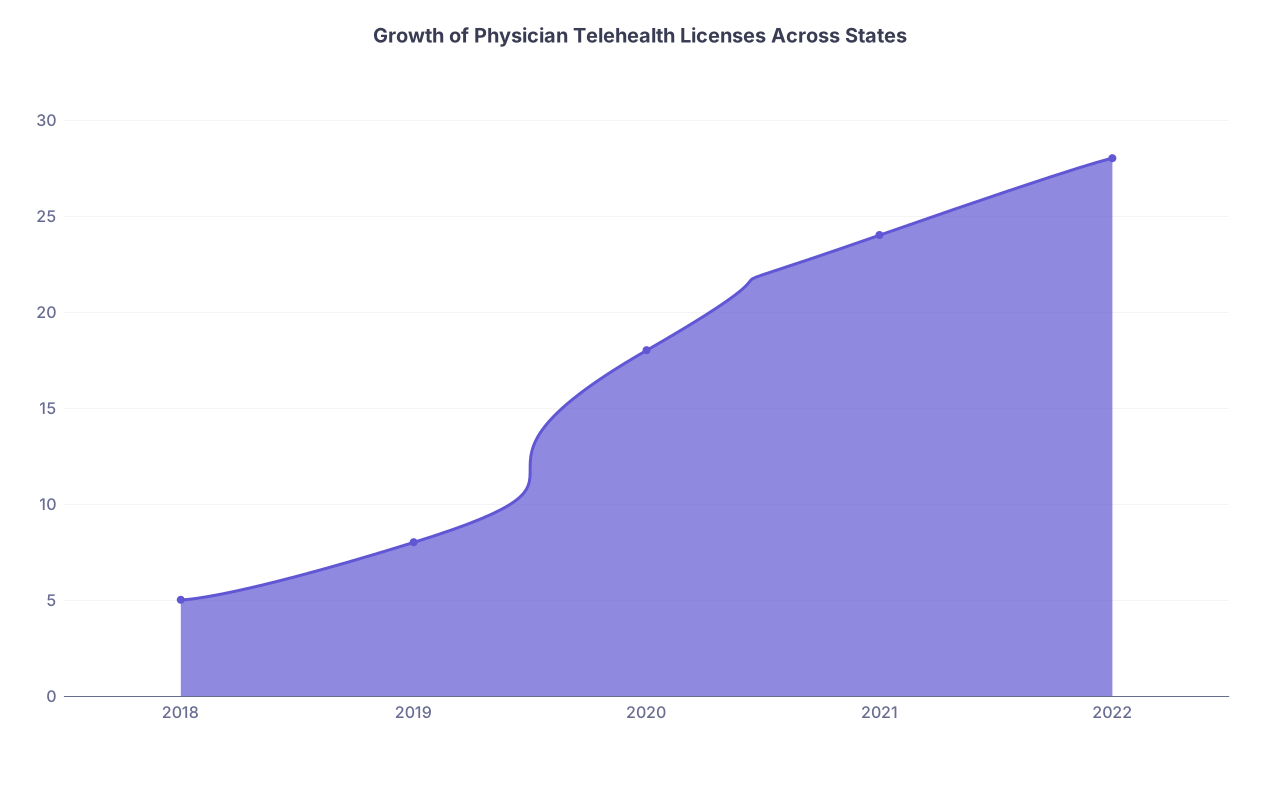
| Category | Value |
|---|---|
| 2018 | 5 |
| 2019 | 8 |
| 2020 | 18 |
| 2021 | 24 |
| 2022 | 28 |
That line reflects the reality: more clinicians hold multi‑state telehealth licenses. Contracts will increasingly try to chase that with broader non‑compete language.
What you should insist on:
- State‑specific restrictions. If you practice in State A physically, your telehealth non‑compete should not block you from purely virtual work in States B, C, D with no overlapping patient base.
- Specialty‑specific telehealth limitations. If you are an inpatient neurologist, a generic ban on “telemedicine services” is absurd.
10. What Happens If You Ignore or Violate a Non‑Compete?
Physicians love to say, “These are never enforced.” That is wrong. They are absolutely enforced, especially by large systems.
Typical sequence if you violate:
- Cease and desist letter to you and your new employer or moonlighting group.
- Threatened injunction to stop you from working.
- Demand for damages and sometimes repayment of sign‑on bonuses, relocation, or training costs.
New employers often back away fast when they get that letter. They do not want to fund litigation for someone they just hired.
Enforcement is especially aggressive when:
- You leave and immediately join the direct competitor across the street.
- You are high revenue (ortho, GI, cardiology).
- You recruit staff or patients from your prior job.
For moonlighting infractions, it often plays out as:
- Immediate termination from your main job.
- Loss of eligibility for bonus payouts, tail coverage, or loan forgiveness that required continuous employment.
- Reportable issues if they try to characterize it as “professional misconduct” (rare, but I have seen attempts).
11. Practical Game Plan: How to Protect Your Future Self
Let me make this brutally practical.
Step 1 – Inventory Every Relevant Contract
You should have copies (not vague memories) of:
- Current primary employment agreement.
- Any moonlighting contracts (past and present).
- Locums agreements.
- Telehealth platform agreements.
- Residency/fellowship contracts if they have ongoing obligations.
Read all sections titled:
- “Restrictive Covenants”
- “Non‑Competition”
- “Exclusivity”
- “Outside Activities”
- “Non‑Solicitation”
- “Confidentiality”
Step 2 – Map the Geography
Literally.
- Get a map.
- Plot your current employer’s facilities.
- Draw the radii they define (10, 20, 30 miles).
- Overlay where you might want to work or moonlight next.
You will immediately see whether the contract quietly blocks your entire metro area.
Step 3 – Define Your Non‑Negotiables
For many physicians, these are:
- You will not agree to be blocked from working in your current city for more than 12 months.
- You will not agree to a radius that essentially kills your ability to practice your specialty within reasonable commuting distance.
- You will not agree to a clause that bans all telehealth work across multiple states.
Walk away if they will not move on these and you have alternatives. This is not theoretical; I have seen physicians accept ridiculous clauses and then spend 1–2 years commuting 90 miles because of it.
Step 4 – Get Local Counsel When the Stakes Are High
If you are signing:
- Your first attending contract.
- A contract with a huge bonus or partnership track.
- Anything with a broad multi‑state, multi‑hospital non‑compete.
Spend the money on a healthcare attorney who actually negotiates physician contracts in your state. Not your cousin who “does real estate.”
12. The Future: Where Non‑Competes Are Likely Headed
We are not moving toward more physician freedom by default. We are moving toward:
- Larger corporate consolidation.
- More centralized telehealth platforms.
- Tighter system‑wide branding and market control.
Those entities will keep pushing for:
- Broader geographic restrictions (“any market where we operate”).
- Broader service restrictions (all telehealth, all in‑person, all consultative work).
- Longer durations masked as “reasonable” (18–24+ months).
On the other side, you have:
- Growing state‑level skepticism of non‑competes.
- Aggressive plaintiff’s lawyers itching to challenge abusive clauses.
- Physicians starting to walk away from predatory offers.
The physicians who do best in this environment are the ones who:
- Read the contracts.
- Push back early.
- Keep their options intentionally open (multi‑state licenses, diversified income streams, skill sets that travel well).
FAQ (Exactly 5 Questions)
1. If my state bans non‑competes, can I safely ignore geographic restrictions in my contract?
No. States that ban or limit non‑competes often still enforce other restrictive covenants: non‑solicitation, confidentiality, in‑term exclusivity. Employers may still threaten enforcement, and you or a new employer might cave to avoid a fight. You treat the contract seriously, even in a “ban” state, and have a local attorney confirm what is actually unenforceable versus what is just ugly.
2. Do non‑competes apply if I am terminated without cause or my contract is not renewed?
Depends on the wording. Some contracts explicitly say the non‑compete survives “regardless of reason for termination,” which is brutal. You should negotiate for language that voids the non‑compete if you are terminated without cause or if you resign for defined “good cause” like nonpayment, unsafe staffing, or breach by the employer.
3. Can my employer stop me from doing telehealth on my days off for a platform in another state?
They can try, and sometimes they succeed. If your contract includes exclusivity or non‑competition language that covers telehealth or “any clinical practice,” they may argue that even out‑of‑state telehealth is competitive. Stronger argument for them if they run their own telehealth service or are licensed in that state. You need that clarified and, ideally, carved out before you sign.
4. Are moonlighting restrictions usually enforceable against residents and fellows?
Frequently, yes. Residency and fellowship agreements that restrict outside employment or moonlighting are typically enforced by program policy rather than full‑blown litigation, but they can still cost you your spot or delay graduation. If a hospital‑employed GME program ties you into a post‑training non‑compete, that is more controversial and state‑dependent, and absolutely something to challenge before joining.
5. What is a reasonable non‑compete for a hospitalist in a mid‑size city?
Reasonable, in my view, is no more than 12 months, with a 5–10‑mile radius around the primary hospital where you actually work, limited to inpatient adult hospitalist medicine. Anything broader—multiple hospitals you never staff, 20–30 miles, 18–24 months, or bans on all internal medicine practice—crosses the line from business protection into anti‑competitive handcuffs. That is where you push back hard or walk.
Key points to keep: Non‑competes and geographic restrictions are not boilerplate; they decide where and how you can work for years. Moonlighting is not immune—exclusivity and “competitive services” language can quietly kill side gigs. And you have far more leverage before you sign than after. Use it.