The retirement clock started ticking the day you got your first paycheck—and nobody told you.
That’s what it feels like, right? You look up for two seconds from Anki or sign-out, see some attending posting about maxing their 401(k) in residency, and suddenly you’re doing compound interest math on your phone at 1:30 a.m., convinced you’ve already ruined your financial future.
Let me say this clearly:
You are not ruined. But you also can’t keep pretending this doesn’t matter.
You’re in this weird in‑between space:
- You’re not making real money yet
- You’re not exactly “young” in the traditional workforce sense
- And you feel like you’ve started the “adult” game ten years after everyone else
So the voice kicks in:
“Everyone else has a 401(k).”
“I’m almost 30 with no retirement account.”
“Every year I wait is millions lost, right?”
Let’s unpack this without sugarcoating it—but also without the unnecessary panic spiral.
What “Behind” Actually Means (And Where You Probably Stand)
First thing: you feel behind because you are behind compared to your college friends who started at 22 in tech, finance, engineering.
But that’s the wrong comparison group.
Your actual cohort is other physicians on the same training timeline. And here’s the uncomfortable but true thing:
Most residents and many early attendings are an absolute mess with retirement planning.
I’ve watched PGY-3s with $7 in their checking account two days before payday.
Fellows who still don’t know if their hospital even has a retirement plan.
Brand new attendings making $350k who haven’t signed up for their 401(k) after 18 months.
You’re not the outlier for having no retirement benefits yet. You’re the norm.
The real danger isn’t that you don’t have benefits right now.
It’s that if you don’t understand how this works, you might waste your first 5–10 attending years, which are your highest power years for compounding.
Let’s put some numbers to this.
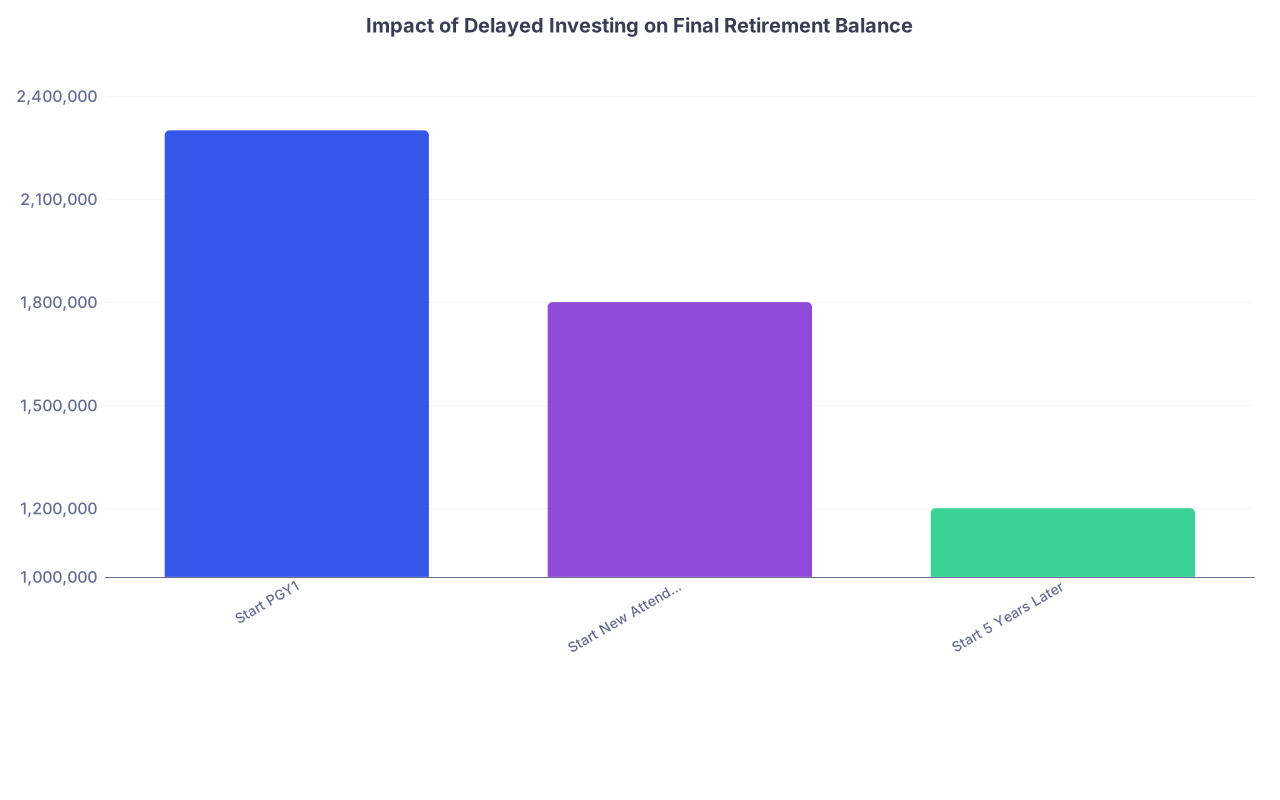
| Category | Value |
|---|---|
| Start PGY1 | 2300000 |
| Start New Attending | 1800000 |
| Start 5 Years Later | 1200000 |
Assumptions: $10k/year invested, 7% return, retiring at 65.
Is this exact? No. But directionally? Dead on.
You’re not “late to the party” right now as a student or resident.
You become late when you’re an attending and still not doing anything.
Why You Don’t Have Benefits Yet (And Why That’s Not Totally Your Fault)
Medical training is almost designed to make you bad at this.
You’ve probably had:
- Zero formal teaching on retirement accounts
- Vague comments like “you should start investing early” with no specifics
- A vibe that talking about money is… gross? Less noble? Not what “real” doctors care about?
Then you get:
- Med school: no income, just debt and vibes. No 401(k), no employer. You can’t really save for retirement unless you have significant outside support or side income.
- Residency: small-ish income, insane hours, mental bandwidth of a goldfish at 2 a.m., plus maybe a 403(b) or 401(k) buried somewhere in your HR portal that no one explained properly.
So you tell yourself: “I’ll figure it out when I’m an attending.”
This is the most dangerous sentence in physician finance.
Because “I’ll figure it out later” turns into:
- “I need to move and get settled.”
- “I need to pay off my credit cards.”
- “I’ll start after my loans are under control.”
- “We’re having a baby, this is a bad time.”
- “Daycare is expensive, I’ll start in a few years.”
And suddenly it’s been five attending years. Gone.
What Actually Counts as “Retirement Benefits” For You
Let’s translate the alphabet soup into “Do I have anything or not?”
Here’s what usually exists in medicine:
| Role | Typical Account Type | Employer Match? | Realistic To Use? |
|---|---|---|---|
| Med Student | Roth IRA (self) | No | Hard, but possible |
| Resident/Fellow | 401(k) or 403(b) | Sometimes | Yes |
| Attending W-2 | 401(k)/403(b), 457(b) | Often | Absolutely |
| Attending 1099 | Solo 401(k), SEP IRA | No | Yes, self-funded |
You might be telling yourself “I have no retirement benefits” when what’s actually true is:
- You haven’t signed up for your residency 401(k)/403(b)
- You haven’t opened your own Roth IRA
- You haven’t thought about moonlighting money beyond “more take‑home = more DoorDash”
The system doesn’t make this intuitive. HR emails are 9 pages of jargon. Orientation day is a blur. And nobody sits you down and says, “Do this specific thing now.”
So you do nothing, and call it “no benefits.”
If You’re a Med Student: “I Have Literally Nothing, Is That Bad?”
Short answer: No, it’s not fatal. But you can actually do something if you want to stop feeling helpless.
Real talk:
If you’re living on loans, you are not expected to be contributing to retirement. You don’t have taxable “earned income,” so you can’t contribute to most accounts unless you also have a job.
You’re not behind relative to other med students. The problem is the timeline. Your classmates in other fields started work at 22. You’ll maybe start at 28–32.
So what can you do?
- Stop doom‑scrolling retirement calculators that assume people start at 22
- Learn the basics now so you’re not trying to decode “Roth vs Traditional” during intern year post-call
- If you do have a legit job with W-2 income (tutoring, scribing, etc.), you can open a Roth IRA with that income—doesn’t have to be big. Even $500–$1000/year builds the muscle of “I am someone who invests.”
The real advantage right now isn’t the money you can contribute. It’s the fact that you can enter residency already knowing exactly what to click when that HR email shows up.
If You’re a Resident/Fellow: “I Haven’t Signed Up For Anything. Am I Screwed?”
This is the group I see panic the hardest.
You meet a co-resident who says they’re maxing a Roth IRA and putting 10% in their 403(b), and suddenly you feel like a financial corpse.
Let me be blunt:
If you’re PGY-2 or PGY-3 and have never touched your retirement options, you haven’t blown your future.
But you do need to stop ignoring it.
Here’s the hierarchy, if you’re trying to keep it simple and not become a personal finance nerd:
Figure out if your program offers a match.
Not “maybe” or “I think so” or “someone said.” Log in to the HR portal. Email HR if needed.- If there’s a match (ex: 3% of your salary if you contribute 3%) and you’re not taking it, that’s free money you’re throwing away.
If there is a match: contribute at least to the match.
Even if it’s like $100–$200 per paycheck. You’ll barely notice it after a month or two.If there’s no match or you want to keep things dead simple: open a Roth IRA.
Why Roth during training? Your tax bracket is probably the lowest it will ever be in your career. Paying tax now for tax‑free later is usually a good trade.Invest it in something boring and broad.
A simple target-date index fund or a broad stock index fund (like “Total US Stock Market”) is fine. If you’re thinking about picking stocks, stop. You don’t have time for that.
And if you’re thinking:
“I’m so far behind, what’s the point of starting with $50–$100 a month?”
This is the perfectionism talking. The “if I can’t do it perfectly, I won’t do it at all” voice.
That voice is how people end up at 40 with nothing.
Moonlighting and Retirement: Is Extra Income Your Way to Catch Up?
Here’s where this actually intersects with “Moonlighting and Benefits.”
- A stress reliever (ironically) because you feel less trapped by your base salary
- A tool to jumpstart retirement if you’re feeling behind
But only if you don’t treat it like “fun money.”
I’ve seen:
- Residents pick up 2–3 moonlighting shifts a month and designate 50–100% of that income straight to Roth IRA or 403(b) contributions
- Fellows using moonlighting entirely to build a 3–6 month emergency fund plus a starter retirement portfolio before they even hit attending life
You can do something like:
- Base residency salary: covers rent, food, life
- Moonlighting: designated for
- Roth IRA
- Paying off the highest-interest debt
- Maybe extra 403(b) if available
If you’re 1099 for your moonlighting, it gets more interesting (and more complicated). You might be eligible for:
- A solo 401(k)
- A SEP IRA
But let me be honest: most residents don’t have the bandwidth to set this up alone. If you’re going that route, you probably want a quick session with a fee‑only financial planner who actually understands physicians—not a “free consultation” from someone trying to sell you whole life insurance.
The Big, Ugly Fear: “Will I Ever Be Able to Retire at All?”
This is what’s really under all of this, right? This quiet terror that you will:
- Start late
- Have big loans
- Want kids / a house / maybe a parent to support
- And then die in your 70s still doing overnight calls because you never caught up
Let me be direct:
Most physicians who work a normal career, avoid catastrophic financial mistakes, and start investing during their first 5 attending years do not end up destitute and unable to retire.
The ones who struggle usually have a combination of:
- Never starting retirement contributions until late 40s or 50s
- Massive lifestyle inflation (house, cars, private schools, etc.) consuming everything
- Getting sold terrible financial products instead of using straightforward retirement accounts
You’re already doing the hardest part:
You’re thinking about this before your first real attending paycheck.
You don’t need a perfect spreadsheet. You don’t need 18 accounts. You don’t need to backtest 50 portfolios.
You need:
- To understand your options
- To commit to starting as soon as you can reasonably afford to
- To not drift through your first 5 attending years on autopilot
Concrete “I’m Panicking, What Do I Do This Month?” Plan
If your brain is spiraling, anchor to something simple and short‑term.

| Step | Description |
|---|---|
| Step 1 | Today |
| Step 2 | Check if you have 401k or 403b access |
| Step 3 | Ask HR about match and vesting |
| Step 4 | If student, learn basics |
| Step 5 | Set contribution to at least get match |
| Step 6 | Open Roth IRA if extra room |
| Step 7 | Plan to enroll day 1 of residency |
| Step 8 | Automate monthly contributions |
| Step 9 | Resident or Fellow? |
This month, aim for:
If you’re a student:
- Learn what 401(k), 403(b), Roth IRA are
- Decide: day 1 of intern year, you will sign up for whatever’s offered and at least contribute something
If you’re a resident/fellow with a plan available:
- Log in, check if there’s a match
- Set contribution to at least meet the match (even 3–5%)
- If you can, set up a small automatic Roth IRA contribution ($50–$100/month)
If your program has no plan at all:
- Prioritize opening a Roth IRA
- Treat part of any moonlighting like “future me” money, not lifestyle money
Is this “optimal”? No.
Is it 1000x better than worrying and doing nothing? Absolutely.
Quick Reality Check: How Far Behind Are You, Really?
Let’s say:
- You finish residency/fellowship at 32
- You start contributing $1,000/month at 7% return
- You do that from 32–65
You end up around ~$1.5–$1.7 million (rough ballpark, depending on assumptions).
If you somehow can do $2,000/month as an attending? Now you’re looking at ~$3M+.
Could starting at 28 instead of 32 help? Yes.
Is your life over if you start “late” at 32 or 35? No.
Your advantage as a physician is high future earning power.
Your risk is ignoring this long enough that your high income never has time to compound.
FAQs
1. I’m almost 30 with zero retirement accounts. Is that a disaster?
No. It feels awful because you’re comparing yourself to non-med peers who started at 22. Relative to other physicians, you’re normal. The disaster scenario is not “no retirement at 30.” It’s “no retirement plan at 40 with a big attending income that’s been spent instead of invested.”
2. Should I wait to invest until my loans are paid off?
Usually no. Student loans are long-term, relatively low-interest debt for most physicians. Completely ignoring retirement until they’re gone can cost you more in lost compounding than you save in interest. A balanced approach—pay loans on a solid plan and start at least modest retirement contributions—is almost always better than “all or nothing.”
3. I’m a resident and can barely cover my bills. Is putting in 1–2% even worth it?
Yes. Not because 1–2% will make you rich, but because it establishes the habit and infrastructure. Even $50–$100 a month invested in a target-date or index fund is real. And if there’s an employer match, that tiny contribution may be doubled. Don’t let “it’s small” be an excuse to do nothing.
4. What if my program doesn’t offer any retirement plan at all?
Then your first stop is a Roth IRA that you open yourself through a brokerage (Fidelity, Vanguard, Schwab, etc.). Automate a small monthly contribution. It’s not as painless as payroll deduction from a 401(k), but it’s still absolutely valid retirement saving. If you moonlight as 1099, you can consider a solo 401(k), but only if you have the bandwidth to set it up correctly.
5. Isn’t investing risky? What if I lose money and regret starting?
Market volatility is real, but not investing is its own form of risk—specifically, the risk that inflation and lost time eat your future options. If you use low-cost index funds inside tax-advantaged retirement accounts and keep a long-term view (decades, not months), the historical risk of permanent loss drops dramatically compared to short-term trading or stock picking.
6. What’s the single most important thing I should do if I’m freaking out about being behind?
Decide and set up one concrete action this month: enroll in your residency 401(k)/403(b) for at least the match, or open a Roth IRA and automate a small monthly contribution. Action kills anxiety. You can optimize later. The biggest mistake isn’t picking the wrong fund—it’s doing nothing for years because you’re paralyzed by feeling “behind.”
Key points to walk away with:
- You are not doomed for having no retirement benefits in school or early residency—but staying passive into your attending years is what really makes people fall behind.
- Even small, imperfect contributions now (especially if there’s an employer match or you use a Roth while in a low bracket) are far better than waiting for the mythical “perfect time.”
- Use moonlighting and your first attending years deliberately: automate retirement saving early, keep lifestyle creep in check, and you’ll be far more okay than your 2 a.m. panic is telling you.