
The fear that asking for more money will get you dropped is wildly common—and wildly exaggerated.
You’re not crazy for worrying, though. Medicine trains you to be compliant, grateful, and “professional,” which often gets twisted into “don’t rock the boat, ever.” Then you hit moonlighting contracts, attending offers, telehealth side gigs, or some “innovative” future-of-medicine startup… and suddenly you’re staring at a number that feels low, wondering:
If I ask for more, will they just move on to the next warm body?
Let’s talk about that fear honestly. Not with the fake “Know your worth!” LinkedIn energy. With the actual worst-case scenarios you’re playing in your head at 2 a.m. on night float.
The ugly little voice: “If I push, they’ll drop me”
Here’s the core anxiety: you finally get an offer—moonlighting shift, urgent care weekend gig, telemedicine, first attending job—and instead of feeling excitement, your brain goes:
- “What if they think I’m greedy?”
- “What if they’re offended and rescind the offer?”
- “What if this is my only shot and I blow it by asking for more?”
- “Everyone tells me medicine is saturated now… they’ll just find someone else.”
I’ve heard versions of this from residents looking at $90/hr moonlighting when their co-resident is getting $130/hr across town, or new grads offered $220k primary care positions in high-cost cities, terrified to say anything.
Here’s the blunt truth: serious employers expect you to negotiate. They may not love it, but they’re not shocked by it. In most settings, the chance that you get completely dropped just for asking is low.
Not zero. But low.
Where people get burned isn’t because they ask. It’s because of how they ask, when they ask, and who they’re dealing with.
Let’s pull this apart.
When asking for more absolutely will NOT get you dropped (99% of normal situations)
There are scenarios where the “I’ll be dropped if I negotiate” fear is basically fiction.
Think of most of these:
- Hospital-based moonlighting for residents
- Large telemedicine platforms
- Big health systems / academic centers
- Large corporate groups (Envision, Optum, USACS, etc.)
- Union or standardized pay structures
These places have:
- Standardized rate ranges
- Budgets already set and approved
- A hiring process with HR/legal/compliance involved
They’re not impulsively rescinding because you asked, “Is there any flexibility on the rate?”
They may say no. They may say, “This is our standard rate.” They may be annoyed for 15 seconds. But dropping you entirely? That creates more work for them. More emails. More onboarding of someone else. More delay in filling shifts they desperately need covered.
You know what they really hate? Vacant slots. Uncovered nights. Angry service chiefs asking why the ED board is full because there aren’t enough nocturnists.
You asking an honest, calm question about pay is not the crisis they’re trying to avoid.
Where the risk is (a bit) higher—and why
Now, I’m not going to lie and say it never happens. There are contexts where pushing too hard or doing it badly can get you ghosted or deprioritized:
- Tiny private groups with fragile egos running the show
- Super competitive, “sexy” jobs (popular city, light workload, high pay)
- One-off moonlighting gigs where you’re easily replaced by another resident
- Startups or small telehealth companies with “we have 50 other applicants” energy
In these cases, what gets you dropped isn’t the act of asking. It’s the combination of:
- Tone – coming across as entitled, adversarial, or ungrateful
- Timing – asking after they’ve bent over backwards to make accommodations
- Mismatched market – demanding top 5% compensation for a job everyone wants
For example: a small boutique urgent care in a desirable urban area offering $150/hr, limited shifts, no nights. You write back with a long email about “industry standard” and demand $220/hr, extra PTO, and a signing bonus—yeah, they might just pass.
Not because you negotiated. Because you signaled you’re going to be high-maintenance in a job where they don’t have to tolerate that.
Totally different thing.
What actually happens when you ask for more (the boring reality)
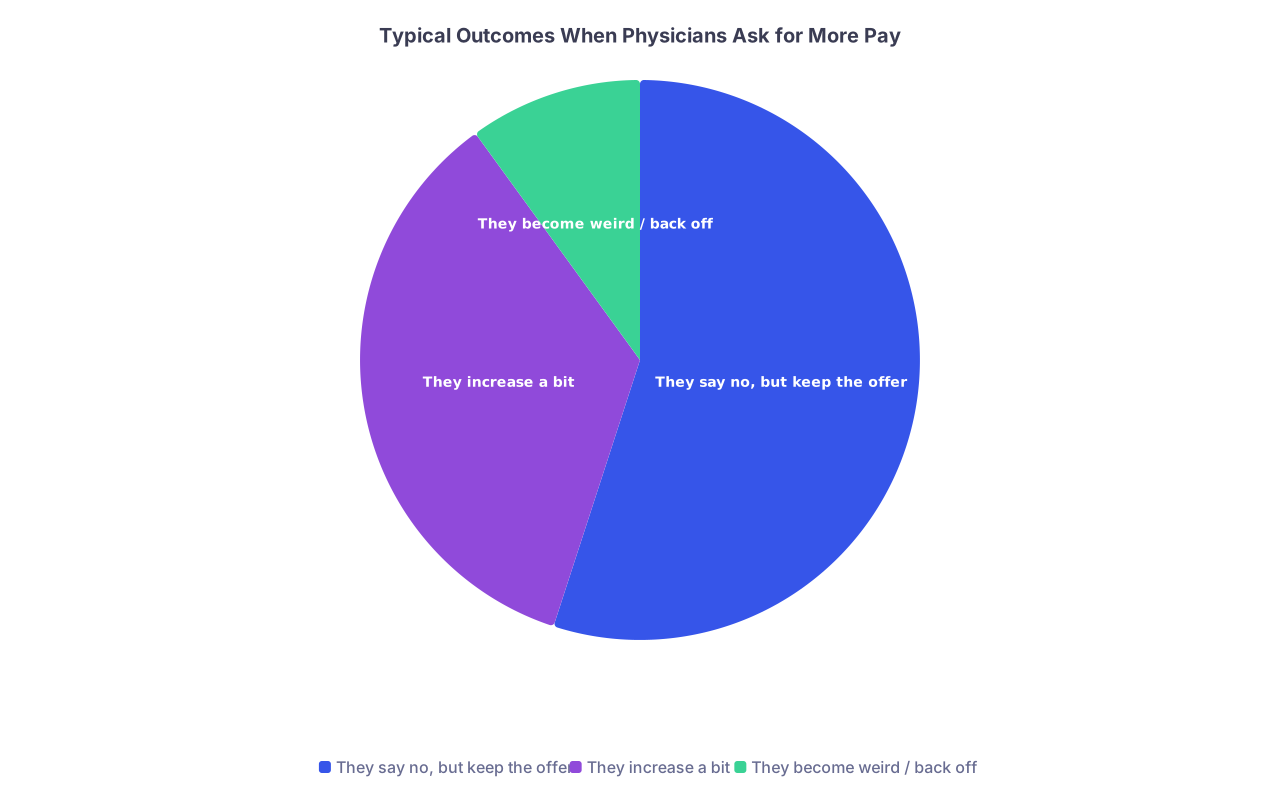
Strip away your catastrophic thinking, and outcomes usually fall into 3 buckets:
| Category | Value |
|---|---|
| They say no, but keep the offer | 55 |
| They increase a bit | 35 |
| They become weird / back off | 10 |
Most common:
They say something like, “Our rate for moonlighting is standardized at $110/hr; we can’t adjust it but we’d still love to have you.”
Second most common:
They bump something: “We can’t change the hourly rate, but we can offer a $2,000 sign-on,” or “We can’t move to $140/hr, but we can do $125/hr.”
Least common:
They get cagey. Slow responses. Less warmth. Suddenly the “we’re very excited about you” energy drops. In rare cases, an official, “We’ve decided to move in a different direction.” Those account for a minority of stories I’ve heard, but yeah, they stick in your brain because they’re scary.
Here’s the piece your anxiety ignores: if they do drop you simply for asking, is this actually a place you want to be tethered to for years?
Moonlighting specifically: are you actually replaceable for asking?
Moonlighting makes this worse because you feel extra disposable. You’re “just a resident” or “just per diem,” so you assume they’re doing you a favor.
Reality check: moonlighting often exists because they’re desperate. Volume is up, post-COVID staffing is weird, budgets are tight, attendings are burned out and refusing extra shifts. You’re not a charity case—they need bodies.
But your brain tells you: They have a stack of residents begging for this.
Sometimes true. Often exaggerated.
Here’s how moonlighting usually shakes out on the negotiation front:
Big hospital internal moonlighting:
Rates are usually flat and not negotiable. Ask once, nicely: “Is the $115/hr rate standard for everyone, or is there any flexibility?” They’ll probably say it’s fixed. You say, “Got it, thanks for clarifying.” Done. No drama.External community ED/hospitalist moonlighting:
More flexible. You might ask, “Given my PGY level and experience with independent call, is there any room for $130/hr instead of $115?” They might meet you halfway, or bump nights, or add differentials.Shady-seeming offers with unclear structure:
These are the only ones where I’ve seen people get weird pushback for negotiating. Example: “$90/hr, 24-hour in-house call, but you can sleep, it’s super chill.” You ask about malpractice, tail, patient volume, rate flexibility—and they ghost you. Which is honestly a bullet dodged, not a loss.

How to ask without triggering anyone’s “this person is a problem” radar
You want a script. Because in your head it’s: either say nothing and resent the offer, or ask and risk the whole thing imploding.
There’s a middle path.
Basic rules that keep you safe:
- Be brief and matter-of-fact. No manifestos. One or two sentences.
- Signal enthusiasm + curiosity, not entitlement.
- Ask once. Don’t harass. Don’t hound. If they say no clearly, you’re done.
- Anchor in data if you have it—but don’t lecture.
Examples you can literally steal/adapt:
For a moonlighting job:
“Thank you for the offer—this opportunity is really appealing. Given similar roles I’ve seen in the area in the $120–130/hr range, is there any flexibility on the proposed $110/hr rate?”
For an attending offer:
“I’m very excited about the role and can see myself here long-term. Based on MGMA data and what I’ve seen peers offered in similar markets, I was hoping to be closer to $250k. Is there any room to move the base toward that range?”
For telehealth:
“The position sounds like a great fit. One question: is the $80/hr rate fixed, or is there any flexibility based on experience or volume?”
You’re not demanding. You’re not threatening to walk. You’re asking a clear, professional question.
That alone almost never gets you dropped.
The silent cost of not negotiating (that your anxiety conveniently ignores)
You’re so focused on “What if they drop me?” that you skip the equally awful question: what if they don’t drop you, but you under-earn for years because you were scared to ask?
Let’s say:
- You’re looking at a recurring moonlighting gig: 4 shifts/month, $110/hr, 10 hours/shift
- You wonder if $125/hr is possible but don’t ask
Over a year:
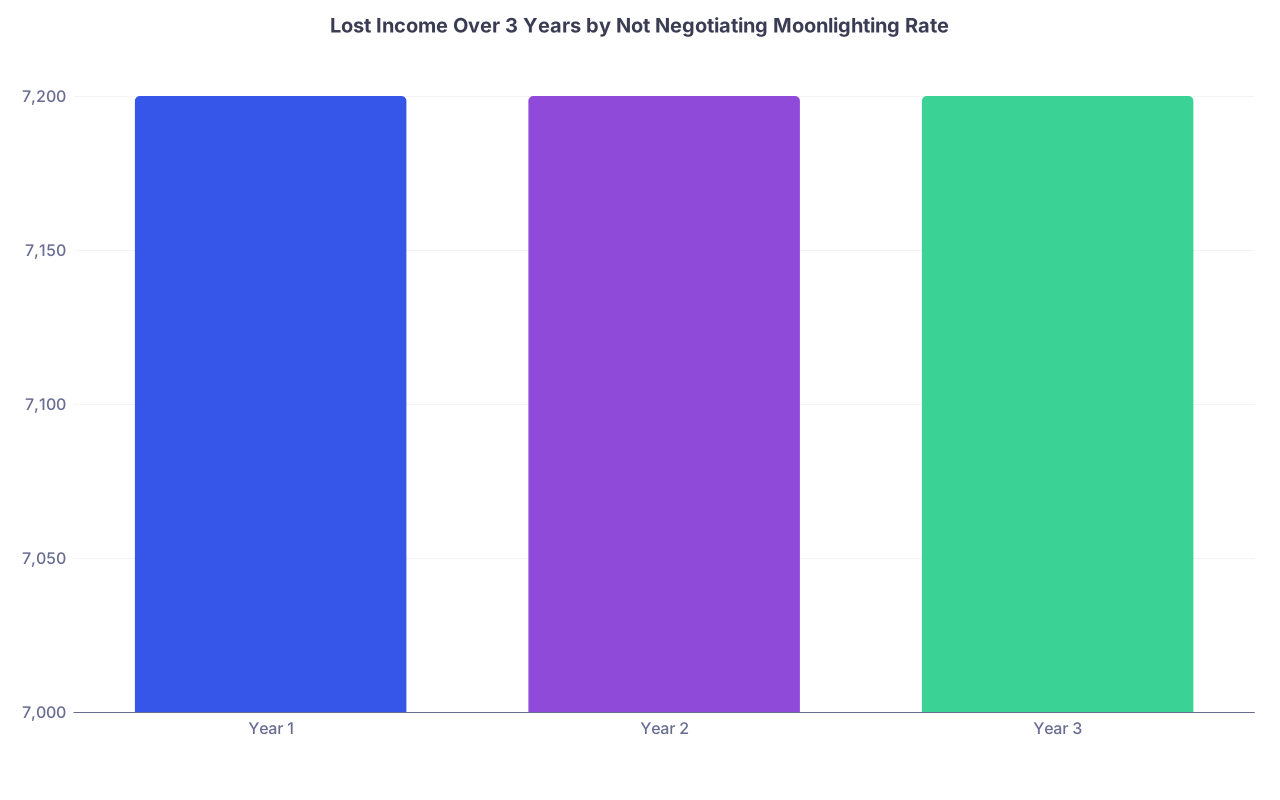
- At $110/hr: 4 × 10 × 12 × $110 = $52,800
- At $125/hr: 4 × 10 × 12 × $125 = $60,000
That’s $7,200 for one polite email you never sent.
Stretch that across multiple contracts and years as an attending, and the “I don’t want to rock the boat” tax becomes brutal.
| Category | Value |
|---|---|
| Year 1 | 7200 |
| Year 2 | 7200 |
| Year 3 | 7200 |
You pay that with your time, your fatigue, your loans.
And ironically, the places least willing to discuss pay are often the most likely to squeeze you in other ways: patient volume, admin duties, call burden.
So yes, there’s risk in asking. But there’s also risk in never asking.
Red flags: when getting dropped might actually be a favor
Your brain frames “getting dropped” as this catastrophic moral judgment: you asked for more, therefore you’re ungrateful, therefore you’re a bad doctor/human.
Reality: sometimes a rescinded or cooled offer is data. Data that they don’t see you as a professional peer with negotiating power.
Watch for these vibes:
- They get defensive the second you ask a basic question like, “Is malpractice occurrence or claims-made?”
- They say things like, “Residents at your level should be grateful for this opportunity.”
- They frame you as interchangeable: “We have plenty of candidates willing to take this as-is.”
- They avoid answering pay/benefits questions directly and pivot to “culture” and “family feel.”
You’re not losing a dream job. You’re dodging a place that wants full control and zero boundaries.

| Step | Description |
|---|---|
| Step 1 | Receive Offer |
| Step 2 | Ask Once About Pay |
| Step 3 | Decide If Still Worth It |
| Step 4 | Consider Improved Offer |
| Step 5 | Reassess If You Want This Job |
| Step 6 | Response |
How to negotiate when you’re deeply conflict-avoidant
If your heart rate spikes just thinking about hitting “send,” you’re not alone. Medicine selects for people who are good at following rules and thriving in hierarchies. It does not select for natural negotiators.
So you cheat a bit.
You can:
Blame your mentors.
“My mentors encouraged me to ask whether there’s any flexibility on compensation, so I did want to check…”Blame the market.
“From talking with co-residents and looking at regional data, I’ve seen similar positions in the X–Y range…”Use humble language without apologizing.
“I’m wondering if…” is fine. Just don’t say, “I’m so sorry to ask this, feel free to ignore…”
You’re not trying to “win” some aggressive negotiation war. You’re trying to act like a normal professional adult who understands that pay is… negotiable.
And yes, hit send even if your palms are sweating.
Will AI, telehealth, and “future of medicine” stuff make negotiating more dangerous?
Here’s the ominous background music in your head:
“In the future, there’ll be so many doctors and AI tools and NPs that physicians will be replaceable. So if I negotiate, I’m done.”
There’s some truth and a lot of exaggeration.
What I see coming:
- Big platforms and mega-systems with more standardized pay bands. Less wiggle room, but also less personal ego reaction to you asking.
- Niche gigs (rural, underserved, nights, heavy volume) still needing real human physicians and being flexible with pay for those willing to do hard work.
- More per diem / 1099 / gig-style doctor work. Which, by definition, lives and dies on negotiation and rate setting.
In other words: your leverage shifts, but it doesn’t disappear. You’ll need negotiation more, not less, as medicine splinters into side gigs, moonlighting, telehealth, start-ups, and portfolio careers.
Learning to send one calm email asking about rate is a survival skill, not a luxury.
Quick reality check: when you probably should not push
There are times when, honestly, I’d tell you to keep your head down and take the standard deal:
Internal residency moonlighting with clear, posted fixed rates
Everyone gets $110/hr. You’ve confirmed that. Pushing hard for $130/hr when your co-residents are at $110 just brands you as “that resident.” Not worth it.Once-in-a-lifetime training opportunity (e.g., prestigious fellowship with subpar pay)
You’re there for the credential, not the paycheck. Still ask about benefits/logistics, but base pay is probably not moving.Unionized, tightly regulated positions
Rate is literally in a contract for the entire group. You can ask to understand the structure, but individual exceptions are rare.
But those are exceptions.
Most of the time, it’s reasonable to at least ask the question once.
So, will asking for more get you dropped?
Sometimes. Not often. And usually only in places that are showing you, loudly, who they are.
If you remember nothing else, make it these:
- Asking once, politely, about pay almost never gets a serious offer pulled. Tone and context matter more than the fact of asking.
- Not negotiating has a very real cost—in money, burnout, and how people treat you.
- If they drop you just for asking, that’s a blaring red flag, not proof you did something wrong.
You’re not “difficult” for wanting to be paid fairly.
You’re a physician. You’ve given them years of your life, your sleep, your sanity. You’re allowed to ask.