
The biggest money leak in first attending contracts is not your base salary. It is how badly you negotiate CME money, time, and travel.
You sign fast. You tell yourself you will sort out conferences later. Then it hits you: no protected days, a $1,000 “CME stipend” that barely covers an online board review, and a department chair asking why you are “missing clinic for some meeting in San Diego.”
Let’s fix that.
You are not asking for a perk. You are securing the minimum professional infrastructure to stay competent, competitive, and sane. And most employers will give more if you ask correctly and specifically.
Below is the playbook I wish every new attending had before they talked to HR.
Step 1: Know the Numbers Before You Negotiate
If you do not know what “good” looks like, you cannot negotiate intelligently. You will either accept crumbs or ask for something so far off norms that you get written off as naïve.
Typical CME Packages by Employer Type
| Employer Type | Annual CME Money | CME Days/Year | Travel Support |
|---|---|---|---|
| Academic Hospital | $2,500–$5,000 | 5–10 days | Usually allowed |
| Large Health System | $3,000–$6,000 | 3–7 days | Usually allowed |
| Private Group | $1,500–$4,000 | 3–5 days | Variable/negotiable |
| FQHC / Community | $1,000–$3,000 | 3–5 days | Often limited |
| Concierge / Boutique | $3,000–$8,000 | 5–10 days | Usually generous |
These are ranges I keep seeing in actual contracts on desks and in inboxes. Yes, outliers exist. But this is your realistic target zone.
Now anchor your ask. For a full‑time clinical attending in a reasonably resourced system, I consider anything below:
- $3,000 per year in CME money
- 5 paid CME days per year
to be weak and worth pushing on.
If your specialty has high conference expectations (cards, onc, surg subspecialties), your ceiling is higher. $5,000–$7,000 and 7–10 days are very defendable.
Step 2: Decide What You Actually Need (Not Just “More”)
“More CME” is not a strategy. You need a concrete picture of how you will use CME in the next 2–3 years. That drives your negotiation, your wording, and your leverage.
Build a 3‑Year CME Plan
Sit down for 20 minutes and rough this out:
Board requirements
- How many CME hours per cycle?
- Any mandated content (MOC, QI, risk management)?
- Cost of board review course you actually want.
Core conferences you care about
- Example for a cardiologist:
- ACC or AHA annually (rotating).
- One focused meeting (EP/IC/Heart Failure) every other year.
- List:
- Typical registration fee.
- Usual locations (for rough flight cost).
- Duration (for days off needed).
- Example for a cardiologist:
Online CME / subscriptions
- UpToDate, DynaMed, specialty society membership with CME, board review Qbank.
- Which do you already rely on? Which do you want your employer to pay directly?
Licensure and DEA
- License renewal often requires CME.
- Some contracts count these as CME expenses, some do not. You want them clearly allowed.
Now ballpark your annual cost.
Example — reasonable for many specialists:
1 major national conference:
- Registration: $900
- Flight: $400
- Hotel (3 nights x $250): $750
- Meals/incidentals: $250
- Total: ~$2,300
Online CME/board review/Qbanks/licenses: $1,000–$1,500
This puts you at ~$3,300–$3,800/year without doing anything wild. And that assumes just one in‑person conference.
So walking in asking for $4,000–$5,000 CME money and 5–7 days is not greedy. It is aligned with what it realistically costs to maintain your skills.
Step 3: Understand the Three Moving Parts: Money, Time, Travel
CME in a contract is not one line. It is a mini‑ecosystem. You need all three pieces defined:
CME Money (Stipend or Allowance)
Key questions:- Annual dollar amount?
- Is it “use it or lose it” or can it roll over?
- What counts as CME? (Courses, society dues, licenses, DEA, textbooks, tech, etc.)
- Reimbursement vs. prepaid corporate card vs. employer booking?
CME Time (Days Off)
Key questions:- How many days per year?
- Are these in addition to vacation and holidays, or pulled from PTO?
- Are travel days counted as CME days?
- Are weekends considered CME time or “on your own”?
CME Travel Rules
This is where people get burned.- Economy vs. business? (Some systems explicitly ban business class.)
- Daily lodging and meal caps?
- International meetings allowed or domestic only?
- Any “must be within X miles” rule?
- Does travel time count as work time for payroll/OT purposes if you are non‑exempt? (For employed physicians this can matter.)
If you do not tighten all three in writing, you get HR “interpretations” later.
Step 4: Use Timing and Leverage Correctly
Your leverage is highest before you sign and after they have decided you are their top candidate.
You want this sequence:
- Interview → verbal enthusiasm from the department
- Verbal or email offer (salary, broad terms)
- They send the contract draft
- You review and return with edits that include CME
Do not try to negotiate CME in the first interview. You look like you are optimizing perks before they even like you. Wait until you have evidence they are invested.
When you counter, package your CME asks with your other contract tweaks. One clean email or conversation:
- Salary / RVU floor / signing bonus
- CME money, days, and travel clarifications
- Call expectations
- Non‑compete terms
HR and legal will route your edits once. Use that window.
Step 5: Concrete Language You Can Lift Into Your Contract
You want specificity. Vague phrases like “reasonable CME” are how you get denied reimbursement for a course you actually need.
Here is language you can adapt and send to HR or your recruiter. Use it as written or tweak by a few words.
CME Money Clause
Employer will provide Physician with an annual CME allowance of $4,000. This allowance may be used for CME‑related expenses including but not limited to: conference registration fees, travel and lodging for CME activities, professional society dues, state medical license fees, DEA registration, maintenance of certification fees, CME‑producing online subscriptions, and medical textbooks or educational materials. Unused CME allowance may roll over for one additional contract year, after which any remaining balance will expire.
If they balk at including license/DEA/MOC, fall back to:
…including conference registration fees, travel and lodging for CME activities, CME‑producing online subscriptions, and medical textbooks or educational materials.
But still try to keep “professional society dues” in there. Those are heavily used and easy to justify.
CME Time Clause
Physician will receive 5 paid CME days per contract year, in addition to standard vacation, holiday, and sick leave. CME days include reasonable travel time to and from CME activities. CME days will be scheduled with reasonable notice and in coordination with service needs, and shall not be unreasonably denied.
The key phrases: “in addition to” and “shall not be unreasonably denied.” Without those, you are handing them a PTO pool they can starve.
If they insist on PTO only, then push for:
- Higher PTO total with explicit ability to use a portion for CME.
- Or: “Employer will provide 5 CME days; these days will be deducted from Physician’s PTO balance but will not be subject to standard PTO blackout dates.”
That at least prevents them from blocking you from using PTO for a conference.
Travel and Approval Language
CME meetings and courses must be relevant to Physician’s specialty and approved in advance by the Department Chair or designee. Approval shall not be unreasonably withheld. Travel in economy class and lodging at conference‑rate or reasonably comparable hotels will be reimbursed from the CME allowance subject to standard organizational travel policies.
If you will likely present research or give talks, add:
When Physician is an invited speaker or presenting original research on behalf of Employer, expenses for that meeting will be covered by Employer in addition to and not deducted from the annual CME allowance.
That last line alone can save you thousands if you are academic‑leaning.
Step 6: Script the Actual Negotiation Conversation
You do not need to sound like a lawyer. You need to sound organized, reasonable, and firm.
Imagine you are on a call with the recruiter or HR after reviewing the draft. Here is how I would do it.
You:
“I had a chance to review the contract. Overall it looks good and I am very interested. I had a few items I want to tighten up so we are all on the same page. One is the CME package.”
Them:
“Sure, what are you thinking?”
You:
“I see $2,500 in CME money and 3 CME days. For my board requirements and at least one national meeting a year, I realistically need closer to $4,000 and 5 CME days. That is pretty standard across comparable systems. I have some sample language that spells out eligible expenses and clarifies that CME days are in addition to vacation. Would your team be open to that adjustment?”
Stop talking. Let the silence sit.
Typical responses:
- “That should be fine, send the language and we will run it by legal.”
- “We can do $3,000 but our policy caps days at 3.”
- “We have a standard policy we do not change.”
If they cite “standard policy,” do this:
You:
“I understand you have standard language. My concern is being able to maintain my board certification and stay current without absorbing a lot of out‑of‑pocket cost. If the dollars cannot move, could we at least clarify that license, DEA, and professional society dues count toward the CME allowance, and that CME days are in addition to PTO? That would make the current numbers workable.”
Often HR is much more willing to tweak definitions than numbers. Use that.
Step 7: Special Cases – Moonlighting, Locums, and Multiple Employers
You asked about moonlighting and benefits. Here is where things get messy.
If You Plan to Moonlight
Most primary employers will not pay CME for work you do elsewhere. But they also benefit from you staying skilled and licensed. Your goal is to:
Use your main employer’s CME package to cover:
- Board requirements.
- Specialty‑wide updates.
- Licensure.
Use moonlighting income (not their benefits) to:
- Pay for moonlighting‑specific credentials (extra state licenses, hospital orientations).
- Extra courses (e.g., procedural workshops) that directly increase your moonlighting rate.
Two contract points to watch:
Non‑compete and outside work clause
- Ensure your main contract does not bar you from moonlighting or penalize you for doing CME related to that work.
- If the contract restricts “competing activities,” carve out an explicit exception for approved moonlighting and CME.
IP and research language
- If you do courses that lead to independent content (courses you create, online materials), make sure your employer does not automatically own that intellectual property.
If You Do Locums as Primary Work
Locums agencies sometimes throw around “CME money” as a perk. It is usually weak and strings‑attached. Assume:
- It will not cover a full major conference.
- It may be contingent on a minimum shifts threshold.
Treat locums CME perks as bonus money, not your base plan. You are essentially your own employer. Build your personal CME budget from your hourly rate and protect it like overhead.
Step 8: Common Traps and How to Avoid Them
These are the patterns I see repeatedly when people send me their “I think I messed up” contracts.
Trap 1: CME Days Hidden Inside PTO
Contract says:
Physician will receive 25 days of PTO per year, which may be used for vacation, sick leave, and CME.
Looks generous. It is not. That is vacation, illness, funeral, childcare crash, and all CME in one bucket.
Fix:
- Push to add “plus 5 dedicated CME days” or
- At least “Of the 25 days, a minimum of 5 may be reserved for CME use at Physician’s discretion.”
Trap 2: “Reasonable CME” With No Numbers
This is useless. Reasonable to whom? The CFO whose bonus improves if you travel less?
Fix:
- Insist on a specific dollar amount and specific number of days.
- At minimum, “Employer will provide CME support consistent with current organizational policy, which as of the effective date of this Agreement includes: X dollars and Y days.”
Trap 3: No Approval Standard
Language:
CME activities must be approved by the Chair.
No standard. No criteria. That lets them deny anything that looks “too fun.”
Fix:
CME activities must be relevant to Physician’s specialty and approved by the Chair. Approval shall not be unreasonably withheld.
Seems small. It matters a lot when you want to go to that out‑of‑state course.
Trap 4: No Rollover
You will have years where you are pregnant, on leave, swamped, or there is a pandemic. You may use $500 of your $3,000.
If it all expires, you just left $2,500 on the table.
Fix:
Unused CME allowance may roll over for one additional contract year, after which any remaining balance will expire.
A one‑year rollover is a very reasonable ask and often accepted.
Step 9: Compare Offers Using CME as a Real Dollar Value
Two jobs:
Job A:
- Base: $280,000
- CME: $2,000 + 3 days (counted as PTO)
Job B:
- Base: $270,000
- CME: $5,000 + 7 dedicated days
Most people fixate on the $10,000 salary difference. That is a mistake.
Quantify:
- Job A: You will likely spend $1,500–$2,000 of your own money each year beyond their stipend. Plus lose 3 days of vacation.
- Job B: You will pay almost nothing out‑of‑pocket and keep vacation separate.
Over a 3‑year span:
- Out‑of‑pocket + “lost” vacation value on Job A can easily wipe out a large chunk of that salary difference.
- More CME days also make it easier to build an academic profile, present, network, and eventually move to better‑paying or more flexible roles.
Do the math. Make CME a line item in your comparison, not an afterthought.
Step 10: Lock It Down Before You Sign
Here is your “do not skip” checklist for CME in your first contract:
- Annual CME dollar amount stated clearly.
- Number of CME days per year stated clearly.
- Explicit: CME days in addition to PTO / vacation.
- Definition of eligible CME expenses included.
- Travel and lodging reimbursement language tied to CME allowance.
- Approval standard includes “shall not be unreasonably withheld.”
- Rollover clause if possible.
- Language about invited speaking/presenting coverage not hitting your CME pool (if academic leaning).
- No conflicting language in HR handbook that quietly overrides your contract (ask for the handbook).
If something is “policy” but not in your contract, get it referenced:
CME benefits will be provided in accordance with Employer policy, which will not reduce the CME benefits described in this Agreement during the term of this Agreement.
That prevents them from cutting CME in a budget crunch and saying “it is policy now, sorry.”
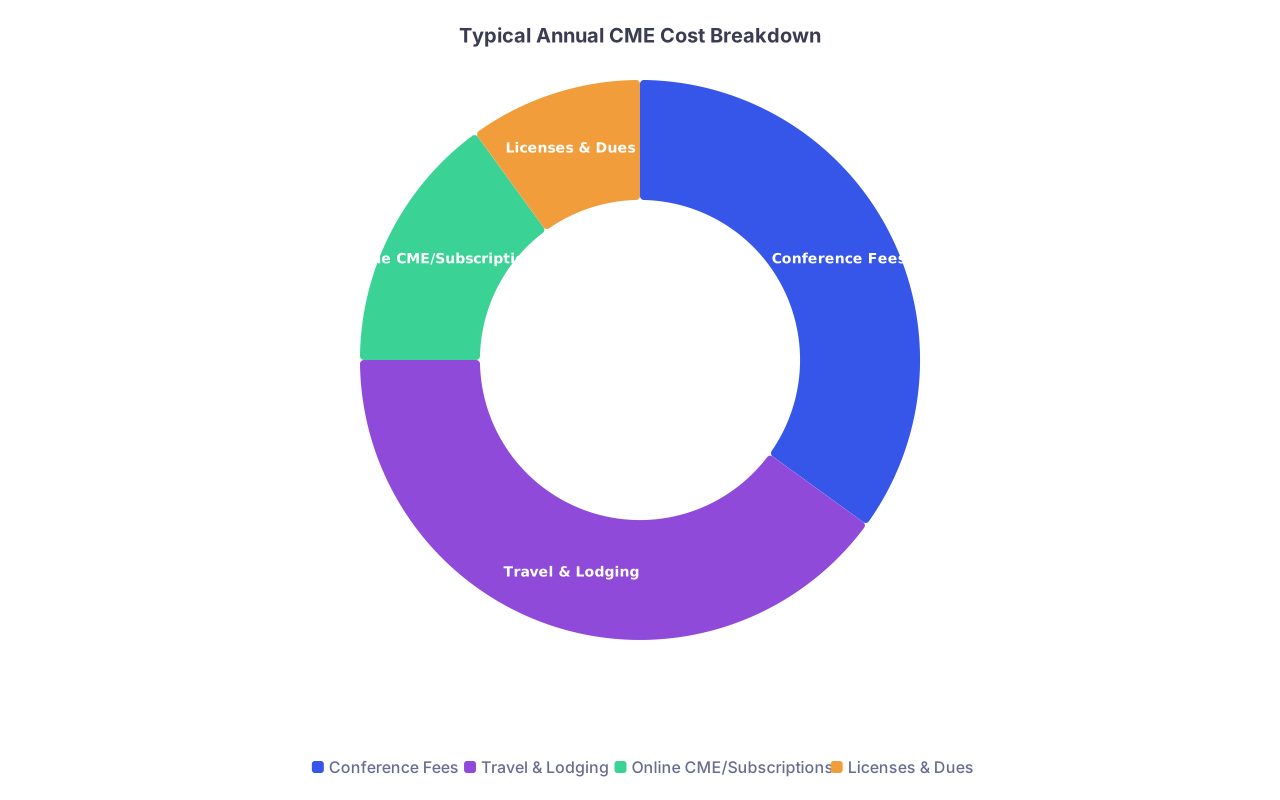
| Category | Value |
|---|---|
| Conference Fees | 35 |
| Travel & Lodging | 40 |
| Online CME/Subscriptions | 15 |
| Licenses & Dues | 10 |

| Step | Description |
|---|---|
| Step 1 | Draft CME Plan |
| Step 2 | Review Contract CME Terms |
| Step 3 | Confirm in Writing |
| Step 4 | Define Specific Changes |
| Step 5 | Discuss With Recruiter or HR |
| Step 6 | Prioritize Must Haves |
| Step 7 | Decide Accept or Walk |
| Step 8 | Adequate? |
| Step 9 | Employer Response |


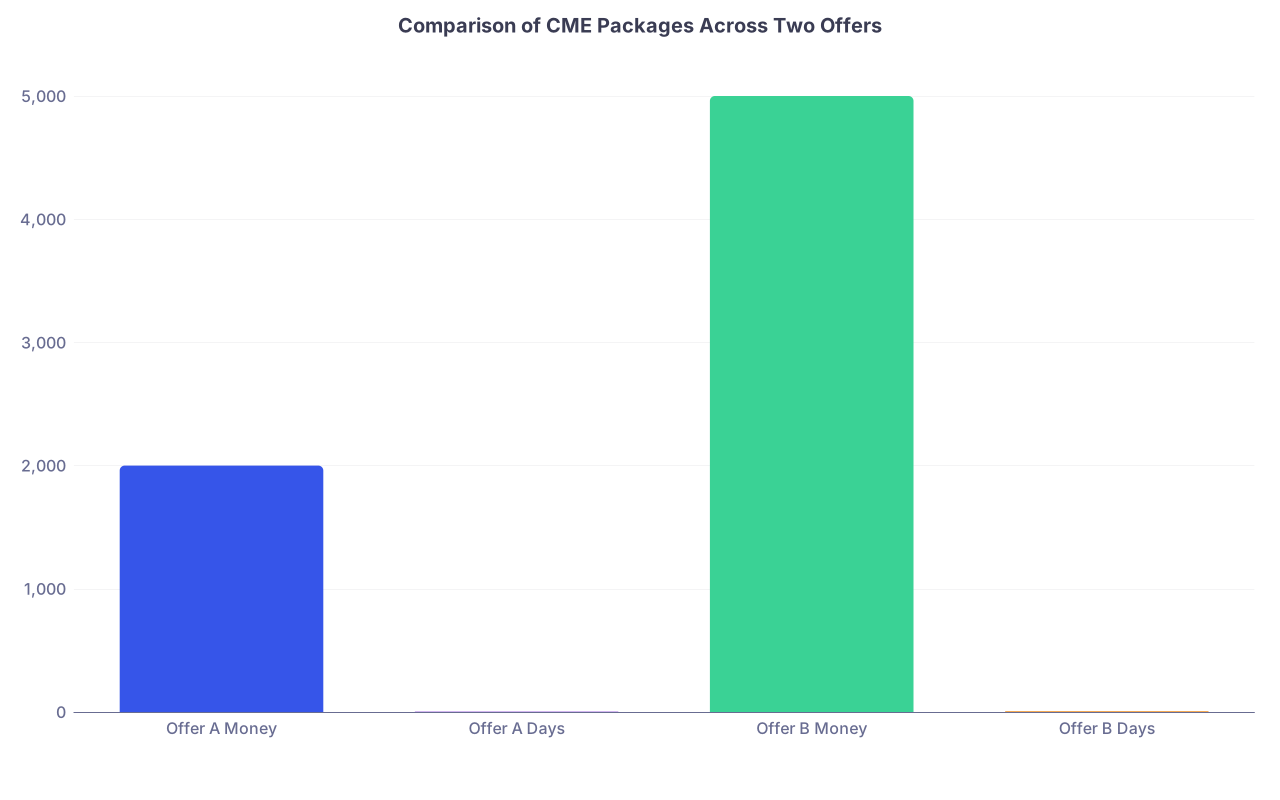
| Category | Value |
|---|---|
| Offer A Money | 2000 |
| Offer A Days | 3 |
| Offer B Money | 5000 |
| Offer B Days | 7 |