
Sign‑on bonuses are not free money. They’re debt with better marketing.
Hospitals and staffing companies figured out a long time ago that if you call it a “bonus” instead of a forgivable loan, tired residents and overworked attendings will sign on the dotted line without asking enough questions. I’ve watched that movie more times than I like: a $25k–$75k “bonus,” a three‑year commitment, and then a physician paying back five figures plus interest because they underestimated how miserable the job would be.
Let’s pull the curtain back on what those sign‑on bonuses actually are, how the payback math really works, and the traps baked into the fine print.
What a Sign‑On Bonus Really Is (Legally and Financially)
Strip away the marketing and you’re usually dealing with one of three structures:
- A pure bonus (rare in medicine).
- A forgivable loan.
- An advance against future compensation.
Most “sign‑on bonuses” for physicians, NPs, PAs, and other clinicians are #2 or #3.
The money is typically:
- Paid upfront or in installments
- Tied to a fixed service commitment (1–5 years, most often 2–3)
- Subject to prorated repayment if you leave early
- Taxed as income when you receive it
- Not refunded by the IRS if you later have to pay it back
So yes, you get a check. But you’re also taking on a conditional liability that lasts for years.
A lot of contracts will even admit this in one sentence buried halfway through: “Physician acknowledges that the sign‑on bonus constitutes a loan forgiven over the term of employment.” That one line changes everything.
The Standard Payback Formula (And How It Burns People)
Most repayment clauses follow a simple structure:
- Commitment: 3 years
- Bonus: $30,000
- Forgiveness: equal monthly or yearly over the commitment term
- If you leave early: you owe the unforgiven remainder
Translated into a formula:
Unforgiven amount =
Bonus × (Remaining commitment time / Total commitment time)
Example:
- $30,000 bonus
- 3‑year commitment (36 months)
- You leave at 18 months
Remaining time: 18 months
Unforgiven fraction: 18 / 36 = 0.5
You owe: 0.5 × $30,000 = $15,000
Sounds fair on paper. In real life, here’s where it goes sideways:
- That $30k was taxed when you got it, so you spent maybe $20–22k.
- You now owe $15k gross back.
- The IRS does not automatically “untax” that portion for you.
- You might be able to take a deduction in a later year under “claim of right,” but it’s messy, and you’re still out a chunk of real money today.
I’ve seen more than one physician realize they effectively netted a few thousand dollars for locking themselves into a terrible job—once you factor taxes, repayment, and the fact they took a below‑market base in exchange for that “bonus.”
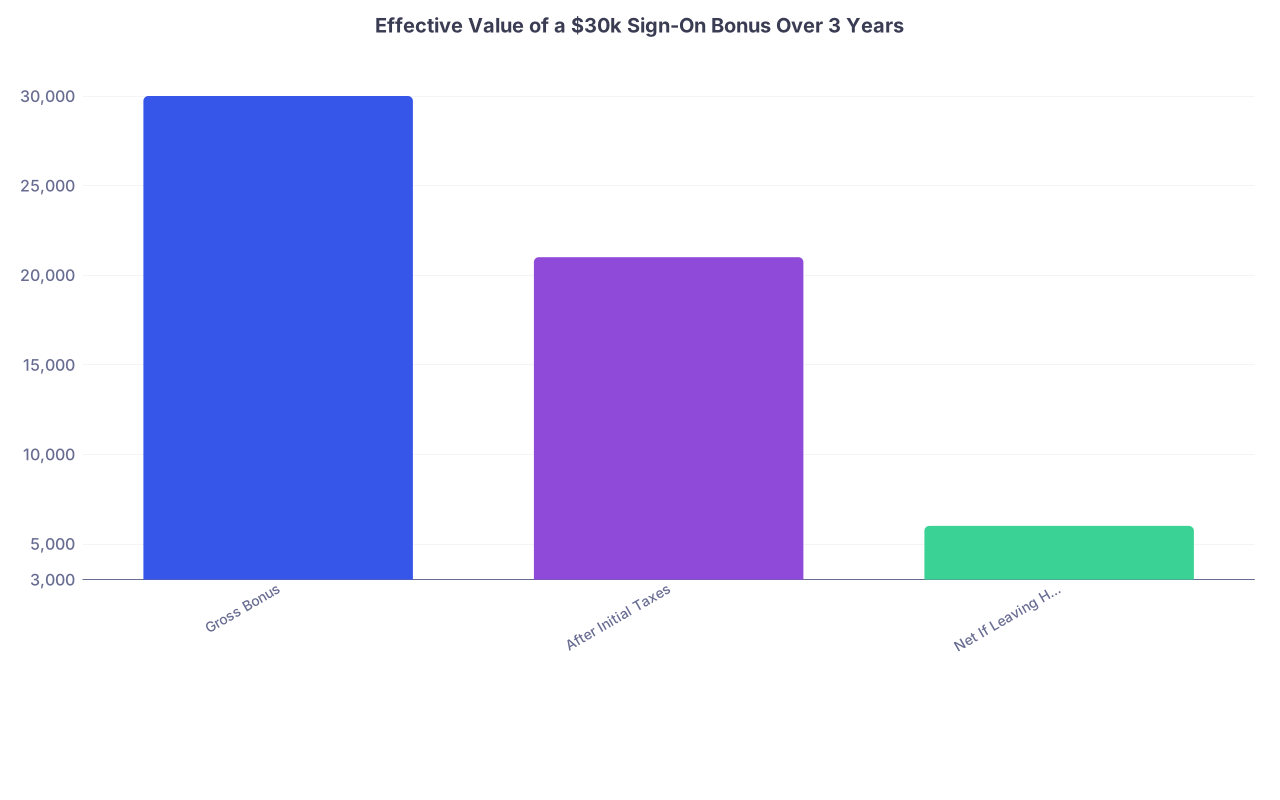
| Category | Value |
|---|---|
| Gross Bonus | 30000 |
| After Initial Taxes | 21000 |
| Net If Leaving Halfway (after $15k repayment) | 6000 |
In that scenario, your three‑year “$30,000 bonus” nets you about $6,000 if you leave halfway. That’s $333 a month to give up flexibility and negotiate power. Not impressive.
Common Sign‑On Bonus Myths That Cost You Money
Let me break a few persistent myths I see in moonlighting and first‑job contracts.
Myth 1: “If the job is awful, I’ll just leave. The bonus is free upside.”
No. The bonus is designed to create friction to leaving.
Hospitals know their staffing models are brittle. They overpromise support, underestimate burnout, and then patch the holes with money. The sign‑on is not a generous gift; it’s a golden handcuff.
The worse the job, the more painful the repayment clause usually looks:
- Longer commitments (3–5 years)
- Front‑loaded “incentives” that all claw back if you leave “for any reason”
- Tying the bonus to noncompete regions, so you either repay or move
If your gut says, “I might want out within a year,” that sign‑on is not free upside. It’s a bet that you’ll be willing and able to write a five‑figure check to escape.
Myth 2: “They’ll waive repayment if I have a good reason.”
Read the clause. Most contracts define “good reason” very narrowly or not at all.
Common repayment triggers:
- You resign, for any reason.
- You’re terminated “for cause” (and the definition of “cause” is broad).
- You fail to maintain privileges or licensure (including for health reasons).
- You don’t meet RVU or productivity thresholds that are themselves unrealistic.
I’ve seen groups refuse to waive repayment even when:
- The schedule changed drastically from what was promised.
- The call burden doubled after a colleague left.
- The hospital cut staffing, making the job unsafe.
- The clinician had a medically documented need to relocate.
Do some employers negotiate or waive? Occasionally. But if you’re counting on their kindness instead of what’s on paper, you’re gambling with your future self’s bank account.
Myth 3: “A big sign‑on bonus means it’s a great job.”
More often, it means they can’t get or keep people.
Look at locums rates. When a hospital can’t staff an ICU, ED, or hospitalist program, they do one of two things:
- Jack up locums pay.
- Jack up sign‑on and retention bonuses.
A $75k sign‑on for a rural ED might look shiny. But if the base pay is mediocre and the workload borderline unsafe, that’s not a deal. That’s hazard pay dressed up as a welcome gift.
The Tax Angle Everyone Forgets
Here’s the part almost no recruiter walks through with you.
When you get that bonus:
- It’s taxed as ordinary wage income.
- Your employer withholds at a supplemental rate (often 22–37% federal, plus state/local).
- You see the net deposit and mentally anchor to that number.
If you later repay part (or all) of it:
- You’re paying back gross dollars, not after‑tax dollars.
- You generally don’t get your original withholding back.
- At best, you might claim an itemized deduction or a credit under IRC §1341 (“claim of right”) if the repayment is over $3,000, and the timing lines up. That’s a separate conversation with a CPA, not a guarantee.
Here’s a simple version of what happens:
- $40,000 sign‑on paid in PGY‑3 year
- 30% combined tax withheld → you see $28,000
- You leave after 1 year on a 4‑year commitment
You owe 3/4 of $40k = $30,000 - You cut a $30,000 check
Result: you borrowed $28k, repaid $30k. You’re net negative $2k cash, plus you traded negotiating leverage and flexibility during that year.
This is why calling it “free money” is delusional. It’s an expensive, illiquid, conditional loan.
The Fine Print That Really Matters (And Gets Ignored)
When I review contracts, I ignore the glossy flyer number (“$30k sign‑on!”) and go straight to the ugly part. You should too.
Here’s what actually changes the game:
How long is the commitment?
1 year is one thing. 3–5 is another. Longer term = bigger risk.How is forgiveness calculated?
Monthly forgiveness is better than annual. If you leave at 11 months on an annual schedule, you might owe almost all of it back.What events trigger repayment?
Watch for vague language:- “Any termination for any reason”
- “Failure to comply with employer policies”
- “Failure to meet productivity expectations”
Are there carve‑outs?
Better contracts exempt things like:- Employer material breach
- Relocation for spouse military orders
- Employer‑initiated schedule changes beyond X%
- Documented health issues
Is it structured explicitly as a loan?
If there’s a promissory note, interest rate, or acceleration clause, you’re in straight loan territory. That means:- They can send you to collections.
- They can pursue you even if you leave medicine.
- They can sometimes demand immediate full repayment if you breach any condition.
| Term | Safer Version | Risky Version |
|---|---|---|
| Commitment length | 1–2 years | 3–5 years |
| Forgiveness period | Monthly | Annual or end-of-term |
| Repayment trigger | Narrow, defined | Any termination, broad “cause” |
| Structure | True bonus, no note | Loan with promissory note & interest |
| Carve-outs | Several well-defined | None or “at employer discretion” |
If your contract is the entire right column, that “bonus” is a trap.
Negotiating Better Terms (Or Walking Away)
Here’s the part where you take back leverage.
Most clinicians assume the sign‑on package is fixed. It’s usually not. Employers will bend on structure more than on headline numbers because they care about optics and budget lines.
Targeted asks that actually matter:
Shorten the commitment.
“Can we make the forgiveness term 24 months instead of 36?”Monthly proration.
“I’d like the repayment to be prorated monthly, not yearly, so if I leave at 23 months I don’t owe a full year.”Narrow repayment triggers.
“Repayment should not apply if I leave due to employer breach, major call/schedule change, or unsafe staffing levels.”Cap repayment.
“If I leave in the last year of the term, can we cap repayment at 25% of the original bonus?”Trade bonus for base.
“Drop the sign‑on to $10k and raise my base by $X; I prefer ongoing comp to a front‑loaded bonus.”
That last one is the sleeper move. Rationally, over a few years, higher base or RVU rates beat one‑time cash almost every time—especially in moonlighting‑heavy specialties like EM, anesthesia, hospitalist medicine, and critical care, where your earning potential scales with shifts and RVUs.
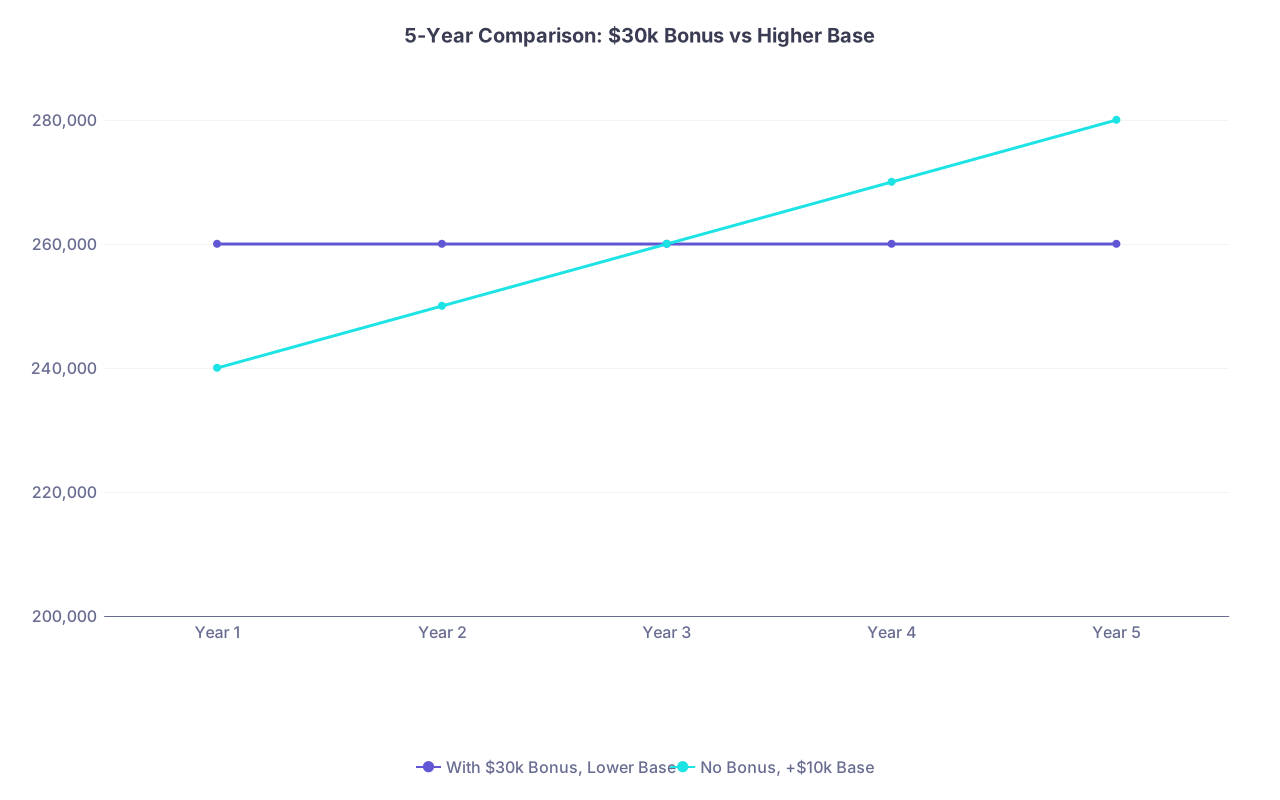
| Category | With $30k Bonus, Lower Base | No Bonus, +$10k Base |
|---|---|---|
| Year 1 | 260000 | 240000 |
| Year 2 | 260000 | 250000 |
| Year 3 | 260000 | 260000 |
| Year 4 | 260000 | 270000 |
| Year 5 | 260000 | 280000 |
By year 3–4, that extra base usually swamps the “bonus” and doesn’t handcuff you to a place you might outgrow.
How Sign‑On Bonuses Interact With Moonlighting and Locums
If you’re reading this under “Moonlighting and Benefits,” you’re probably already doing locums, night shifts, or per diem work—or thinking about it. Here’s where it intersects with sign‑ons.
Noncompetes + repayment clauses + moonlighting
Your “primary” employer may:- Limit where you can moonlight.
- Count outside work as a breach if not approved.
- Use that breach to trigger repayment of the sign‑on.
I’ve seen contracts where picking up a handful of ED shifts at a competing hospital 25 miles away technically triggers default on a $50k bonus.
Locums flexibility vs. bonus handcuffs
Many people take a big bonus to land a “stable” gig, then watch their colleagues making more with locums, and want to jump ship. That’s when the realization hits: the only thing keeping you from a better schedule and pay is a repayment clause.Negotiating an explicit moonlighting carve‑out
Push for:- “Moonlighting allowed outside X miles, up to Y hours/month, provided it does not interfere with scheduled shifts.”
- A statement that compliant moonlighting does not trigger breach or repayment.
If you want future flexibility to mix W‑2, 1099, and locums work (the direction a lot of medicine is heading), a heavy sign‑on with a broad noncompete is the opposite of what you want.

| Step | Description |
|---|---|
| Step 1 | Offered Sign-On Bonus |
| Step 2 | Prioritize higher base and flexible terms |
| Step 3 | Consider accepting with minor edits |
| Step 4 | Negotiate or walk away |
| Step 5 | Need flexibility in next 2-3 years |
| Step 6 | Contract terms favorable? |
When a Sign‑On Bonus Actually Makes Sense
Let me be fair: they’re not always bad.
A bonus can be rational if:
- You’re genuinely comfortable with the location and scope.
- The commitment term is short (1–2 years) and prorated monthly.
- The total compensation (base + bonus + benefits) beats market, not just the bonus line.
- The repayment triggers are tightly drafted and reasonable.
- You’re not planning major life changes (fellowship, move, spouse’s career shift) in that window.
Even then, treat it as a discounted future paycheck, not a lottery win. Save most of it. Do not inflate your lifestyle around it. If you end up leaving early, you want cash on hand to write that check without panic.
The Bottom Line
Three key points, and then you can go back to your shift:
Sign‑on bonuses are usually structured as loans or advances, not gifts. You’re trading flexibility for cash, and the math often looks ugly if you leave early.
The value is in the terms, not the headline number. Commitment length, forgiveness schedule, repayment triggers, and noncompete language matter more than whether the bonus is $20k versus $30k.
You can almost always do better by negotiating structure—or by taking less “bonus” and more base. If you care about moonlighting, locums, or keeping your exit options open, big handcuffs disguised as “free money” are exactly what you should be skeptical of.