
The worst time to discover your insurance is garbage is the week after you need it.
You do not “set and forget” disability and life insurance as a physician. You upgrade it — deliberately — every single phase of your training and early career. If you treat it like a one‑time task, you’ll either be underinsured, overpaying, or stuck with a policy that does not match your life anymore.
Here’s a clear, year‑by‑year roadmap so you always know, “At this point I should…”
Big Picture: How Your Coverage Should Evolve
Before we go year by year, anchor on this:
- Disability insurance is about protecting income you haven’t earned yet.
- Life insurance is about protecting people who depend on that income.
As your income potential and dependents change, your coverage has to move with them. That means:
- Early: lock in own-occupation disability with strong future increase options.
- Mid: add/upgrade life insurance when you get a spouse, kids, mortgage.
- Later: prune life insurance as assets grow; keep disability tight until very close to financial independence.
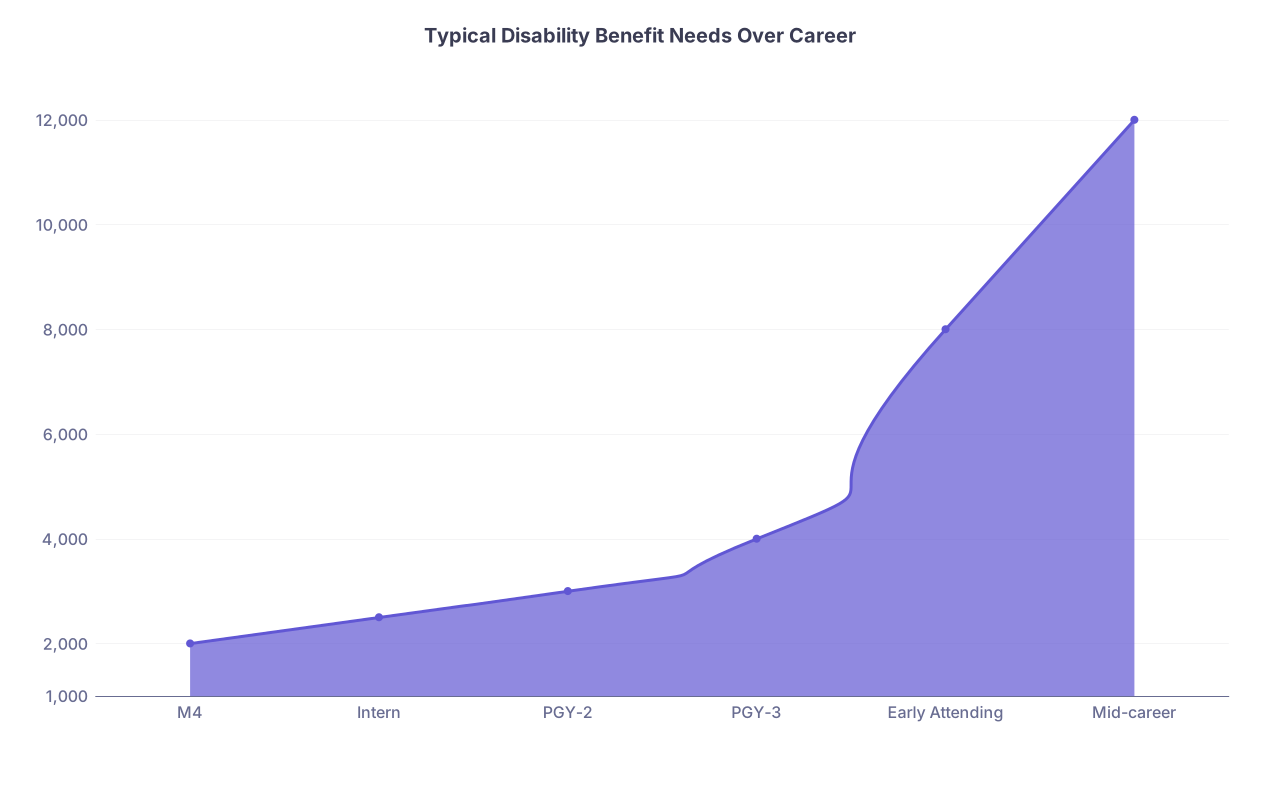
| Category | Value |
|---|---|
| M4 | 2000 |
| Intern | 2500 |
| PGY-2 | 3000 |
| PGY-3 | 4000 |
| Early Attending | 8000 |
| Mid-career | 12000 |
Now let’s walk it year by year.
M4 / Final Year of Training Before Residency: Lock In the Foundation
At this point you should be:
- Getting your first real, individual own-occupation disability policy.
- Ignoring most life insurance unless you already have dependents or debt co-signers who’d be wrecked by your death.
Disability Insurance: This is the “Must Do” Year
If you do nothing else M4, do this:
Get an individual own-occupation policy (not just group, not just school-sponsored).
Make sure it has:
- True own-occupation (you’re disabled if you can’t do your specialty, even if you work in another job).
- Residual/partial disability rider.
- Future increase option (FIO) / guaranteed insurability rider.
- Non‑cancellable, guaranteed renewable language.
Target benefit:
- Usually max for students: $2,000–$5,000/month, depending on carrier.
Avoid junk:
- No “any occupation” policies.
- No policies sold by someone who can’t clearly explain residual vs total disability in 30 seconds.
Why now? Because your health is probably the best it will ever be, and residents often get discounted rates. Underwriting now means any weird medical issue that pops up later doesn’t ruin your coverage or jack up your price.
Life Insurance: Minimal, Unless…
At this point you should skip life insurance unless:
- You’re married and your spouse relies on your income (or clearly will soon).
- Your parents co‑signed huge loans and can’t absorb them if you die.
- You already have a kid. (Yes, many M4s do.)
If that’s you, consider:
- A simple 20–30-year level term policy, $500k–$1M.
- No whole life. No universal life. You are not there yet.
PGY‑1 (Intern Year): Confirm, Don’t Create Chaos
You’re drowning in notes, pages, and night float. You don’t have time for financial gymnastics. But you do have two key jobs.
At this point you should:
- Confirm your individual disability policy is active, paid, and accurate.
- Understand — not rely on — your hospital’s group disability coverage.
Disability: Check, Don’t Assume
Do this once, early in PGY‑1:
- Log in to your insurer portal:
- Confirm benefit amount (probably around $2,000–$5,000/month).
- Confirm riders: own-occ, residual, FIO.
- Confirm premium payment method and date.
Then:
- Read your program’s group disability policy summary:
- Does it define disability as own-occupation or any occupation?
- When does it kick in? After 90 days? 180?
- Is there a cap (e.g., $3,000/month)?
You’ll likely find what I see over and over: group coverage is fine as a backup, terrible as primary.
Life Insurance: Maybe Your First Policy
At this point you should get term life if:
- You got married or partnered and share rent/mortgage.
- You had a kid.
- Someone depends on your income. Not “morally” — actually.
Basic starting point:
- 1–2x your projected resident salary per year of term left is too low.
- Realistic: 10–15x your attending-level expected income, because you’re insuring the future, not your PGY‑1 paycheck.
Example: Planning to be a hospitalist making ~$280k?
- 10x = $2.8M term policy.
- If money is tight, start with $1M–$1.5M, then add more later.
PGY‑2: Turn On the Upgrade Path
At this point you should:
- Use the future increase option on your disability policy if you can.
- Adjust life insurance if major life changes happened.
Disability: First Bump
Many carriers let you increase coverage without new medical underwriting as your income rises. This is where residents screw up by ignoring those annual letters.
In PGY‑2:
- Check current income (base + typical call pay).
- Look at your policy’s max benefit allowed at this income.
- Increase your monthly benefit as much as the rider allows.
Typical target by end of PGY‑2:
- $3,000–$4,000/month benefit if allowed.
Do it even if you feel poor right now. You’re not insuring PGY‑2 income; you’re protecting the path to attending income.

Life Insurance: Adjust for New Realities
Ask:
- Did you marry, divorce, have a kid, or buy a home this year?
- Did your spouse cut back work (or plan to) due to your call schedule?
At this point you should:
- If no dependents, no shared debt: you can still reasonably skip life insurance.
- If anyone depends on you: verify you have at least $500k–$1M of term, on the way to that 10–15x income goal.
You don’t need to be perfect yet; you do need to be moving in the right direction.
PGY‑3 (or Final Year of Residency): Get Ready for Attending Income
This is the most important upgrade year before practice.
At this point you should:
- Max out disability coverage as much as your resident income and rider allow.
- Nail down a plan for a post‑residency disability upgrade based on your job offer.
- Revisit life insurance assuming next year you’ll be making real money.
Disability: Two-Stage Plan
Stage 1 — Before you graduate:
- Contact your disability agent or insurer.
- Tell them: “I’m finishing internal medicine residency this year, planning to be [hospitalist/cardiology fellow/whatever]. What’s the maximum I can increase now, and what additional increase can I lock in in the first year as an attending?”
At this point you should aim for:
- End of PGY‑3: $4,000–$5,000/month benefit if the rider allows.
Stage 2 — Plan for first attending contract year:
- Many carriers offer special new attending limits regardless of current income, based on your specialty.
- Get in writing:
- The max monthly benefit you’ll be eligible for day one of attending.
- The deadline to exercise that option (often within 6–12 months of finishing training).
Early Fellowship (PGY‑4 to PGY‑6): Specialty Lock‑In & Incremental Increases
If you’re going into fellowship, you’re extending lower-income years, but you’re also raising your eventual income dramatically. That’s why this phase is sneaky important.
At this point you should:
- Make sure your policy defines disability based on your final specialty, not just “physician.”
- Use every increase window your carrier offers.
Disability: Specialty and Scale
Confirm:
- If you match cardiology, ortho, anesthesia, etc., confirm your policy will recognize that specific specialty as your occupation. If not, consider:
- A small new policy with a carrier that does.
- Or a contract change if allowed (does not always happen easily).
Then, each fellowship year:
- Recalculate: income, max allowed benefit.
- Increase benefits if:
- Premiums are tolerable.
- You’re not already near the carrier’s attending limits.
By end of fellowship, a reasonable target:
- $6,000–$7,500/month benefit (sometimes more if long fellowship or moonlighting income).
Transition to First Attending Job (Year 0–1 as Attending): Big Jump Year
This is the massive upgrade moment. Do not coast here.
At this point you should:
- Use your job offer/contract to maximize your disability coverage.
- Rebuild life insurance from “cheap resident bandaid” to “serious family protection”.
Step 1: Immediately After Signing Your Contract
As soon as your employment contract is signed:
- Send it to your disability agent.
- Ask: “What is the maximum monthly benefit I can get now, including my existing policy plus any new coverage, based on this contract?”
Typical goals for new attendings:
- Hospitalist/IM: $10,000–$12,000/month.
- Surgical subspecialties, anesthesia, radiology: sometimes $15,000–$20,000/month.
- If your existing insurer can’t go that high, you may layer:
- Keep your original policy.
- Add a second policy from another carrier to get to your target.
| Specialty | Typical Starting Income | Target Monthly Benefit |
|---|---|---|
| Hospitalist | $250k–$300k | $10k–$12k |
| General Surgery | $350k–$450k | $12k–$15k |
| Anesthesia | $400k–$500k | $15k–$18k |
| EM | $300k–$400k | $10k–$14k |
| Cards/GI (early) | $450k–$600k | $15k–$20k |
Key rider you may now consider adding (if not too expensive):
- Cost-of-living adjustment (COLA) rider — especially valuable if you’re far from financial independence.
Step 2: Life Insurance Upgrade
Now you’re earning real money and (often) ramping up real obligations: house, kids, spouse backing off work. This is where life insurance really matters.
At this point you should:
- Calculate how much your family would need if you died tomorrow:
- Mortgage balance
- Other debts
- College funding targets
- Ongoing living expenses until spouse can retire
Common rule of thumb: 10–15x your gross attending income in term life.
- $350k income → $3.5M–$5M term.
- That might mean:
- Keeping a resident-era $1M policy.
- Adding a new $2–4M policy with 20–30-year term.
Term length:
- If you’re 32 and want kids through college + mortgage gone:
- 25–30-year term is reasonable.
- If you’re 40 with teenagers:
- 15–20-year term might fit.
Stay with level term. Almost no new attending actually needs permanent life insurance unless there’s a complex estate or special needs planning situation.
Years 2–5 as Attending: Optimize and Avoid Bloat
Once the initial frenzy settles, you’ll go into maintenance mode — but with targeted upgrades.
At this point you should, once a year:
- Review your disability and life insurance at the same time as your contract or compensation review.
- Adjust for jumps in income or major life events.
Annual Disability Check (Years 2–5)
Each year:
- Check your new income (including bonuses, RVU bumps, moonlighting).
- Ask your agent/carrier:
- “What’s my current benefit?”
- “What’s the max I’m eligible for now?”
- Increase coverage if:
- Your lifestyle has grown and you would actually need the higher income to maintain obligations.
- You’re more than 10 years from likely financial independence.
If you’re aggressively saving and on track for early FI, you might stop increasing at some point and just keep a solid baseline (e.g., $10k/month).
Annual Life Insurance Check (Years 2–5)
Ask yourself:
- Did you:
- Buy a more expensive house?
- Have more kids?
- Take on big business loans or private practice buy‑in?
At this point you should:
- Top up term life if your obligations exploded beyond your current coverage.
- Or, if you’re overinsured (yes, that happens), you can:
- Let smaller old policies lapse at the next renewal date.
- Keep one or two large, clean term policies.
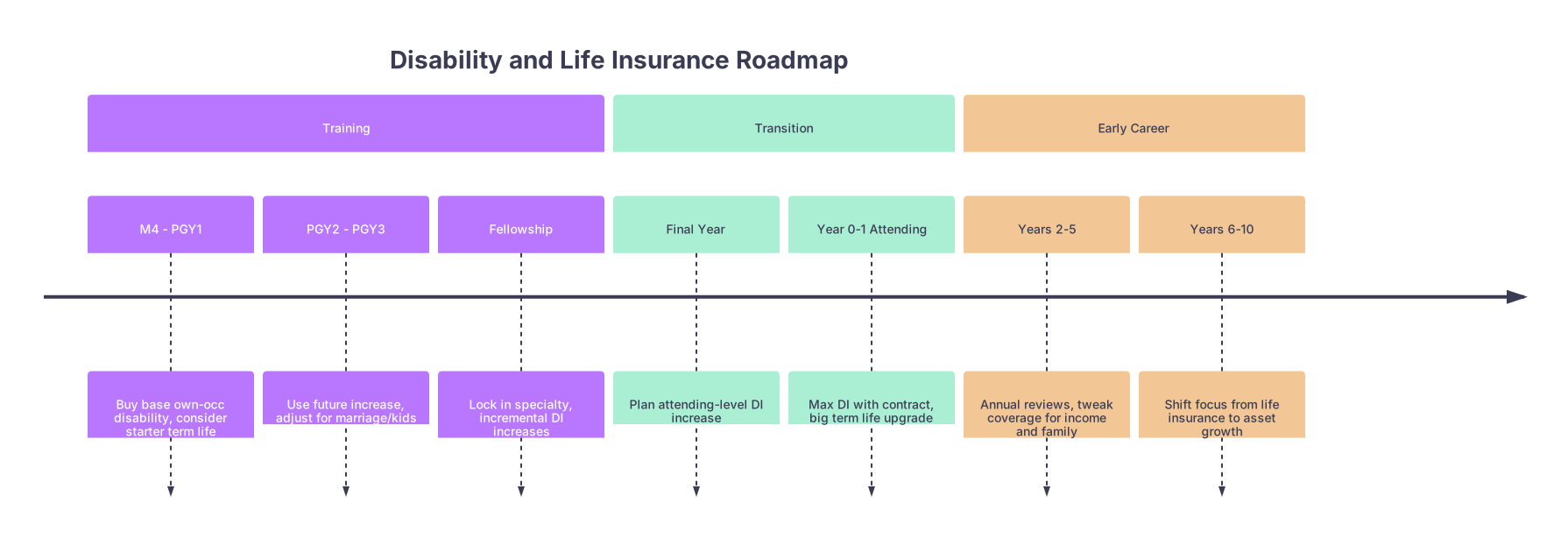
| Period | Event |
|---|---|
| Training - M4 - PGY1 | Buy base own-occ disability, consider starter term life |
| Training - PGY2 - PGY3 | Use future increase, adjust for marriage/kids |
| Training - Fellowship | Lock in specialty, incremental DI increases |
| Transition - Final Year | Plan attending-level DI increase |
| Transition - Year 0-1 Attending | Max DI with contract, big term life upgrade |
| Early Career - Years 2-5 | Annual reviews, tweak coverage for income and family |
| Early Career - Years 6-10 | Shift focus from life insurance to asset growth |
Years 6–10 as Attending: Shift From Insurance to Independence
By mid‑career you’ll (hopefully) have:
- Significant retirement savings.
- Home equity.
- A more predictable practice and income.
Insurance becomes backup, not the primary safety net.
At this point you should:
- Reevaluate whether you still need maximum disability coverage.
- Plan a glidepath to reducing life insurance as assets grow.
Disability: Right-Size, Don’t Automatically Max Out
If you’re:
- Saving 20%+ of your income.
- Sitting on a 6–12‑month emergency fund.
- On track to reach financial independence in, say, 10–15 years.
Then it may be reasonable to:
- Keep disability coverage strong but not necessarily maxed to carrier limit.
- Consider dropping COLA rider once your investment portfolio is substantial (depends on cost vs risk tolerance).
If you’re behind on savings or in a volatile specialty, keep robust coverage. Disability risk doesn’t vanish just because you’ve been lucky so far.
Life Insurance: Start Planning the Exit
As assets rise, dependents age, and debts drop:
At this point you should:
- Look at the gap between “family’s needs if I die” and “assets already accumulated.”
- When the gap shrinks dramatically, you can:
- Stop adding new term policies.
- Plan for some policies to naturally expire without replacement.
Example:
- You’re 45, kids are teenagers, portfolio is $1.5M, mortgage is half paid.
- You might reduce from $4M coverage to $2M by:
- Letting a 20‑year term policy from your 30s quietly expire.
- Keeping a single 30‑year term that runs into your 50s.
Late Career / Approaching Financial Independence: Intentional Wind‑Down
Eventually, the goal is to be self-insured.
At this point you should:
- Decide when you’re comfortable dropping disability insurance.
- Let term life policies expire as the math makes sense.
Disability: The End Date
Most physicians can reasonably consider stopping disability coverage when:
- Work becomes optional based on your portfolio (not your mood).
- You’re within a few years of planned retirement.
- Losing your income would be annoying, not catastrophic.
Canceling a policy you’ve paid for 20+ years feels wrong emotionally. But keeping expensive coverage you don’t actually need is just charity to the insurer.
Life Insurance: Final Expiration
The ideal scenario:
- By the time your longest term policy expires, your:
- Mortgage is either gone or comfortably manageable by your spouse.
- Kids are out of the house or almost there.
- Retirement savings can support the survivor.
At this point you should not replace expiring term with new policies unless something unusual is going on:
- Large new late‑career debt.
- Second family with very young kids.
- Special needs dependent needing lifelong care (this is where permanent insurance may make sense, ideally planned earlier with an estate attorney).
How to Run Your Own Annual 20‑Minute Insurance Audit
Every year — pick a month, set a recurring calendar event.
At this point you should:
- Pull:
- All disability policies (individual + group).
- All life insurance policies (term + any legacy weird products).
- For each, write on a notepad:
- Current benefit / death benefit
- Monthly/annual premium
- End date or term length remaining
- Ask three questions:
- If I became disabled tomorrow, would this benefit actually cover my life?
- If I died tomorrow, would my family have enough — or too much — relative to cost?
- Has my income, debt, or family situation changed enough to justify an upgrade or reduction?
If the answer to any of those feels off, that’s your signal to adjust.
Take one concrete step today: locate your current disability and life insurance policies (emails, PDFs, portals) and write down the benefit amounts and end dates on a single sheet of paper. Once it’s in front of you, you’ll immediately see whether your next move is “upgrade now” or “set a reminder for the next career jump.”