
The idea that “a below-average Step score kills your shot at competitive specialties” is lazy, half-true advice that makes anxious people like us spiral unnecessarily.
You and I both know the fear: you open your score report, your stomach drops, and your brain immediately jumps to, “Derm is gone. Ortho is gone. ENT is gone. I ruined my career with one exam.”
Let’s not sugarcoat anything. Some doors get heavier with a lower Step score. Some will slam shut at certain programs. But “off-limits forever”? That’s not how this actually works on the ground.
I’m going to walk through this like someone who’s sat in on rank meetings, heard attendings say “I don’t care if they have a 250, they were weird,” and watched people with 220s match into things they “weren’t supposed” to get. And yeah, I’ve also seen people with mid-250s not match.
So if your brain is screaming “I’m doomed,” let’s pick that apart piece by piece.
Step Scores and Competitive Fields: What’s Actually True vs The Panic in Your Head
Here’s the part that sucks: scores do matter. A lot. Especially in competitive stuff.
Programs are drowning in applications. They use filters. They use numbers. It’s faster. It feels “objective.” It’s not personal; it just feels very personal when you’re the one on the wrong side of the line.
But your brain is probably exaggerating a few things:
- You’re imagining that every program has some magical 250+ cut-off.
- You’re assuming that one number outweighs every other part of your file.
- You’re thinking “below average” means “dead on arrival.”
Reality is messier.
| Specialty | Step Score Role | Typical Pattern |
|---|---|---|
| Dermatology | Very Heavy | Filters + then holistic |
| Plastic Surgery | Very Heavy | Strong research emphasis |
| Orthopedics | Heavy | Scores + letters + away |
| ENT | Heavy | Research often essential |
| Radiology | Moderate-Heavy | Higher scores preferred |
And now with Step 1 pass/fail, Step 2 is the new screening favorite. So if your Step 1 was low/pass and your Step 2 is also below average, yeah, you’re fighting uphill. But uphill is not the same as impossible.
Here’s the basic truth I’ve seen over and over:
- A below-average Step score closes some doors, especially at the top-tier name-brand places.
- It forces you into a more strategic, less ego-driven, more “I really have to prove it” route.
- It does not equal “you can never do this specialty.”
You just won’t be able to rely on your score to carry you. At all.
What “Below-Average” Actually Means (And How Bad Is Your Situation, Really?)
Your anxiety probably lumps everything into two categories: “amazing score” and “garbage score.” That’s not how programs see it.
Let me break it into rough mental buckets for competitive specialties:
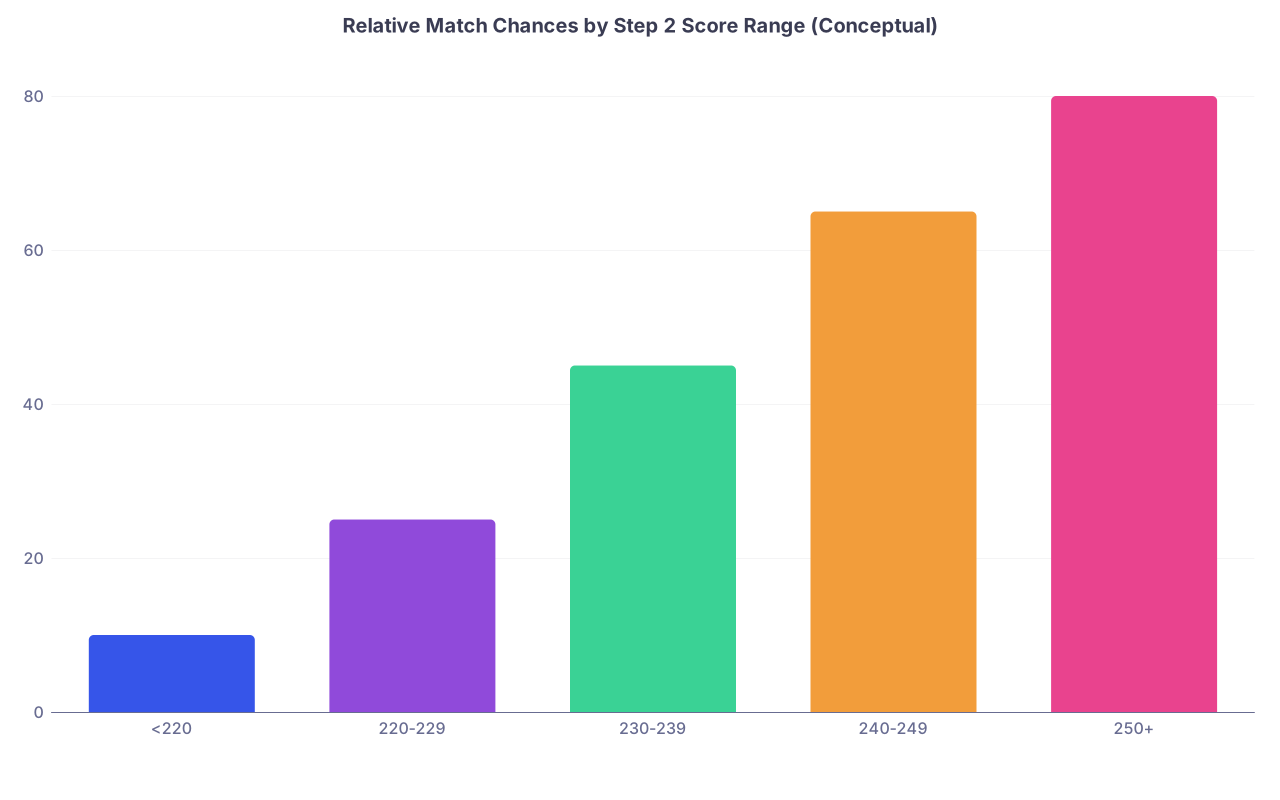
| Category | Value |
|---|---|
| <220 | 10 |
| 220-229 | 25 |
| 230-239 | 45 |
| 240-249 | 65 |
| 250+ | 80 |
(Those numbers are NOT exact stats; they’re the kind of rough probabilities I’ve seen play out in real life for competitive fields over time.)
How programs think, roughly:
- Below ~220: Most competitive programs filter you out automatically. You need serious compensating strengths, connections, and a very wide, realistic list.
- ~220–229: Some competitive programs will auto-screen you out. Others will still glance at your file. You’re not dead, but you’re not getting by on numbers.
- ~230–239: You’re in the “okay, let’s actually read this application” group for many places, but not all the super-elite.
- ~240–249: You’re competitive on paper, but not a shoo-in. They expect other parts of your app to match this level.
- 250+: You clear almost every numeric screen. But you can still be rejected if the rest of your app is meh.
If your score is in the low 220s and you’re thinking derm, plastics, ENT, ortho, neurosurg, integrated vascular… yeah, your anxiety isn’t crazy. You’ll have to fight for it.
But the nuance matters: “harder” is not “never.”
How Different Competitive Specialties Treat a Weak Score
Let’s go field by field for a second. Because “competitive” is not one uniform blob.
| Specialty | Score Weight | Other Big Levers |
|---|---|---|
| Derm | Very High | Research, mentorship, AOA |
| Plastics | Very High | Research, home program, audition |
| Ortho | High | Away rotations, letters, fit |
| ENT | High | Research, letters, connections |
| Rad Onc | High | Research, niche projects |
How a low-ish score actually plays:
Derm:
A 220? Brutal. But I have seen a mid-220s applicant with derm research, strong mentorship, and a ridiculous letter from a chair match at a mid-tier program. She applied widely, had like 80+ applications, and did multiple aways. It was not “easy.” But it happened.
Plastics:
Independent pathways, strong home programs, and research years can sometimes patch lower scores. But plastics culture is still very score-conscious. If you’re truly below-average, you probably need either:
- a research year or two, or
- to consider an indirect route (gen surg → plastics), or
- to widen your target to programs that historically take more non-traditional applicants.
Ortho:
Here, I’ve seen 220–230 people do it if they crushed:
- away rotations (like, top student on service)
- letters from well-known ortho attendings
- being the kind of person who shows up at 4:30 a.m. with a good attitude and is useful in the OR.
Away rotations are huge in ortho. They’ve given people a shot despite non-stellar scores.
ENT / Neurosurg / Rad Onc:
These are more research-heavy and insular. Lower scores don’t kill you by themselves, but they stack badly if you also don’t have:
- substantial, specialty-specific research
- a mentor willing to make calls
- a ridiculously strong personal reputation locally
So if your brain is saying, “I’m under 230, so all these fields are just gone,” that’s too absolute. It’s more: “My path will be riskier and may require a backup plan, extra years, or going all-in with no ego.”
The Stuff That Can Actually Offset a Below-Average Score
Your anxiety probably whispers, “Nothing can fix this.” That’s wrong.
Does anything completely erase scores? No. But there are things that move the needle more than you’d think.
Here’s what I’ve watched actually rescue people:
Ridiculously strong, specific letters
- Not “hard worker, team player” fluff.
- I mean: “This student is in the top 1–2% I’ve worked with in 20 years. We will try to keep them here. You should take them without hesitation.”
- Especially from someone known in the specialty.
Aways/audition rotations where you basically live and breathe the service
- Show up early, leave late, read constantly.
- Be the person everyone actually wants back.
- I’ve seen programs ignore mediocre scores if the entire team is pushing for a student they loved on away.
Serious, focused research with outputs
- Not one poster tacked onto a multi-author project.
- Multiple abstracts, a first-author paper, ongoing projects.
- Enough that someone in that field can say, “They’re already functioning like a junior resident academically.”
A believable, coherent story
- Admissions and PDs hate “I just like it because it’s cool.”
- They do respond to: “Here’s how my background, my work, and my clinical experiences all align with this field – and here’s what I’ve already done in it.”
Programs that structurally don’t care as much about “shiny”
- Newer programs.
- Less ‘big-name’ geographic areas.
- Community or hybrid programs in competitive fields.
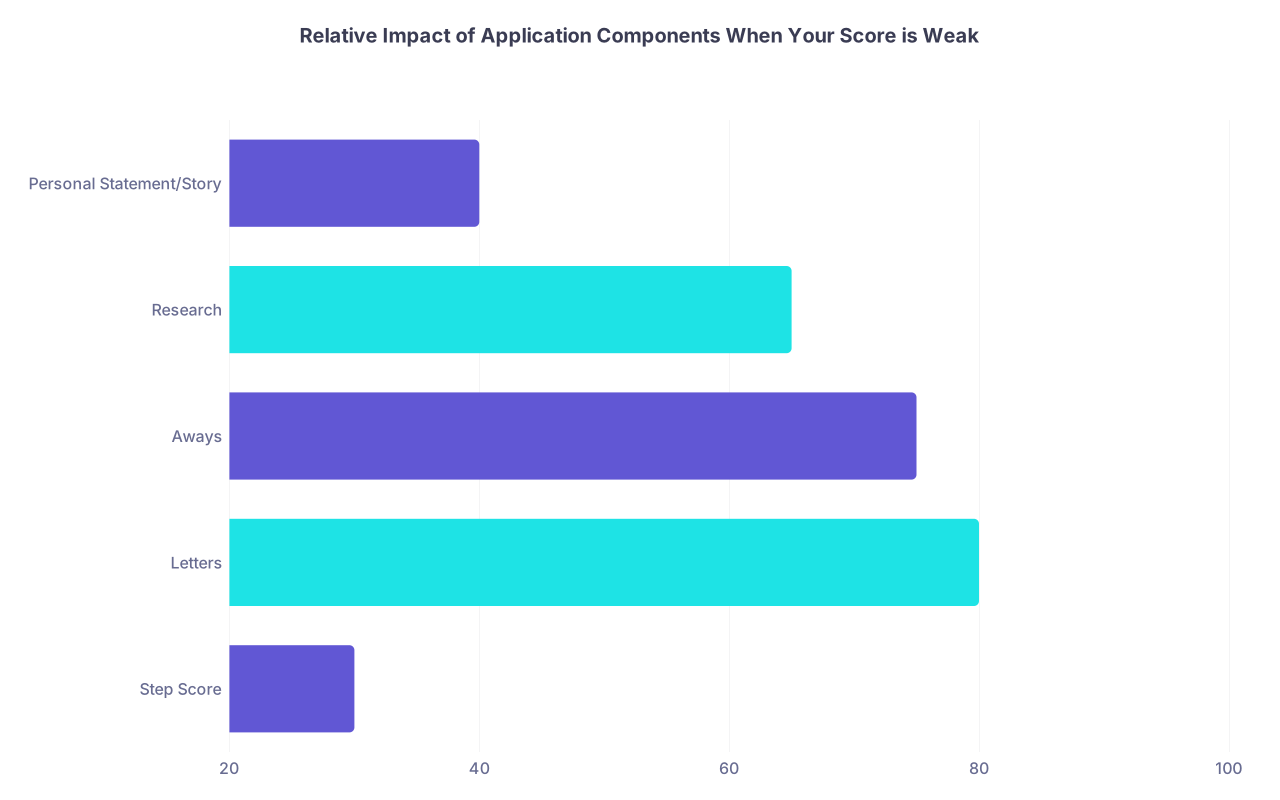
| Category | Value |
|---|---|
| Step Score | 30 |
| Letters | 80 |
| Aways | 75 |
| Research | 65 |
| Personal Statement/Story | 40 |
Again, not real numbers. Just the rough shape of how I’ve seen lower-score candidates salvage outcomes: letters and aways can matter more than you think when numbers hurt.
Questions You’re Probably Torturing Yourself With (And Blunt Answers)
“Should I just give up on my dream specialty?”
Not automatically. Ask yourself:
- Are you willing to:
- potentially do a research year (or two)?
- apply to 60–100+ programs?
- live in places you didn’t imagine living?
- accept a real chance of not matching and have a backup plan?
If all of that sounds like a hard no, then you might not be “in love with the specialty” so much as “in love with the idea of it.” That’s different.
But if you’re reading this with your stomach in knots thinking, “I can’t imagine doing anything else,” you at least owe yourself a serious, strategic attempt.
“Am I being delusional?”
You’re being delusional if:
- You have a 215 and want derm at a top-10 program, with no research, no mentor, and no backup.
- You won’t consider less competitive programs or locations.
- You expect your personal statement to make everyone forget your numbers.
You’re not being delusional if:
- You have a below-average score but are ready to overcompensate on everything else.
- You’re okay being “underdog applicant who applied smart and worked twice as hard.”
“What if I apply and don’t match? Won’t that look terrible forever?”
Unmatched doesn’t tattoo your forehead. Programs see it, sure. But what they care about is:
- What you did after not matching.
- How you explain it without sounding bitter, dishonest, or clueless.
- Whether you used that year to strengthen your application in a real way (research, prelim year, more exposure, better letters).
I’ve watched people not match ENT → do a research year → match the next cycle. People not match ortho → do a surg prelim → match ortho or pivot to something else surgical they ended up loving.
Is it fun? No. Is it career-ending? Not necessarily.
How to Decide If the Risk Is Worth It (Without Gaslighting Yourself)
Let’s make this more concrete and a bit unemotional, because your anxiety is probably doing all-or-nothing thinking.
Ask these questions and answer them honestly:
Where do my scores actually sit for this specialty?
- Look up NRMP Charting Outcomes for matched vs unmatched in your specialty.
- If you’re below the mean of unmatched applicants, you need major compensating strengths.
What non-score strengths do I already have in this field?
- Home program?
- Specialty-specific research?
- Strong early mentorship?
- Solid prior evaluations on rotations?
Am I willing to fully commit to this specialty this year?
- By that I mean: most research, networking, away rotations, and application energy go here.
- No half-hearted “I’ll throw in a few apps and see.”
Do I have a real backup that I’d be okay with emotionally?
- Not your parents’ dream field. Yours.
- Something that you could see yourself doing at 2 a.m. without hating your life.
If you end up with something like:
“I’m below average, but I have a home program, some research, and a great mentor who believes in me, and I’m willing to do an away + apply broadly,” then no, competitive fields are not off-limits.
If you’re thinking: “I’m below average, I have zero exposure, no mentor, and I don’t want to do any extra years or far-away programs,” then the door is not locked, but it’s barely cracked open at best.
Concrete Next Steps if You Have a Below-Average Step Score and Big Dreams
Here’s exactly what I’d do if I were you and still wanted to swing for a competitive field:
Have a brutally honest talk with a specialty insider
- Not just your school’s generic advisor.
- A program director, associate PD, or senior faculty in that field.
- Show them your CV and Step scores. Say, “I want your honest take and what it would take to be viable.”
Lock down a real mentor—today
- Someone in the specialty who:
- knows you personally,
- is willing to advocate for you,
- has enough clout that their email or phone call actually matters.
- Someone in the specialty who:
Double down on clinical performance
- From now on, your reputation on the wards and your letters matter even more.
- Be the student residents want to work with again.
- People absolutely talk in selection meetings about “good hang” vs “pain to work with.”
Stack your file with specialty-specific stuff
- Research projects in that field.
- Local talks, posters, anything you can realistically complete before applications.
- Shadowing and clinics in that specialty, not just random exposure.
Plan aways like they’re high-stakes auditions
- Apply to aways at mid-tier or less flashy programs that might be more holistic.
- Treat every day there as an interview.
FAQ (Exactly 5 Questions)
1. I have a below-average Step score and no research. Is a competitive specialty even realistic?
It’s very shaky without research, especially for derm, plastics, ENT, neurosurg, and rad onc. For ortho and some others, research is still important but clinical reputation and aways may matter more. You don’t absolutely need a 20-line PubMed page, but you do need something to show commitment to the field. If you’re starting from zero, talk to faculty now about getting on fast-moving projects (retrospectives, chart reviews, case series). You can improve this piece over 6–12 months if you’re aggressive about it.
2. Should I take a research year just because my Step score is low?
Not automatically. A research year makes sense if:
- You’re targeting a very research-heavy field (derm, plastics, ENT, neurosurg).
- You can work with someone known in the field who will actually mentor and advocate for you.
- You’re going to produce real outputs—posters, presentations, maybe papers.
If it’s just “random research, unclear mentor, no clear plan,” you’re wasting time and money. Get a specific plan on paper with a PI before committing.
3. Will a strong Step 2 score “erase” a weak Step 1 score?
No, but it can significantly blunt the damage. Programs like “upward trajectory.” If Step 1 was low/pass and Step 2 jumps to solid or above average, it tells them you can improve, handle clinical material, and maybe had a rough first round. If both are low, then Step 2 becomes part of the problem, not the solution. If you haven’t taken Step 2 yet, treat it like your one serious chance to change the narrative.
4. How many programs should I apply to if my score is below average for a competitive field?
More than you’re comfortable with. For a truly competitive specialty with a weaker score, 60–100+ is not crazy. You’ll hear people say, “I applied to 25 derm programs and got 5 interviews” — that’s usually with strong numbers and strong mentors. You don’t have that luxury. Apply broadly: geographically, by program reputation, and by size. Then actually use your mentor to help target where you might realistically get a look.
5. What if I’m scared to tell mentors my real Step score?
They’re going to find out eventually. It’s better that they hear it from you with a plan attached: “My Step 1 is X, Step 2 is Y, and I know that’s not ideal for this field. Here’s what I’m already doing to strengthen my application. Can you help me figure out where I realistically stand and what else I need?” Most decent faculty respect that honesty. And if someone instantly writes you off without a real conversation, that’s probably not the mentor you needed anyway.
Open your score report right now and write down three things: your exact score, your dream specialty, and one realistic backup. Then email one faculty member in that dream specialty today asking for a 20–30 minute honest meeting about your chances and what it would take to be viable. Don’t let this live only in your head.