
Last week, a fourth‑year I know refreshed her email for the 40th time before 10 a.m. She’d applied to 28 dermatology programs and suddenly realized everyone on Reddit was saying “60+ or you’re not serious.” She looked up from her laptop and said what you’re probably thinking: “Did I just screw up my entire career with one dumb decision?”
Let me say the thing you’re scared to say out loud: maybe you did apply to too few programs for how competitive your specialty is. But that does not automatically mean you’re doomed, unmatched, or destined to reapply. There’s still strategy left.
Step 1: Be Brutally Honest — Did You Actually Under‑Apply?
This is where the panic gets loud. “Too few” is meaningless until you put it against real numbers for your specialty and your application.
Here’s a rough reality check (U.S. MD/DO, first-time applicants, no major red flags):
| Specialty | Safe-ish Range* |
|---|---|
| Dermatology | 60–80+ |
| Plastic Surgery | 45–70 |
| Orthopedic Surg | 60–80 |
| Neurosurgery | 40–70 |
| ENT (Oto-HNS) | 50–70 |
| Ophthalmology | 50–70 |
*Not guarantees. Just what I keep seeing from matched applicants and PD comments.
Now overlay your situation:
- Applied to 18 derm programs with average Step 2, no home program, minimal research?
Yeah, that’s under‑applying. Badly. - Applied to 45 ortho programs with strong letters, good research, and a couple away rotations at big places?
Less catastrophic. - Applied late October to 25 ENT programs with mid‑range scores?
Also concerning.
Here’s the gut‑punch summary:
You’re under‑applied if you have multiple risk factors (below‑average metrics for that field, no home program, limited research, no aways) and you applied to the low end or below the usual range.
To make this less abstract:
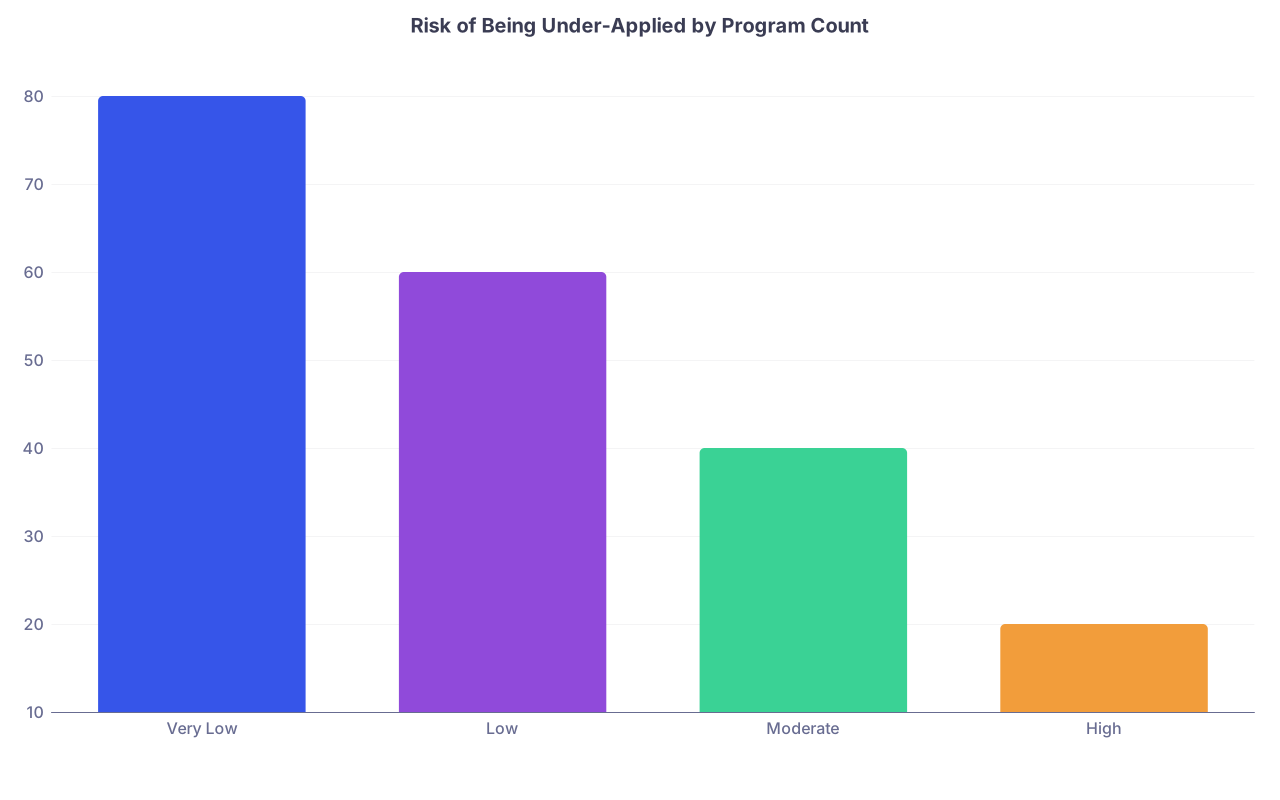
| Category | Value |
|---|---|
| Very Low | 80 |
| Low | 60 |
| Moderate | 40 |
| High | 20 |
Pretend those bars are your “safety margin” as you drop program numbers. Once you’re in the 20s and 30s for ultra‑competitive specialties, your margin shrinks fast unless you’re a truly exceptional candidate.
But here’s the twist:
Even if you did under‑apply, you’re not out of moves yet.
Step 2: Time Check — What Can You Still Change Right Now?
Your options depend heavily on where in the cycle you are.
If It’s Still Early (Apps Just Submitted, Before Many Interviews)
You have the most control here.
You can:
- Add more programs (if the system is still open and programs accept late apps).
- Email programs you’re geographically tied to and consider late applications.
- Fix obvious holes in your application (CV errors, uploaded wrong personal statement, missing experiences).
This is the “throw more darts at the board” stage. Yes, it costs more money. Yes, it sucks. But if you’re in something like ortho or derm with 25 applications total and no A++ stats, adding more programs is not overkill; it’s damage control.
If It’s Mid-Season (Some Invites Out, Some Silence)
This is where the anxiety gets sharp. Others have 8–10 invites and you’re staring at 0 or 1.
At this point, you can:
- Add a few more lower‑tier or mid‑tier programs that might still review late applications.
- Broaden your geography. Rural, Midwest, South, smaller cities. Respectfully: if you’re short on interviews, you don’t have the luxury of being picky about cool cities.
- Reach out to your specialty advisor or program director and ask bluntly, “Should I add more programs now?”
If It’s Late (Most Interviews Are Out, You Have Few or None)
You’re in “salvage and plan B” territory. Not hopeless. But different.
Your realistic moves:
- Email programs that haven’t sent out all their invites, expressing strong interest (without being weird).
- Ask your home program PD or mentor if they’d be willing to make a call or send an email for you to a couple of realistic programs.
- Start parallel planning: SOAP, prelim/transitional year, or reapplication.
This is the part no one wants to think about, but it’s better than getting blindsided in March.
Step 3: Understand Why “Too Few” Hurts So Much
Your anxiety here is actually very rational. In competitive specialties, the math is ugly.
You’re competing for:
- Limited interview slots
- At programs that:
- Filter by Step scores (even when they pretend they don’t)
- Prefer known schools, home programs, and aways
- Heavily favor research in their field (derm, plastics, neurosurg especially)
So when you cut your program list down, you’re not just saving money. You’re:
- Decreasing your chances to hit that magic interview threshold (often ~10–12 for a decent match chance, depending on specialty).
- Banking on:
- Programs actually looking at your application
- Your metrics being competitive enough to beat their filters
Here’s the part few people say out loud:
A lot of really strong applicants under‑apply because they’re trying to be “reasonable” or “efficient” or they don’t want to move somewhere they’d hate. Then they don’t match and suddenly the idea of “somewhere I don’t love but I’m in my dream specialty” sounds way better than not matching at all.
Step 4: What You Can Still Actively Do (Not Just Panic-Scroll)
Here’s where you switch from “I ruined everything” to “I’m going to squeeze every drop of probability out of this mess.”
1. Add Programs Strategically (Not Randomly)
Don’t just click everything. Target:
- Community or hybrid programs
- Programs in less popular locations
- Places that accept a mix of MD/DO/IMG if that fits you
- Programs where your med school or mentors have known connections
Ask your advisor:
“Given my app, which 10–15 programs would you add right now if this were your career on the line?”
Then actually do it. Today. Not “this weekend when I have time.”
2. Use Your Network (Yes, Even if You Hate Asking for Help)
This feels gross, but it matters.
People who can help:
- Your home specialty PD
- Faculty who wrote you strong letters
- Attendings from aways who actually liked you
What they can do:
- Send a short, targeted email:
“We have a strong applicant who may be under‑applied. I’d appreciate your taking a look at their application to Program X if you have any flexibility.”
Does that guarantee an interview? No. But I’ve seen it flip a cold app into an invite enough times to say you’d be hurting yourself not to at least try.
3. Fix Any Self‑Inflicted Wounds
You’d be amazed how many people sabotage themselves with:
- A generic, forgettable personal statement
- Vague descriptions of research or leadership
- No clear “why this specialty” narrative
You can’t reupload everything in every system mid‑cycle, but:
- If there’s a supplemental or program‑specific PS still editable: sharpen it.
- If you get the chance to send a program-specific interest email, make it good:
- Why that program
- Why that city/region
- One or two concrete details (an attending, a track, a case log emphasis)
Don’t send a three‑paragraph essay. Two tight paragraphs with specifics beat a wall of text.
Step 5: Worst‑Case Scenario Thinking (Because You’re Already There)
Let’s go down the road your brain is already sprinting down:
“What if I don’t get enough interviews and I don’t match?”
Here’s what I’ve actually seen people do who survive that outcome and still end up in competitive fields:
SOAP or prelim year
- Take a prelim surgery or transitional year while you strengthen your app.
- Pros: You stay clinically active, can get fresh letters, maybe do research nearby.
- Cons: It’s exhausting, and you’re juggling reapplying during intern year.
Dedicated research year
- Especially big in derm, plastics, neurosurg, ENT.
- Pros: Publishes your way into being taken more seriously.
- Cons: Low pay, delay of real salary and training, psychologically rough watching classmates move on.
Parallel plan into a related field
- Example: Didn’t match ortho → do general surgery → later pursue fellowships that still get you close to what you want.
- Or ophtho → internal medicine + rheum → still see tons of eye disease.
- Not the first choice, but absolutely many people end up satisfied here.
I’m not saying “don’t worry, it all works out.” Sometimes it doesn’t. But there are more paths forward than your anxiety is letting you see right now. Matching late into your dream field after detours is still matching. No asterisk on your white coat.

| Step | Description |
|---|---|
| Step 1 | Apply to too few programs |
| Step 2 | Proceed to rank list |
| Step 3 | Add more programs |
| Step 4 | Plan for SOAP or reapply |
| Step 5 | Research year or prelim |
| Step 6 | Reapply more broadly |
| Step 7 | Match in desired or related field |
| Step 8 | Enough interviews? |
| Step 9 | Interviews improve? |
Step 6: How to Mentally Survive the Waiting Without Imploding
This isn’t “mindfulness” fluff. This is how you stop yourself from doing destructive things mid‑season (like sending unhinged emails to PDs).
Set rules for checking email/ERAS/Thalamus
- Example: 3 times a day. Morning, lunch, evening.
- If you stare at it all day, you’ll spiral and start catastrophizing every silence as a rejection.
Limit doom‑scrolling
- Reddit, SDN, Discord servers where people drop every invite they get?
Use them for data, not self‑harm. - If every time you check you feel worse, log out. For real. You won’t miss anything that changes your outcome.
- Reddit, SDN, Discord servers where people drop every invite they get?
Keep a list of “controllables” vs “uncontrollables”
- Controllables:
- How many more programs you apply to
- Which mentors you ask for help
- How you prep for the interviews you do get
- Uncontrollables:
- Who they already know
- How many internal candidates they have
- How many interview spots they cut this year
- Controllables:
Focus your energy where it can still move the needle, not on the black box of selection committees.
A Quick Reality Check on Numbers (Because Your Brain Is Lying to You)
Your brain is probably doing this:
- “Everyone else applied to 80+ programs, I only applied to 40, I’m definitely not matching.”
Not true. I’ve seen:
- Someone with 60 ophtho apps, 0 interviews (weak letters, late apps).
- Someone with 28 derm apps, 6 interviews, matched (fantastic research, home program, great mentorship).
- Someone with 75 ortho apps, 2 interviews, unmatched (mediocre narrative, no connections, lukewarm letters).
More programs help. I won’t sugarcoat that. But they don’t replace:
- Strong letters
- Clear commitment to the field
- A narrative that makes sense
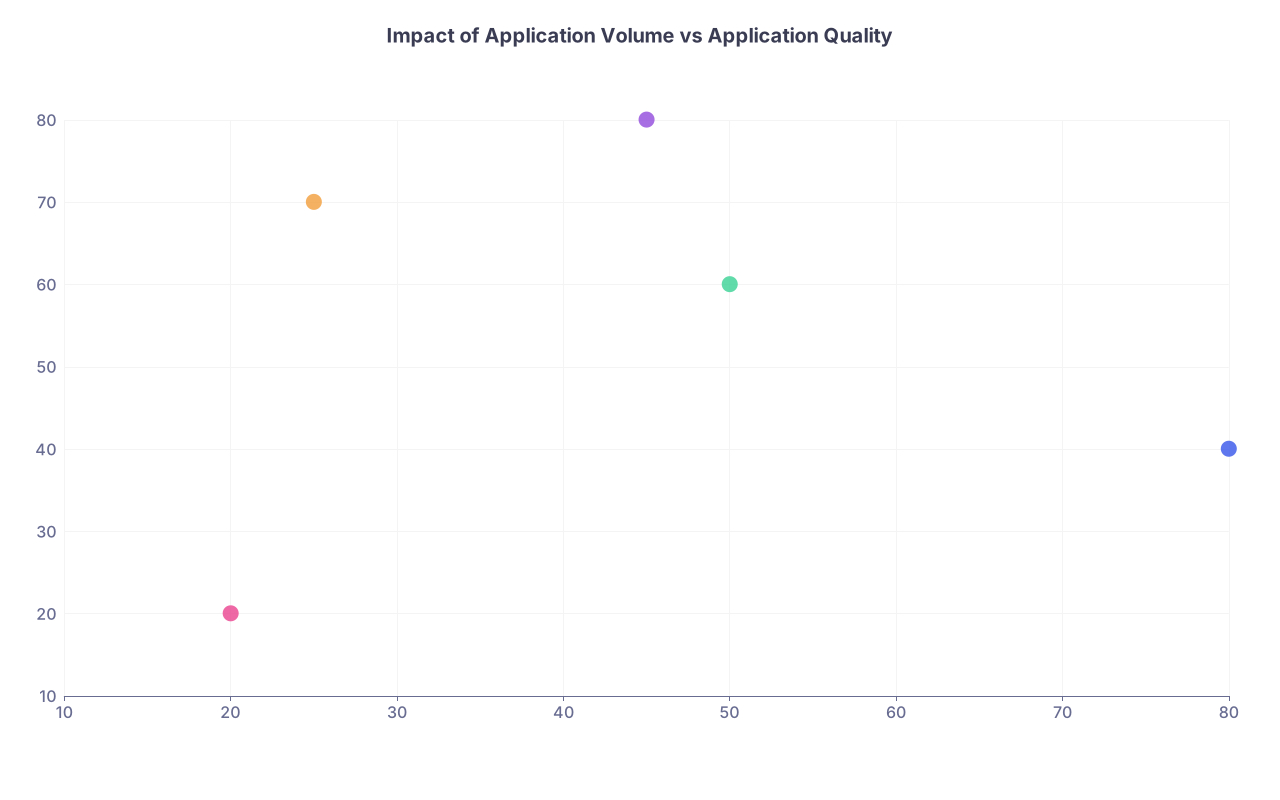
| Category | Value |
|---|---|
| Low quality, many apps | 80,40 |
| High quality, moderate apps | 45,80 |
| Average apps, average quality | 50,60 |
| Few apps, high quality | 25,70 |
| Few apps, low quality | 20,20 |
Think of it like that chart: number of programs is just one axis. Quality is the other. You need both, but if you’re low on volume, then you absolutely must squeeze every ounce of value out of your quality.
So… Are You Screwed?
Here’s my honest answer:
If you’re in a hyper‑competitive specialty, applied to way fewer programs than peers, have no standout features, and you’re already late in interview season with no invites…
Your chances this cycle are not great. I won’t lie to you.But “not great this cycle” is not the same thing as “never.”
I’ve seen people get in on the second try with a stronger, broader app and a clearer, humbler story.
And if you’re early or mid‑season?
You still have moves. They’re not fun, they’re not cheap, and they don’t guarantee anything. But they’re better than sitting in fear convincing yourself it’s already over.
One Concrete Step You Can Take Today
Open your program list right now and do three things:
- Count how many programs you applied to in your specialty.
- Compare that number to what matched applicants in your field typically recommend.
- Add 5–15 more realistic programs today if you’re clearly under that range and still have the chance.
Then email one mentor and say:
“I’m worried I under‑applied in [specialty]. Here’s my current list and numbers. Would you be willing to suggest a few more programs and possibly reach out to one or two on my behalf?”
Do that today. Not when you “feel less anxious.” You won’t.
FAQ (Exactly 5 Questions)
1. Is there any point adding programs late in the season?
Sometimes, yes. Some programs review applications later, some have cancellations, and some keep a rolling process. Will it be as good as applying early? No. But a late application is still more chance than no application. Especially to less popular locations or smaller programs.
2. I only have 1–2 interviews in a very competitive specialty. Should I already plan to SOAP?
Quietly, yes. Hope those interviews go well and prep hard, but in the background, talk to your advisor about SOAP options, prelim/transitional years, or a research year. It’s not pessimistic; it’s protective. Better to have a plan you don’t use than scramble in March with no idea what you’re doing.
3. Will emailing programs to express interest help if I under‑applied?
Sometimes. A generic “I’m very interested in your program” email does nothing. A short, specific message tied to geography, a known connection, or a niche interest can push a marginal app into the “maybe” pile. Especially if it’s backed by a mentor email.
4. I chose not to apply to certain regions because I don’t want to live there. Was that a mistake?
Possibly. In super competitive specialties, geography snobbery can cost you a match. Only you can decide what trade‑offs you’re willing to make, but be honest: is “never living in X state” really more important than getting into your dream field at all?
5. If I under‑applied this year, does that mark me forever as a weaker candidate when I reapply?
No. Programs don’t have a blacklist that says “this person was dumb and applied to too few programs.” They mostly care about: what you did with the extra time (research, prelim year, better letters), whether your story makes more sense now, and if you took the second shot seriously by applying broadly and thoughtfully. The under‑applying part stings emotionally, but it’s not a permanent stain.