You are not automatically screwed because your school doesn’t have your dream specialty. But if you pretend it doesn’t matter, that will screw you.
Let me just say the thing you’re probably too scared to say out loud:
“I’m at a school with no home program in a competitive specialty, everyone on Reddit says I’m dead in the water, and I feel like I picked the wrong med school and ruined my whole career before it even started.”
Yeah. I know that feeling.
The harsh truth no one sugarcoats: you are at a disadvantage
Not doomed. Not locked out. But yes, behind compared to:
- The MS3 at UCSF who can just walk onto their home derm service,
- The student at a big-name academic center who has three faculty in plastic surgery offering them projects,
- The kid whose school has a built-in pipeline to ortho because the chair basically funnels their students into good programs every year.
Programs like home students. They know them. They’ve seen them on rounds. They’ve heard attendings say, “She works hard, you want her in your program.” You don’t have that built-in marketing machine.
So yeah. There is a gap.
But the real question isn’t “Do I have a disadvantage?” It’s: “Can I build a different set of advantages fast enough to close that gap?”
That’s where this actually gets interesting.
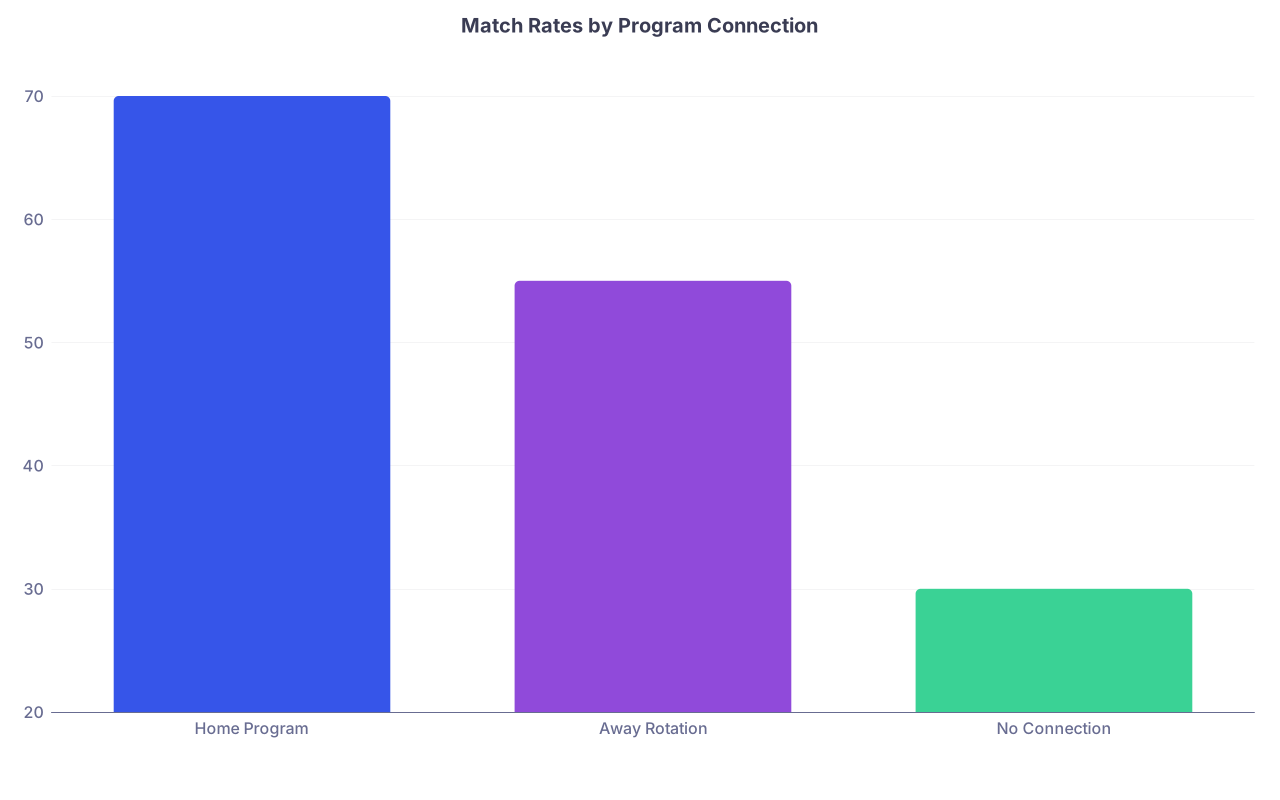
| Category | Value |
|---|---|
| Home Program | 70 |
| Away Rotation | 55 |
| No Connection | 30 |
No, those numbers aren’t exact from any one study. But that pattern? Very real. Having some connection helps. Having none hurts.
Your job is to move yourself from “No Connection” to “Has Connections” as aggressively as possible.
Why it feels so unfair (and why that feeling is actually useful)
You’re not just worried about match statistics. You’re spiraling:
- “Everyone else will have letters from big-name faculty and I’ll have…Dr. Random Internist who thinks derm is ‘putting cream on stuff’.”
- “How am I supposed to show interest in ENT when my school doesn’t even have an ENT clerkship?”
- “If I ask for away rotations, will my school think I’m abandoning them or being ungrateful?”
- “What if programs look at my app and think, ‘No home program = no real exposure = red flag’?”
Here’s the twist: that anxiety is actually a survival alarm. It’s your brain yelling, “You can’t passively float through this like everyone else. You need a plan now.”
The people who get burned in your position are the ones who:
- Decide on a competitive specialty late,
- Realize in MS4 that they’ve never worked with faculty in that field,
- Have no letters from within the specialty,
- And then say, “But I’m a hard worker, that should be enough, right?”
It’s not. Not in derm, plastics, ortho, ENT, urology, neurosurgery, rad onc, optho, etc.
You can’t afford to be casual.

What “no home program” actually changes for you
Let’s be concrete. Having no home program usually means:
- No built-in clinical rotations in that specialty at your main hospital
- No automatic access to that specialty’s faculty for mentorship or letters
- No established research pipeline in that field within your own school
- No “our students traditionally match in X program” credibility trail
What that really translates into:
You must import almost everything that home students get for “free.”
And you have to do it while also doing all the normal med student stuff: passing Step, not failing rotations, pretending you have a personality during OSCEs, etc.
Let me break down the big buckets: exposure, mentorship, research, clinical performance, and away rotations.
1. Exposure: showing you actually know what you’re asking for
Programs in competitive fields hate tourists. The “I shadowed for two afternoons and now I want neurosurgery because brains are cool” crowd.
No home program means they may quietly worry: “Has this person actually seen what we do?”
You fix that by aggressively maximizing any exposure you can get, even if it’s patchwork:
- Find affiliated hospitals or community physicians in your field. Beg. Politely. For shadowing opportunities.
- Use every elective slot you have to get some exposure before away rotation season. Even if it’s at a smaller site.
- Go to national or regional specialty meetings if you can swing it, especially student/resident sections. This counts more than you think.
Your goal: by the time you’re applying, you can clearly and specifically talk about cases you’ve seen, day-to-day realities, and why you still want in.
2. Mentorship: you can’t do this one alone
Here’s one of the nastiest parts: your own school might be lovely but completely powerless in your field.
Your dean can write you a generic letter. Your internal medicine attending can vouch that you’re not a disaster. But for ortho, derm, plastics, ENT? Committees want to hear from their own people.
You probably need:
- At least 2 strong letters from physicians in the specialty
- Ideally at least 1 from a place with some name recognition in that field
- Someone who’s willing to pick up the phone or send an email to advocate if needed
Without a home program, you usually get these from:
- Early, intentional shadowing that turns into a real relationship
- Research mentors in the field (even if remote or at another institution)
- Away rotations, where your entire purpose is: impress, be useful, and leave with a letter
If you’re early (M1/M2), you have time to build this slowly. If you’re already M3 and just realized you want derm with no derm department at your school, I’m not going to lie—you’re in scramble mode. Still possible, but every month matters.

| Step | Description |
|---|---|
| Step 1 | No Home Program |
| Step 2 | Early Exposure |
| Step 3 | Find External Mentors |
| Step 4 | Join Research Projects |
| Step 5 | Strong Core Clerkships |
| Step 6 | Targeted Away Rotations |
| Step 7 | Letters From Specialty |
| Step 8 | Competitive Application |
Research: the ugly gatekeeper in competitive specialties
For some fields, research is “nice to have.” For a lot of competitive ones, it’s almost mandatory.
No home program usually means:
You don’t have someone down the hall saying, “Hey, want to help with this chart review?” So you end up watching SDN posts like, “I had 12 derm pubs by M3” and feeling sick.
The median research expectations are brutal in some specialties. Quick snapshot feel (not exact numbers, but directionally real):
| Specialty | Research Expectation Level |
|---|---|
| Internal Med | Low–Moderate |
| General Surgery | Moderate |
| Orthopedic Surgery | High |
| Dermatology | Very High |
| Plastic Surgery | Very High |
| ENT | High |
Here’s what you do when your school doesn’t hand you research on a silver platter:
You go hunting elsewhere.
- Cold email faculty at nearby institutions in that field. Yes, really. Many students get projects this way.
- Ask, explicitly: “Do you have any retrospective projects, chart reviews, or case series I could help with remotely?”
- Use national student specialty organizations. Many have research networks or mentorship programs.
- Be willing to do the unsexy data grunt work. That’s your in.
Is it harder without local connections? Yes.
Is it impossible? No. I’ve watched students at small Caribbean schools publish in decent journals because they latched onto one overworked academic attending at a nearby center and basically became their research assistant.
You don’t need 20 papers. But you do need to show real involvement in the field somehow.
Away rotations: your home program replacement
This is where your lack of home program can actually become a weird advantage—if you play it right.
For students with a home program, away rotations are often “a nice extra.”
For you? They’re your main stage.
Your away rotations are:
- Your de facto “home” department
- Your audition for a letter
- Your shot to prove you can hang with students who’ve had 2 years of direct exposure
So you treat them like life-or-death. Not in an annoying, try-hard way. In a “I will be the most reliable, prepared, non-complaining human on this team” way.
That means:
- Know your basic exam and core clerkship content cold before you show up
- Pre-read about the common cases/procedures at that site
- Show up early, leave late, do the scut, and don’t whine
- Be teachable; don’t flex what you don’t really know
You want someone on that rotation to say, “Wait, you don’t even have this specialty at your home school? And you performed like this?” That narrative is powerful. It flips your disadvantage into an underdog story.
The narrative problem: how you explain having no home program
You’re probably worried programs will see “No home program in X” and assume:
- “They couldn’t get exposure, they might not know what they’re getting into”
- Or worse: “They might be using this as a backup or random choice”
You want to preempt that by:
- Clearly explaining when and how you discovered the field
- Showing that despite no home program, you actively sought out experiences
- Demonstrating consistent, long-term engagement (not a last-minute pivot)
Something like:
“I attend a medical school without a home ENT program, so I sought out opportunities at affiliated hospitals and through national meetings. Over the past two years, I’ve shadowed in clinic and OR, completed a dedicated ENT elective at [Hospital], and worked on a multi-center project on [topic]. These experiences confirmed that I want a career in this field, despite the structural limitations at my home institution.”
That’s a very different story from, “My school didn’t offer it so I couldn’t do much, but I think I’d like it.”
Where being “behind” is fixable vs. where it’s not
Let me be brutally honest for a second. There are things you can absolutely make up for, and things that, if they’re weak, even a home program wouldn’t save.
You can compensate for:
- No home department → by strong away rotations and external letters
- Less built-in research → by targeted, externally found projects
- Limited early exposure → by intentional shadowing and electives
You cannot magically erase:
- Chronically weak clinical evaluations
- Low Step/board scores in hyper-competitive fields (like sub-220 trying for derm)
- A completely late, last-minute decision with nothing in your history tying you to the field
So before you kill yourself chasing plastics with a 210 and no research, ask honestly: is this a stretch or pure fantasy? Sometimes your anxiety is actually realism.
But if your stats are at least in the realm, and your main “flaw” is just “my school doesn’t have this specialty”? That is survivable. With a plan.
Stop doomscrolling. Here’s what you actually do next.
If you want to feel less behind, you have to act like someone who refuses to stay behind. That means today, not “after this block” or “when things calm down” (they don’t).
Here’s the concrete, non-fluffy version:
- Identify 3–5 programs within driving distance or reachable by email that do have your field.
- Draft one email template you can tweak for each attending: who you are, your school, your interest in their specialty, your lack of a home program, and specifically what you’re asking for (shadowing? research? a brief meeting?).
- Send the emails. Even if your stomach knots up. Even if you’re sure they’ll ignore you.
Because the students with home programs already have faculty advocates speaking their names in conference rooms. You don’t. Not yet.
You can sit in that reality and let it crush you, or you can decide, right now, to start building your own version of a home program from the outside in.
Open your email, find one faculty name in your dream field at a nearby institution, and send a short, respectful message asking for a 15-minute conversation. Hit send before you talk yourself out of it. That’s how this starts.