The myth that “you have to know your specialty by MS1 or you’re doomed” is garbage.
But. Deciding late on a competitive specialty does make everything harder, riskier, and more stressful than anyone admits on those glossy school brochures.
You’re basically asking: “If I wake up in MS3 or even early MS4 and suddenly realize I want derm, ortho, ENT, plastics, neurosurgery, optho, urology, or something similarly impossible… did I just ruin my chances by being late to the party?”
Let’s walk through this like adults. No sugarcoating, no doom spiral. Just the actual realistic outcomes people don’t say out loud.
First: You’re Not the Only One Who “Decided Too Late”
I’ve seen this exact story so many times it’s almost predictable:
You start med school thinking primary care, maybe IM, maybe peds. You don’t chase research hard. You don’t care which attending knows your name. You’re just trying to pass.
Then third year hits. You do your surgery rotation. Or derm. Or radiology. Or you scrub into an ortho case and suddenly, annoyingly, your brain lights up.
And now you’re staring at the NRMP data thinking:
- “I have zero publications.”
- “I didn’t join the specialty interest group.”
- “No one in that department knows who I am.”
- “My Step 1 is pass/fail, my Step 2 is okay but not insane.”
- “Everyone else has been planning this since undergrad. I decided 4 months before ERAS.”
You feel like you showed up late to a party where everyone already knows each other and you’re standing there holding a stale cookie.
Here’s the uncomfortable truth: being late does matter in competitive specialties. But it doesn’t mean you’re automatically out. It means your path probably won’t be straight.
What “Realistic Outcomes” Actually Look Like
Let’s be brutally honest and also specific. For late deciders in competitive specialties, the realistic possibilities usually fall into a few buckets:
| Outcome | Rough Likelihood* |
|---|---|
| Match straight through first try | Moderate |
| Need research year(s) then match | Common |
| Pivot to a less competitive field | Common |
| Don’t match after 1–2 cycles | Uncommon but real |
*Not hard data, just what I’ve seen across multiple classes and programs.
Now let’s break these down in a human, non-statistical way.
Outcome 1: You Match Straight Through (Yes, Even Deciding Late)
This is the scenario your anxious brain refuses to believe is possible, but it absolutely happens.
Who pulls this off?
Usually people who, even without deciding early, accidentally did a lot of the “right” things:
- Strong Step 2 (for many competitive fields that now means 245–255+; some are a bit lower, some higher).
- Good clinical evals with strong comments like “top 10% student I’ve worked with.”
- At least some research, maybe not in the field, but something.
- Solid letters from core rotations or a short but intense away rotation that went really well.
- They absolutely crush their late-to-the-game away rotations and home rotation.
They decide in, say, winter of MS3. They scramble to:
- Set up at least one away rotation.
- Get on a research project, even if it’s retrospective or a case series.
- Meet the department chair/program director and be honest: “I know I’m late, but this is what I’m doing now.”
Programs are actually used to this story. They’ll side-eye the late switch if your application looks half-hearted. But if your narrative is consistent and your recent performance screams “this person is serious,” you’re still in the game.
Does it limit which programs you’re competitive for? Yes.
Maybe before you could’ve been in the running for top 10 places. Now more realistically it’s mid-tier university programs, solid community programs, or smaller academic centers. But that’s still matching. That’s still the specialty.
Outcome 2: You Need a Dedicated Research Year (or Two)
This is honestly the most common “realistic” path for late-deciders in derm, plastics, neurosurgery, ENT, ortho, etc.
The pattern is almost cliché:
- You decide late in MS3 or early MS4.
- You look at your CV and it’s… fine, but quiet. Minimal research in the field. Limited letters from the specialty.
- Your Step 2 is decent but not “wow.”
- The faculty you talk to say some version of: “You can apply this year, but I’d strongly consider a research year.”
A research year is basically hitting pause on graduating or training to stack your application with:
- Multiple projects, posters, maybe even a first-author paper if timing works.
- Deep mentorship from one or two attendings who can then write monster letters.
- Actual name recognition in your department and sometimes nationally if you present at conferences.
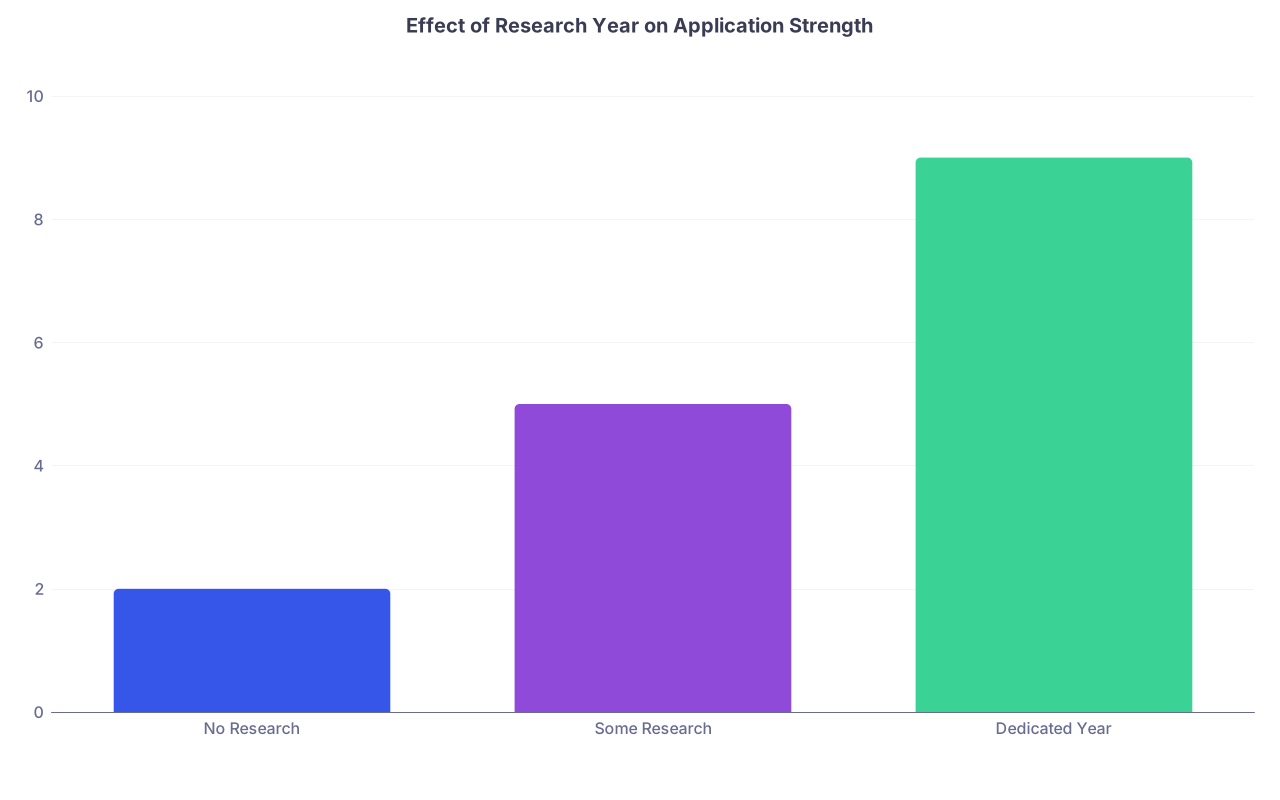
| Category | Value |
|---|---|
| No Research | 2 |
| Some Research | 5 |
| Dedicated Year | 9 |
(Think of those numbers as “relative competitiveness,” not scores. Huge jump with a focused year.)
This path feels like failure when you’re the anxious MS3 who just wants to move on with life. Everyone else is going straight through. You’re… going backwards? Watching your classmates graduate and start residency while you analyze charts and submit IRB amendments?
But here’s the thing: I’ve watched people go from “Honestly probably won’t match derm” to “Matched derm at a great place” purely because they swallowed their pride and did a research year.
Downsides:
- Delayed income.
- Visa issues if you’re an IMG sometimes.
- Existing loans hanging over your head.
- The psychological hit of “being behind.”
Upsides:
- Much stronger shot at actually doing the specialty you want for the rest of your life.
- Time to fix holes in your application.
- A buffer to mature, get better at interviews, understand the field.
Most people who commit to a serious, structured research year with active mentorship and clinical involvement end up matching their competitive specialty. Not always at their dream program. But in.
Outcome 3: You Pivot to a Less Competitive Field (On Purpose, Not as a Consolation Prize)
This is the outcome no one wants to admit they’re considering, but almost everyone thinks about at 3 a.m.
“Do I actually love ortho? Or do I love the idea of ortho? Could I be just as happy in PM&R, sports medicine, or anesthesia?”
Or derm vs medicine with a heme/onc or allergy fellowship later.
Or plastics vs general surgery with a niche in complex reconstruction.
Sometimes, when you zoom out, what you really want is:
- A certain lifestyle.
- A certain patient population.
- A certain balance of procedures vs clinic.
- A certain income range.
And multiple paths could get you there.
I’ve seen late-deciders who could have done the brutal research-year-then-try-again route for a hyper-competitive field but instead said: “I want to start residency on time, not gamble. I like this other path enough.”
Was that a compromise? Yes.
Was it always regret? No.
I’ve watched people end up very happy in:
- Anesthesia instead of radiology.
- IM with procedures instead of cardiology or GI later.
- PM&R/sports instead of ortho.
- OB/GYN instead of urology.
The key difference is whether this pivot is:
“I’m panicking and settling out of fear,”
or
“I’ve thought hard about what I want my actual life to look like and this fits.”
You can’t fix it by pretending there’s no tradeoff. There is. But not every tradeoff is a tragedy.
Outcome 4: You Don’t Match After 1–2 Tries (Yes, That Happens Too)
Let’s not lie: this scenario exists.
You decide late. You don’t do a research year or you do a disorganized one. You apply ultra broad but your application is just not there yet. Result: no match.
Then you scramble into a prelim year. Or a transitional year. Or nothing at all and do more research.
After one no-match, your anxiety goes nuclear. It feels like every choice you make is closing doors. And at some point, you face a hard choice: keep doubling down on the hyper-competitive field, or strategically pivot.
The people who crash the hardest are usually the ones who:
- Refuse to consider alternatives no matter what mentors say.
- Don’t listen to their home department feedback.
- Apply like it’s a lottery instead of a targeted strategy.
At the same time, I’ve seen people not match on the first try for ENT, then do a serious research year and match the second try. Or do a strong prelim surgical year and match categorical the next cycle.
It’s not that failing to match once is a death sentence. It’s that you need a clear, guided plan for what changes between cycle 1 and cycle 2. Same weak application + same strategy = same outcome.
This is where you must stop listening to random Reddit threads and start listening to actual program directors and senior faculty who place people into that specialty regularly.
How Timing Actually Plays Out (Month-by-Month Reality)
Here’s what “late” usually means in practice:
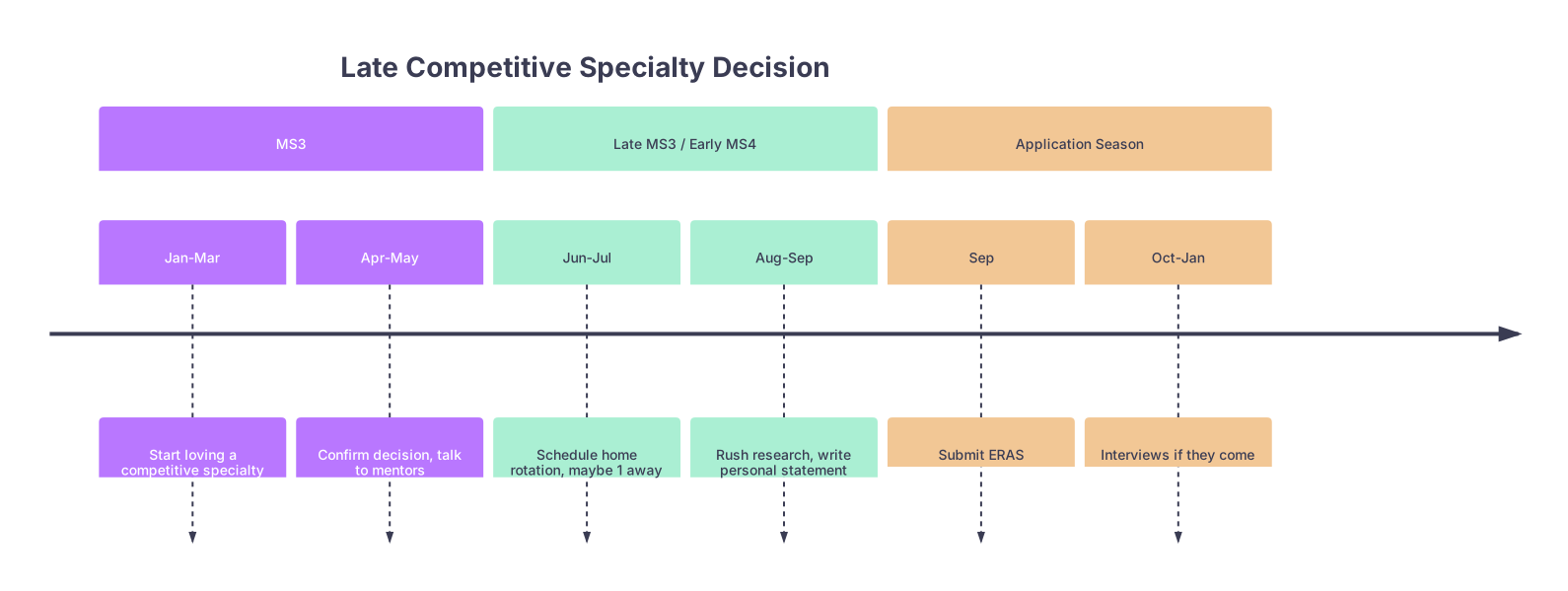
| Period | Event |
|---|---|
| MS3 - Jan-Mar | Start loving a competitive specialty |
| MS3 - Apr-May | Confirm decision, talk to mentors |
| Late MS3 / Early MS4 - Jun-Jul | Schedule home rotation, maybe 1 away |
| Late MS3 / Early MS4 - Aug-Sep | Rush research, write personal statement |
| Application Season - Sep | Submit ERAS |
| Application Season - Oct-Jan | Interviews if they come |
If you decide:
- Before January MS3: you’re actually not that late. You can still reasonably do 1–2 aways, get some research going, and build relationships.
- Around March–May MS3: this is “crunch time late.” Still possible, but you’re sprinting.
- After June MS3 into MS4: for derm/ortho/plastics/neurosurg/ENT, you’re often looking at a research year if you want a realistic shot.
The thing you’re terrified of is waking up in August of MS4 realizing you want plastics having never done a structured plastic surgery rotation. That’s… rough. Not impossible, but extremely steep uphill.
Things That Actually Help (Not the Generic Instagram Advice)
Let’s be specific about what moves the needle for a late decider in a competitive field:
Brutally honest meeting with the specialty leadership at your school
Not just some resident. You need someone who’s placed people in that specialty for years. Ask them:- “If I apply this cycle, what are my real odds?”
- “Would you write me a strong letter if I perform well on your rotation?”
- “What tier of programs should I realistically target?”
A very strong home rotation performance
You’re trying to compress a year of “getting known” into 4–6 weeks. Show up early. Stay late. Be the person who reads about cases the night before and actually understands what’s happening in the OR/clinic.Targeted research, not scattered “anything”
One or two substantial projects in the specialty, ideally with people who are known in the field, will beat 10 random case reports with strangers in unrelated areas. Quality over quantity—but also, yes, volume matters.A coherent story
Your personal statement and interviews can’t sound like, “I panicked and switched.” It has to feel like, “Once I was exposed to this, the fit was undeniable, and here’s how my previous experiences still make sense.”Backup plan that isn’t an afterthought
For truly competitive fields, your anxiety will be lower—not zero, but lower—if you have a real backup:- Applying to both a hyper-competitive specialty and a more attainable one with genuine interest.
- Or mentally committing to: “If I don’t get X number of interviews, I will pivot now, not wait for the rejection letter in March.”
What You Need to Hear (Even If Your Brain Fights It)
You did not ruin your life by deciding late on a competitive specialty.
You may have made it more complicated. More expensive. More delayed. But not impossible.
Realistic truths:
- You might not match at the flashiest name-brand program.
- You might need a research year you never planned for.
- You may pivot to a different field and carry a faint “what if” with you.
- You may also end up exactly where you want after a twisty, non-linear path.
The admissions and residency world loves the straight-line story: “I knew I wanted ortho at age 5, did 20 publications by 19, and matched at HSS.”
That’s the exception, not the standard.
Most people are messier. They figure things out late. They make tradeoffs. They carry some regret and also some relief.
Years from now, you won’t be counting how early you decided. You’ll be living your actual day-to-day life as a physician, dealing with real patients, real call schedules, real colleagues. The specialty is a big piece of that, yes. But the path you took—however late, however ugly—won’t define you as much as you think.
You’re not broken for being late. You’re just at a crossroads with fewer clean options and more anxiety. That’s all.
FAQ (Exactly the Questions Your Brain Is Asking)
1. If I decide on a competitive specialty late in MS3, is it “too late” to match straight through?
Not automatically. If you decide by around January–April of MS3, you still have a fighting chance to:
- Do a strong home rotation.
- Maybe get one away rotation.
- Start at least a couple of research projects.
- Build relationships for letters.
But your margin for error is almost zero. Any big weakness—poor Step 2, mediocre evals, no meaningful mentorship—may push you toward needing a research year to be competitive, especially for derm, plastics, neurosurg, ENT, or ortho.
2. Do I absolutely need a research year if I’m late to decide on derm/ortho/ENT/etc.?
No, but it becomes very common and often strongly recommended. If your current file is:
- Step 2 below the typical average for that field,
- No or minimal specialty-specific research,
- No big-name letter writers in the field,
- And very little time left before ERAS,
then a research year is often the difference between “spray and pray with low odds” and “genuinely solid shot.” It’s not mandatory, but skipping it when your mentors strongly recommend it can turn into an avoidable no-match story.
3. Should I apply to both a competitive specialty and a ‘backup’ at the same time?
Sometimes yes, sometimes no. Programs can smell a fake backup. If you apply to, say, derm and IM, but your IM personal statement is clearly generic and all your experiences scream derm-only, medicine PDs won’t be impressed.
Dual-apply if:
- You’re genuinely okay with the backup specialty.
- You tailor your application for both (separate statements, separate letter sets, real interest).
Don’t dual-apply just to soothe anxiety while secretly telling yourself you’d “never” actually do the backup.
4. What if I decide very late (like early MS4)? Should I still apply that cycle?
Usually, no. If you’re talking about August/September MS4 and you:
- Haven’t done a real rotation in that specialty,
- Don’t have letters from that field,
- Have zero research or connections,
then applying that cycle is often a wasted shot that may hurt you later. In that situation, the smarter, less ego-driven move is:
- Do a strong home rotation and maybe an away.
- Start research now.
- Plan a dedicated research year.
- Apply the following cycle with a coherent, much stronger application.
It feels horrible to delay. But sometimes the mature move is to stop trying to speedrun a process that just… can’t be speedrun.
Years from now, you won’t remember the specific week you “decided too late.” You’ll remember whether you panicked and thrashed, or paused, planned, and chose the path you can actually live with.