
You can match a competitive specialty with zero publications.
You just don’t have margin for sloppy thinking about everything else.
I know that’s not the soothing, “publications don’t matter at all!” line you want. But the other extreme—“no pubs = doomed”—is also wrong. The truth is in the miserable, grey middle where anxious applicants like us live.
Let’s pull this apart like we’re on call and the pager won’t stop.
First: Are You Actually at Zero?
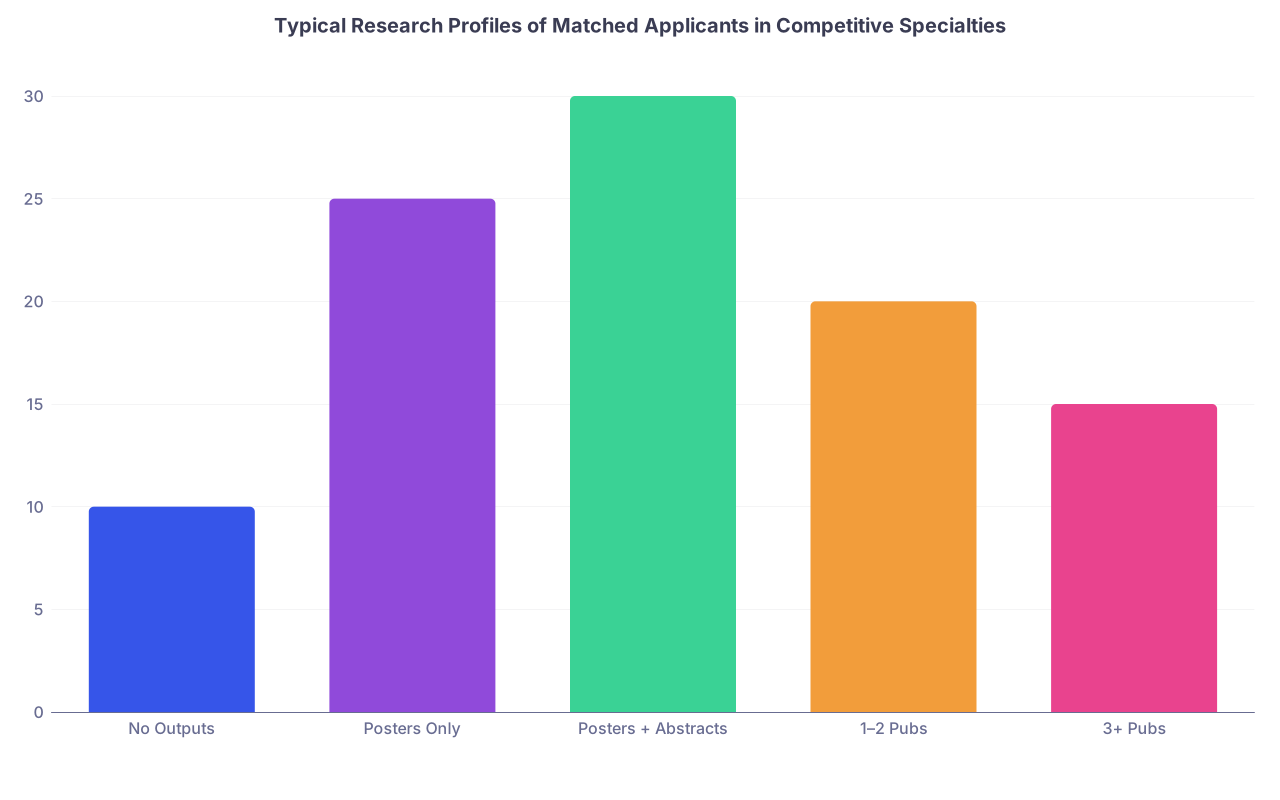
| Category | Value |
|---|---|
| No Outputs | 10 |
| Posters Only | 25 |
| Posters + Abstracts | 30 |
| 1–2 Pubs | 20 |
| 3+ Pubs | 15 |
Before you freak out, define what you mean by “no publications.”
Because programs don’t just look for “PubMed or bust.” They see “scholarly productivity,” and that includes:
- Posters
- Oral presentations
- Abstracts
- Case reports (even unpublished)
- Quality improvement projects
- Book chapters / review articles
- Local/regional conferences
If your CV truly has none of that—no posters, no abstracts, nothing research-y—then yeah, you’re starting at a disadvantage for stuff like derm, plastics, ortho, ENT, urology, rad onc, even some competitive IM fellowships tracks.
But if you have:
- A poster at a local conference
- An abstract accepted somewhere
- A submitted manuscript (even not accepted yet)
- A case you presented at M&M or a departmental meeting
Then you’re not “zero.” You’re just “not flashy,” which is annoying but not fatal.
Harsh truth: the applicant with 8 first-author pubs in JAMA Derm has a different level of insulation from risk than you do. But that doesn’t mean doors are locked for you. It just means you have to win in other categories.
How Much Do Publications Actually Matter by Specialty?
Let’s stop pretending all specialties are the same. They’re not.
| Specialty Type | Research Importance | Typical Expectation at Match (not a rule) |
|---|---|---|
| Ultra-competitive (Derm, PRS) | Very High | Multiple outputs, some pubs |
| Highly competitive (ENT, Ortho, Rad Onc, Optho, Urology) | High | At least some outputs, 1+ pub helpful |
| Mid-competitive (Anes, EM, Gas IM tracks) | Moderate | Posters/abstracts common, pubs helpful |
| Less competitive (FM, Psych, Peds) | Low–Moderate | Any research is a plus, not a requirement |
If you’re aiming for:
- Dermatology
- Plastic surgery
- ENT
- Neurosurgery
- Orthopedic surgery
- Radiation oncology
- Ophthalmology
- Competitive academic IM tracks (think Heme/Onc, Cards pipeline at big-name places)
…then yes, programs expect to see some research. But “some research” does not always equal “peer-reviewed PubMed-indexed publication with your name first.”
Things that matter at least as much as publications in those fields:
- Step scores (yes, even with Step 1 pass/fail, Step 2 is now the filter)
- Class rank / AOA / honors in clerkships
- Letters from known faculty in the specialty
- How strongly you’re vouched for (“I’d take this student over our own residents” type language)
- Whether you did an away/sub-I and impressed them
I’ve seen people with:
- Zero pubs, but 260+ Step 2, strong letters, away rotations → match derm
- One meh poster, strong performance on sub-I, glowing letters → match ortho
- Several publications but average scores and generic letters → not match ENT
Publications help open doors. They aren’t the only key in the lock.
The Worst-Case Scenarios You’re Imagining (And What’s Actually True)
Let me guess what’s running through your head at 2 a.m.:
- “Programs will auto-screen me out if I have no publications.”
- “Everyone else applying to [insert specialty] has multiple publications from high school somehow.”
- “If I don’t fix this now, I’ll never match and my whole career is ruined.”
Let me hit each of those.
1. “Automatic Rejection Without Publications”
Most programs don’t have a “no pubs = auto-reject” checkbox.
They do have:
- Step 2 cutoffs
- School reputation weight (whether they admit it or not)
- Preference for people with home/away rotations in the specialty
- A vague “research interest” filter
Zero research can get you deprioritized, especially at research-heavy, academic powerhouses. But it’s almost always in the context of your whole app.
If you’ve got:
- Strong Step 2
- High class rank / honors
- Great specialty letters
- A clear, coherent story about why that field
…then plenty of programs will at least read your app. Especially community-based or clinically heavy ones that care more about work ethic than h-index flexing.
2. “Everyone Else Is Light-Years Ahead”
No. The loudest people on Reddit and SDN are the 265 + 10 publications + 4 away rotations crowd. Silent majority is way more average.
What you don’t see:
- The ortho applicant with 0 pubs, 1 poster, 255, who matched a solid community program
- The derm applicant who did 3 research years and still scrambled because they were weird on interview day
- The ENT applicant who had no research but was the obvious workhorse on sub-I and got ranked high because attendings fought for them
Are you behind compared to the top of the pool? Probably. Are you automatically behind everyone? No.
3. “If I Don’t Have Publications Now, It’s Over”
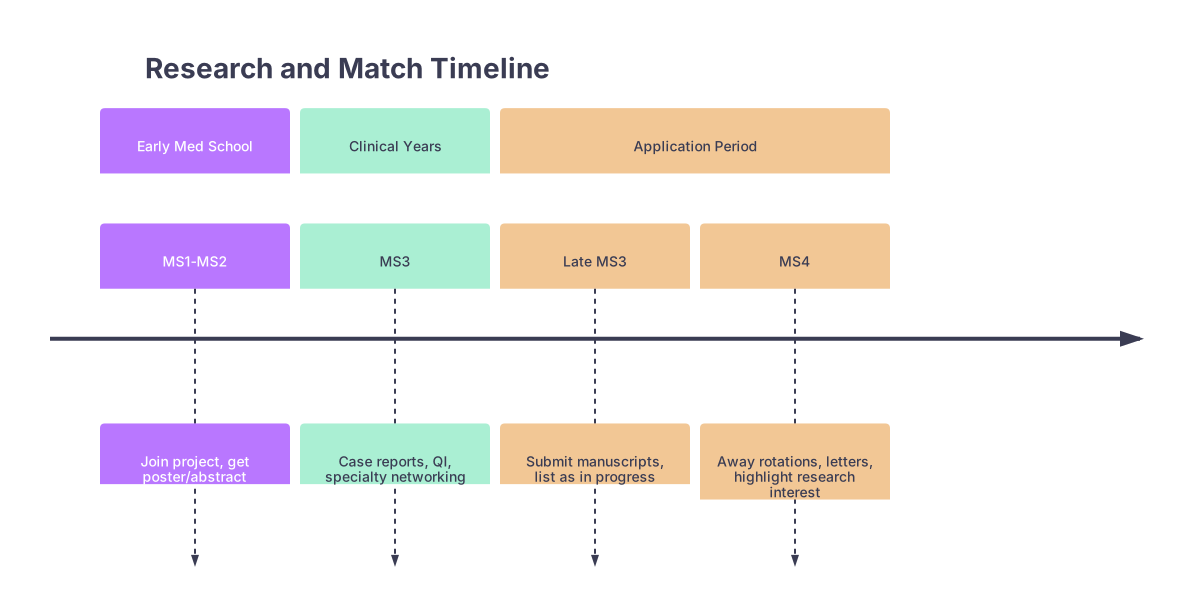
There are at least three different “timelines” where you can still salvage things:
| Period | Event |
|---|---|
| Early Med School - MS1-MS2 | Join project, get poster/abstract |
| Clinical Years - MS3 | Case reports, QI, specialty networking |
| Application Period - Late MS3 | Submit manuscripts, list as in progress |
| Application Period - MS4 | Away rotations, letters, highlight research interest |
You can:
- Start fast projects (case reports, QI) in MS3–MS4
- Add “submitted” or “in preparation” work before ERAS
- Build narrative: “I came to research late, but here’s what I did quickly once I realized the importance”
That last part matters. Programs don’t just look at what you did; they look at how you responded when you realized you were behind.
If You’re Truly at Zero: Priority List by Timeframe
Let’s say you’re MS3 going into MS4, eyeing a competitive specialty, and your research section is a graveyard.
You feel behind because…you are behind. But you’re not done.
1. Lock Down the Only True “Hard Filter” You Control: Step 2
If you haven’t taken Step 2 yet: publications are irrelevant if your score is garbage.
I’m not being dramatic. You don’t compensate for a 215 Step 2 in derm with a rushed case report.
If forced to choose between:
- Crushing Step 2 and doing zero research this month
- Mediocre Step 2 and starting a random weak project
You crush Step 2. Every time.
2. Do Fast, Realistic Research – Not Fantasy Projects
You are not going to produce an RCT before ERAS opens. Stop pretending.
You can reasonably do:
- Case reports from interesting patients on your rotations
- Retrospective chart reviews with narrow questions
- QI projects already running in the department
- Help an ongoing project with data collection / chart abstraction

The question to ask a potential research mentor is not “Do you have any projects?” It’s:
“What projects are already far enough along that I can realistically get a poster or abstract before ERAS and possibly a manuscript under review?”
And then you follow up. Ruthlessly. Annoying persistence beats being “respectfully patient” and forgotten.
On ERAS, “submitted” and “in progress” still count as activity. Are they as good as published papers? No. Are they better than blank space? A thousand times yes.
3. Build Relationships in the Specialty
No publications + no relationships = rough.
No publications + strong relationships + great letters = survivable.
So while you’re panicking about research, do not ignore:
- Being the hardest worker on your home specialty rotation
- Going to department conferences, journal clubs, tumor boards
- Staying after clinic/OR to help with follow-up, notes, etc.
- Asking directly, “What can I do to be a strong applicant for this specialty from where I am right now?”
Faculty remember:
- The student who volunteered to come in early
- The student who followed through on a small project
- The student who didn’t vanish after the rotation ended
They will absolutely write in letters: “This student has limited research only because they realized their specialty late, but they’ve already done X, Y, and Z in a short time.” That framing saves you.
How to Frame “No Publications” on Your Application
You can’t hide from it. So you need to control the story.
Bad version:
“I didn’t have time for research because of rotations and studying.”
Good version:
“I didn’t understand early in medical school how critical research was for [specialty]. Once I decided on this path in late MS3, I actively sought projects in [department], joined [specific project], and worked on [case report/QI]. I’m continuing this work during MS4 with the goal of contributing meaningfully to [field-specific question].”
Programs want to see:
- Insight: you get that this is a weakness
- Action: you didn’t just accept it; you moved
- Specificity: you’re not doing random research to pad a CV; it connects to your interest in the field
On interviews, you will almost certainly get:
“So I see limited research here—tell me about that.”
Have an answer ready. Not a defensive speech. A calm explanation plus what you did about it.
Where Applicants Without Publications Still Match Well
There are “lanes” where zero publications hurt less.
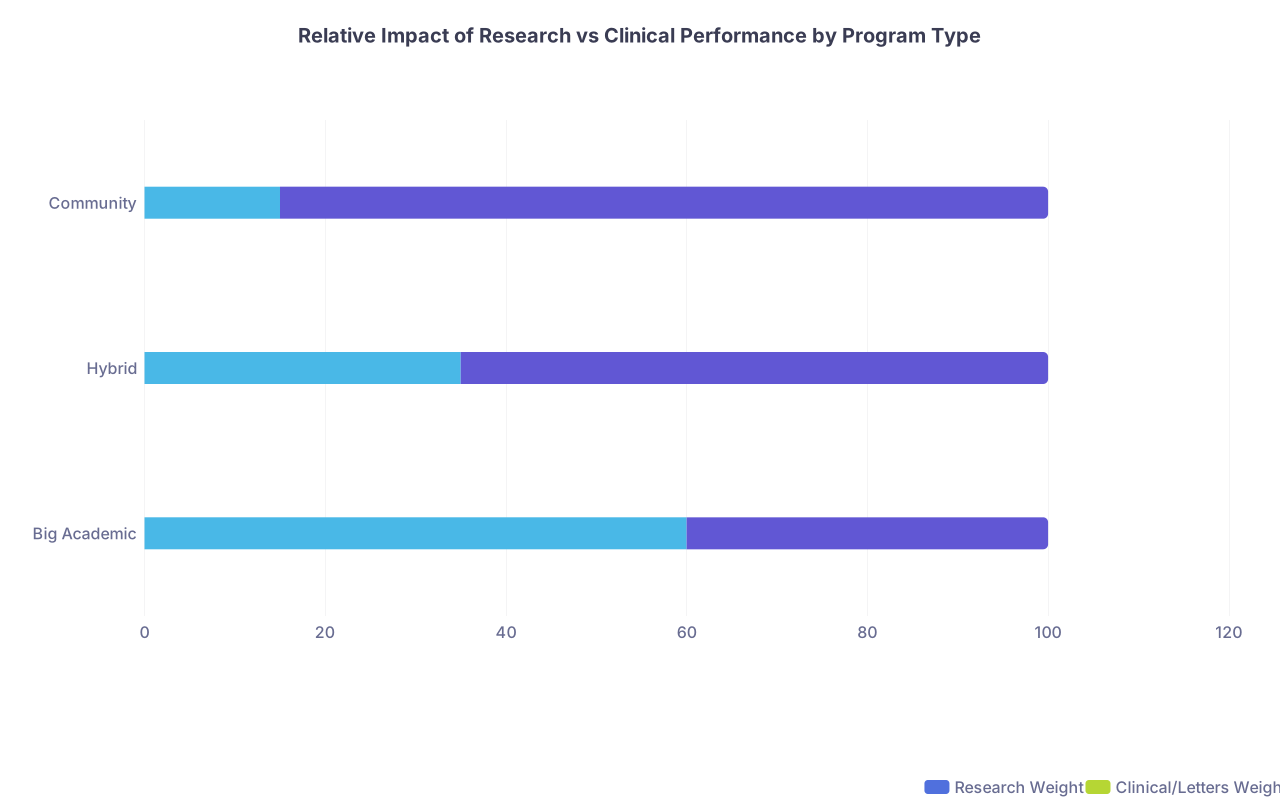
| Category | Research Weight | Clinical/Letters Weight |
|---|---|---|
| Big Academic | 60 | 40 |
| Hybrid | 35 | 65 |
| Community | 15 | 85 |
If you have no publications, consider:
- Community-based programs in your specialty
- Hybrid academic–community programs that value worker bees
- Strong regional programs where you have geographic ties
- Programs where your school has historically placed grads, even average ones
No publications + strong fit + strong letters + solid Step 2 → still very workable at many of these places.
And honestly, some of these programs give better operative or clinical experience than glittery “Top 10” names obsessed with h-indices.
What If You Don’t Match?
I’m going to say the quiet part out loud because you’re thinking it anyway.
Worst-case scenario: You apply to a competitive specialty with no publications, you swing hard, and you don’t match.
Then what?
You still have options:
Prelim year (surgery or medicine) + reapply with:
- New letters
- Strong clinical performance
- Maybe a small research portfolio you build during that year
Dedicated research year
- Join a department as a research fellow
- Crush out a stack of abstracts/posters/pubs
- Reapply with a completely different research story
Reassess specialty choice
Not the fun option. But sometimes it’s the right one. I’ve seen people pivot to:- Anesthesiology
- EM
- IM with a path toward a good fellowship
- Radiology
And end up genuinely happy. With decent lifestyles and solid training.
None of these feel good when you’re staring at ERAS. But they’re real, valid, survivable paths. Your life does not evaporate if you don’t match your dream specialty on the first try.
Rapid-Fire Triage: What To Do This Week
If you’re spiraling right now, here’s the brutal, short checklist.
- If you haven’t taken Step 2 → prioritize studying. Period.
- Email 2–3 specialty faculty: “I’m applying to [specialty] this year, have limited research, and would really value your advice on how to realistically strengthen my app from here. Can we meet briefly?”
- Ask each: “Is there a small, fast-moving project I can help with where I could reasonably get at least a presentation/abstract before ERAS?”
- Show up to departmental events and be visible.
- Start outlining a personal statement that acknowledges late entry into the field and shows what you did about it.

You’re trying to turn “no pubs” from a dead-end into “late start, fast ramp-up.” Programs respect that story when it’s real.
Key Takeaways
- You can match a competitive specialty with no publications, but only if other parts of your application are legitimately strong and you’re smart about program selection.
- You should aggressively pursue fast, realistic research opportunities now—not fantasy projects that will never finish.
- Your narrative and letters can soften the “no pubs” hit if they clearly show insight, effort, and upward movement instead of excuses.