
The usual “derm vs plastics” competitiveness talk is lazy and wrong.
People throw around board score cutoffs and Instagram stereotypes and miss what actually matters: these are two completely different selection ecosystems that just happen to sit at the top of the competitiveness pyramid.
Let me break this down specifically.
1. Raw Competitiveness: Similar Altitude, Different Terrain
Both dermatology and integrated plastic surgery live in the same rarefied air: tiny number of spots, massively overqualified applicants, and essentially no safety programs.
But how that competitiveness shows up is not identical.
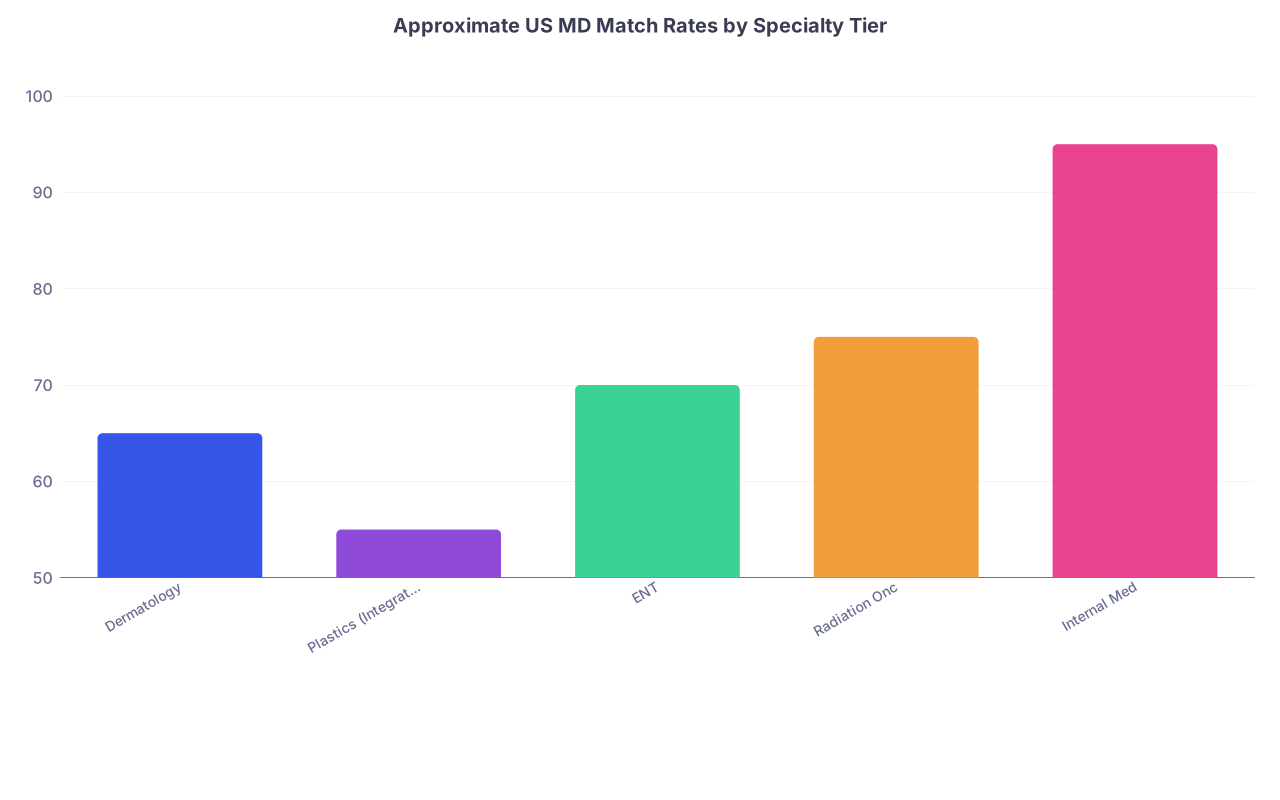
| Category | Value |
|---|---|
| Dermatology | 65 |
| Plastics (Integrated) | 55 |
| ENT | 70 |
| Radiation Onc | 75 |
| Internal Med | 95 |
These numbers move a little year to year, but the pattern holds: plastics and derm are both brutal compared to core specialties. The key nuance is the profile of the people going unmatched.
In dermatology, unmatched often means: 250+ Step 2, AOA, solid research, and still did not land a categorical spot. In plastics, unmatched often means: excellent scores and CV, but not enough visible, hands-on surgical commitment, weak letters, or poor performance in sub‑Is.
Here is how the two differ structurally.
| Factor | Dermatology | Integrated Plastic Surgery |
|---|---|---|
| Number of PGY1+ spots/year (approx) | ~550–600 | ~180–200 |
| Match pathway | Mostly categorical PGY-2 (via advanced + prelim) | Pure categorical PGY-1 integrated |
| Applicant pool | IMGs, DOs, MDs, prelim TY/medicine, re-applicants | Almost entirely US MD, some DO; IMGs extremely rare |
| Backup options | IM, medicine prelim, TY, reapply | General surgery prelim, research year, late GS switch |
The superficial take: plastics is “harder” because the match rate is a bit lower and there are fewer spots. The more accurate take: they are differently punishing.
In plastics, the door is narrower from the start—you either look like a future surgeon early, or programs lose interest. In dermatology, more people are allowed to “try,” but the bar is so high that many polished, research-heavy, 250+ applicants still fall short.
If you want a slogan:
Dermatology is an exam-and-research arms race.
Plastics is an identity test in a surgical tribe.
2. Applicant Profiles: Who Actually Matches?
Let’s build two composite applicants that actually resemble people I’ve seen.
The classic dermatology applicant
Fourth-year MD at a mid-to-high tier school. Step 2 CK 255. Step 1 was pass but with an unofficial “above average” whisper from the dean. Top 15–20% of class, maybe AOA, strong clinical comments in medicine and peds (“analytical, detail-oriented, excellent with patients”). Three dermatology research projects, one middle-author pub, one case report, two posters. Did a dedicated derm research block or a full research year at a home or external derm department.
Their letters: One “this is a future academic dermatologist” letter from the home PD or chair; one from a subspecialty derm attending (complex med derm, peds derm, or Mohs); maybe one from medicine or heme-onc who can speak to diagnostic reasoning.
Personality on interview: polished, articulate, slightly Type A, enjoys problem-solving and follow-up relationships. Talks about pattern recognition, chronic disease, maybe skin-of-color care or psoriatic arthritis. Not necessarily “hands” focused, though some will mention minor procedures or Mohs.
The classic integrated plastics applicant
Fourth-year MD at a strong academic school. Step 2 CK 255–260+. Solid clinical honors in surgery, IM, and at least one sub‑I in general surgery or plastics. The Step 1 pass is less of a problem if the narrative around surgery performance is stellar.
Research: at least a handful of surgical or plastics-related projects. Could be a mix of outcomes research, QI in reconstruction, case series on microsurgery, craniofacial anomalies, or breast reconstruction. One or two first-author pubs is very helpful. Some will have taken a research year in a big-name plastics lab.
Letters: The currency is surgical credibility. One letter from the plastic surgery PD or division chief at the home institution. One from a big-name plastic surgeon from an away rotation. One possibly from an academic general surgeon or trauma surgeon who can say “In the OR, this student functions like an intern already.”
Personality on interview: confident, energetic, usually more extroverted or at least highly socially fluent in the OR environment. Talks about “owning the result,” reconstruction challenges, operating for hours, long-term follow-up, and multidisciplinary care with ENT, neurosurgery, or oncology.
Key difference
Plastics wants to see:
“You are already a surgical resident in all but name.”
Derm wants to see:
“You are already thinking like a dermatologist-scientist.”
If you are trying to contort yourself into one archetype while your natural trajectory is the other, programs can tell.
3. What Each Specialty Actually Screens For
Scores and research get you in the door. They do not tell the whole story. Programs, especially at the top, are looking for specific traits that correlate with thriving in their world.
Dermatology: cognitive precision and longitudinal care bias
Dermatology lives in three overlapping domains:
- Outpatient, image-heavy diagnosis
- Chronic immunologic disease management
- Procedural dermatology (biopsies, excisions, Mohs)
The selection system reflects that. Programs quietly prioritize:
Pattern recognition and diagnostic reasoning
Multiple attendings will comment on how quickly you started forming differential diagnoses for rashes, pigmented lesions, hair disorders. If you are the student who pulls up dermpath slides on your own time or correlates clinic photos with histology, they notice.Comfort with ambiguity and chronic disease
Many derm patients are not “fixed.” They are managed indefinitely. Residents who can sit with that—who can titrate biologics, negotiate expectations, and remember dozens of long-term follow-ups—do better. The program wants evidence that you do not need immediate procedural gratification every day.Research maturity
This is where dermatology is unforgiving. The field is tiny, but the academic output is huge. Many top applicants have a derm-focused research year, meaning 5–15 abstracts/posters and a couple of pubs. Programs use that to screen for future faculty potential. If your entire CV is basic science in cardiology, it reads as “late convert,” and you will need to compensate with stellar derm letters and performance.
Plastic surgery: technical trajectory and OR culture fit
Plastics sits at the extreme procedural end. Microvascular free flaps, complex recon, aesthetics, hand. Program directors are looking for:
Proven surgical work ethic
Not “I worked hard in med school.” They want:- glowing sub‑I comments about pre-rounding, post-op care, and staying late;
- attendings saying you volunteered to help with late add-on cases;
- residents writing “I would be happy to have this person on my team.”
Technical potential
They cannot see you do a free flap as a student, but they can see your respect for tissue, your ability to suture, your comfort in the OR (draping, anticipating needs, not getting flustered). A strong letter that says “technically ahead of peers” moves applications into the interview pile quickly.Cultural alignment with surgeons
This is not about being loud or macho. It is about being okay with hierarchy, with OR pace, with getting direct feedback, and with the reality that your day’s success is tied to the case list, not a clinic schedule. On interview day, they sense who genuinely enjoys that world versus who is looking for prestige with lighter call.
Derm might care a bit less if you are slightly introverted, as long as you are sharp and dependable. Plastics will wonder if you will advocate in the OR, call for help appropriately, and bond with the team during 8-hour cases.
4. Match Strategy: How Each Field Punishes Mistakes
The two application systems punish different miscalculations.
Timing and signal: dermatology
Because derm heavily weights research and letters from derm faculty, the biggest unforced error is coming in late.
Common self-sabotage patterns:
No derm exposure until late M3 or even M4
You discover derm, like it, but by then you have zero derm letters, zero derm research, and you are trying to throw a couple of case reports together in 6 months. You may still match, but you are starting from behind.Generic research, not anchored in derm
Three papers in cardiology and none in dermatology does not look terrible, but it does not help you compete against applicants whose entire CV screams “lifelong derm kid.”Weak home department connection
If your school has derm but your letter from the PD or chair is lukewarm, the rest of your application has to overcompensate. Derm PDs talk. The behind-the-scenes question is always: “If their home program did not take them, why?”
Strategic advantage for derm: you can “pivot” more easily if you miss. You can do a prelim medicine year, a research fellowship, reapply, or shift to rheum, allergy, or heme-onc. You do not have to love the OR.
Timing and signal: plastic surgery
In plastics, the biggest mistake is non-committal surgical identity.
Common derailers:
No clear plastics commitment before ERAS
If your third year looks like “I liked everything,” with weak early surgery performance and no plastics research, then a last-minute decision to apply integrated plastics reads as unserious. You will be compared to applicants who joined the department’s journal club as MS1s.Weak or absent away rotations
Integrated plastics, similar to ortho and ENT, still values aways heavily. If you do not perform well on at least one plastic surgery away rotation, your odds plummet. Programs want to see you function on their service, under pressure, with their residents.Underdeveloped letters from actual plastic surgeons
A spectacular IM letter does not help much if you do not have at least two very strong letters from plastic surgeons. And by strong, I mean specific comments on your OR behavior, technical growth, and team integration, not just “pleasant to work with.”
Strategic disadvantage for plastics: if you miss, your path is messier. You can:
- take a research year and reapply;
- do a general surgery prelim year to stay clinically active;
- pivot to categorical general surgery and later try independent plastics (which is shrinking);
- or change fields entirely.
None of those is simple. And your entire prior branding as “future plastic surgeon” can make some non-surgical fields suspicious of your long-term commitment.
5. Lifestyle, Money, and Motivation: Who Actually Stays Happy?
Derm and plastics both suffer from mythologizing. “Lifestyle derm” and “rich plastics” are clichés that skew decision-making.
Dermatology reality
Yes, dermatology has an objectively favorable lifestyle compared to most other top-tier specialties.
- Call is typically light, mostly phone-based, and fairly predictable.
- The day is mostly clinic, with a high degree of control over scheduling and case mix.
- Procedural derm (Mohs, cosmetics) can be highly lucrative with fewer physical demands than long OR days.
But you pay for that with a particular kind of work:
Repetitive chronic disease management.
You will see acne, psoriasis, eczema, rosacea, and skin checks, all day, every day. Plenty of satisfaction in solving diagnostic puzzles—but once established, much of your job is adjustments and counseling.High patient volume.
Many derm clinics run 20–35+ patients per half-day depending on practice style. If you hate fast-paced clinics and short visits, real-world derm may grate on you.Cosmetic pressure.
In some markets, there is heavy emphasis on cosmetic procedures, aesthetic judgment, and practice branding. If you are derm-for-lupus and dermpath and have zero interest in injectables, choose residency and future practice carefully.
The happiest dermatologists I have seen genuinely like clinic medicine and are content with outpatient repetition in exchange for control and flexibility.
Plastic surgery reality
Plastics can be extraordinarily satisfying, but the work is heavier.
Call and hours.
You will take call for facial trauma, hand, burns (at some centers), and post-op complications. Nights in the OR happen. The lifestyle improves post-residency, but you will live in the hospital for a while.Long, technically demanding cases.
Microsurgical reconstructions, craniofacial work, gender-affirming surgery, complex breast recon after radiation—these are cognitively and physically taxing.Business and aesthetics.
If you plan on a significant cosmetic practice, you will be a surgeon and a businessperson. Marketing, practice management, patient expectations around body image—it is a whole additional dimension.
But the flip side: you get to literally rebuild people. Traumatic injuries, cancer defects, congenital anomalies—you see dramatic, visible change. Many plastic surgeons will tell you they cannot imagine going back to a specialty where they do not “fix” something tangible daily.
People who are miserable in plastics often chose it for prestige and money and only belatedly realized they dislike long OR days and complicated, sometimes demanding patient populations.
6. Board Scores, Research, and “Rescue” Strategies
Let me answer the unpleasant but common question: “If my numbers are X, which one should I target?”
I will generalize a bit. Reality is, of course, messier.
If your Step 2 CK is very strong (260+)
You are competitive for both, if the rest of your story matches.
For derm:
You still need derm research and at least one heavyweight derm letter. A 260 without derm-specific work is impressive but not sufficient at the top programs.For plastics:
260 helps you get noticed, but weak surgical letters or an anemic OR narrative will sink you. I have seen 260+ applicants not match integrated plastics because the letters said “nice, enthusiastic,” but nothing about operative promise.
If your Step 2 CK is high but not extreme (245–255)
This is the gray zone.
For derm:
You must compensate with:- robust derm research output;
- an AOA-level clinical record;
- and gold-standard letters.
At community derm programs, 245+ with strong derm alignment can absolutely match. At the hyper-elite research-heavy residencies, the threshold is higher.
For plastics:
245–255 is workable at many integrated programs if your surgical identity is rock solid: high-impact letters, away rotations where someone is calling the PD on your behalf, and meaningful research.
If your Step 2 CK is <240
Now you are on thin ice for both fields, and you need brutal honesty.
Dermatology:
Can it still happen? Yes. But the path almost always includes:- a dedicated derm research year (or two);
- strong advocacy from derm faculty who have actually worked with you;
- strategic target list focused on less research-obsessed programs.
Plastics:
Sub-240 for integrated plastics is a serious handicap unless:- there is a clear explanation (major illness etc.);
- your surgical performance and letters are off-the-charts stellar;
- you are willing to consider a longer path (research years, general surgery then independent).
In both fields there are “rescue” maneuvers (research fellowships, reapplications, stepping-stone specialties), but each extra year is expensive and draining. Match once if you can.
7. Personality and Day-to-Day Fit: Be Honest With Yourself
Forget prestige for a second. Ask yourself, “What do I actually want my daily misery to look like?” Because every specialty has misery; you just get to choose the type.
You are more derm if:
You find pattern recognition satisfying.
Staring at photos and slides and immediately seeing “this is lichen planus vs pityriasis rosea” gives you a quiet thrill.You like chatting with patients.
20–30 brief conversations daily, negotiating adherence, discussing side effects, managing expectations about chronic disease. That does not drain you completely.You care about visual details but do not need an OR to be happy.
You might enjoy procedures, but you also like thinking about pathophysiology, systemic manifestations, and long-term management.The idea of predictable hours and outpatient control appeals to you more than all-day cases.
You are more plastics if:
You feel at home in the OR.
The lights, the pace, the team communication—none of it feels overwhelming. Even as a student, you are already paying attention to steps, not just watching passively.You like long, difficult projects with visible results.
Rebuilding a mandible or breast mound over multiple stages and watching the patient regain confidence? That sounds deeply satisfying.You can tolerate or even enjoy chaos.
Trauma consults at 2 am, complex inpatients with flaps and drains, multidisciplinary tumor boards—this sounds like your kind of challenge.You are okay with business and aesthetics being part of your professional life.
If you are choosing derm because you hate the OR, good. That is insight, not cowardice. If you are choosing plastics because you think “derm is boring, just rashes,” also fine—just make sure you have actually done a derm elective and know what you are dismissing.
8. Nuanced Takeaways: Competitiveness with Context
Let me strip this down to the core contrasts.

Dermatology competitiveness = research + cognitive + brand.
The bar is high, but the filter is broad. You need:- strong scores;
- derm-specific research and mentorship;
- departmental advocacy.
Plastic surgery competitiveness = surgical identity + performance.
The bar is also high, but the filter is narrower. You need:- clear, early commitment to surgery/plastics;
- standout OR behavior and away rotation performance;
- letters from people with actual power in the field.
From a purely numerical standpoint, integrated plastics may have a slightly lower match rate. But that stat hides the key truth: derm lets more people into the race; plastics keeps the gate closed unless your whole application screams “surgeon.”
One last thing that rarely gets said out loud: both specialties are bad ideas if your primary motivation is lifestyle or money. Those can be secondary reasons. But if you do not genuinely like the core work—clinic volumes and chronic disease in derm, OR marathons and recon complexity in plastics—you will burn out fast, regardless of how competitive you were on paper.

| Step | Description |
|---|---|
| Step 1 | Start - Interested in competitive field |
| Step 2 | Consider Plastic Surgery |
| Step 3 | Reassess motivations |
| Step 4 | Consider Dermatology |
| Step 5 | Reassess specialty choice |
| Step 6 | Enjoy OR long cases? |
| Step 7 | Comfort with heavy call? |
| Step 8 | Enjoy fast paced clinic? |
3 Key Points To Leave With
Dermatology and plastic surgery are equally elite but select for different people: derm favors research-heavy, cognitively oriented applicants; plastics favors OR-proven, surgically branded applicants.
Board scores and research are necessary but not sufficient; letters, identity, and timing (especially aways for plastics and early derm exposure) are what actually separate match from miss.
You should choose based on the day-to-day work you can tolerate and enjoy for decades—clinic and chronic disease versus OR and reconstruction—not on social media narratives about lifestyle or income.