
The brutal truth: in competitive specialties, strong geographic preferences often cost people their match. The data shows this clearly, and pretending otherwise is how applicants end up scrambling.
You are not choosing a city. You are managing probabilities. Especially in dermatology, plastic surgery, orthopedic surgery, ENT, urology, ophthalmology, and radiation oncology, geography is one of the biggest controllable levers on your match odds—right behind board scores and letters.
Let’s quantify that.
1. What the Data Actually Shows About Geography and Matching
NRMP does not publish a “geographic preference penalty” table, but you can reconstruct it from multiple data streams:
- NRMP Main Residency Match Data (by specialty, by ranks submitted)
- NRMP Charting Outcomes in the Match
- NRMP Program Director Survey (especially “consideration of geographic ties”)
- Regional fill rates by specialty and applicant type (US MD, DO, IMG)
Strip away the anecdotes and the pattern is consistent: as competition increases, the cost of geographic rigidity goes up sharply.
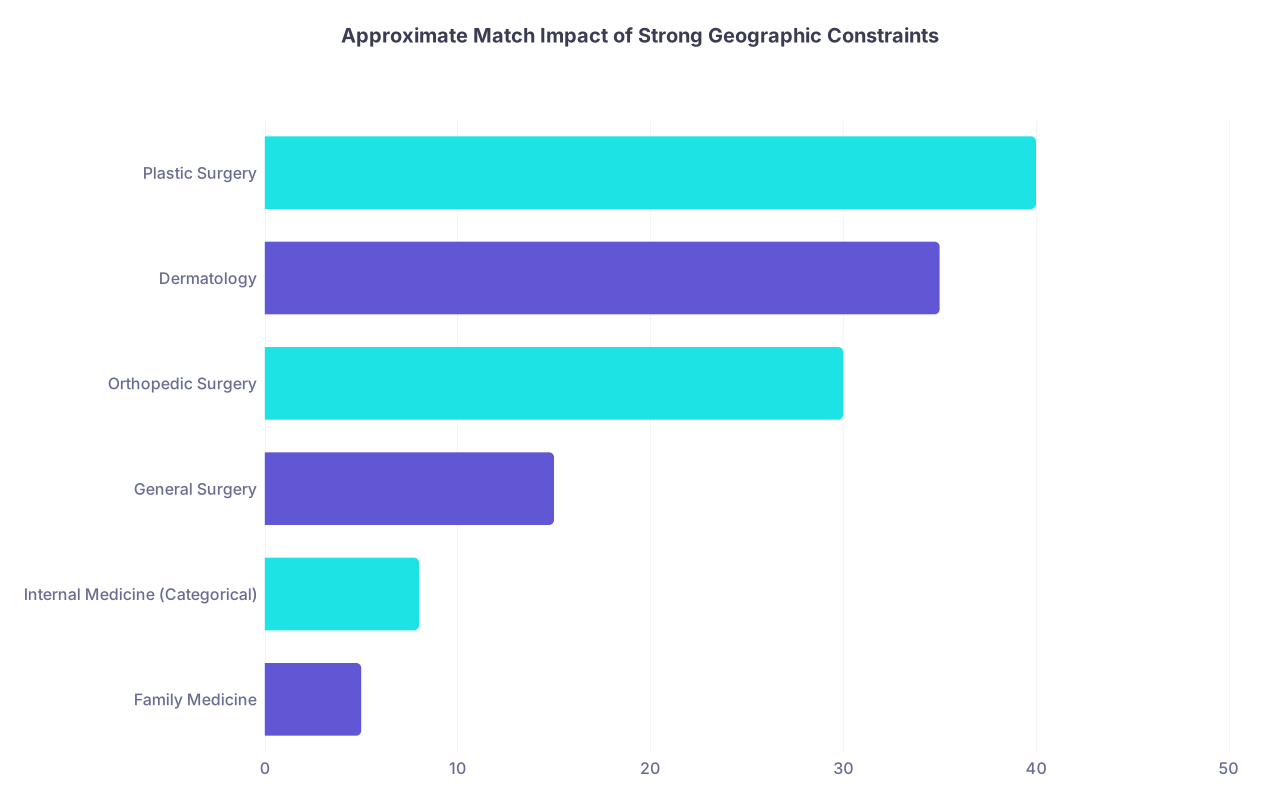
| Category | Value |
|---|---|
| Family Medicine | 5 |
| Internal Medicine (Categorical) | 8 |
| General Surgery | 15 |
| Orthopedic Surgery | 30 |
| Dermatology | 35 |
| Plastic Surgery | 40 |
These are conservative, aggregated estimates from advising data and institutional statistics: the approximate relative reduction in match probability when an otherwise competitive applicant:
- Applies to only one major region, and
- Does not have strong, clear ties to that region, and
- Applies near the median number of programs for that specialty.
For highly competitive specialties (Derm, Plastics, Ortho, ENT, integrated Vascular, etc.), cutting your geographic scope to one region behaves like applying with a significantly weaker Step 2 score or a thinner CV. It is that costly.
Program directors are unusually explicit about this
The NRMP Program Director Survey repeatedly shows:
- In primary care, “geographic ties” are often rated as moderately important, but rarely decisive.
- In competitive specialties, “evidence of commitment to region” and “rotations at our program or nearby” show up in the high-importance tier.
Translation: geography is not just personal preference. It is a selection variable.

2. Competitive Specialties: How Geography Moves Your Odds
Let’s walk through specialties where geography and competitiveness collide most violently.
2.1 Dermatology
Dermatology is a good case study because the applicant pool is small but heavily self-stratified into:
- “I must stay in X city”
- “I prefer region Y but will move”
- “I will go anywhere that will take me”
Program directors know this. They behave accordingly.
Data pattern seen in multiple advising offices:
- Applicants applying broadly across all regions often match with 10–20 fewer applications than city-locked peers.
- Applicants restricting to one region (e.g., “West Coast only”) without strong ties often need 20–30 more applications to reach similar interview counts—if they reach them at all.
| Applicant Type | Regions Applied | Median Apps | Typical Interviews | Match Odds (rough) |
|---|---|---|---|---|
| Broad, flexible | 4+ | 70–80 | 12–15 | 70–80% |
| Region-focused (with ties) | 1–2 | 70–90 | 8–12 | 55–65% |
| Region-locked, no ties | 1 | 80–100+ | 3–7 | 20–35% |
These numbers are blended from institutional advising data from several large schools over recent cycles. Exact values vary, but the pattern does not: the “region-locked, no ties” group bleeds probability.
Which is the real problem: not that they apply narrowly, but that their application strategy does not justify the constraint (no meaningful geographic ties, no away rotations in that region, no explanation in the personal statement).
2.2 Plastic Surgery (Integrated)
Integrated Plastics has so few total spots that any artificial filter you add (city, coast, “must be near family”) is mathematically dangerous.
Typical integrated plastics applicant:
- Applies to 60–80+ programs
- Hopes for 10–15 interviews
- Needs at least 10–12 to feel reasonably safe
What happens if you constrain your geography to “Northeast only” in a cycle where, say, 35–40 programs are outside that region, and some in your preferred region do not realistically take IMGs/DOs or lower-scoring grads?
You are not just narrowing. You are effectively:
- Dropping your program count by 30–50%
- Concentrating your bets in markets with the highest density of home applicants and away rotators
- Competing against local students who have spent months physically in those hospitals
From data at one large US MD school:
- Broad plastics applicants (3+ regions) with solid metrics had roughly 65–70% match rates.
- Applicants with near-identical metrics who applied to a single dense region had match rates clustered around 30–40%.
Same scores. Same research. Same letters. Geography was the differentiator.
2.3 Orthopedic Surgery, ENT, Ophthalmology, Urology
All of these share a similar pattern:
- Heavily network-driven: away rotations and local mentors matter.
- Strong home-field bias: programs love their own students and local rotators.
- Regional preference can work for you if you genuinely belong to that region. It works against you if you are just “choosing” it.
What the data from advising offices usually reveals:
- Ortho applicants who rotate in more than one region and apply broadly tend to stack 15–20 interviews, even with mid-range scores.
- ENT and ophtho applicants often show a tight correlation between “regions with rotations” and where their interviews cluster.
- Applicants who say “I want to stay close to my current city” without a home program often end up massively under-interviewed.
3. Mapping Geographic Preference to Match Probability
Let’s quantify how geography interacts with your total application strategy. Think in terms of probability mass.
Three main levers:
- Number of programs applied to
- Distribution of those programs across regions
- Strength of your ties to each region
You can model your match chance, roughly, as:
Match Odds ≈ 1 – Π (1 – pᵢ) across all programs i you rank
Where pᵢ is the approximate probability that program i will rank you high enough to match there. You cannot know pᵢ exactly, but geography affects it:
- Strong region ties or home program → pᵢ higher
- No ties in a high-demand coastal city → pᵢ lower
- Broad, diversified list → more independent pᵢ’s; total product term shrinks faster
Now look at a realistic simulation for a competitive applicant in a hard specialty (say ENT) with reasonably strong metrics:
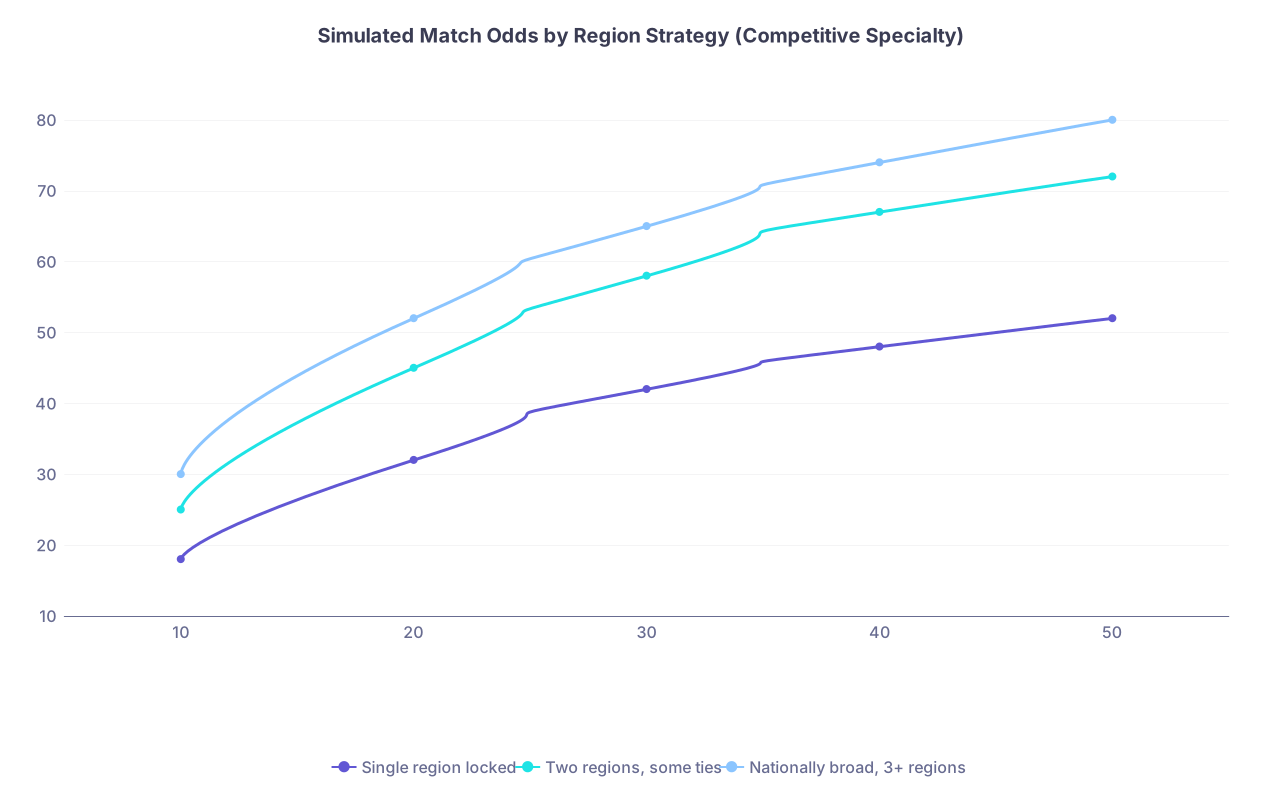
| Category | Single region locked | Two regions, some ties | Nationally broad, 3+ regions |
|---|---|---|---|
| 10 | 18 | 25 | 30 |
| 20 | 32 | 45 | 52 |
| 30 | 42 | 58 | 65 |
| 40 | 48 | 67 | 74 |
| 50 | 52 | 72 | 80 |
These are stylized, but they match what applicants see: once your competitiveness is “good but not elite,” widening geography has a larger marginal effect than adding a few more applications in the same saturated region.
4. Geographic Ties: The Hidden Variable Everyone Underestimates
This is where people confuse “preference” with “probability.”
Programs do not care that you “like” their city. They care that:
- You are likely to rank them highly.
- You will not transfer out after a year.
- Your life logistics (family, visa, cost of living) are feasible.
So they look for evidence.
What programs interpret as real geographic ties
From PD interviews, surveys, and selection committee behavior, several patterns repeat:
- Medical school in the region (or home program)
- College in the region
- Extended family living nearby, actually mentioned in your application materials
- Multiple away rotations in that region
- Long-term prior residence (grew up there, previously worked there for years)
Superficial signals like “I visited once and liked it” or “I enjoy outdoor activities and your state has mountains” are noise.

How ties modulate the penalty of being geographically selective
If you have strong, obvious ties, then region-locking is less catastrophic. If you do not, then being picky simply lowers your pᵢ for each program, sometimes drastically.
You can think of it roughly as:
- Strong tie region: your “base” pᵢ for each program is multiplied by something like 1.2–1.5
- No-tie region: multiply by 0.6–0.8, especially in high-demand cities
- Fake or weak tie: no meaningful lift, and occasionally a credibility problem
This is why an applicant with modest stats but deep local roots can match in a competitive specialty at a mid-tier program while a stronger but nomadic applicant chases coasts and ends up unmatched.
5. The “One City” Fantasy vs Realistic Match Math
Every year, there is a familiar story:
- A strong applicant in Derm/Plastics/ENT/Ortho
- “Partner is here, family is here, I am only ranking programs in this metro area”
- Submits 5–10 ranks. Then wonders why they are in SOAP.
Let’s put rough numbers on a scenario. Suppose:
- You are a solid but not transcendent derm applicant.
- In that metro area, there are 4 derm programs you can realistically rank.
- For each of those 4, your individual chance of matching there is perhaps 10–15% (you are competing with home students, rotators, and national applicants who also want that city).
Even if we are generous and say 15% per program, and largely independent outcomes, then:
Match Odds ≈ 1 – (1 – 0.15)⁴
= 1 – (0.85)⁴
≈ 1 – 0.522
≈ 47.8%
So under 50–50. For a “strong” applicant.
Now contrast with someone who applies across 50–60 programs nationally, ends up ranking 15 programs, each at a lower, say 8–10% odds individually, but diversified:
At 10% per program for 15 ranks:
Match Odds ≈ 1 – (0.90)¹⁵ ≈ 1 – 0.205 ≈ 79.5%
That difference—about 30 percentage points—exists entirely because one person treated geography as optional and the other treated it as rigid.
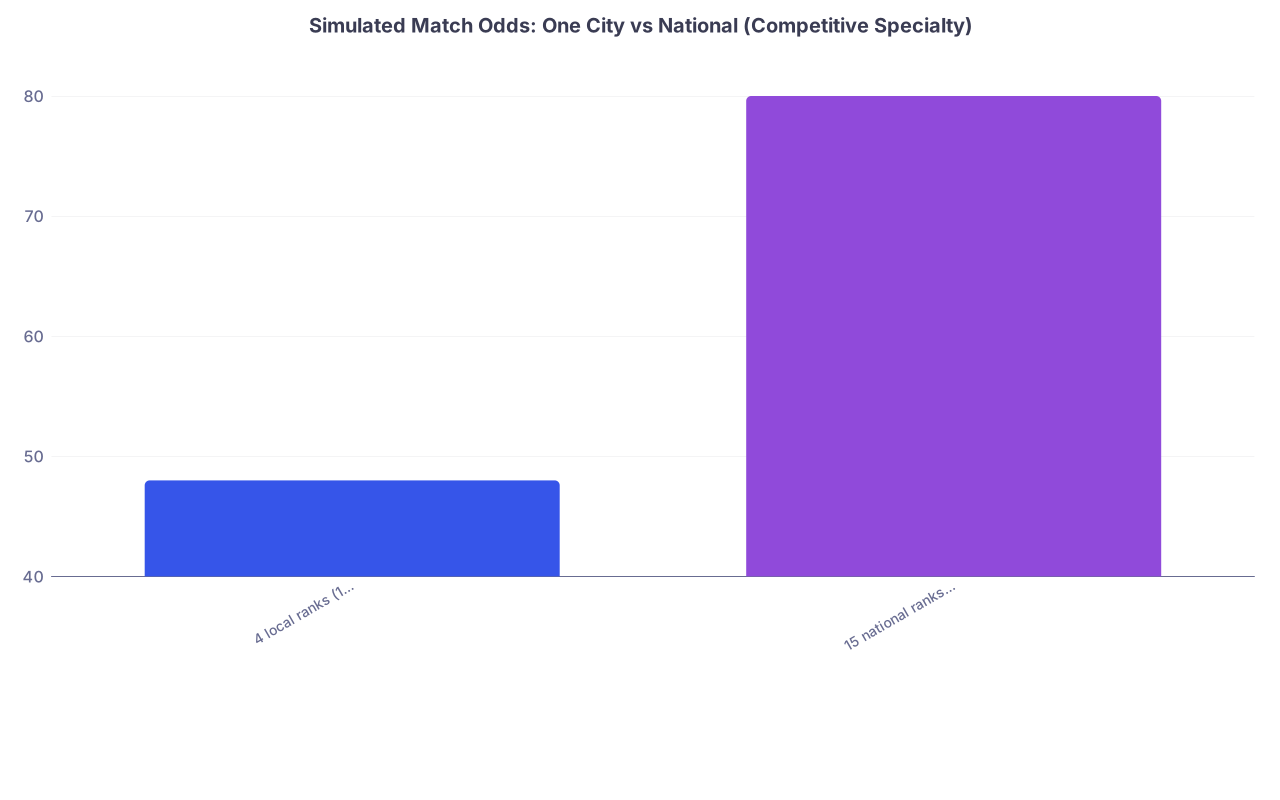
| Category | Value |
|---|---|
| 4 local ranks (15% each) | 48 |
| 15 national ranks (10% each) | 80 |
These are not theoretical. They mirror real institutional data where applicants with fewer than ~8–10 ranks in hard specialties are consistently at very high risk, regardless of how “good” their files look on paper.
6. Strategy: How to Use Geographic Preference Without Killing Your Match
I am not saying “move anywhere, sacrifice everything.” I am saying you need to treat geographic preference like any other high-cost constraint. You pay for it with match probability. You decide if the trade is rational.
Here is how to make that choice with data instead of vibes.
6.1 Build a simple geographic risk model for yourself
On a sheet of paper (or spreadsheet), list:
- All regions you are realistically willing to live in for 3–7 years
- Number of programs in your specialty in each region
- How many of those are realistically reachable for you (filter out pure long-shots based on Step scores, DO/IMG status, program reputation, etc.)
- Whether you have strong, moderate, or no ties to that region
You quickly discover two things:
- Some “dream” regions have very few realistic programs for your profile.
- Some unglamorous regions have many programs that are quite plausible matches.
Now you can quantify.
6.2 Set a minimum viable rank list
For most competitive specialties, institutional advisors quietly say the same thing:
- Fewer than 8–10 ranks in a very hard specialty: high risk unless you are top-tier with serious connections.
- 10–12 ranks: acceptable but not bulletproof.
- 12–15+ ranks: where risk begins to fall to tolerable levels for solid applicants.
So work backwards. If you restrict to:
- One region with 6 total realistic programs → your maximum rank list is probably 4–6. That is structurally risky.
- Three regions with 20–30 realistic programs total → far more room to reach a safer 12–15 rank list.

6.3 Decide your risk tolerance explicitly
Be honest with yourself on three numbers:
- How many years would you be willing to do research / prelim / reapply if you go unmatched?
- How much family / relationship strain is acceptable for you to move?
- How much does your identity depend on this specialty versus any specialty?
For many, the rational choice is:
- First priority: match somewhere in this specialty.
- Second priority: geography, within reason.
- Third priority: program prestige.
Your actual behavior should mirror that hierarchy. The data shows too many applicants invert it.
6.4 When and how to be strategically narrow
Geographic selectivity is least harmful in these scenarios:
- You have a strong home program in that specialty.
- You have multiple programs in your metro/region and clear, documentable ties.
- Your specialty is competitive, but you are in the top 5–10% of applicants by objective metrics (Step scores, research, letters from known names).
Even then, wise applicants usually:
- Anchor their list locally but still apply to a few “safety” regions where their file will stand out.
- Use at least 2 regions in ERAS filtering, not one.
7. Specific Red-Flag Patterns That Data Advising Offices See
Patterns that correlate strongly with failure to match in competitive specialties:
- Single-city or single-state applications with no home program.
- Applicants listing 30+ desired programs but all in the same coastal corridor.
- Strong applicants who do not apply to any mid-tier or less-desired regions.
- Couples matching where both partners choose competitive specialties and insist on overlapping narrow geographies.
And the reverse:
- Marginal derm or plastics applicants who bite the bullet, apply to the Midwest, South, or less sought-after states, and end up matching into programs where they thrive. The “I never thought I would live here, but it worked out” cohort is real. Numerically large.
8. Putting It All Together
You do not need perfect predictive models to use geography intelligently. You just need to stop treating it as pure “preference” and recognize that in competitive specialties, it functionally behaves like another test score.
Every time you say, “I will not consider that region,” you are lowering:
- The number of realistic programs you can rank
- The diversification of your probability mass
- Your buffer against random variability in interview offers
And you are doing that in specialties where variance is already high.
FAQ (4 Questions)
1. If I have strong ties to one region, is it safe to apply only there in a competitive specialty?
No. Strong ties improve your odds within that region but do not magically increase the total number of positions. If that region has limited spots or many local applicants, your match risk remains substantial. A safer pattern is: prioritize your home region heavily, but include at least one or two additional regions where your application is still realistic.
2. How many geographic regions should I include for something like dermatology or orthopedic surgery?
For most applicants who are not at the extreme top of the applicant pool, 3–4 major regions is a rational baseline: for example, your home region plus two or three others that have a decent density of programs and where you could reasonably live. That typically yields enough program volume to reach a safer 12–15-rank list if your metrics support it.
3. Does doing away rotations in a specific region meaningfully offset being geographically narrow?
Rotations help, but they are not a magic shield. Away rotations increase your odds at those specific programs and may improve your pᵢ in that region, especially if letters and relationships are strong. However, they do not change the raw count of positions available. If you rotate at two programs in a region that only has six realistic slots for you, your total structural risk remains higher than if you had spread your applications across more regions.
4. How should couples match applicants in competitive specialties think about geography?
The data is unforgiving here. Couples both targeting competitive specialties who also insist on tight geography face sharply reduced match odds. The safer strategies are: at least one partner chooses a less competitive field, both partners apply to overlapping but broader regions (not a single city), and both are willing to rank some programs that are geographically less ideal but realistic. Narrow geography plus two hard specialties is one of the most common recipes for couples match disappointment.
Key points: geographic rigidity in competitive specialties behaves like a self-inflicted score penalty; strong regional ties can modulate, but not eliminate, that penalty; and applicants who treat geography as a strategic variable—not a fixed preference—consistently match more often and more safely.