
Limited Financial Resources? Low-Cost Strategies for Competitive Applications
What do you do when everyone tells you, “For derm you need 3 aways, 80+ applications, and tons of research,” and you look at your bank account and think: “I can afford… maybe one flight and a bus ticket”?
If that’s you, then we’re talking about the same reality. Competitive specialty. Limited money. People casually dropping $8–12K on the application cycle. You’re trying to figure out how to not torch your financial life before residency even starts.
Let’s get specific.
I’ll walk through how to build a competitive application to fields like derm, ortho, ENT, plastic surgery, neurosurgery, urology, ophthalmology, or rad onc when you don’t have a family safety net, extra savings, or the ability to “just throw apps everywhere and see what sticks.”
Not theory. Actual tactics. What to do, what to skip, and where you get the most ROI for each dollar.
Step 1: Know Exactly Where the Money Usually Disappears
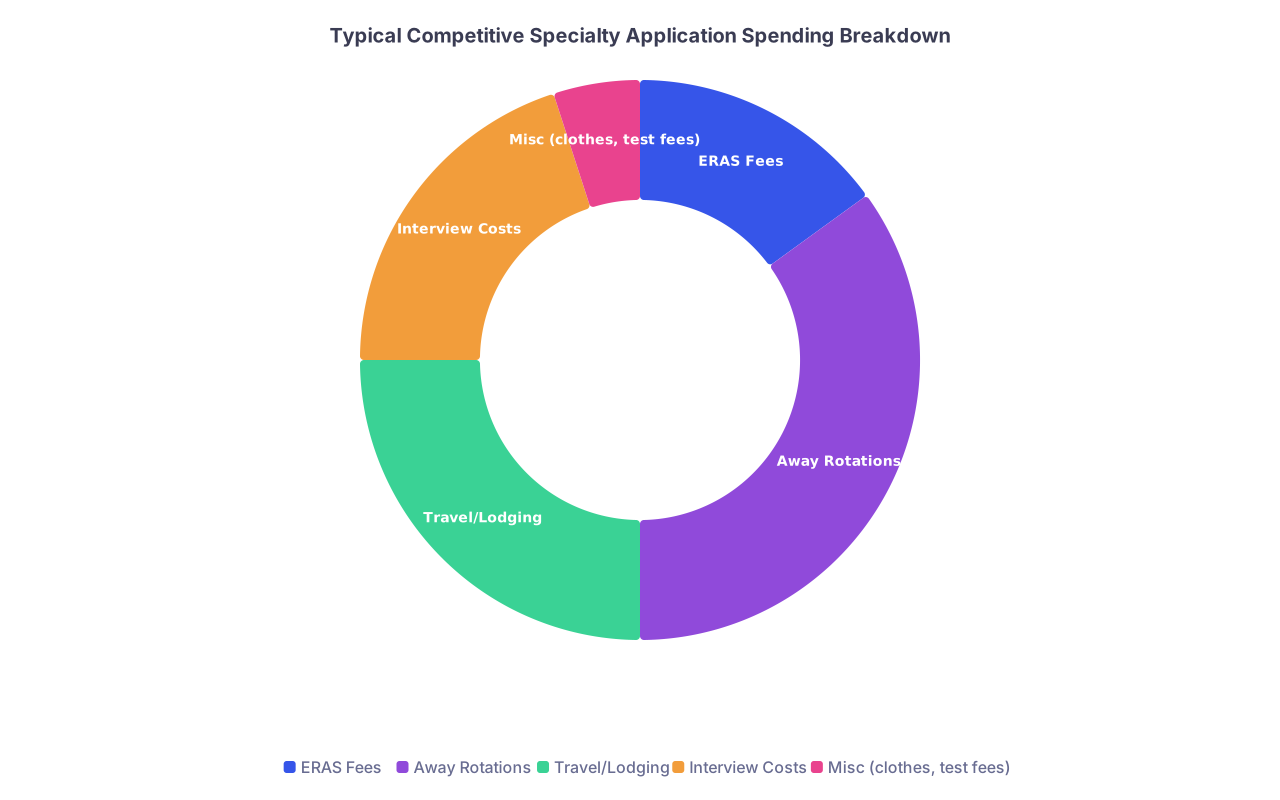
| Category | Value |
|---|---|
| ERAS Fees | 1500 |
| Away Rotations | 3500 |
| Travel/Lodging | 2500 |
| Interview Costs | 2000 |
| Misc (clothes, test fees) | 500 |
Most people go broke on residency applications for five reasons:
- They apply way too broadly with ERAS.
- They do multiple away rotations like they’re collecting stamps.
- They fly to every interview because “this program is really good.”
- They don’t use any waivers or institutional support.
- They panic and add programs late instead of having a plan.
You don’t have the luxury of “spray and pray.” You need a surgical approach.
Think in two buckets:
- Non‑negotiable investments – some things you probably must pay for.
- Discretionary flex – things everyone says you “should” do but you can often replace or minimize.
Here’s the rough reality for competitive specialties if you’re trying to stay lean but still serious:
| Category | Lean But Serious Target | Typical High-Spend Applicant |
|---|---|---|
| ERAS Fees | $400–$900 | $1500–$2500 |
| Away Rotations | $0–$2500 (0–1 away) | $3000–$6000 (2–3 aways) |
| Travel/Lodging | $0–$1500 (mostly virtual) | $2500–$4000 |
| Interviews | $0–$300 (clothes, misc) | $800–$2000 |
| Exams/Score Reports | $0–$300 | $200–$600 |
You’ll probably land somewhere in the left-hand column if you’re intentional. Now let’s talk how.
Step 2: Start With the Free and Discounted Money
If you’re short on cash and you haven’t squeezed every waiver and fund available, that’s mistake number one.
ERAS / Application Fee Help
You need to attack this early, not the week you’re submitting.
AAMC Fee Assistance Program (FAP)
- Many people use it for MCAT only and forget it exists for med school.
- Depending on your school and year, FAP can lower certain costs (not ERAS fees directly, but other AAMC fees like MSPE transmission, etc.).
- If you were ever FAP‑eligible, that’s a signal you should also be asking your school for financial help for residency applications.
Institutional “hardship” or “equity” funds
I’ve seen these under names like:- “Student hardship fund”
- “Residency application support”
- “Diversity and equity student support grants”
- “Travel fund for underrepresented or low‑income students”
Ask your dean of student affairs or financial aid office directly:
- “Are there need‑based funds for away rotations or residency interview expenses?”
- “Who has discretion over those funds?”
You’re not begging. You’re reallocating resources that are literally designed for students like you.
Departmental money (this is underused)
For competitive specialties, the department often has informal money:- “We can probably cover your registration for this national conference.”
- “We have some travel money for students presenting posters.”
You unlock this by having a mentor who knows your situation and advocates: - “Dr. X, I’m planning to apply to ortho but I’m pretty financially limited. Are there any departmental funds for students doing aways or presenting research?”
You’d be surprised how often the answer is yes. Quiet yes. Not-advertised yes.
Step 3: Make One Specialty-Aligned Story Without Buying 3 Aways
You do not need three away rotations to be taken seriously, especially post‑COVID where many programs have admitted they overused this metric.
What you do need is a coherent narrative in that specialty:
- Home rotation(s) with strong evaluations
- At least one faculty member who knows you well enough to push for you
- Some specialty‑relevant involvement (research, QI, clinical projects, teaching)
- Ideally one external validator (an away, virtual rotation, or conference poster)
If you have no money for away rotations
Then your priorities shift:
Max out your home rotation performance
- Show up early, leave late, help the residents, read about cases.
- You want comments like: “Acts like a sub‑intern already,” “Top 5% of students I’ve worked with.”
Those comments turn into LORs that can compete with away rotation letters.
Become “department visible” without leaving town
- Present at local grand rounds or resident conference.
- Join the specialty interest group and actually do things (organize panels, help with didactics).
- Volunteer for any departmental project that puts your name next to an attending’s.
Use virtual aways or formal online experiences
Some specialties (especially during and after COVID) started:- Virtual rotations
- “Visiting student” lecture series
- Online research collaborations
These are cheap and can get you:
- A faculty connection
- A letter of recommendation
- Something that shows external interest
Is it as good as a full away? No. But if you execute this well, it’s respectable.
If you can afford exactly one away
Then you treat that away like it’s an investment, not a vacation.
Choose it based on:
- Where your app is most realistic (not just “famous programs”)
- Where your school or mentor has a connection
- A place that historically takes home and visiting students seriously
Ask your mentor directly:
“Given my Step score, class rank, and CV, if I could only do one away, where would you send me?”
Then on that away:
- Be the hardest worker on the team
- Get to know the PD and associate PD by name
- Tell at least one faculty member clearly: “This is one of my top‑choice programs.”
That clarity matters more when you only have one shot.
Step 4: Low-Cost Research That Actually Moves the Needle
You do not have to pay to do research. You do not need a research year in a different city with some unpaid position you can’t afford to take.
You need products: posters, abstracts, maybe a paper or two. Most programs care more about the existence of your output than the price tag of the lab.
Here’s the efficient way:
Start with your own institution
Email or talk in person to faculty in your specialty:- “Do you have any chart reviews or retrospective projects I can help with?”
- “Anything nearing completion that needs help with data collection or editing?”
Retrospective projects are your best friend: low barrier, short timeline, very common in surgical specialties and derm/ophtho.
Take “low-prestige” but high-yield projects
- Case reports
- Small retrospective series
- QI projects that lead to posters
Are they glamorous? No.
Do they give you lines on your CV and something to talk about? Yes.
Leverage residents
Residents are often drowning in half-finished projects:- “Hey, that project we started PGY2, we never finished the chart review.” This is gold for you. Residents are closer to your level, more flexible, and desperate for help. Ask them:
- “If I help finish this project, can I be on the abstract/poster?”
Present at cheaper venues
- Regional specialty meetings
- Institutional research days
- Virtual conferences with low or waived fees for students
You don’t need to fly to the national meeting in Hawaii to get “Presented at [Specialty] Annual Meeting” on your CV. Many will be virtual or regional with minimal cost.
If a mentor says, “You should come to this national conference,” your default response is:
“I’d love to. My finances are tight. Are there any travel scholarships or departmental funds for students presenting?”
Make them say no explicitly. Often they’ll find money.
Step 5: Build a Targeted, Realistic Program List (Instead of 80 Apps)
The idea that you must apply to 70–100 programs for competitive specialties is lazy thinking. Sometimes necessary for certain profiles, but not automatically true.
You need your list to reflect fit and probability, not fear.
How to build a smarter list
Use these four filters:
Geography where you have ties
- Home state
- Region where you went to undergrad
- Where your partner/family lives
Programs weigh this more than they admit. Put more programs here.
Program type and size
- Midsize university and strong community programs are often more accessible than super-elite academic places.
- Smaller/newer programs can be less saturated.
Matched applicant data
Look at:- NRMP Charting Outcomes or specialty‑specific match data
- Where your school’s graduates in that specialty have matched
Where you have any connection
- Your faculty trained there
- Residents came from your school
- You did a virtual event with them
Now structure the list:
| Program Tier | Number of Programs (Competitive Specialty) |
|---|---|
| Reach (top tier) | 5–10 |
| Solid realistic | 20–30 |
| Safety/less competitive | 5–10 |
For a true money‑constrained applicant in a competitive specialty, a 35–45 program list is often far more rational than 80+. Painful? Maybe. But realistic.
You make up the difference with crafting a strong application and leaning on connections, not just paying ERAS to shotgun your file.
Step 6: Cut Travel Costs Without Looking Disengaged
Interview travel is where people blow thousands for prestige points that don’t affect their rank list much.
You can absolutely match a competitive specialty with:
- Mostly virtual interviews
- Strategic in‑person trips
- Zero “I just wanted to see the city” flights
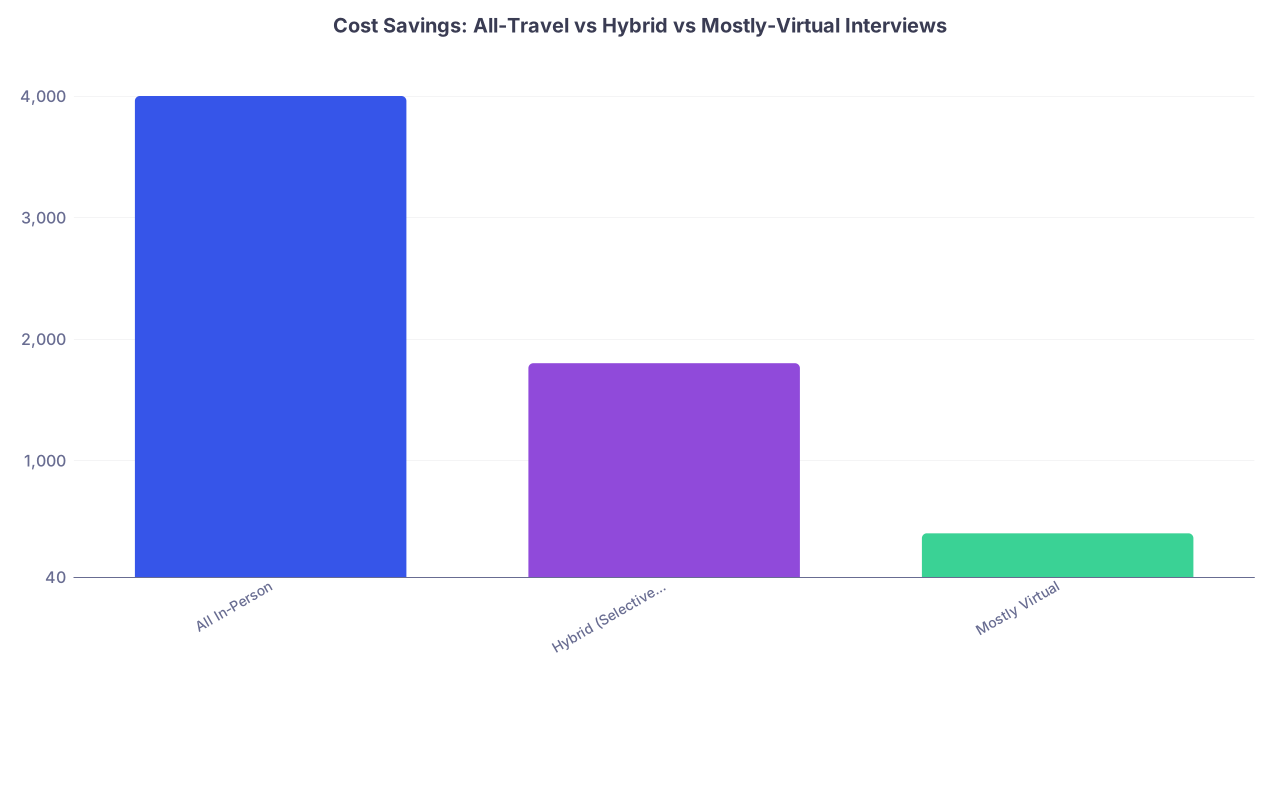
| Category | Value |
|---|---|
| All In-Person | 4000 |
| Hybrid (Selective Travel) | 1800 |
| Mostly Virtual | 400 |
Strategy for interview season if you’re broke
Default to virtual unless there’s a specific reason
Specific reasons:- It’s a top‑3 program for you.
- They heavily favor in‑person attendance (some surgical programs quietly do).
- It’s in your home region and cheap to get to.
Cluster travel
If three programs are in the same region and all offer similar dates, email coordinators:- “I’ll be in [city/region] on X and Y dates for other interviews. Do you have any flexibility to schedule around then?”
People do this. They just don’t talk about it.
- “I’ll be in [city/region] on X and Y dates for other interviews. Do you have any flexibility to schedule around then?”
Crash with friends/family when possible
Free couch > hotel. Always.
You’re not on vacation. You’re on a mission.Use student/alumni housing lists
Some schools and programs keep:- “Visiting student housing”
- Alumni networks who host interviewees
Ask explicitly:
“Do you have a list of local alumni or student housing options for visiting applicants?”
Stop caring about looking “fancy”
- You don’t need a $600 suit. A well‑fitted, simple outfit is perfectly fine.
- You don’t need new luggage.
- No one is scoring your hotel choice.
The only thing that matters is how you interview and what your file already says.
Step 7: Make Your Application Look “Rich In Value” Even If Your Budget Isn’t
You can’t list “limited financial resources” under “experiences,” but you can absolutely frame what you did within constraints as strength.
You want your application to read as:
- Focused
- Efficient
- Impact‑oriented
- Deliberate
Instead of scattered and underdone.
How to do that in ERAS
Curate your activities
Do not list 25 meaningless things. Pick those that show:- Commitment to your specialty
- Leadership or impact
- Long‑term involvement
Write your experience descriptions like someone who knows exactly why they did what they did. No fluff.
Connect the dots in your personal statement
You do not have to describe your financial situation in detail, but you can imply resourcefulness:- “I sought out local opportunities that allowed me to work closely with residents and faculty over multiple years.”
- “Without the ability to complete multiple away rotations, I focused on building depth at my home institution—taking on roles that allowed me to meaningfully contribute to the service.”
If a trusted advisor says it fits, you can briefly mention constraints as part of your story, but be careful not to sound like you’re making excuses. The frame is: “Here’s what I did with what I had.”
Letters that highlight your hustle
Ask your letter writers explicitly:- “If appropriate, could you speak to my reliability, work ethic, and how I’ve taken initiative on projects and patient care?”
A line like, “Despite limited resources, they consistently found ways to contribute to our research and clinical teams,” coming from an attending is more powerful than you saying it about yourself.
Step 8: Plan Your Financial Timeline Like It’s Another Clerkship
You can’t “wing” the money side. You need a basic cash‑flow timeline.
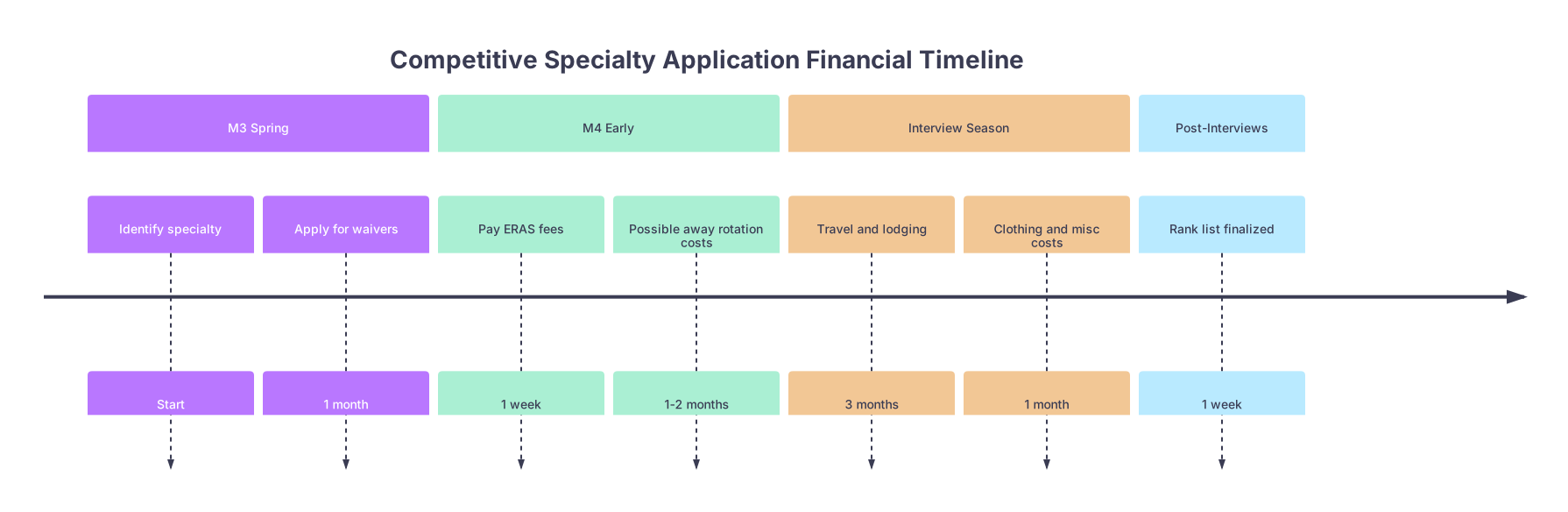
| Period | Event |
|---|---|
| M3 Spring - Identify specialty | Start |
| M3 Spring - Apply for waivers | 1 month |
| M4 Early - Pay ERAS fees | 1 week |
| M4 Early - Possible away rotation costs | 1-2 months |
| Interview Season - Travel and lodging | 3 months |
| Interview Season - Clothing and misc costs | 1 month |
| Post-Interviews - Rank list finalized | 1 week |
Basic structure:
M3 spring / early M4
- Start talking to financial aid and your dean.
- Start applying for any assistance funds.
- Decide if an away is financially possible or not. Early.
ERAS submission (early fall)
- Have saved or secured (loans, family, grants) the ERAS amount for your targeted program list.
No last‑minute freak‑outs where you add 20 programs on a credit card at 2 a.m.
- Have saved or secured (loans, family, grants) the ERAS amount for your targeted program list.
Interview season (late fall–winter)
- Decide in advance: max number of trips you’ll pay for.
- Track costs in real time instead of guessing.
Post‑match/pre‑residency
Don’t forget: there’s a financial cliff after the match. Moving, deposits, etc. Your lean strategy now protects you from getting destroyed later.
If you need to take out a small, targeted additional loan to cover ERAS + 1 away + 1–2 trips, that can still make sense. The key is: small and intentional, not “I’ll worry about it later.”
Step 9: When You’re Truly On the Edge — What Not to Cut
If your money situation is dire, you might be thinking, “What if I just apply to 10 programs and hope?” That’s not strategy, that’s gambling.
Here’s what you usually should not cut, even on a tight budget:
- All away/virtual exposure to other programs
- Enough programs to reasonably match for your profile
- Professional-looking interview clothing (doesn’t need to be expensive, just presentable)
- At least one attempt at building some research or scholarly work in the specialty
And here’s what you can almost always cut or reduce without killing your chances:
- Multiple aways just for appearances
- Extra “super‑reach” programs that are clearly unrealistic
- Flying to in‑person “second look” events
- Attending expensive conferences where you’re not presenting anything
If you’re stuck, sit down with a brutally honest advisor (not the “everyone should apply to 80 programs” type) and say:
“I have exactly $X I can spend on this entire process. How would you allocate it if you were in my shoes?”
Force them to prioritize with you.
Step 10: Competitive Specialty Reality Check (Without the Doom)
Yes, competitive specialties are harder. Yes, money helps. It buys travel, optional research years, nicer optics.
But programs still like:
- Grit
- Maturity
- Residents who won’t crumble on call
- People who have clearly done a lot with a little
If you show up with:
- Strong home performance
- Serious engagement with your specialty
- Some scholarly work
- A targeted program list
- A professional, prepared interview presence
You’re in the game. Even without dropping $10K.
Key Takeaways
- You win this game by targeting, not by outspending: focused program lists, one purposeful away (or a strong home/virtual strategy), and cheap but real research products.
- Use every source of external support: school hardship funds, departmental money, travel grants, virtual options. Make people tell you no.
- Your application needs to feel deliberate and rich in value, even if your budget is thin. Depth at home, visible commitment, and smart choices will matter more than the number of flights you took.