
You are a PGY-2 on nights. It is 3:17 a.m., you just finished a septic shock admission, and your co-resident casually says: “Yeah, I am thinking cards then EP… or maybe critical care too, be double-boarded, keep options open.”
You nod like this is normal. Inside, you are thinking:
“I barely understand how to match into one competitive fellowship. How do people line up two?”
That is what we are going to fix. Right now.
This is about matching into double-boarded competitive fellowships. Think cardiology–critical care, pulmonary–critical care–sleep, heme/onc plus palliative, anesthesia critical care plus ECMO-focused CT-ICU work, EM–critical care, or GI–transplant hepatology. You want overlapping boards, high-acuity work, and maximum leverage in a saturated market.
Let me break this down specifically.
1. What “Double-Boarded” Actually Means (And What It Does Not)
First, clarity. People throw “double-boarded” around in lazy ways.
True double-boarded usually means:
- Two ABMS-recognized board certifications
- With a clear training pathway (integrated or sequential)
- Often with overlapping practice domains (e.g., cards + CCM; pulm + CCM + sleep; heme/onc + palliative)
Examples that fit what you are probably imagining:
- IM → Cardiology → Critical Care
- IM → Pulm/Critical Care → Sleep
- IM → Hematology/Oncology → Palliative Medicine
- IM or EM → Critical Care → Neurocritical or ECMO/advanced ICU niche
- IM → GI → Transplant Hepatology
You are not asking about “I did a non-ACGME one-year research fellowship then a real fellowship.” Different animal.
Integrated vs sequential pathways
Some combinations are structurally baked into the system. Others are you stitching them together.
| Primary Route | Fellowship 1 | Fellowship 2 |
|---|---|---|
| IM | Pulm/Critical Care | Sleep Medicine |
| IM | Cardiology | Critical Care Medicine |
| IM | Hem/Onc | Palliative Medicine |
| IM or EM | Critical Care Medicine | Neurocritical Care |
| IM | Gastroenterology | Transplant Hepatology |
Pulm/CCM is basically designed for double-boarded life. Cards + CCM is more sequential and timing-sensitive. EM + CCM is politically charged in some places. Hem/Onc + Palliative is easier structurally but still requires strategy if you want top-tier locations.
If you do not know which pair you want, you are not “behind,” but you do need to understand which combinations require early, aggressive positioning (cards + CCM, EM + CCM) versus which you can add more flexibly (palliative, sleep).
2. The Timeline Reality: You Do Not Have as Much Time as You Think
You probably imagine: intern year to “explore,” PGY-2 to “decide,” PGY-3 to apply. That is already too late for some double-board strategies if you are aiming high.
Let me map this out bluntly for a standard IM → subspecialty → second boards route.
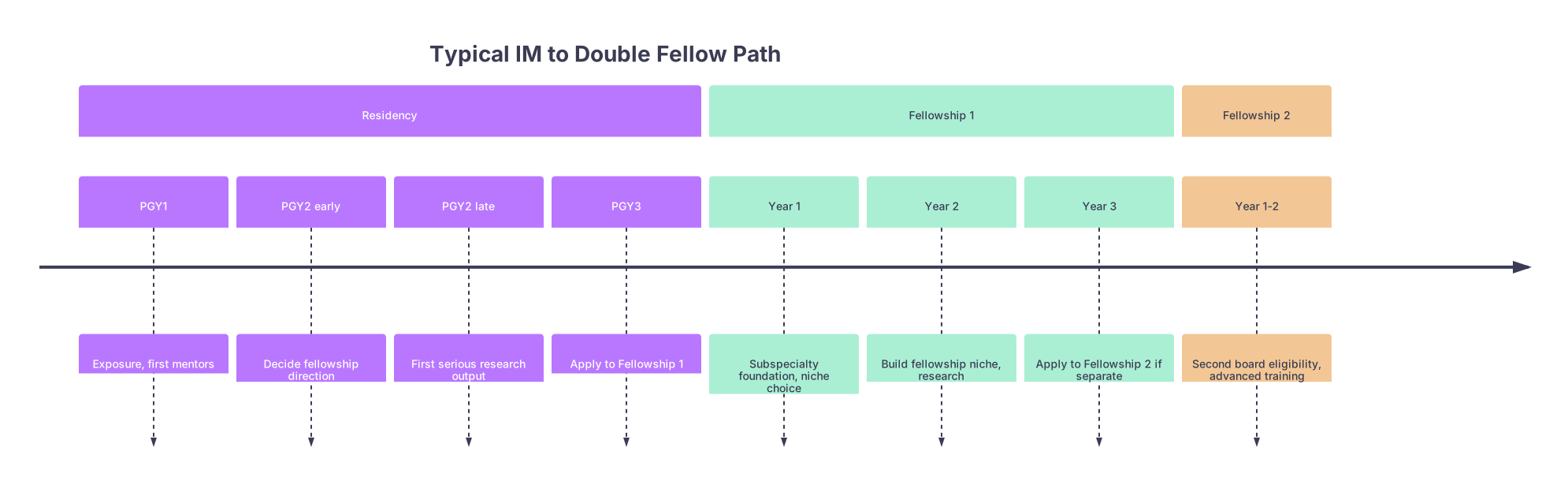
| Period | Event |
|---|---|
| Residency - PGY1 | Exposure, first mentors |
| Residency - PGY2 early | Decide fellowship direction |
| Residency - PGY2 late | First serious research output |
| Residency - PGY3 | Apply to Fellowship 1 |
| Fellowship 1 - Year 1 | Subspecialty foundation, niche choice |
| Fellowship 1 - Year 2 | Build fellowship niche, research |
| Fellowship 1 - Year 3 | Apply to Fellowship 2 if separate |
| Fellowship 2 - Year 1-2 | Second board eligibility, advanced training |
Compressed translation:
- PGY-1: You need to be at least leaning toward a field by spring if you want to be competitive for the top fellowship (Fellowship 1).
- PGY-2: This is your production year—abstracts, manuscripts, key mentor letters.
- PGY-3: You are not just applying to Fellowship 1. You are already quietly calibrating how Fellowship 1 sets you up (or blocks you) from Fellowship 2.
If your endgame is something like “I want to be double-boarded in cardiology and critical care with a heavy ECMO practice at a quaternary center”, then waiting until PGY-3 to decide on critical care is naïve. Programs that dominate those niches (e.g., places like Columbia, Hopkins, Michigan, Mayo, some big Texas systems) already have people in their pipeline from PGY-1.
3. Which Combinations Are Actually Worth It?
Not every pair of boards pays off equally. Some are strategically superb. Some are CV decoration.
Let me be direct.
High-yield, high-leverage pairs
These are combinations that:
- Clearly expand your practice scope
- Increase job flexibility and institutional value
- Are well recognized by hospitals and payors
Cardiology + Critical Care
This is the golden child combination right now.
Why institutions love it:
- You can staff both a CICU and a MICU/SICU flexibly
- You understand complex hemodynamics, MCS, ECMO at a higher level
- You bridge cardiology services with intensivist teams
The catch:
- Extremely competitive.
- Many CCM programs quietly prefer pulm-CCM or anesthesia-CCM; EM-CCM and cards-CCM folks sometimes fight for oxygen in certain markets.
- Timing is tricky—do you apply CCM during cards, after cards, or via an integrated track?
Pulmonary/Critical Care + Sleep
This is the “quiet powerhouse” combination.
You become the hospital’s Swiss Army knife:
- You can run an ICU
- You cover inpatient pulmonary consults
- You supervise a sleep lab (and bill very nicely for it)
Sleep is relatively low-intensity, protected outpatient work. That balance can save your career at 55.
Hem/Onc + Palliative Medicine
If you want to own serious illness conversations and complex symptom management, this is the combo.
Structurally straightforward:
- Do IM → Hem/Onc → 1-year Palliative
- Or occasionally Palliative → Hem/Onc, but that is rarer and less efficient
You become the go-to for:
- Chronic cancer pain
- End-of-life care planning
- Integrated oncology–palliative services (which cancer centers increasingly push hard)
EM or IM + Critical Care + Neurocritical Care
Pretty specific niche, but at big centers with strong neurosurgery/stroke programs, this combination is valued highly.
You need to be precise here:
- EM → CCM → Neurocritical (and board as CCM, then UCNS Neurocritical)
- IM → CCM → Neurocritical with similar pathway
The timing is more complicated, but the structural value is real if you have the stomach for neuro-ICU life.
Lower-yield or misunderstood combos
You will hear these floated all the time:
- “I will do nephro + CCM and be super competitive.”
- “I will add ID to critical care for ICU infections.”
Sometimes this works. But at many institutions these extra boards do not dramatically change your job options. You become over-trained on paper and under-utilized in practice.
Reality check: hospitals primarily think in service lines, not your tally of board certifications. If your extra fellowship does not unlock a distinct service line they need (sleep lab, transplant hepatology, ECMO program, palliative service), it often buys you prestige more than power.
4. Strategy Starts in Residency: The “Anchor Fellowship” Model
You cannot plan two fellowships at once from day one without losing your mind. You need an anchor.
The anchor is:
- The fellowship that is most competitive or
- The one that takes the most years and
- The one that drives your identity on paper
Cardiology anchor example:
- You are IM. You love hemodynamics, echo, advanced imaging. You know you want cards.
- Cards is harder to match than CCM at many places. Cards becomes your anchor.
- You optimize 100% of your residency portfolio for a top-tier cards match.
- You treat critical care interest as an aligned sub-narrative, not the main story.
Pulm/CCM anchor example:
- Your final goal is ICU-heavy life with maybe sleep on the side.
- Pulm/CCM is the obvious anchor because of the integrated structure.
- You do not waste time pretending you might do general cards or GI unless that is truly in play.
How early do you need to pick the anchor?
If you want elite-level programs:
- By mid PGY-1: You should have a working hypothesis. Not a contract, but a direction.
- By early PGY-2: That hypothesis must be concrete enough to drive your research, mentors, and electives.
Residents who say “I am keeping all doors open” into late PGY-2 often end up with no door fully open at a competitive level. Broad uncertainty leads to shallow CVs.
5. Building a CV That Serves Two Fellowships Without Looking Unfocused
This is where people screw up. They try to be everything.
The key principle: One narrative, two applications.
Your CV should look like it was built for your anchor fellowship, with secondary elements that make perfect sense for the second board.
Example: IM → Cardiology (anchor) → Critical Care
You need:
Cardiology-heavy foundation
- Research in heart failure, EP, imaging, interventional outcomes, etc.
- Cards electives at your home institution and, if weak, away rotations at a stronger one
- Letters from cardiologists with national reputations where possible
Integrated critical care flavor baked in
- ICU rotations where you shine
- A project or two that crosses both worlds
- Example: cardiogenic shock outcomes, VA-ECMO survival, CICU sepsis management
- A mentor who straddles both fields if available (many CICU directors have dual roles)
What you do not do:
- Random ID case reports + nephro QI + one heart failure poster + an ICU commentary “because I might do CCM.”
- That CV screams “dabbler with no real center.”
Your personal statement for cards:
Cardiology-first, with ICU interest as a contextual strength.
Your eventual CCM personal statement:
ICU-first, with deep cardiology pedigree as your competitive edge.
Same underlying story. Two emphases.
6. Letters, Mentors, and Politics: The Stuff People Avoid Talking About
People pretend fellowship match is “scores + research + good person.” That is naive. Matching into double-boarded paths at high-end programs is heavily relationship-driven.
You need at least three mentor types
Primary subspecialty champion (anchor field)
- They sell you into Fellowship 1.
- Should be a program director, division chief, or well-known faculty.
- Their letter talks about your ceiling in that field and compares you to previous stars.
Systems-level or ICU-aligned mentor
- Makes you look serious about critical care / palliative / sleep / sub-niche.
- Ideally someone with cross-department respect (e.g., ICU medical director, palliative section chief).
Residency-level advocate
- PD or APD who can speak to your reliability, team function, and leadership.
- Programs will absolutely call them, especially if you are double-boarding.
The political landmines
You will hit some variation of this conversation:
“We are happy you want cards. But doing critical care later—does that mean you will leave academics earlier? Will you dilute your cath lab volume?”
Some cardiology faculty view CCM as a distraction unless you align it with the CICU mission. You need to preempt that.
You frame it as:
- “My long-term plan is to run a CICU or advanced shock program, not to be a generic MICU intensivist.”
- “I want to bring standardized critical care practices into the cardiac ICU environment.”
For heme/onc + palliative:
“Are you leaving the research track for a touchy-feely palliative job?”
You counter:
- “I want to lead an integrated oncology–palliative service and improve end-of-life oncology care at a systems level.”
- Back it with actual QI or outcomes work if you have it.
If your mentors do not understand your endgame, your letters will sound disjointed. Which is deadly for double-board strategies.
7. Timing: When Do You Actually Apply to the Second Fellowship?
This varies a lot by pair. Let me lay out a simplified comparison.
| Pathway | Apply to Fellowship 2 | Common Duration |
|---|---|---|
| IM → Cards → CCM | Cards year 2–3 or post-cards | 1–2 years |
| IM → Pulm/CCM → Sleep | During last year of Pulm/CCM | 1 year |
| IM → Hem/Onc → Palliative | Final Hem/Onc year | 1 year |
| IM/EM → CCM → Neurocrit | Last CCM year or post-CCM | 1–2 years |
| IM → GI → Hepatology | GI year 2–3 | 1 year |
The bottleneck: Cards → CCM
This is the one people mess up chronically.
You essentially have three choices:
Concurrent mindset, sequential application
- You match cards at a place with a strong ICU/CCM footprint.
- During cards, you intentionally work with ICU teams, do ECMO/CICU research, get to know intensivists.
- Apply to CCM in your last year of cards with a very clean narrative.
Prearranged integrated track (rare but powerful)
- Some institutions have informal or formal structures where they “pipeline” a small number of cards fellows into CCM.
- This is heavily relationship-based. If you want this, you start cultivating it as early as PGY-2–3.
Cards at one place, CCM elsewhere
- More flexible, but politically a bit trickier—you need to convince CCM programs you are not just “moonlighting from cards” but that ICU is a core part of your identity.
The key: if you want cards + CCM, you look for cards programs that are friendly to that path from day one. You do not just match any cards spot and “figure it out later.”
8. Choosing Programs With Double-Boarding in Mind
When you rank residency programs, you should already be thinking about fellowship pipelines. Not just for one fellowship. For both.
You want to know:
- Does this residency have a strong track record matching into my anchor fellowship?
- Does this institution also offer the second fellowship internally (or have tight regional relationships)?
- Are there faculty who live the life I want—double-boarded, doing the combined niche I am targeting?
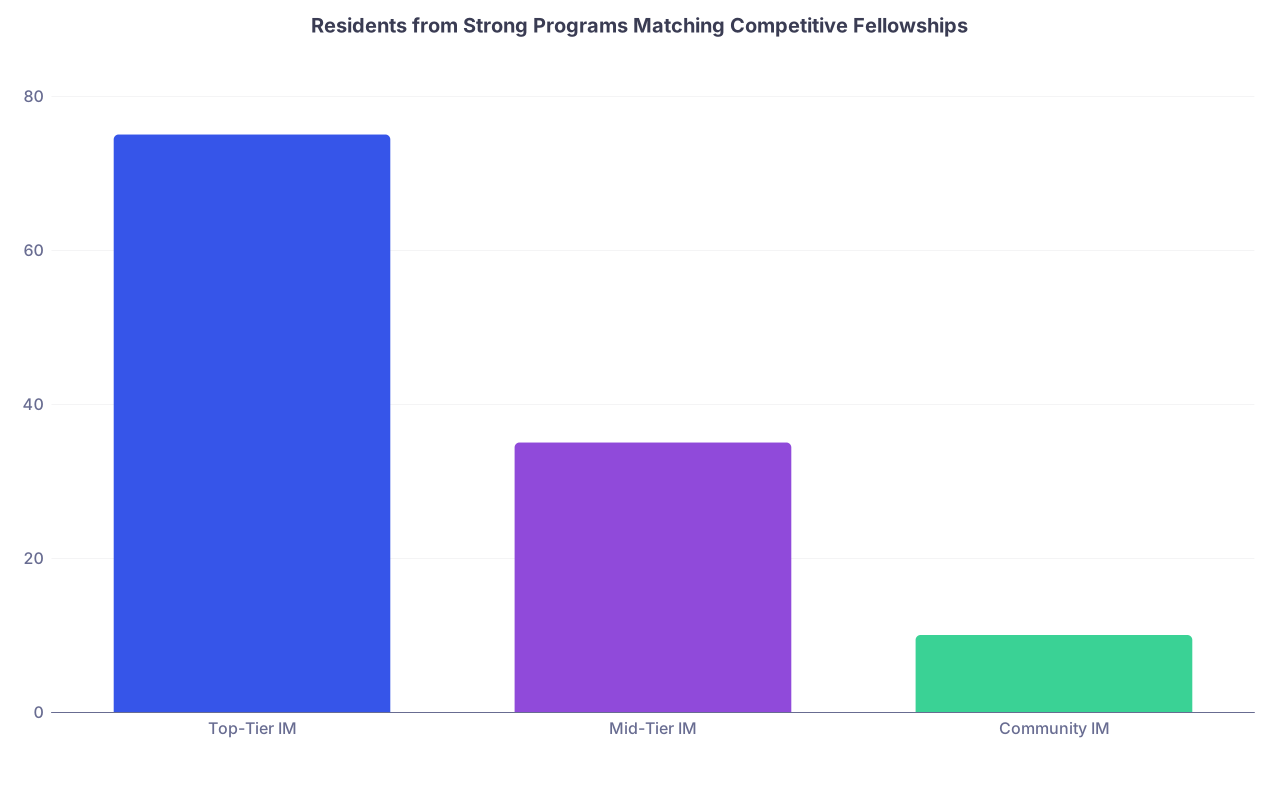
| Category | Value |
|---|---|
| Top-Tier IM | 75 |
| Mid-Tier IM | 35 |
| Community IM | 10 |
(I am generalizing the numbers here to make a point: high-output programs push a much higher proportion of grads into competitive fellowships.)
When evaluating programs, explicitly ask:
- “How many of your last 5 years of graduates matched into cardiology? How many into CCM? Any who did both?”
- “Do you have faculty who are double-boarded in X and Y? Can I meet them?”
- “If I did hem/onc here and then wanted to add palliative, is that supported internally?”
Blank stares are your signal to downgrade that program if double-boarding is truly your priority.
9. Research: Depth Over “Inflated PubMed Count”
You will see residents chasing insane numbers: 20+ case reports, 10 low-impact retrospectives, miscellaneous poster clutter. Then they wonder why interviews feel underwhelmed.
For double-boarded tracks, depth and coherence matter more.
Example: Targeting Cards + CCM
A serious research arc could look like:
- PGY-1: Assist on a retrospective cohort of cardiogenic shock admissions, focusing on vasopressor and inotrope use.
- PGY-2: Take ownership of a sub-study about ECMO outcomes or post-arrest management. First or second author. Present at a major meeting (ACC, AHA, SCCM).
- PGY-3: Expand into a QI project in the CICU—e.g., standardized sepsis bundle adoption, sedation protocols. Publish in a decent journal.
By the time you apply to cards, your CV says:
“I am a future cardiologist who already thinks like an intensivist and has measured outcomes in complex cardiac critical illness.”
When you apply to CCM later, your CV says:
“I am a cardiologist with a proven track record in ICU-focused projects, especially shock and ECMO, and I now want to deepen that skill set to lead modern ICUs.”
Same body of work. Different emphasis.
10. The Personal Side: Burnout, Lifestyle, and “Do I Actually Want This?”
Here is the part no one puts in glossy brochures.
Double-boarding in competitive fields often means:
- 5–8 years post-MD of nonstop training
- Night call well into your 30s, sometimes 40s
- Moves between cities and institutions that strain relationships
- Identity diffusion if you are not disciplined about your end role
ICU, heme/onc, and advanced heart failure in particular are burnout factories if you do them without structure.
So you need a target daily life in mind. Not just “two boards.”
Ask yourself:
- Do I want 80–90% ICU time forever, or 50% ICU, 50% clinic/procedures?
- Am I okay being on a death-heavy service all the time (hem/onc + palliative, advanced HF + ICU)?
- Do I want to live at a quaternary center, or would I prefer a strong regional system where double-boarding gives me leverage and flexibility?
Then test those assumptions.
Do not decide you want cards + CCM before you have:
- Done real CICU and MICU months, not just as the lost intern.
- Watched what the attendings’ lives actually look like at 10 p.m. on a Sunday.
- Talked to at least one person who regrets a similar path and asked why.
11. Red Flags and Common Mistakes
I have watched people blow excellent chances with the same errors on repeat.
Here are the big ones:
Vague future goals
- “I might do cards or GI or heme/onc then critical care or palliative.”
- This reads as unfocused to everyone. Pick a lane. You can change later, but you cannot present as indecisive during key application cycles.
Scattered research with no through-line
- One nephro case report, one ID abstract, one QI poster in general medicine, and now you say you are obsessed with ECMO? Programs do not buy that.
Letters that do not match the narrative
- If your best letter is from a nephrologist and you are applying to cards, that is a big mismatch. Double-boarding does not justify random letters.
Ignoring institutional politics
- Matching into cards at a place that actively blocks or discourages CCM later, then acting surprised when they do not support your second fellowship plan.
Assuming you can “add on” anything later
- Some fields like palliative or sleep are easier to tack on. Others, like CCM, depend heavily on being taken seriously as committed to the field. That image starts early.
12. A Focused 10-Point Action Plan (Condensed)
If you skimmed everything above, here is the spine.
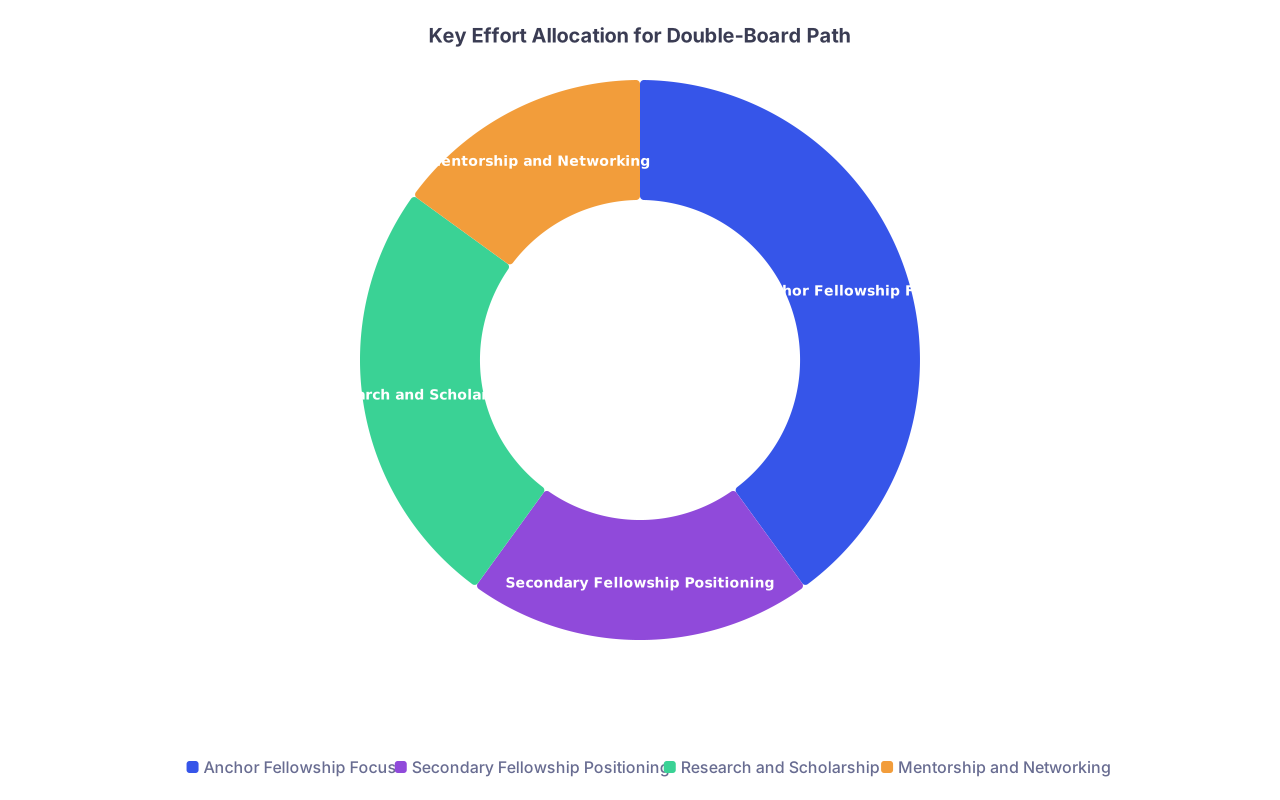
| Category | Value |
|---|---|
| Anchor Fellowship Focus | 40 |
| Secondary Fellowship Positioning | 20 |
| Research and Scholarship | 25 |
| Mentorship and Networking | 15 |
- PGY-1: Decide on a probable anchor fellowship by spring. You are allowed to be 70% sure, not 100%.
- PGY-1–early PGY-2: Get at least one serious mentor in that field. Tell them explicitly you are considering a double-board path and which second field.
- PGY-2: Start or own a research project that naturally sits at the intersection (cardiac ICU, onc–pall care, ICU sedation with pulm/CCM, etc.).
- PGY-2–3: Stack electives in your anchor field at strong institutions. If your home program is weak, consider a targeted away rotation.
- PGY-3 (ANCHOR APPS): Apply to Fellowship 1 with a crystal-clear narrative. Do not dilute it with “maybe I will add X and Y and Z later.”
- Fellowship 1, Year 1: Find the faculty who embody the double-boarded life you want. Attach yourself. Ask them how they timed their training.
- Fellowship 1, Year 2: Decide whether you will apply to Fellowship 2 internally, externally, or not at all. Begin focused prep—projects, electives, letters.
- Fellowship 1, late Year 2 / Year 3: Apply to Fellowship 2 with a portfolio that shows you already function in that space, not that you woke up last month wanting another board.
- Fellowship 2: Do not coast. Your reputation at this stage will follow you into your first job directly.
- Job search: Target institutions where your double-board configuration actually changes how they use you—ICU time allocation, service leadership, program building.
13. One Concrete Example: IM → Pulm/CCM (Anchor) → Sleep
To make this less abstract, let me lay a realistic path.
PGY-1:
- You noticed you like ventilators more than discharge summaries. ICU months energize you. Cards is interesting, but you do not care about cath lab culture. So you lean toward pulm/CCM.
- You ask the pulm/CCM PD if you can join a QI project on ICU liberation bundles.
PGY-2:
- You become the resident who knows the vent settings. Nurses ask for your input. Attendings notice.
- You co-author a paper on ARDS management outcomes. Present a poster at ATS or CHEST.
PGY-3:
- You apply to pulm/CCM with letters from:
- ICU medical director
- Pulm/CCM PD
- Residency PD
- Your statement: “I want to become an intensivist with a strong footprint in chronic respiratory failure and post-ICU care, potentially incorporating sleep medicine.”
PuLM/CCM Fellowship Year 1–2:
- You realize half the unit has OSA, obesity hypoventilation, CPAP/BiPAP questions.
- You do a project on post-ICU sleep disturbances or adherence to home NIV.
- You spend time in the sleep lab and do a small secondary project there.
Fellowship Year 2–3:
- You apply to a 1-year sleep fellowship. Your CV now screams:
- Advanced training in respiratory failure
- Specific research and clinical interest in sleep-disordered breathing
- Strong letters from ICU and sleep leadership
Attending life:
- 50% ICU/pulm, 50% sleep lab or clinic.
- Flexible schedule, strong billing potential, clear differentiation from pure pulm or pure sleep docs.
That is double-boarding done intelligently.
Final 3 Takeaways
- Pick an anchor fellowship early and build a coherent story around it. Double-boarding works only if you look world-class in at least one field first.
- Structure your research, mentors, and program choices so they keep both fellowships plausibly open without making you look scattered. One narrative, two applications.
- Be sure the second board actually changes your day-to-day practice and career leverage. Extra training without extra function is just burning years for a nicer email signature.