
Most residents completely misunderstand how they’re actually hired in competitive fields. They focus on prestige, scores, and “being a good resident,” while the decision-makers are quietly screening for something else entirely—very differently in academic vs private-track positions.
Let me break this down specifically, because the rules are not the same.
1. The Core Difference: What Each Side Is Really Buying
In competitive specialties (derm, ortho, ENT, plastics, neurosurgery, rad onc, IR, GI, cards, etc.), both academic and private practices want talent. But they are “buying” different products.
Academic departments are buying:
- Future grant revenue
- Reputation and publications
- Niche expertise to build or protect service lines
- Someone who can teach and not embarrass the brand
Private groups are buying:
- Immediate or near-immediate clinical capacity
- Revenue generation and procedural volume
- Reliability, low drama, low risk
- Someone who makes colleagues’ lives easier, not harder
If you remember nothing else:
- Academic = future upside and institutional value.
- Private = current or near-term cash flow and workload coverage.
Everything in the hiring process is just a proxy for those two core goals.
2. What “Competitive” Actually Means For Jobs
There is a naive belief that once you match derm / ortho / plastics / ENT / neurosurgery / IR, the hard part is over.
Wrong.
In tight markets, fellowship-trained applicants outnumber jobs in desirable cities. Academic departments use this to be extremely picky. Private practices use this to push starting comp down unless you show distinct value.
As a mental model:
| Dimension | Academic Center Priority | Private Practice Priority |
|---|---|---|
| Clinical Volume | Medium | Very High |
| Research | High–Critical | Low–Medium |
| Teaching | Medium–High | Low–Medium |
| Revenue Today | Medium | Critical |
| Future Upside | Very High | Medium |
| Brand/Prestige | Very High | Variable |
The result:
- Academic jobs are fiercely gate-kept by a small, politically entangled group.
- Private jobs are gate-kept by fewer people, but with much stronger immediate financial incentive.
Both are competitive. Just in different currencies.
3. How Academic Hiring Actually Works (Not the Brochure Version)
Forget the glossy “we value teaching and innovation” tagline. Here is how academic hiring decisions commonly happen in practice.
3.1 The Real Gatekeepers
Officially: “The search committee will review all applicants.”
In reality, for competitive subspecialties, the short list is usually built by:
- Section chief / division chief
- One or two senior rainmakers (the people who bring in grant or RVU dollars)
- Sometimes the department chair, but often only at the later stages
Search committees often see a curated pile, not the whole applicant pool.
If you think sending a cold application through the HR portal is enough, you are already behind.
3.2 Three Main Academic “Archetypes”
Academic departments in competitive fields generally hire for three archetypes:
The Grant Athlete
- Primary value: R01 potential, K awards, major multi-center trials
- Classic in rad onc, med onc, neurology subspecialties, some surgical fields
- Publications: first-author in solid journals, often with PhD or substantial basic science record
- Hiring lens: “Can this person bring in 300k–800k in annual direct and indirect costs within 5 years?”
The Clinical Workhorse with a Twist
- Primary value: high-volume, reliable clinician who will still publish a little and show up for teaching
- Common in ortho, ENT, neurosurgery, GI, IR
- Hiring lens: “Will this person cover call, move cases efficiently, and not wreck resident morale?”
The Niche Builder
- Primary value: fills a strategic hole—complex spine, skull base, Mohs, advanced IBD, limb salvage, etc.
- Hiring lens: “Does hiring this person give us a program or referral base we currently lack?”
You must know which archetype you are selling yourself as. Confused branding kills academic offers.
3.3 What They Actually Screen For
Academics talk about “fit” constantly. Translated:
Funding trajectory (for research-leaning positions):
- Have you already been on grants?
- Any K-award submissions? F32, T32 training?
- Strong letters from funded investigators vouching that you can run your own lab?
Publication pattern:
- Trend matters more than raw count. Are your last 2–3 years productive?
- First-author and last-author papers signal independence and leadership.
- Name of journals absolutely matters.
Pedigree and networks:
- Training at places like MGH, UCSF, Mayo, HSS, MD Anderson, Penn, WashU still opens doors.
- More important: Do key senior people at those places pick up the phone for you?
Teaching and reliability:
- Residency directors and PDs are asked bluntly: “Is this someone you would rehire?”
- Any hint of being difficult, unsafe, or arrogant with learners is fatal for many academic jobs.
And then there is politics.
3.4 Departmental Politics (The Part No One Prints)
Key reality: in competitive specialties, “We do not have a position” often really means “No one is willing to spend their political capital on you.”
Examples I have watched play out:
- A spine surgeon fellowship grad blocked because the existing senior spine surgeon did not want competition for cases.
- A rad onc applicant with solid funding trajectory quietly rejected because their fellowship director was not on good terms with the target chair.
- A derm surgeon not considered because a different internal candidate’s spouse was being promised that exact niche.
Academic hiring sits on top of:
- Internal retention promises
- Spousal hires
- Institutional strategy (building or closing service lines)
- Who is feuding with whom this year
If you are wondering why people keep telling you, “You’d be a great fit but not this cycle,” this is often the real reason.
4. Private-Track Hiring: Same Game, Different Scoreboard
Private-track positions in competitive fields tend to be more direct, more financial, and less concerned with your h-index.
But they are not casual about hiring. One bad partner can wreck a group.
4.1 Who Actually Decides
In private practice, the decision-makers are:
- Managing partner or small group of partners
- Sometimes a practice administrator who does the math and whispers in everyone’s ear
- In large multispecialty groups, a service line chief plus C-suite input
No formal “search committee.” Much more: “We liked her on dinner, and the numbers make sense.”
4.2 Three Main Private-Track “Archetypes”
Again, think in archetypes.
The Immediate Producer
- You are expected to step into a busy clinic / OR block and keep up.
- Common in ortho, ENT, dermatology, GI, IR, neurosurgery.
- Heavy emphasis on procedural competence and efficiency.
The Market Expander
- You are hired to open or grow a satellite, tap new referral streams, or build a new service (e.g., complex hand, advanced endoscopy, cosmetic practice).
- They care about your ability to market yourself, give talks, charm referring docs.
The Future Partner (with Long Runway)
- Smaller practices that are willing to subsidize you while you build volume.
- They are buying character and long-term compatibility more than immediate revenue.
4.3 What They Actually Screen For
Private groups run a completely different set of filters:
RVU / case volume potential
- They ask: “Can we get this person full within 6–18 months?”
- They will mentally simulate: How many OR days, how many clinic slots, what referral base is ready?
Technical skills and scope of practice
- Can a new IR hire handle complex venous work, trauma, tumor ablations, or just bread-and-butter lines and ports?
- Is the new orthopod comfortable with trauma call, or only elective sports?
- They do not want to discover your limitations after you sign.
Personality and culture
- Does this person seem like someone they can share call with, share revenue with, and not want to strangle at year three?
- How do they talk about staff, APPs, schedulers, OR nurses? Any whiff of diva behavior is a massive red flag.
Risk
- Litigation history, professionalism flags, substance issues—anything that could hurt contracts with hospitals or payers.
They rarely care deeply about your publication count unless it helps with marketing or brings prestige that attracts high-end referrals.
5. How Evaluation Tools Differ: CV, References, and the “Backchannel”
Let’s get specific about how two hiring worlds look at the same data.
5.1 CV / Portfolio
Academic departments scrutinize:
- Grants, trials, senior-author and first-author publications
- Fellowships and “brand name” training sites
- Evidence you can carve out a unique niche (e.g., “complex revision arthroplasty + outcomes research program”)
Private practices skim for:
- Training pedigree primarily as a quality proxy (“MGH-trained” still sells)
- Fellowships that match their business need: spine, joints, Mohs, advanced endoscopy, IR/DR dual certification, etc.
- Red flags: unexplained gaps, frequent moves, nonrenewed contracts.
5.2 Letters and References
Academics:
- They care who wrote the letter as much as what it says.
- A short, bland letter from a major name often carries more weight than a long glowing letter from someone unknown, simply because the major name will not risk their reputation by endorsing a weak candidate.
- Department chairs and fellowship directors get calls like: “Is this person someone I should hire into a tenure track?” Those 30-second phone calls matter more than any formal letter.
Private practice:
- They want to know: Is this person safe, fast, and not a jerk?
- In many cases, one or two phone calls to people they know at your residency or fellowship site will be decisive.
- They will heavily weight comments from OR nurses, techs, and anesthesiologists that they trust. Word gets around.
5.3 The Backchannel
Both worlds do backchannel checks. They just ask different questions.
- Academic backchannel: “Are they serious about research? Are they self-directed? Would you bet on them to get a K or R award?”
- Private backchannel: “Would you go into partnership with this person? Would you trust them on call at 2 a.m. with your family member?”
If you have irritated key people at your training site, it will follow you, particularly in small competitive fields (like pediatric neurosurgery, microvascular plastics, or advanced IR).
6. Interview Dynamics: What Each Side is Listening For
You will often experience both types of interviews in the same season. Here is what they are really probing for.
6.1 Academic Interviews
They will look at:
Your vision
- Can you articulate a 3–5 year plan that threads research, clinical work, and teaching?
- Do you know what kind of support you need (protected time, lab space, statisticians, coordinators)?
Your alignment with their existing strengths
- Are you duplicating someone already there? That is bad.
- Or are you complementing and expanding a program (e.g., adding complex pelvic recon in urogynecology)?
Your realism
- Unrealistic expectations (“I need 80% research, half the call load, and full salary”) will kill offers.
- They need to see that you understand RVU expectations, promotion criteria, and how hard it actually is to get funded.
You will also be informally rated by residents and fellows. They kill more academic offers than people realize, with comments like: “Clearly not interested in teaching” or “Came off as dismissive.”
6.2 Private Practice Interviews
They care less about your 5-year research plan and more about:
How you talk about money and partnership
- Candid but not entitled is the sweet spot.
- If you do not ask any questions about compensation, partnership terms, or payer mix, you will look naive.
Call and workload attitude
- Saying “I want to be busy, but I also really need work-life balance” in a group currently drowning in cases is a mismatch.
- They want to hear that you understand the grind of your first few years.
Referral building
- Some groups will explicitly ask: “How would you grow your practice here?”
- Intelligent answers mention: meeting referring PCPs and specialists, community talks, building a specific niche, leveraging your fellowship expertise.
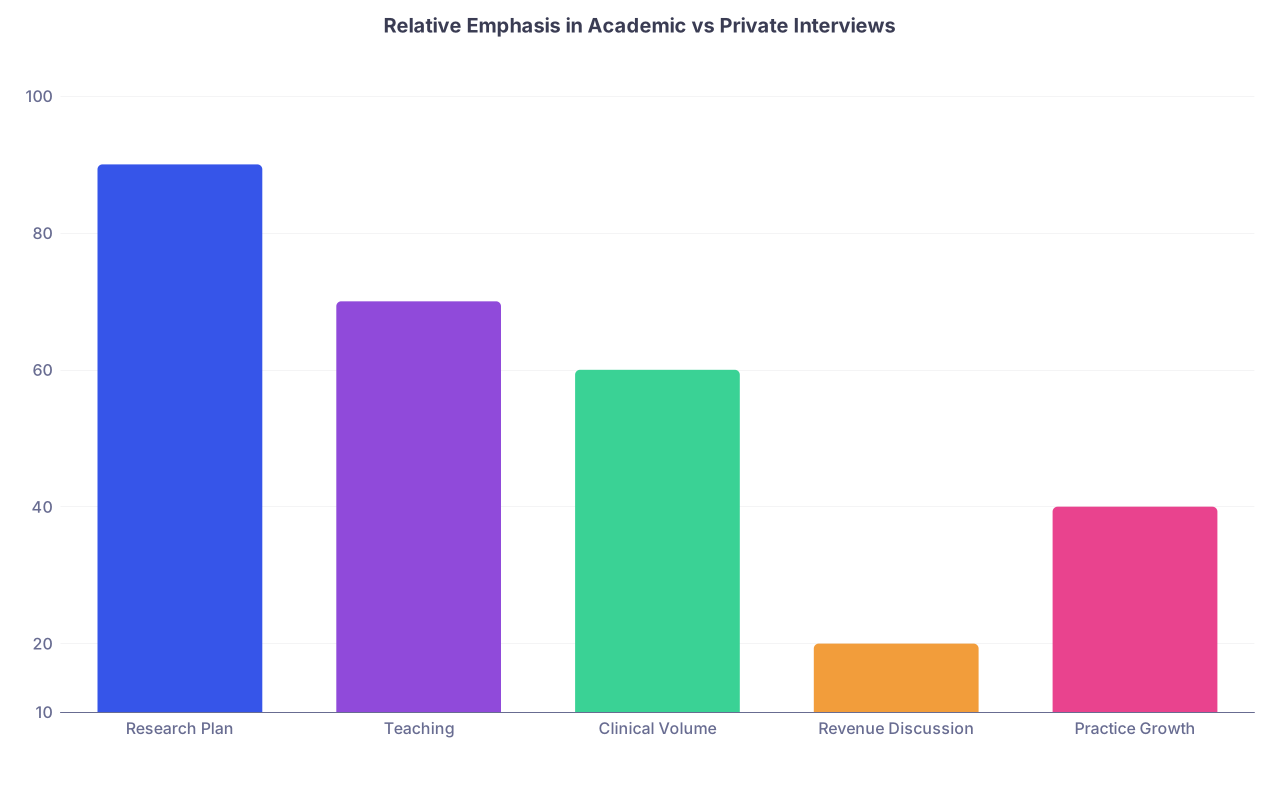
| Category | Value |
|---|---|
| Research Plan | 90 |
| Teaching | 70 |
| Clinical Volume | 60 |
| Revenue Discussion | 20 |
| Practice Growth | 40 |
(Think of that bar chart as the academic side. Flip it for private: research drops, revenue and growth spike.)
7. Contract, Compensation, and Career Trajectory
Here is where hiring differences become brutally concrete.
7.1 Academic Offers
Common characteristics:
- Lower starting salary compared with private for the same field and city.
- A mix of base salary plus incentive based on RVUs, quality metrics, or academic output.
- Protected time for research or education that is often more fragile than advertised.
Promotion tracks matter:
- Tenure / tenure-track: mythically stable, actually high-pressure for funding and publication.
- Clinical track / educator track: more secure clinically, but promotion criteria still exist and can be opaque.
What they really want to see from you:
- A clear sense that you will not demand more protection and fewer duties than you bring in revenue or prestige.
- That you understand someone is paying for your protected time and you must justify it.
7.2 Private-Track Offers
Private practice offers in competitive specialties are highly variable, but you will often see:
- Higher base salary or guarantee, usually time-limited (1–3 years)
- Clear productivity-based compensation (RVU, collections, profit share)
- Partnership track language, sometimes vague, sometimes very concrete
What they are screening during negotiations:
Whether you understand risk and reward.
- You accept lower guarantee in exchange for higher upside? That signals confidence and realism.
- You demand high fixed salary and quick partnership with no buy-in? That raises alarms.
Whether you are comfortable with market realities:
- Payer mix (Medicaid heavy vs commercial)
- On-call burden
- Competition from hospital-employed physicians
8. How You Should Prepare During Residency and Fellowship
You cannot wait until PGY-5 or year 2 of fellowship to think about this. Competitive fields are small, and your reputation is already forming.
8.1 If You Are Targeting Academic Positions
You should:
- Attach yourself early to productive mentors who actually publish and get grants, not just talk about it.
- Build a coherent scholarly niche, not 15 random case reports. Think “clinical outcomes in revision arthroplasty” or “image-guided tumor ablation.”
- Present nationally (AAOS, AANS, ASCO, SIR, ACR, AAD, depending on your field). The hallway conversations matter.
- Make sure at least 2–3 letter writers are people who will take phone calls on your behalf and can say, “Yes, this person is the real deal.”
Be explicit with mentors early: “I want an academic job in [X]. What do I need to accomplish in the next 2–3 years to be seriously considered?”
8.2 If You Are Targeting Private-Track Positions
You should:
- Prioritize procedural competence and speed without compromising safety. Chiefs talk.
- Learn the business basics: RVUs, block time, payer mix, referral patterns.
- Work well with staff. OR and clinic staff feedback leaks back to hiring groups more than you think.
- During away rotations or electives, behave like you are already interviewing: ask how partners are compensated, what call is like, what mistakes prior hires made.
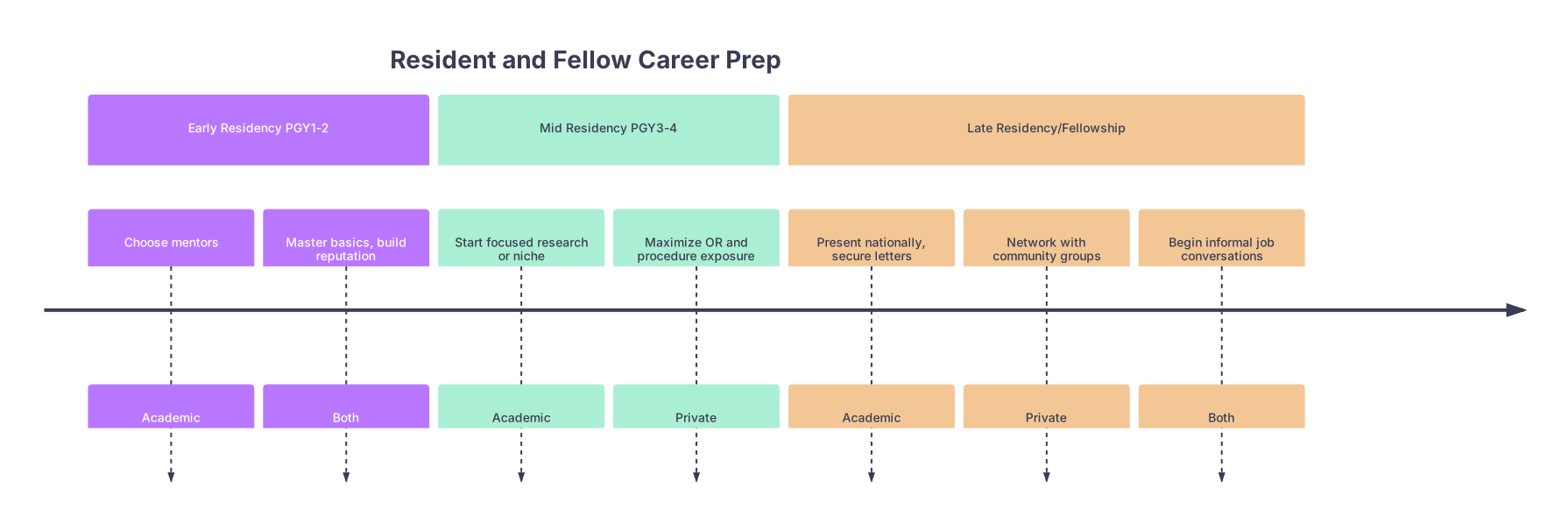
| Period | Event |
|---|---|
| Early Residency PGY1-2 - Choose mentors | Academic |
| Early Residency PGY1-2 - Master basics, build reputation | Both |
| Mid Residency PGY3-4 - Start focused research or niche | Academic |
| Mid Residency PGY3-4 - Maximize OR and procedure exposure | Private |
| Late Residency/Fellowship - Present nationally, secure letters | Academic |
| Late Residency/Fellowship - Network with community groups | Private |
| Late Residency/Fellowship - Begin informal job conversations | Both |
9. Strategic Mistakes I See Over and Over
Let me be blunt about common errors.
Trying to play both tracks simultaneously without a coherent story.
Example: You tell academic programs you want 70% research, yet your CV has minimal scholarly work. Then you tell private groups you are “not that into research,” but your mentors only know you as the research resident who disappeared from clinic. Both sides smell inconsistency.Overestimating how much your fellowship name alone matters.
In private practice, fellowship pedigree helps least in oversupplied markets. They care more about your ability to fill their OR schedule and not scare referring docs.Ignoring red flags during interviews because the city is attractive.
If an academic chair dodges any question about protected time, assume you’ll be full clinical by year three.
If private partners cannot clearly explain partnership track or past partner departures, assume there is a reason.Burning bridges at your training institution.
Residents who are “good clinically but toxic to work with” do not vanish into a vacuum. Their names are mentioned, often unprompted, when job candidates are reviewed.
10. Putting It Together: How Hiring Really Differs
To crystallize the contrast:
Academic hiring in competitive specialties is a reputational economy. Your research, mentors, and political alignment with departmental goals dominate. Revenue matters, but prestige and future upside are the currency.
Private-track hiring is a cash-flow and risk economy. Your ability to generate profitable, safe, efficient clinical work, fit into a group, and not blow up contracts is the currency.
Your strategy should be built around what that specific employer is actually buying—not what you wish they cared about.
You are not just “finding a job.” You are aligning yourself with a business model: grant-funded plus RVU-subsidized academic enterprise, or volume-driven private / hybrid practice.
Once you see that clearly, the moves you need to make during residency and fellowship become much more obvious.
With that clarity, you are ready for the next step: learning how to run your practice—billing, coding, negotiation, and leadership. But that is a separate playbook.