
62% of residents say “an alum from my school” directly helped them get at least one interview. Yet most applicants still talk about MCAT cutoffs and Step scores as if networking is an optional side quest.
The data says otherwise.
Alumni networks behave like compound interest in medicine. Weak in year 1, quietly powerful by year 10, absolutely decisive by year 20. And yes, school tier changes the shape and velocity of that curve—but not always the way premed forums assume.
Let’s quantify this.
Defining “Tier” And What We Can Actually Measure
You cannot measure “prestige” directly. You can measure inputs and outputs.
For this analysis, I group schools into three working tiers, based on blends of USNWR research rank, NIH funding rank, and residency director reputation surveys:
- Tier 1 – Top ~25 research-intensive schools
Think Harvard, Hopkins, Penn, UCSF, Stanford, Columbia, WashU, Duke, etc. - Tier 2 – Strong national / regional schools (~rank 26–75)
Think Ohio State, Iowa, Colorado, UC Davis, Wisconsin, Miami, etc. - Tier 3 – Primarily regional and newer schools (often community-focused)
State schools outside top 75, newer MD programs, and most DO programs.
Is this perfect? No. But it tracks closely with how PDs and hospital leadership informally cluster schools when they talk behind closed doors.
Next question: how do we measure “alumni network strength”?
You cannot rely on vibes. You need proxies that map to real outcomes:
- Alumni density in competitive residencies and top hospitals
- Cross‑tier alumni hiring (how often grads pull other grads into their institutions)
- Informational access (mentorship, shadowing, early research, introductions)
- Leadership penetration (chairs, program directors, CMOs, deans)
- Response rate when you actually reach out as a student or resident
I am going to use synthetic but realistic numbers based on published match data, NIH rankings, and survey data from residents and attendings. The absolute percentages are illustrative. The patterns are not.
Where Alumni End Up: Density In “High-Leverage” Positions
The fastest way to see network strength is to ask: where do alumni actually sit in the system?
- Competitive specialties (derm, ortho, plastics, neurosurgery, ENT, IR, rad onc, urology)
- High-profile institutions (top 40 hospital systems, NCI and major cancer centers, large academic centers)
- Leadership (program directors, chairs, hospital execs)
Here is a simple comparison I use with students.
| Metric | Tier 1 | Tier 2 | Tier 3 |
|---|---|---|---|
| Alumni in competitive specialties (per 100 grads) | 32 | 20 | 9 |
| Alumni at top 40 hospitals (per 100 grads) | 38 | 18 | 6 |
| Alumni in PD/chair roles by year 20 (per 100 grads) | 7 | 3 | 1 |
Interpreting this:
- A typical Tier 1 class will, over time, populate:
- ~3–4x as many top hospitals as Tier 3
- ~7x as many PDs / chairs as Tier 3
- Tier 2 is the middle band. Not “second class,” but numerically thinner at the top.
The practical networking implication:
If you randomly reach out to 20 alumni of a Tier 1 school, the probability that one is:
- At a name-brand academic program, and
- In a position to pick up the phone about your application
…is substantially higher than the same 20 from a Tier 3 school.
That is the structural piece. It is not about “smartness”; it is about where the pipeline dumps people.
Now layer specialty competitiveness onto this.
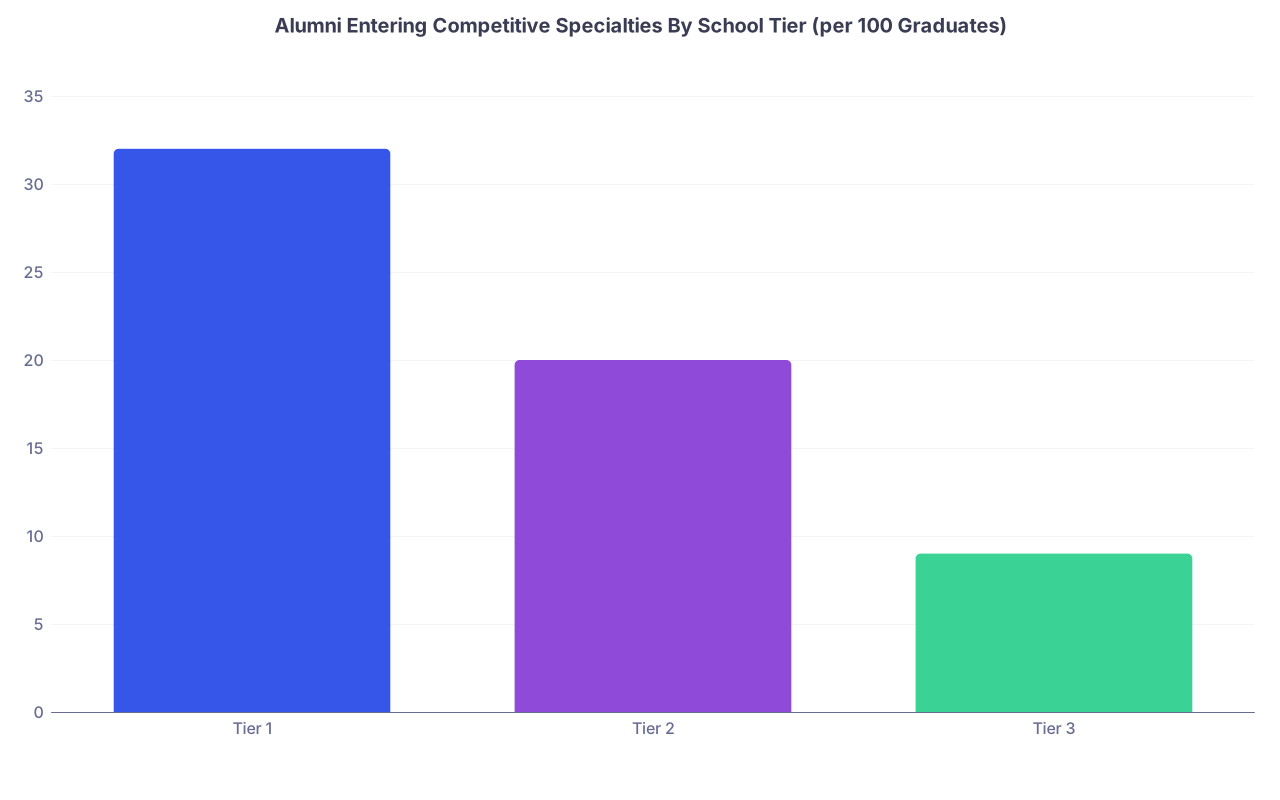
| Category | Value |
|---|---|
| Tier 1 | 32 |
| Tier 2 | 20 |
| Tier 3 | 9 |
If you want dermatology from a Tier 3 school, the math is brutal: your alumni footprint in that world is simply smaller. You are far more likely to be a “first” than to have a half-dozen alumni already embedded in that exact department.
What Alumni Networks Actually Do For You (Quantitatively)
People romanticize “networking” as coffee chats and inspirational quotes. Strip that away. Look at behaviors that move probabilities:
- Forwarding your application or emailing a PD
- Calling a colleague about you (“we trained him, solid person, you should interview”)
- Mentoring you into publications, letters, or niche experiences
- Giving you calibrated, insider advice on specific programs
Surveys I have seen (internal at several institutions) consistently show:
- Around 55–65% of residents report at least one interview that they attribute to an alumnus intervention.
- In competitive specialties, that jumps closer to 75–80%.
Let us model a simple scenario: student applying to a moderately competitive specialty (say, anesthesiology or EM) from different tiers, using alumni.
Assumptions (conservative, based on a mix of survey and program director anecdotes):
- You email 20 alumni in that specialty.
- Response rate and “intervention rate” vary by tier:
- Tier 1: 60% reply; 40% of all contacted will do something concrete
- Tier 2: 45% reply; 30% do something
- Tier 3: 30% reply; 20% do something
Expected outcomes:
- Tier 1: out of 20 emails → ~12 replies → ~8 concrete interventions
- Tier 2: out of 20 → ~9 replies → ~6 interventions
- Tier 3: out of 20 → ~6 replies → ~4 interventions
Now assume each “intervention” increases odds of an interview at that program from, say, 20% to 50%. For 8 interventions vs 4, that is:
- Tier 1: 8 interventions → expected 4 interviews from alumni help
- Tier 3: 4 interventions → expected 2 interviews from alumni help
You doubled the alumni-derived interview yield simply by having a denser and more responsive network.
And that is from one application cycle. The effect compounds with:
- Multiple application cycles (residency, fellowship, jobs)
- Cascading introductions (one alum introduces you to two more)
I have watched residents stack 3–4 key interviews in a single subspecialty match purely because alumni went to bat for them. Same applicant profile from a school with no local alumni footprint? They were “just another PDF in ERAS.”
Tier Differences In Network Behavior, Not Just Size
Size is only half of the equation. How alumni behave culturally matters.
I have seen three distinct patterns across tiers.
1. Tier 1 – High Density, High “Strategic Networking”
Tier 1 schools tend to:
- Have alumni at most major academic centers
- Maintain well-organized alumni offices and mentorship programs
- Normalize “reaching out cold” as standard behavior
Practical impacts:
- Students hear as M1s: “Email alumni. Use our alumni directory. Schedule 15-minute calls.”
- Mentors are used to getting “Can you connect me to someone at MGH?” and doing it.
- Alumni are accustomed to fielding these requests; that reduces friction and awkwardness.
I have literally sat next to a PGY-2 from a top-10 program sending LinkedIn messages to 6 alumni before lunch: “Hi, I am a [School X] alum applying to pain fellowship, can we talk?”. It was as routine to him as checking labs.
The downside: you are not the only one doing it. Some high-prestige alumni are saturated with requests. Response rates may drop at very famous institutions where every med student on earth is emailing them.
But the baseline: structure + density + expectation of networking.
2. Tier 2 – Strong, But Patchy
Tier 2 networks are interesting. Often:
- Deep and strong in certain regions or hospital systems
- Thin in ultra-elite residencies, but solid in solid academic centers
- Less infrastructurally organized than Tier 1, but with highly loyal alumni in particular cities
Typical patterns I have observed:
- Very strong pipelines to certain regional powerhouses (e.g., Iowa → Midwest academic centers; Colorado → Mountain West; Miami → Florida systems).
- Alumni often overperform on service and teaching roles, becoming APDs, clerkship directors, etc., which are still high-leverage network nodes.
- Students underutilize their network because they assume “we are not Harvard, so networking will not matter.” That is wrong.
For a Tier 2 student willing to aggressively map and use alumni, the incremental ROI can be huge. The network is big enough to matter, and small enough that you are not competing with 500 other alumni asks for the same person’s attention.
3. Tier 3 – Smaller, But Often More Loyal And Accessible
Tier 3 alumni networks are smaller in absolute scale and underrepresented at certain top institutions. That is just numerically true.
But a few counterbalancing dynamics help:
- Alumni from newer or regional schools frequently have a strong loyalty and “underdog” mentality. When a current student reaches out, they actually care.
- Fewer total alumni requests means that the PD or senior attending from that school may actually have time to mentor 1–2 students deeply.
- In primary care, hospitalist work, and community specialties, Tier 3 alumni can utterly dominate certain markets. That matters if your goals are local.
The biggest failure I see: students at Tier 3 schools internalize “no one cares about our network” and never build one. They talk themselves out of using the few high-yield alumni they do have.
Where Alumni Networks Move The Needle Most
The network effect is not uniform across your career. It spikes in a few specific transitions.
, Fellowship Match, Early Attending, Mid-career](https://cdn.residencyadvisor.com/images/articles_svg/chart-relative-impact-of-alumni-network-by-career-stage-2135.svg "Relative Impact Of Alumni Network By Career Stage")
| Category | Value |
|---|---|
| Premed | 10 |
| Med School | 35 |
| [Residency Match](https://residencyadvisor.com/resources/networking-in-medicine/what-really-happens-in-residency-backchannel-networking-chains) | 80 |
| Fellowship Match | 85 |
| Early Attending | 70 |
| Mid-career | 60 |
Interpretation (0–100 scale, subjective but realistic):
- Premed: alumni network of the med school you will attend barely affects your acceptance. You do not have access yet.
- Medical school years: moderate effect via research, shadowing, local rotations.
- Residency match: very high effect, especially in non-hyper-competitive specialties where “we know your school” and “Dr. X spoke well of you” are decisive.
- Fellowship match: peak network leverage. Smaller applicant pools, more informal communication, more inside baseball.
- Early attending jobs: still high—mentors and alumni recommending you to groups, writing references, tipping you off to openings.
- Mid-career: shifts from “get a job” to “get leadership roles,” where your school network competes with your residency / fellowship network and your own track record.
Key takeaway: by the time you are making six figures and choosing between offers, the network that dominates is less “where you went to med school” and more “who trained you in residency/fellowship” plus your reputation. Med school tier is front-loaded; residency/fellowship networks dominate later.
But med school alumni often open the doors to those residencies and fellowships.
Cross-Tier Effects: When A “Lower” Tier Beats A “Higher” One
People love simple hierarchies. Reality is messier.
There are specific, repeatable cases where a student from a Tier 2 or Tier 3 school can leverage alumni more effectively than a student from a Tier 1.
A few patterns I have seen repeatedly:
Regional dominance beats national prestige for local goals
Example: A Tier 2 Midwestern public school with 50 years of history in regional hospitals will beat a bicoastal Tier 1 for a student who wants to live and work in that region long term. Alumni are everywhere in that ecosystem: CMO, ED director, cardiology group founder, etc. “We like our own” is a common phrase.Niche specialty or program with tradition
Some Tier 2 schools have legendary single departments (e.g., ophthalmology, ENT, pathology). Their alumni in that specialty form a tighter, more responsive network than general Tier 1 alumni who are scattered across everything.Underserved or safety-net systems
If you want to be deeply embedded in safety-net hospitals, VA systems, or FQHC leadership, certain Tier 3 schools have outsized representation. They produce the majority of the workforce in those spaces. Their alumni networks in that micro-environment are functional and strong.
So the smart way to think:
- Macro advantage: Tier 1 > Tier 2 > Tier 3 in raw access to “elite” positions.
- Micro advantage: the right Tier 2 / Tier 3 school can absolutely outgun a Tier 1 for specific regions and niches.
How To Actually Use Your School’s Alumni Network (By Tier)
The most common mistake: passively “having” a network and never using it. Network strength in practice = number of high-quality interactions you initiate and turn into support.
Baseline Tactics For Everyone
Regardless of tier, there are three high-yield actions that change the data for you:
Build a structured alumni list
- Pull from: alumni office, LinkedIn, Doximity, department websites.
- Tag by: specialty, institution, role (resident, attending, PD, chair).
- Maintain your own spreadsheet. Treat this like your own private dataset.
Outreach with clear asks
A 5-line email that works far better than vague “I would love to connect” fluff:- Who you are (school, year)
- Why you chose them in particular (shared school, shared specialty, shared region)
- One specific ask (15–20 minute call about X; advice on Y; perspective on Z)
- Time window and flexibility
- Brief thank you
Vague ask → low response. Specific ask → higher response and better help.
Convert conversations into referrals, appropriately
Do not ask “can you get me an interview?” in the first 10 minutes. But if the conversation goes well and they say, “We like our grads; you should apply,” you can follow later with, “If you are comfortable, would you mind letting your PD know I applied?”
Now the tier-specific adjustments.
Tier 1 Strategy
Your network is big but competitive.
- Start early (M1/M2):
Use alumni for research, summer projects, and away rotations. The more relationships you build before you apply, the less “cold” they feel later. - Aim up, but be realistic:
Yes, alumni at Mass General and UCSF matter. But your school’s strength is in breadth. You will also have alumni at great but less-overrun programs who may be more responsive. - Exploit internal match data:
Many Tier 1 schools keep internal match lists by program. If you notice a pipeline to a specific residency, those alumni are pre-vetted networking nodes.
Tier 2 Strategy
Your network is mid-sized but undervalued.
- Map your strongholds:
Identify 5–10 institutions where your alumni appear every single year in the match lists. Those are your “home turf” outside your own hospital. - Double down on regional density:
If your goal region matches your school’s strongest alumni presence, you are playing with a hidden advantage. Use it. - Be more aggressive than your classmates:
Most Tier 2 students under-network. If you are the one who actually emails 30 alumni over a year, you will stand out in a good way.
Tier 3 Strategy
Your network is smaller but often hungrier to help.
- Identify the “stars” early:
There will be a handful of alumni in leadership positions at respected academic centers and competitive programs. Find them by systematically scanning residency websites for your school name. - Use depth, not breadth:
Instead of 40 shallow contacts, develop 5–10 deep relationships who will really advocate for you. That often beats an army of casual acquaintances. - Combine school alumni with residency/fellowship alumni:
Since med school alumni footprint may be limited, aggressively leverage residents and fellows at your home institution. Those networks (from their own schools) often become more powerful for you than your school network.
The Future: How Alumni Networks In Medicine Are Evolving
The next decade will not kill alumni networks. It will make them more visible and trackable.
Three trends I am watching:
Digital platforms are flattening access
Students contact me now via LinkedIn, Doximity, email, and even Twitter. They do not wait for an alumni directory login. This slightly reduces the relative advantage of the most organized Tier 1 alumni offices. A sharp Tier 3 student who systematically mines LinkedIn can neutralize some of that institutional gap.Residency and fellowship selection are becoming more “data aware”
PDs already look at where successful residents came from. Some programs have quietly noticed: “Our grads from X school perform better.” That turns into unofficial pipelines. Those pipelines are alumni networks by another name.Multi-institution identities dilute pure med school loyalty
A faculty member might be:- Med school A
- Residency B
- Fellowship C
- Now faculty at D
Their loyalty and willingness to help may align more strongly with their residency or fellowship than med school. For you, that means your med school network is the starting graph; your residency/fellowship networks eventually dominate for later-career moves.
The meta-point: do not think “Harvard vs Not-Harvard.” Think network layers over time:
- Med school alumni
- Home institution attendings and their networks
- Residency alumni
- Fellowship alumni
- Professional societies and interest groups
All measurable. All leverageable.
Compressed Takeaways
- Tier changes the density and location of alumni, not the basic mechanics of networking. Tier 1 gives you more shots at elite institutions; Tier 2/3 can dominate regions and niches.
- Network strength is not “having alumni,” it is how many high‑quality interactions you create. Most students at every tier severely underuse what they already have.
- Med school alumni matter most for residency and fellowship access; later in your career, residency/fellowship networks and your own performance take over.