

What if you suddenly realize you need mentors, advocates, and connections… right when you’re already an MS4 or a brand‑new intern?
Here’s the answer you actually need:
No, it’s absolutely not too late. But you no longer have the luxury of being casual about it. You have to be intentional and a bit strategic.
Let’s lay it out.
The Truth: You’re Not Late, You’re Just Past the Hand‑Holding Stage
People love to say “start early” with networking. Sure. That’s ideal. But I’ve watched plenty of people coast through MS1–3, wake up in MS4 or PGY1, and still build powerful networks that changed their careers.
Who’s ahead of you?
- The person who’s been grabbing coffee with attendings since MS1
- The classmate who has 3 research mentors, 2 letters, and a conference schedule color‑coded
Who is not ahead of you?
- The large chunk of people who still think “networking” is sleazy and avoid it entirely
- Residents who never email anyone unless they need a form signed
- Students who hide on rotations and then wonder why no one knows them
You’re not disqualified because you’re late. You’re just starting from a different place. And that means:
- You must be clear on what you want from networking.
- You must use the positions you already have (MS4, intern, resident) as leverage.
- You can’t rely on “I’m just exploring” as your pitch anymore.
Step 1: Decide What You Actually Want From Networking
If you’re going to start in MS4/PGY1, you do not have time for fuzzy goals.
You need answers to questions like:
- Do you want better letters for fellowship or a job?
- Do you want research, QI, or leadership roles for your CV?
- Do you want to explore a specialty pivot (e.g., IM → Cards vs. IM → Derm)?
- Do you want career guidance and mentorship because you feel lost?
Pick your top 1–2 goals. Not 5. If you chase everything, you’ll dilute your impact and annoy people.
Here’s a quick way to frame it:
| Goal Type | Concrete Example |
|---|---|
| Fellowship positioning | Strong cards letters, multicenter research |
| Job opportunities | Community ED shift opportunity after residency |
| Career exploration | Shadowing peds heme/onc clinic |
| Academic CV building | QI project with department QI lead |
| Mentorship/support | Regular check-ins with program director or mentor |
You can’t approach a busy attending with “I’d love to connect” and nothing else. You’re late in the game now. Show them you know what you’re asking for.
Step 2: Use Your Current Role as Your Biggest Networking Asset
You actually have more access now than you did as an MS1.
As an MS4 or resident, you have built‑in proximity:
- You’re on clinical teams with attendings daily.
- You’re in conferences, M&M, journal clubs, sign‑out.
- You have institutional email, EMR access, and real patient responsibilities.
That makes it much easier to turn casual contact into a real connection.
Here’s exactly how:
On Rotations (MS4 & Early Residency)
Do 3 simple things:
- Be obviously engaged. Ask 1–2 thoughtful questions per day. Volunteer for reasonable tasks. Don’t be “too cool to care.”
- Signal interest. Say out loud: “I’m considering [their field/fellowship] and would love to learn how you got there.”
- Follow up quickly. Same day or next day: “Could I email you to ask 2–3 more questions about your career path?”
Most attendings will say yes to 15–20 minutes if you’ve shown you’re not a disaster on the rotation.

Step 3: Scripts You Can Actually Use (So You Don’t Overthink It)
You do not need poetic emails. You need short, clear, and specific.
Cold-ish Email After Working With Someone Briefly
Subject: MS4 on your [service] – quick career question
“Dr. Smith,
I’m [Name], the MS4 who worked with you on the hospitalist service last week.
I’m strongly considering a career in hospital medicine with an interest in quality improvement. I really appreciated how you walked us through your discharge process and the readmission project you mentioned.
Would you be open to a brief 15–20 minute meeting in the next few weeks so I can ask a few specific questions about your career path and how you got involved in QI?
I know you’re busy, so completely understand if your schedule is packed.
Best,
[Name]
MS4, [School]”
Short. Concrete. Easy to say yes to.
As a New Resident to an Attending in Your Program
Subject: PGY1 in your clinic – interest in [field/area]
“Dr. Patel,
I’m [Name], a new PGY1 in internal medicine. I’ll be rotating in your clinic next month.
Long term, I’m interested in [cards/onc/primary care with teaching focus/etc.], and several residents mentioned you’ve been a great mentor in that space.
Would you be open to a quick 20‑minute conversation sometime this month (Zoom or in person) about how you approached early fellowship/career decisions?
Thank you for considering this,
[Name], PGY1 IM”
This is not weird. This is how adults in academic medicine operate when they’re serious.
Step 4: You Missed the “Slow Burn” – So Build Fast Trust Instead
Starting late means you don’t have 3 years of casual hallway chats to build trust. So you compensate by being:
- Reliable
- Prepared
- Low‑maintenance
If you get a meeting, here’s how you make it count.
Before the Meeting
- Look them up on PubMed and the hospital website.
- Skim 2–3 of their paper titles or projects. You don’t need to read everything.
- Have 3–5 questions written down.
Examples of good questions:
- “If you were me as an MS4/PGY1, what would you do this year to be competitive for [fellowship/job type]?”
- “How did you find your first mentor? What made that relationship work?”
- “If you had to pick one or two projects that helped your career most, which were they?”
- “What do people waste time on early that doesn’t actually move the needle?”
Then close with the killer question:
“Is there anyone else you think I should talk to about this?”
That’s how one conversation becomes a network.
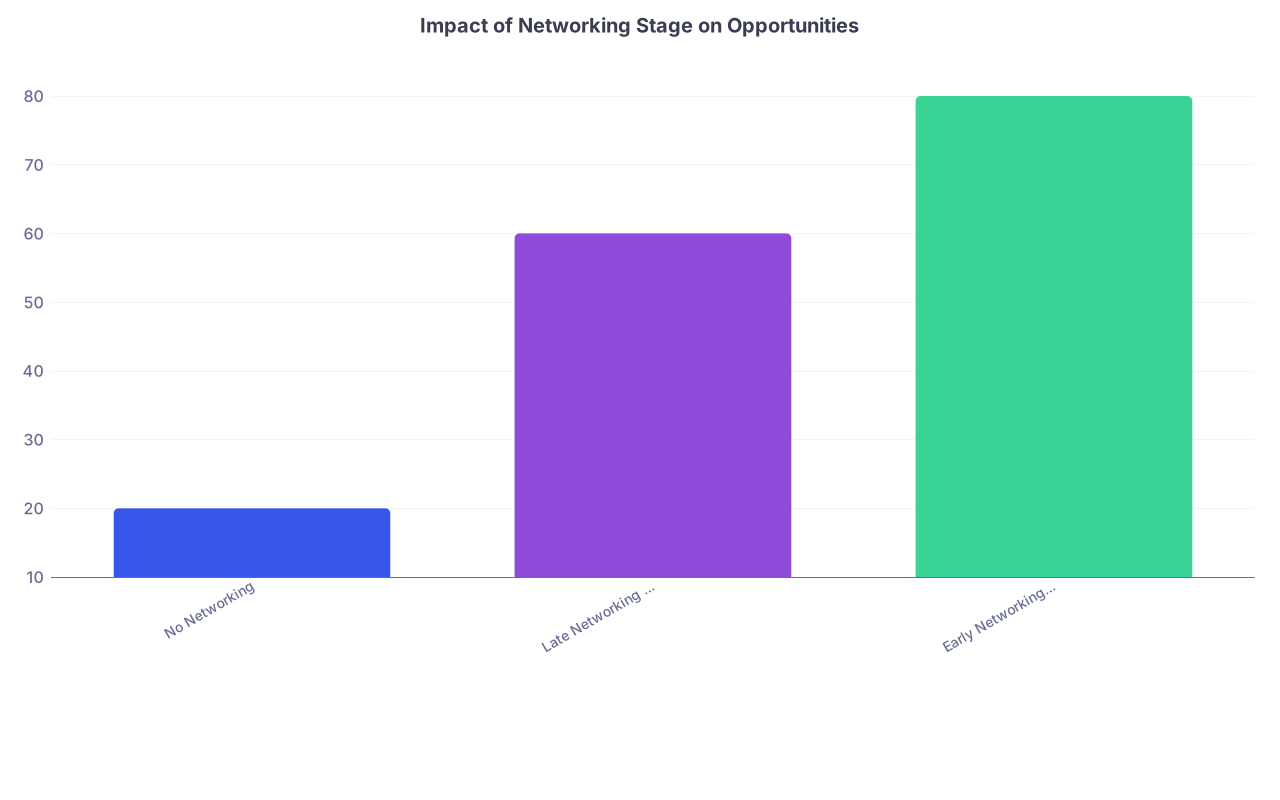
| Category | Value |
|---|---|
| No Networking | 20 |
| Late Networking (MS4/PGY1) | 60 |
| Early Networking (MS1-3) | 80 |
(Think of those numbers as “relative opportunity units.” Early is easier, late is still massively better than none.)
Step 5: Turning “Nice Chat” Into Ongoing Mentorship or Collaboration
Here’s where most people fail. They have one good meeting, then disappear.
You convert a conversation into a relationship by doing two things:
Summarize and thank.
Same day email: “Thank you for taking the time… I’m going to do X, Y as we discussed.” One short paragraph.Implement something they suggested and report back.
“You suggested I talk to Dr. Lee about her QI work. I met with her last week, and we’re brainstorming a small project. Really appreciate the connection.”
Once you’ve done this 1–2 times, you can ask for more:
- “Would you be open to meeting every few months as a mentor as I navigate [fellowship search/early residency]?”
- “If I draft a rough idea for a [project type] could I run it by you for feedback?”
People invest in residents and students who show effort and follow-through. Not in people who collect 30‑minute chats like Pokémon.

Step 6: Fixing the Common Late‑Starter Mistakes
Let me be blunt. These are the ways late networking goes wrong:
You wait until you need a letter.
Emailing someone you barely know to “catch up” 3 weeks before ERAS is transparent and weak. At least build 2–3 genuine interactions first.You only contact people when you want something.
A good benchmark: for every “ask” email, have 2–3 “update/thank you” emails.You hide what you want.
Saying “I’m open to anything” forces your mentor to do extra work guessing. Say, “I’m leaning toward pulm/crit but still open to gen ICU or even cards; here’s why.”You think one institution = your whole world.
Wrong. Late networking should include:- Alumni from your school or program
- People you meet at conferences
- Residents from other hospitals via shared projects, virtual groups, social media (if you use it like an adult, not an influencer)
Step 7: Networking Across Institutions (Even Late)
You’re not locked into your home program’s bubble. Here’s how you expand outward as an MS4 or resident:
Conferences
Yes, even if you’re not presenting.
- Go to 1–2 sessions directly tied to your interest (e.g., SCCM, ASCO, AHA section meetings).
- Ask one question at the mic if you can do it without rambling.
- After the session, say to the speaker:
“I’m a PGY1 interested in [topic]. Really appreciated your point about [X]. Would it be okay if I emailed you about possible ways to get involved in this area at an early stage?”
Then follow the email playbook above.
Alumni and Near‑Peers
Your best “late” networking asset: people 2–5 years ahead of you.
Email template:
“Hi [Name],
I’m [Your Name], MS4/PGY1 at [Institution]. I saw you matched into [field]/are working at [place] after training here.
I’m strongly considering a similar path and would love to ask a few specific questions about how you approached it from [this institution].
Would you be open to a brief 15–20 minute Zoom or phone call in the next few weeks?
Best,
[Name]”
These people remember exactly where you are. They’re often more generous with time than big‑name attendings.

| Step | Description |
|---|---|
| Step 1 | Identify top 1-2 goals |
| Step 2 | Target 3-5 people locally |
| Step 3 | Email to request short meeting |
| Step 4 | Prepare 3-5 focused questions |
| Step 5 | Meeting - ask, listen, take notes |
| Step 6 | Send thank you and summary |
| Step 7 | Act on 1-2 suggestions |
| Step 8 | Update mentor and ask about others to meet |
| Step 9 | Repeat with new contacts |
Step 8: What “Success” Actually Looks Like If You Start Late
You’re not trying to build a LinkedIn‑style “network” of hundreds. That’s useless anyway.
If you’re an MS4 or new resident and you pull this off, success looks like:
- 2–3 real mentors who know your name, your goals, and would reply to an email quickly
- 1–2 letter writers who’ve seen you clinically or on a project and are willing to go to bat for you
- 1–3 concrete things on your CV or in your story that trace directly back to networking:
- A research or QI project
- A leadership or teaching role
- A fellowship/job lead or shadowing experience
That’s more than enough to change the trajectory of your career.
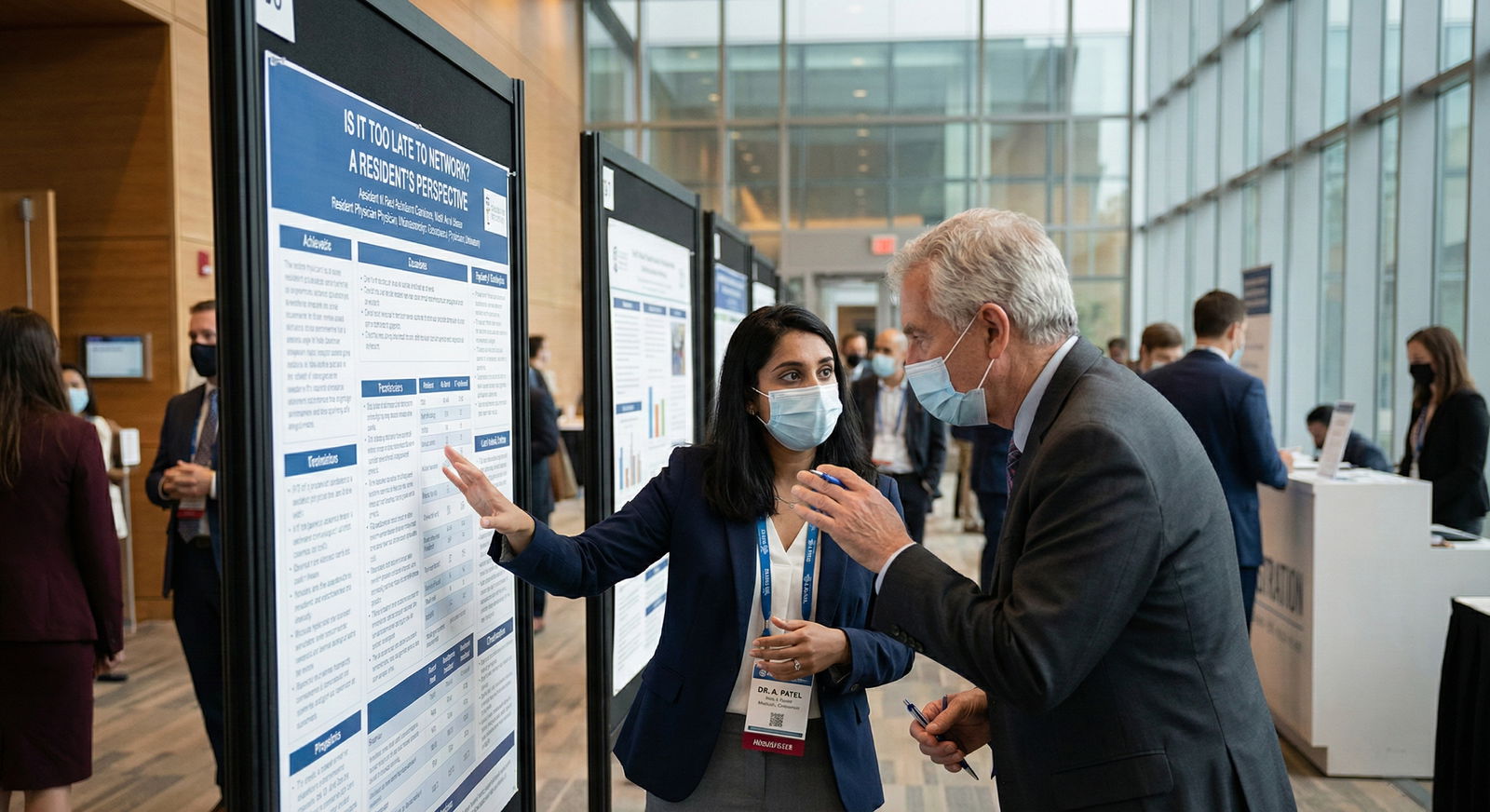
If You’re a PGY2+ and Still Feel Behind
Same answer: not too late. But by now you should be blunt with potential mentors:
- “I’m PGY2 in EM and I’ve realized I want to be competitive for ultrasound fellowship. Here’s what I’ve done so far; here’s what I think I’m missing.”
- “I’m PGY3 in IM considering hospitalist vs. heme/onc; I need help deciding in the next 3–6 months.”
At this stage, your ask is often:
- Honest advice about feasibility
- Targeted help filling specific gaps
- Direct introductions to people in your area of interest
People respect clarity. Especially when you’re not 19 anymore.
FAQ: Late Networking in Medicine (MS4 & New Residents)
1. Is it too late to network if I’m already an MS4?
No. You’re later than ideal, but far from done. Focus on:
- Attendings and fellows on your key rotations
- Alumni who matched into your target specialty
- Program leadership who can speak to your growth
Start with 3–5 intentional conversations this month. Not “someday.”
2. What if I’m naturally introverted or hate “networking”?
Then stop thinking of it as networking. Think of it as:
- Asking smart people how they built the careers you want
- Finding 2–3 long‑term allies in the system
- Doing a couple of projects with people you respect
You do not need to “work a room.” You need to send a few well‑written emails and have focused 20‑minute conversations.
3. How many people should I try to connect with in MS4/PGY1?
You do not need dozens. Aim for:
- 3–5 people you talk to once or twice
- From those, 1–3 who become real mentors or collaborators
Quality beats volume. One strong mentor plus one active project can carry you further than 15 weak “contacts.”
4. Can I ask for a letter of recommendation from someone I just met this year?
Yes, if:
- They’ve seen you clinically or on a project for at least a few weeks
- You’ve had at least one dedicated meeting about your goals
- You’ve given them your CV, personal statement draft, and bullet list of things you hope they can highlight
If not, then you need to deepen the relationship before asking. Or pick someone else.
5. What if no one responds to my emails?
Happens. People are busy; it’s not always about you.
Do this:
- Send one polite follow‑up 7–10 days later
- If still no response, move on and email someone else
- Assume a ~50–60% success rate is normal
Do not take it personally. You only need a few yeses.
6. I’m already burned out. How do I do this without adding a huge burden?
Keep it small and systematized:
- One networking email per week
- One 20–30 minute meeting every 2–3 weeks
- Short thank‑you plus a 2‑line update every month or two
That’s it. Think of it as 1–2 hours per month to possibly change your next 30 years.
Today’s next step is simple:
Open your email, pick one attending, fellow, or alum you respect, and send a 5‑sentence message asking for a 15–20 minute conversation about their career path. Just one.


