

How Many Mentors Do I Really Need at Each Stage of Medical Training?
How many mentors are “enough” when you’re a premed? A third‑year drowning in clerkships? A resident thinking about fellowship? One? Three? Ten?
Here’s the blunt answer: if you’re asking this, you’re already ahead of most people. But you’re probably also overthinking the number and underthinking the roles.
Let me walk you through what actually works.
The Core Idea: You Don’t Need More Mentors. You Need the Right Ones.
Stop chasing a number. You don’t get an award for “Most Mentors Listed on CV.”
You need:
- A small core of stable, long‑term mentors
- A flexible ring of “situational” mentors you tap for specific problems
- Different mixes at different stages (premed vs med school vs residency vs early attending)
Think “mentor portfolio,” not “soulmate mentor.”
At any stage, you want coverage over four functions:
- Career strategy (big picture: specialty, jobs, geography)
- Skill development (clinical, research, leadership, teaching)
- Sponsorship (people who actually open doors and attach their name to you)
- Sanity check (someone who will tell you, “No, that’s a bad idea”)
That can be 2 people or 7. But if you have 5 mentors and none of them would pick up your call when you’re panicking at 11 pm, you don’t really have mentors. You have contacts.
Let’s break it down by stage.
Premed: Fewer Mentors, Broader Perspective
If you’re premed, your problem isn’t lack of “mentorship.” It’s noise. Everyone’s got an opinion: Reddit, TikTok, your dad’s coworker who’s an anesthesiologist from 1997.
Here’s the real target:
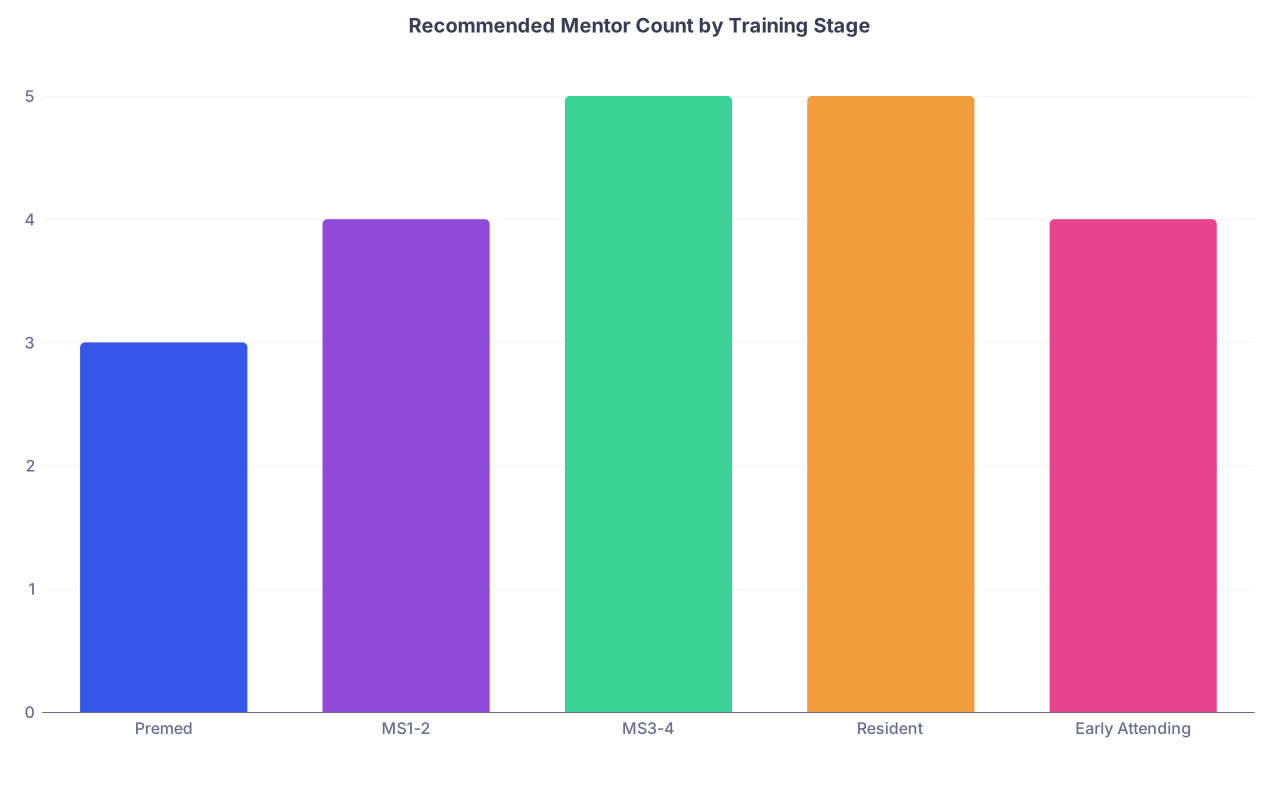
Premed sweet spot: 2–4 mentors
You want:
One “process” mentor (1 person)
Someone who actually understands the modern premed/med school system.
Examples:- Pre‑health advisor who actually knows what they’re doing
- Recent med student or resident (within ~5 years of you) who got in the way you might (nontraditional, low GPA recovery, heavy research, etc.)
One clinical mentor (1 person)
A real physician who:- Lets you shadow
- Actually talks about what their day/week/month looks like
- Is honest, not just selling you the dream
Optional: one research mentor (0–1 person)
Only if you’re actually in a research project that matters. “Matters” doesn’t mean Nature paper. It means:- You have a defined role
- Regular contact
- A chance at a letter down the road
Optional: one “near‑peer” (0–1 person)
A med student 1–3 years ahead who:- Knows the current MCAT/application reality
- Can say, “Don’t waste time on that; do this instead”
| Category | Value |
|---|---|
| Premed | 3 |
| MS1-2 | 4 |
| MS3-4 | 5 |
| Resident | 5 |
| Early Attending | 4 |
Red flags at premed stage:
- More than 1–2 physicians heavily involved in “guiding your path” (you’ll just get conflicting advice)
- No one under age 35 giving you input (systems have changed a lot)
- You’re “collecting” mentors you almost never contact
Medical School Years 1–2: Start Building Your Core Group
Once you’re in med school, the game shifts. You now need people inside your institution who can vouch for you.
MS1–2 sweet spot: 3–5 mentors
You want a mix:
One core faculty mentor (1 person)
- Assigned advisor if they’re actually engaged
- Or a faculty member you click with from a course, interest group, or project
This is your “generalist” mentor: career talk, wellness, overall trajectory.
One research mentor (1 person)
Especially if you’re interested in:- Competitive specialties (derm, ortho, ENT, plastics, IR, etc.)
- Academic careers
They should: - Meet with you at least once a month
- Put you on projects with clear outputs (poster, paper, something tangible)
One clinical or specialty‑curious mentor (1 person)
You don’t need to know your specialty yet, but you should:- Shadow someone in a field you might like
- Have one clinician who can say, “Yes, that specialty matches your personality / no, you’ll hate this”
Near‑peer mentors (1–2 people)
- One M3/M4 at your school
- Maybe one resident you met through interest groups or research
These people help you not sabotage yourself: exam strategy, how to talk to attendings, what actually matters for Step 2.

If you’re M1–2 and:
- You have 0 faculty who know you by name → you have a problem
- You’re on 5 research projects but can’t name 1 person who’d write you a detailed letter → you’re not mentored, you’re used
- Every “mentor” you list is outside your institution → you’re missing local sponsorship
Medical School Years 3–4: You Need a Mentoring “Team”
This is where mentor count matters more. Why? Because now decisions get expensive: specialty choice, away rotations, Step 2 timing, couples match, dual degrees.
MS3–4 sweet spot: 4–6 mentors
You want clear roles:
Primary specialty mentor (1–2 people)
For the specialty you’re seriously considering. They should:- Actively practice in that field
- Know current match realities (not just “back in my day…”)
- Be willing to talk candidly about your competitiveness
Program‑level mentor (1 person)
Often:- Clerkship director
- Program director
- Key faculty in the department at your home institution
This person understands: - How your school is viewed nationally
- Who to call when you apply
- What you need for a strong letter from the department
Research mentor in/near your target field (1 person)
Doesn’t have to be the same as your primary specialty mentor, but often is. This person:- Gets your name on specialty‑relevant work
- Introduces you at conferences
- Can write a heavy‑hitting LOR if needed
Generalist career mentor (1 person)
Not in your specialty. Why? Because you need:- Someone who’s not blinded by their field’s biases
- A sanity check when your specialty choice collides with your life plans (kids, partner, geography)
Near‑peer mentors (1–2 people)
At least:- One resident in your intended specialty
- One M4 who just matched in that field
These folks give you real talk: - How many programs to apply to
- What away rotations actually help
- What Step 2 score makes life easier vs mandatory
| Role | Ideal Count | Key Output |
|---|---|---|
| Specialty mentor | 1–2 | Specialty fit, strategy |
| Program-level mentor | 1 | Institutional support |
| Research mentor | 1 | CV, letters, exposure |
| Generalist career | 1 | Life/career alignment |
| Near-peers | 1–2 | Tactics, recent intel |
Common MS3–4 mistakes:
- One idolized mentor in a specialty, no second opinion → you risk anchoring on bad or outdated advice
- Ten “mentors” all in the same sub‑subspecialty → narrow echo chamber, no perspective
- No one outside your chosen specialty to ask, “If you don’t match, what’s Plan B?”
Residency: Focus Less on Count, More on Power and Diversity
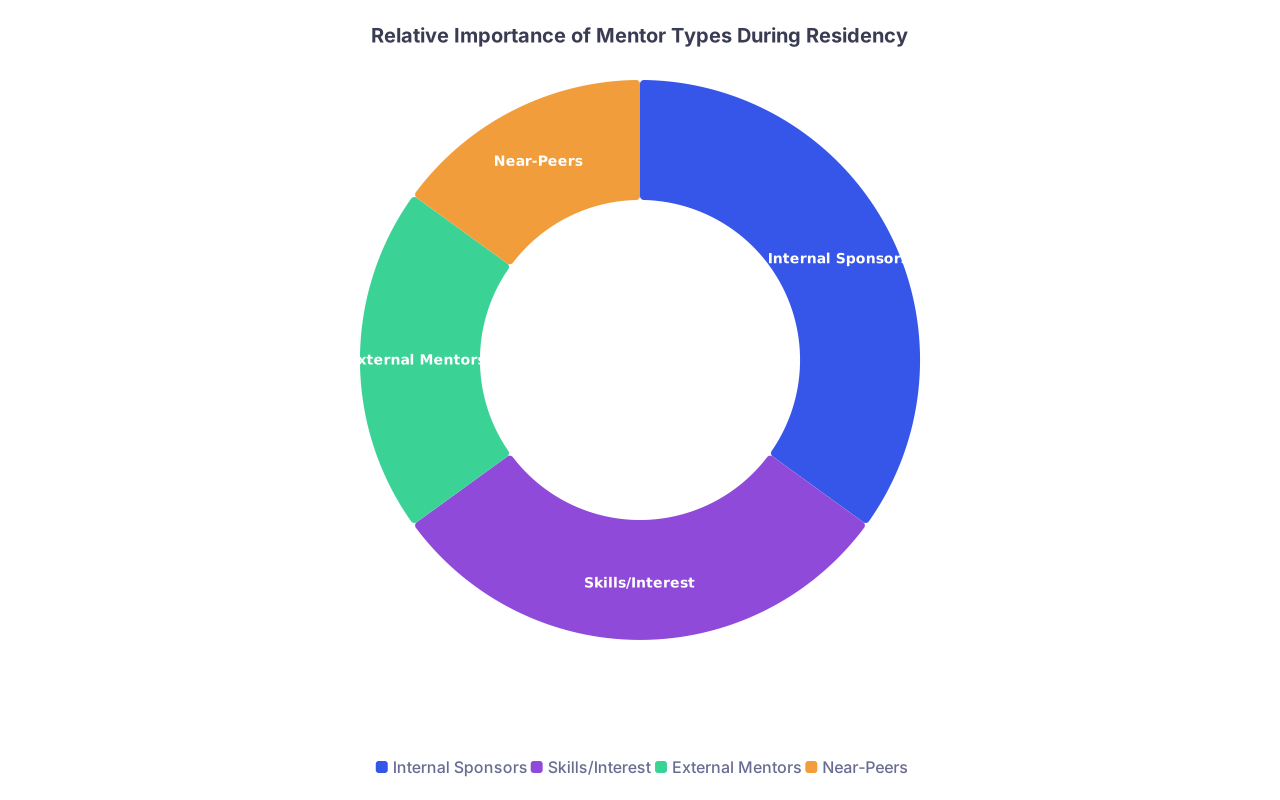
Residency is where mentorship should get more serious, not less. The stakes: fellowships, jobs, visas, academic tracks, geographic roots.
Resident sweet spot: 4–6 mentors
But here, the mix matters more:
Program‑internal sponsor (1–2 people)
These are not just mentors. They’re sponsors. Difference:- Mentors give advice
- Sponsors say your name in rooms you’re not in
You want at least one: - Program director / APD
- Division chief or influential faculty member
Who believes in you enough to: - Recommend you for chief
- Call fellowship directors
- Back you if there’s a hiccup (exam failure, professionalism noise, etc.)
Skills/interest mentor (1–2 people)
Depends on your goals:- Academic clinician → someone with grants, publications, and a track record of building junior faculty
- Community practice → a busy clinician who knows private practice/large group dynamics
- Proceduralist → someone who can advocate for your procedural numbers and training
External perspective mentor (1–2 people)
Someone not in your program, sometimes not even in your city:- Former attending from med school
- Fellowship‑level person in your target niche
- Mentor from a national society
They help with: - CV positioning
- National reputation
- Letters outside your institution’s “brand”
Near‑peer senior resident or recent grad (1–2 people)
These people have:- Just applied to the fellowships or jobs you want
- The freshest memory of what actually mattered vs what the faculty said mattered
| Category | Value |
|---|---|
| Internal Sponsors | 35 |
| Skills/Interest | 30 |
| External Mentors | 20 |
| Near-Peers | 15 |
If you’re a PGY2+ and:
- You can’t name one faculty member who would fight for you for chief → time to cultivate a sponsor
- All your mentors are in one subspecialty you might want → add someone outside that lane
- You’re applying for a competitive fellowship with zero external letters → you’re behind
Early Attending: Shift From Being Mentored to Building a Network
Once you’re an attending, people assume you don’t need mentors. That’s wrong. You do. But the goal changes.
You’re now balancing:
- Promotions
- Leadership roles
- Job changes
- Family and life logistics that actually matter more than abstract “career trajectory”
Early attending sweet spot: 3–5 mentors
You want:
One institutional career mentor (1 person)
This is your:- Division chief who actually cares
- Senior colleague tracking your promotion clock
- Someone who understands your hospital’s politics and can translate them
One external field mentor (1 person)
Especially if you’re academic or subspecialized:- Someone well‑known in your area of interest
- Ideally involved in national societies, guideline committees, or major research
This person broadens your career beyond your hospital walls.
One “life‑integration” mentor (1 person)
Not fluffy. Critical. Someone who:- Has the kind of life balance you actually want (kids/no kids, city/suburbs, dual‑career household, etc.)
- Talks honestly about money, time, burnout, and saying no
Optional: entrepreneurial or non‑clinical mentor (0–2 people)
If you’re interested in:- Starting a side business
- Med‑ed products
- Consulting, start‑ups, or admin work

How To Tell If You Have “Enough” Mentors (At Any Stage)
Forget the number. Ask yourself these five questions:
- Career direction: Is there at least one person I can talk to honestly about my career path who understands my current stage?
- Opportunities: Is there at least one person who actively thinks of me when opportunities arise (projects, talks, leadership roles)?
- Feedback: Is there someone who’s seen my real work (clinically or academically) and gives me specific feedback, not just “You’re doing great”?
- Reality check: Is there someone who will tell me “No, that’s a bad idea” without sugar‑coating?
- Backup plan: If my primary mentor disappeared tomorrow, do I have at least one other person who knows me reasonably well?
If you can honestly say yes to all five, your mentor count is fine, whether that’s 3 or 8.
If you’re saying no to two or more, it’s not that you need “more mentors.” You need to very deliberately upgrade your mentor portfolio.
How To Add Mentors Without Being Awkward or Annoying
You don’t walk up to someone and say, “Will you be my mentor?” That’s weird and heavy.
You do this instead:
Start small.
- Ask a focused question after a lecture.
- Email: “I’m an MS2 interested in X. Could I get 15 minutes for 2–3 specific questions?”
If they’re generous, clear, and thoughtful? That’s a candidate.
Demonstrate follow‑through.
- They suggest a paper → you read it, send a short reaction.
- They connect you to someone → you actually show up on time and prepared.
That’s how you earn sponsorship, not just advice.
Normalize having multiple mentors.
Say explicitly:- “I really value your perspective on research. I also have a clinical mentor in Y.”
Mature mentors like that. They don’t expect to be your everything.
- “I really value your perspective on research. I also have a clinical mentor in Y.”
Prune gently.
If a relationship isn’t helpful:- Stop scheduling regular meetings
- Still be polite, still update them once or twice a year
But redirect your main energy to people who actually move the needle for you.

| Step | Description |
|---|---|
| Step 1 | Brief interaction |
| Step 2 | Short focused meeting |
| Step 3 | Small project or advice follow through |
| Step 4 | Regular check ins |
| Step 5 | Letter writer or sponsor |
FAQ: Mentors in Medical Training (Exactly 7 Questions)
1. Is it bad if I have only one main mentor?
It’s risky, not “bad.” One mentor can be amazing, but you’re exposed if:
- They leave
- They retire
- Their advice is biased or outdated
Aim for at least two people who know you reasonably well and can write strong letters, even if one is your clear “primary.”
2. Can my research PI also be my main career mentor?
Yes, if:
- They actually understand your specialty options
- They’re willing to talk about life beyond publications
But many PIs only see you as a pair of hands. If all your “mentoring” from them is about data and deadlines, you still need a separate career mentor.
3. How often should I meet with my mentors?
Ballpark:
- Core mentors: 2–6 times per year, plus emails as needed
- Research mentors: depends on project cadence; often monthly when active
- Sponsors: a couple of high‑quality check‑ins per year can be enough if they already know you and like your work
Consistency matters more than volume.
4. What if two mentors give me totally opposite advice?
Welcome to medicine.
Your job is to:
- Clarify your own priorities (geography vs prestige, lifestyle vs competitiveness)
- Ask each mentor why they recommend what they do
- Then decide.
If one mentor can’t handle you choosing differently, that’s not a mentor. That’s a narcissist.
5. Do I need mentors who “look like me” or share my background?
It helps, especially if you’re underrepresented in medicine. They’ll understand barriers others don’t see. But don’t limit yourself only to them. You want:
- At least one person who gets your lived experience
- Plus a broader mix of people with power and access in the system you’re trying to succeed in
6. Is it too late to find mentors if I’m already a PGY3 or senior resident?
No. It’s harder, but not too late. You:
- Leverage electives, QI projects, or committee work to work closely with key people
- Ask explicitly for help with fellowship/jobs
I’ve seen residents land fantastic fellowships off a year‑3 connection—because they were strategic and reliable from day one of that relationship.
7. What’s one thing that ruins mentorships fast?
Unreliability.
Things that make mentors quietly give up on you:
- No‑showing or repeatedly rescheduling meetings
- Dropping balls on projects without warning
- Never updating them or closing the loop
You don’t have to be perfect. But you do have to be accountable.
Open your notes app right now and make a simple list: who are your current 3–6 “real” mentors, what role does each actually play, and where’s the gap (sponsor, specialty, sanity check)? That gap is the person you should start looking for this month.


