
It’s 9:30 pm, post-call. You’re staring at your inbox:
• One email about a potential QI project from your attending.
• One from a PhD who wants a collaborator on a clinical trial.
• One LinkedIn message from a medtech startup asking if you’d “ever considered an industry advisory role.”
And you’re thinking:
“Am I supposed to have three different professional lives here? Do I need totally separate networks for clinical, research, and industry… or can this somehow be one thing?”
Here’s the answer you’re looking for:
You do not need three separate, sealed-off networks.
You do need one core network with a few intentional “branches” into each world you care about.
Let’s break that down properly.
The Short Answer: One Core Network, Targeted Branches
You don’t build three careers; you build one career with multiple “interfaces.”
Your core network is built around:
- Who knows your work
- Who trusts your judgment
- Who will pick up your email in under 24 hours
Then, from that core, you build targeted edges into:
- Clinical decision-makers (department, service line, hospital leadership)
- Research people (PIs, statisticians, coordinators, IRB folks)
- Industry contacts (medical affairs, clinical development, consulting, startups)
Those aren’t three separate networks. They’re three clusters inside one map.
What kills people is trying to build three separate identities:
- Separate CVs that tell different stories
- Separate email personalities
- Separate “brands” (clinician here, scientist there, entrepreneur over there)
That’s exhausting and, frankly, unnecessary.
You want one coherent professional story, then you emphasize different chapters depending on who you’re talking to.
How The Three Worlds Actually Overlap (In Real Life)
Here’s how this really plays out if you build things well.
- Your clinical attending introduces you to a PI for a multicenter trial → your first legit research paper.
- That PI sits on a medical advisory board for a device company → you get pulled into a clinical advisory call.
- A biotech medical director you met at a conference knows a fellowship director → you get a quiet nudge in the right direction when your application hits their desk.
Same you. Same core network. Different edges.
To make this practical, think in terms of “anchor people” in each domain.
| Domain | Ideal Anchor Contact | Why They Matter |
|---|---|---|
| Clinical | Division chief or program director | Opens doors locally and for jobs |
| Research | Productive PI or lab director | Grants, papers, letters |
| Industry | Medical director or MSL | Roles, consulting, speaking |
You don’t need 50 people in each category. You need 2–5 strong anchors in each, who trust you and will vouch for you.
When Separate Networks Do Make Sense (And When They Don’t)
You only start thinking about “separate” networks when:
- You’re doing work that can’t be openly discussed across contexts (e.g., confidential industry product strategy).
- You’re in a field where conflict-of-interest landmines are everywhere.
- You’re planning a clean break away from one sector (e.g., leaving clinical entirely).
Most trainees and early attendings are nowhere near that line.
Let me be specific.
You probably do NOT need separate networks if:
You’re a med student or resident exploring:
- “Should I do academic medicine?”
- “Is industry even for me?”
- “Do I actually like research?”
You’re an early-career attending doing:
- Some clinical work
- A couple of research projects
- Maybe one small consulting gig
In all of these, one coherent network is fine. The only thing that needs to change is your framing depending on who you’re talking to, not the actual people you talk to.
You might want partially distinct circles if:
- You hold:
- Major leadership roles in guideline committees
- Paid advisory roles with multiple companies
- Large grants with sensitive IP
Here, you’re not hiding networks, you’re just segmenting information:
- You don’t tweet about early-stage device data you saw under NDA.
- You don’t casually tell your division chief every detail of a company’s upcoming strategy.
- You follow your institution’s conflict-of-interest rules like a hawk.
Still one network. Just smarter boundaries.
How To Build One Network That Works in All Three Worlds
The goal is simple: when your name shows up in conversation—clinical, research, or industry—the reaction is, “Oh yeah, they’re solid. I’d work with them.”
Here’s how to do that without burning out.
1. Pick a through-line for your identity
You need a sentence that works everywhere.
Examples:
- “I’m an internist interested in diabetes care and how tech can actually make it better instead of more annoying.”
- “I’m an EM doc who cares about sepsis, data, and building systems that don’t miss sick patients.”
- “I’m a neurologist into stroke, imaging, and translating evidence into tools that actually get used.”
That through-line lets you:
- Talk to a PI: “I want to study X because it changes Y for these patients.”
- Talk to industry: “I help you understand what will and won’t fly at the bedside.”
- Talk to admins: “I understand both the data and the real workflow.”
If you sound like three different people depending on the room, you’ll confuse everyone—including yourself.
2. Use the same “front door” everywhere
Use:
- One name format (no “Mike” in one setting and “Michael J. Lastname, PhD, MD” in another unless there’s a clear reason)
- One email (institutional for serious work, plus a professional personal email for long-term continuity)
- One LinkedIn that doesn’t look like a half-baked side project
Your CV can have emphasis sections (Clinically-focused vs Industry-ready), but the skeleton should match.
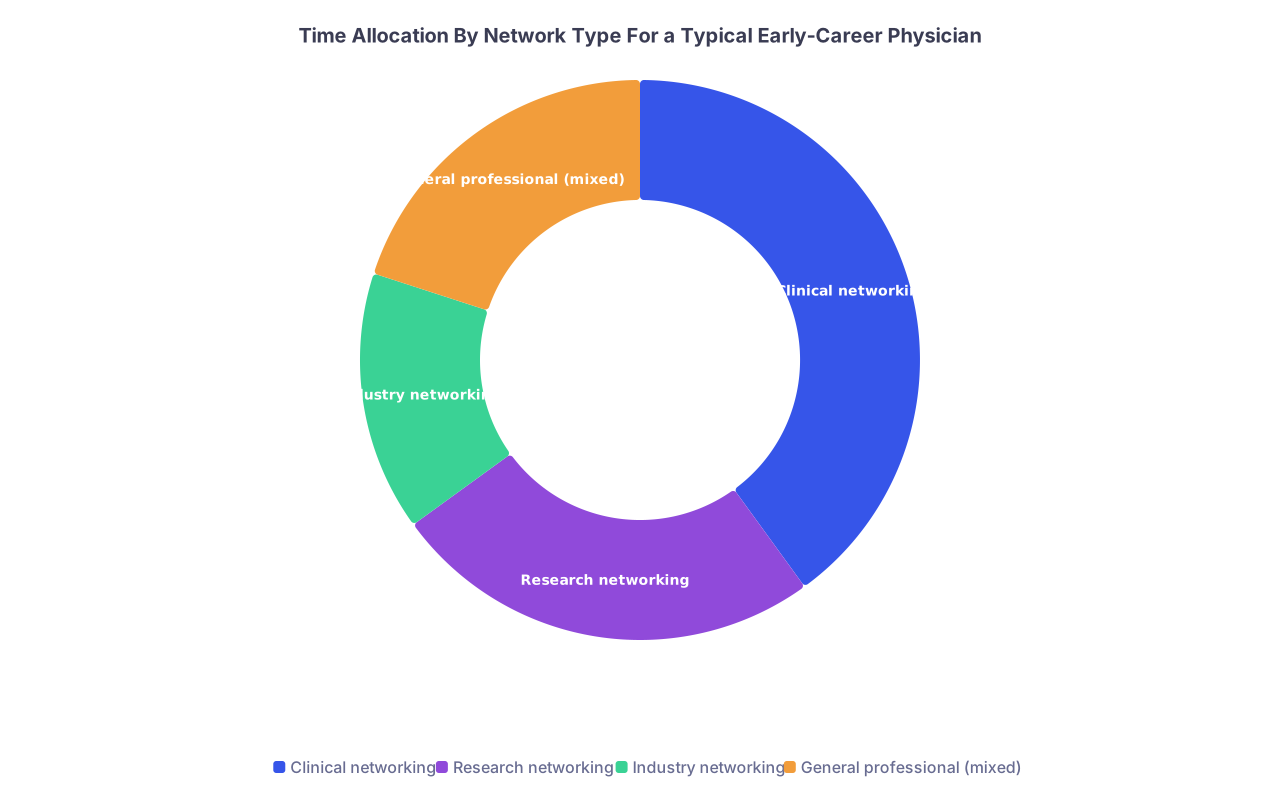
| Category | Value |
|---|---|
| Clinical networking | 40 |
| Research networking | 25 |
| Industry networking | 15 |
| General professional (mixed) | 20 |
Practical Tactics: What To Actually Do in Each Domain
Let’s get concrete. You don’t need to “network” 20 hours a week. You need a few high-yield habits.
Clinical Network: Local and Reputation-Based
Who matters:
- Program directors
- Division chiefs
- Senior attendings who actually like teaching
- Clinic managers / nurse leaders (vastly underrated)
What to do:
- On rotations: ask one reasonable, thoughtful question per day. Not five. One.
- Volunteer for one visible project per year: QI, protocol update, patient education, something.
- After a good month with an attending: send a 3-line thank-you email and connect on LinkedIn.
Your clinical network is built mostly by consistent, competent behavior plus a handful of intentional touchpoints.
Research Network: PIs and “Glue People”
Who matters:
- PIs who actually publish, not just talk
- Research coordinators (they know who gets things done)
- Biostats folks who don’t flinch when you say “missing data”
What to do:
- Start small: join one project, finish it, and don’t disappear before submission.
- When you meet a productive PI: send a short note—“If you ever need someone to help with [X skill], I’d be happy to pitch in.”
- Go to 1–2 real conferences a year and do this:
- Poster? Stand there. Engage people.
- No poster? Pick 2–3 people whose work you like and email them for a 10-minute coffee during the meeting.

| Step | Description |
|---|---|
| Step 1 | Identify area of interest |
| Step 2 | Find productive PI |
| Step 3 | Offer help on small project |
| Step 4 | Deliver work on time |
| Step 5 | Get included on manuscript |
| Step 6 | Ask about next opportunity |
Once people realize you finish things, you’ll have more offers than bandwidth.
Industry Network: Slow Build, High Leverage
Who matters:
- Medical science liaisons (MSLs)
- Medical directors in pharma/biotech/medtech
- Health tech founders/CMOs
What to do:
- Make and maintain a serious LinkedIn. Title, photo, 2–3 sentence “about” that fits your through-line.
- When you present or publish, post it there with a 2–3 sentence practical takeaway for clinicians. Industry people read that.
- Talk to MSLs at conferences like they’re human beings, not walking drug reps. Many are ex-clinicians; they know your track.
You don’t need dozens of industry contacts. You need:
- 2–3 people who think, “If we ever need a clinician for X, I’m calling them first.”
The Big Mistakes People Make With “Separate” Networks
I’ve seen these blow up careers slowly.
Over-separation
- You hide your industry work from your academic mentors because you think they’ll judge you.
- You hide your academic work from industry because you think they want only “business-minded” people.
Result: everyone only sees 20% of your value.
Under-disclosure
- You forget (or “forget”) to mention you’re consulting for Company A while helping design a trial that might affect them.
- You publish without listing relevant relationships.
That’s how you end up on uncomfortable committee agendas and in awkward OIG audits.
Context switching your ethics
Patients > data > money. In that order. Across all worlds. The second that hierarchy shifts depending on who’s paying, your reputation starts rotting.
Your goal is not three faces. It’s one face that fits in three rooms without changing its story.
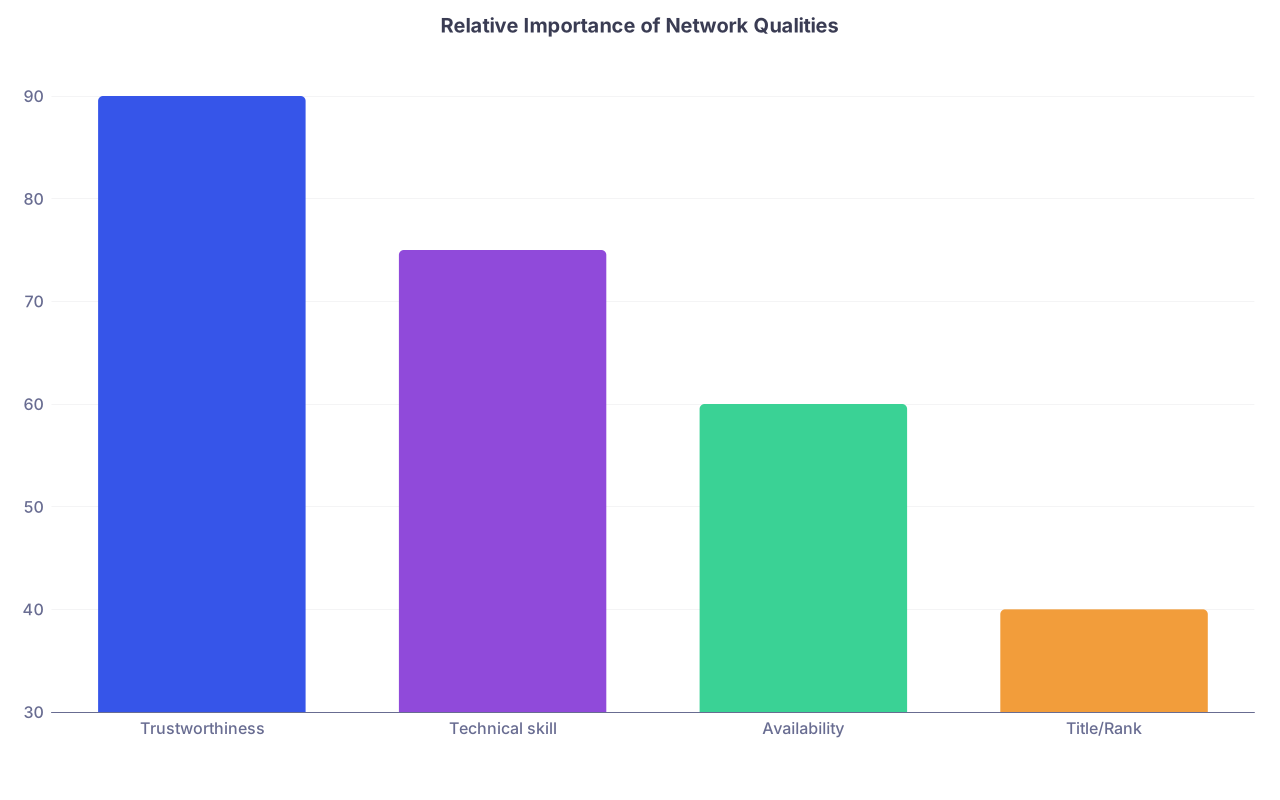
| Category | Value |
|---|---|
| Trustworthiness | 90 |
| Technical skill | 75 |
| Availability | 60 |
| Title/Rank | 40 |
How To Keep Things Straight Without Going Crazy
You’re going to reach a point where you’ve got:
- Clinical projects
- Research collaborations
- Maybe a paying industry thing or two
You don’t need separate networks, but you do need some system.
Simple structure that works:
One “relationships” doc or note
- Columns: Name, Domain(s), How we met, Last contact, Next step.
- Update it monthly. 15 minutes. That’s it.
One conflict-of-interest checklist
- Every new paid role: list it.
- Every committee/grant: check that list before you say yes.
Saves you a world of pain.
One “yearly touch” habit
- Once a year, touch base with:
- Key clinical mentors
- Key PIs
- Key industry folks
This can be:
- “Saw this paper and thought of you.”
- “Quick update on where I landed this year—thanks again for your help back when…”
- “If you’re ever in [city/conference], coffee’s on me.”
- Once a year, touch base with:
People remember who circles back without always asking for something.




Bottom Line: What You Actually Need
So, do you need separate networks for clinical, research, and industry?
No. You need:
- One coherent professional identity
- One core network that sees the same version of you
- A few anchor people in each domain
- Clear ethics and clean disclosure
- Just enough organization so nothing falls through the cracks
The question isn’t “Should I build three networks?” It’s:
“Does my existing network include at least a couple of people in each world I might want to enter?”
If the answer is no, your job this year is not to split yourself into three. It’s to add a handful of edges to the network you already have.
Today, do this:
Open your email or LinkedIn and send one short message to one person in a domain you’re curious about—clinical leader, PI, or industry contact. Ask for 15 minutes to hear how they got where they are. That’s how the right kind of network actually starts.
FAQ: Networking Across Clinical, Research, and Industry (7 Questions)
1. I’m a med student with no idea what I want yet. Should I start building “industry” contacts now?
No. Start with a strong clinical and research foundation. Join a couple of projects, go to at least one real conference, and clean up your LinkedIn. If an industry person shows interest, great—have the conversation—but don’t force it. Industry networking is way more useful once you have some domain credibility.
2. Can I put my industry consulting work on my CV if I want an academic job?
Yes—and you should, but in a way that looks professional and transparent. Use a heading like “Industry and Advisory Roles” and list company, role (e.g., “Clinical advisor”), and topic area. Pair that with solid academic output and nobody reasonable will see it as a negative. Hiding it is what burns you.
3. How do I avoid conflicts of interest if I’m active in more than one space?
Use a simple rule: “Would I be comfortable explaining this relationship on a slide in front of my patients, my department chair, and a journalist?” If not, fix it. Always: disclose, recuse when necessary, and don’t design or lead work that directly benefits a company paying you without full transparency and institutional oversight.
4. Should I have separate LinkedIn profiles or emails for clinical vs industry work?
Absolutely not. One LinkedIn, one professional email. Fragmenting that just makes you look disorganized or shady. Use your profile summary and experiences to tell a coherent story that connects your clinical insight to your research and any industry-facing work.
5. I’m worried my academic mentors will look down on industry connections. What do I do?
Pick your mentors carefully. Many senior academics now have some industry interface. When in doubt, present it as: “I was interested in how products get developed and wanted to see behind the curtain while keeping my academic work rigorous.” If someone reflexively dismisses all industry roles, that’s feedback about their limitations, not yours.
6. How many people do I actually need to know in each domain?
For most early-career folks:
- Clinical: 5–10 people who can vouch for your work and character
- Research: 2–4 PIs or senior collaborators, plus 1–2 “glue” people (stats, coordinators)
- Industry: 2–3 meaningful contacts (MSL, medical director, founder)
Past that, it’s about depth, not raw count.
7. What’s one concrete step to expand my network into a new area this month?
Pick a topic you’re genuinely interested in (e.g., heart failure devices, stroke trials, digital mental health). Find:
- One recent paper
- One company in the space
- One person (PI or medical director)
Send that person a short, specific message: “I’m a [your role] interested in [X]. I read your [paper/see your work at Company Y]. Could I borrow 15 minutes to ask about how you got into this space and what skills are most useful?” That single conversation can become your first anchor in that domain.