
The blunt answer: yes, you should cold email attendings you’ve never met — but only when you have a clear, specific ask and you do it like a professional, not a spam bot.
Most students do this badly. Vague, copy‑pasted, 8‑paragraph life stories. Then they complain no one replies. The attending didn’t “ghost” you. They filtered you.
Let me walk you through exactly when cold emailing makes sense, how to write an email that actually gets answered, and when you’re just wasting everyone’s time.
When It Does Make Sense To Cold Email an Attending
You don’t cold email “to network.” You cold email for a defined purpose that respects their time.
Here are situations where it’s not only acceptable but smart.
- You want research experience with a specific interest (e.g., cardiology imaging, bioethics, health policy).
- You’re applying to that specialty and want a brief informational conversation.
- You read their paper or saw their talk and have a focused, non‑Googleable question.
- You’re rotating at their institution soon and want to introduce yourself with a short, relevant ask.
- You need a very specific kind of mentorship that matches their known interests.
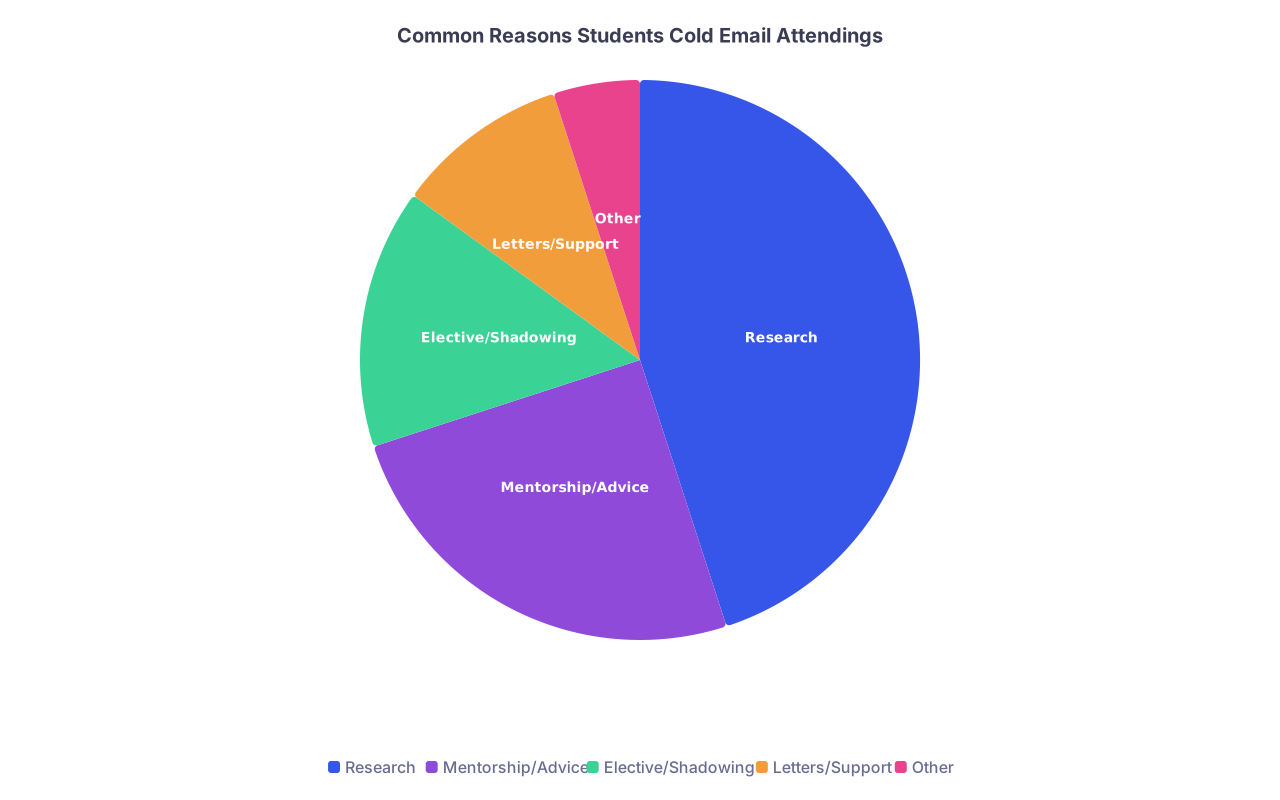
| Category | Value |
|---|---|
| Research | 45 |
| Mentorship/Advice | 25 |
| Elective/Shadowing | 15 |
| Letters/Support | 10 |
| Other | 5 |
Here’s when you should not cold email:
- To ask for a letter of recommendation when they’ve never worked with you. That is a hard no.
- To ask a question answered in 5 seconds by the program website.
- To send your entire CV and say, “Any opportunities?” with no specifics.
- To request shadowing at random private practices that clearly don’t take students.
- To mass‑email 40 attendings with generic copy.
If your ask is something a busy attending can realistically say “yes” to in under 60 seconds, you’re in the right range. If it sounds like unpaid administrative work for them, you’re not.
Who You Should Actually Email (and Who to Skip)
Not all attendings are equal targets for cold outreach. Some are much more likely to respond.
| Priority Level | Who They Are |
|---|---|
| High | Clerkship directors |
| High | Program directors / APDs |
| High | Research‑active faculty |
| Medium | Early‑career attendings |
| Medium | Fellowship‑trained sub‑specialists |
| Lower | Very senior department chairs |
| Very Low | Random private practice attendings |
Good bets
- Clerkship or sub‑I directors. Used to student emails. Often need motivated learners and researchers.
- Program directors and associate PDs. Very accustomed to resident and student outreach. Best for career/field questions, not busywork research.
- Research‑heavy faculty. If they publish a lot, they need manpower. You just have to show you can actually follow through.
- Younger faculty / recent fellows. More likely to remember being you two years ago. Often still building their research portfolio.
Worse bets
- The celebrity chair who keynoted three national meetings last year. You’re one of 200.
- Random private practice physicians who have never taken students. Many don’t have systems for it and are limited by liability and clinic flow.
- Faculty with “Vice Dean of X, Y, Z” attached to their names. They live in meetings. They’re not ignoring you; your email is buried under 400 others.
If you can find someone who is both interested in your area and clearly working with students on PubMed or on the department page, that’s your target.
The Right Timing: When to Hit Send
You can send a great email at the wrong time and still get ignored. Timing matters.
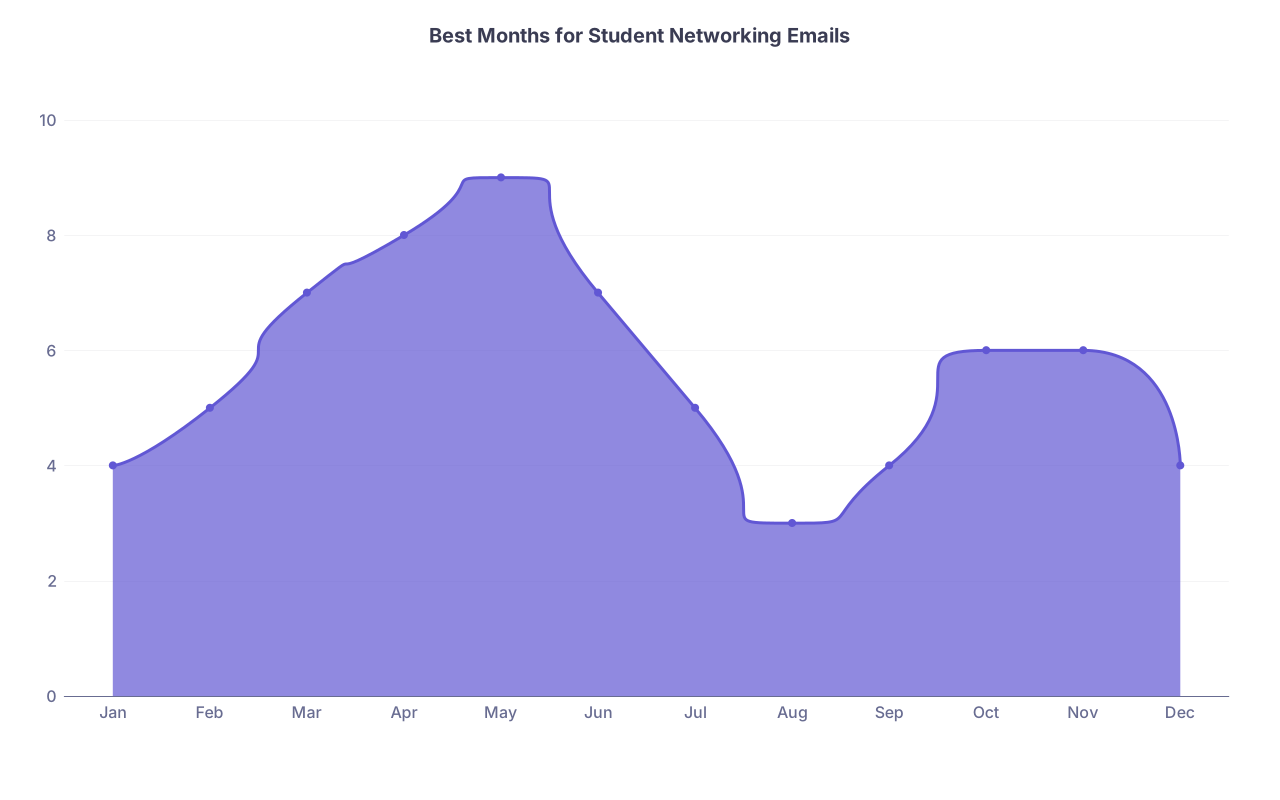
| Category | Value |
|---|---|
| Jan | 4 |
| Feb | 5 |
| Mar | 7 |
| Apr | 8 |
| May | 9 |
| Jun | 7 |
| Jul | 5 |
| Aug | 3 |
| Sep | 4 |
| Oct | 6 |
| Nov | 6 |
| Dec | 4 |
(Scale 1–10 for likelihood of a useful response; 7–9 are your best windows.)
Best times of year
- Early spring (March–May) for:
- Rising M3/M4 students seeking summer or early‑year research
- Early specialty exploration calls before sub‑Is
- Early fall (September–October) for:
- MS1/MS2 looking for longitudinal mentorship
- MS3 lining up projects before a research year
Worst times of year
- Late June–July. New interns and new residents. Everyone is drowning.
- Late December / major holidays. Emails get buried, then forgotten.
- Peak application/interview crunch for that specialty:
- Sept–Nov for residency programs
- Check the specialty’s main application window and avoid high‑stress weeks.
Best times of day
- Aim for:
- 7–9 AM local time (they’re scanning email before clinic/OR)
- Early afternoon (1–3 PM) on non‑OR heavy days
Avoid 10–11 PM “I’m spiraling about my future” emails. It makes you look disorganized.
Exactly How To Write a Cold Email That Gets Answered
Here’s the part you actually care about: templates and structure.
General rules
- Subject line: clear, short, specific.
- Total length: 150–250 words. If it scrolls twice on a phone, it’s too long.
- One clear ask. Not four.
- Make it easy to say yes in under 30 seconds.
Subject line examples
Good:
- “MS3 Interested in Cardiology Outcomes Research – Brief Call?”
- “Rising MS4 Visiting Student – Question About Sub‑I Expectations”
- “Med Student Interested in Your 2023 JAMA Article on Sepsis”
Bad:
- “Networking Opportunity”
- “Help/Guidance Please”
- “Urgent request!!!”
- “Question”
Template 1: Research interest email
Subject: MS2 Interested in [Topic] Research – Quick Question
Dear Dr. [Last Name],
My name is [Name], and I am a [MS2/MS3/MS4] at [School]. I’ve been developing an interest in [briefly: e.g., “outcomes research in heart failure, especially readmissions and health equity”].
I recently read your paper on [1 specific paper, title or journal/year is enough], and I was struck by [1 sentence showing you actually read it – specific result, method, or limitation].
I’m hoping to get involved in a project in this area over the next [time frame – e.g., 6–12 months], ideally where I can contribute [chart review / data collection / literature review / basic stats] and learn from your team.
If you have any ongoing or upcoming projects where an interested student could be helpful, I’d be grateful for the chance to contribute. I can commit approximately [X] hours per week and am comfortable with [list 2–3 concrete skills: REDCap, Excel, basic R, IRB prep, etc.].
I’ve attached a brief CV for context, but I know you are busy and would appreciate any guidance, even if there are no current openings.
Thank you for your time,
[Name]
[Med school, year]
[Phone]
Notice what’s not there: your childhood story, your entire career plan, or five generic compliments.
Template 2: Informational / career advice email
Subject: MS3 Considering [Specialty] – 15‑Minute Call?
Dear Dr. [Last Name],
I’m [Name], a third‑year medical student at [School], currently rotating on [Service or related rotation]. I’m strongly considering [Specialty] and am trying to understand what day‑to‑day life and training pathways look like from someone who recently went through it.
I saw your profile on [department page / recent talk / faculty list] and noticed your work in [brief area – e.g., rural surgery, med‑ed, global health]. That aligns with my interests in [1 line].
If you are open to it, I’d be very grateful for a brief 15–20 minute conversation at your convenience in the next few weeks to ask a few focused questions about [residency selection / fellowships / lifestyle tradeoffs, etc.].
I understand your time is limited, so if a call is not possible, even a short email response to one or two questions would be extremely helpful.
Thank you for considering this,
[Name]
Short, specific, and respectful of time. That’s the bar.
What To Attach, What To Include, and What To Never Do
CV / resume
- Attach once as a PDF named “Lastname_Firstname_CV.pdf”.
- Do not paste your CV into the body of the email.
- Don’t send a 12‑page monster listing every volunteer hour since high school. Trim to what’s relevant.
Links
- A LinkedIn link is optional, not essential.
- Do not send Google Drive folders to someone who has never met you and expect them to click. Many won’t.
Tone
- Professional but human. You’re not applying to be NASA flight commander.
- No slang. No “Hey” opening. No “Bestie, I need derm research.”
Things that kill your email:
- Misspelling their name or title.
- Clearly copy‑pasted template with wrong specialty or paper.
- Asking for a letter of recommendation in the first email.
- Writing like you are entitled to a response or a position.
- Following up every 24 hours like a collections agency.
Follow-Up Rules: How Many Times and How Far Apart
You’re not annoying if you follow up correctly. Most attendings live in inbox chaos.
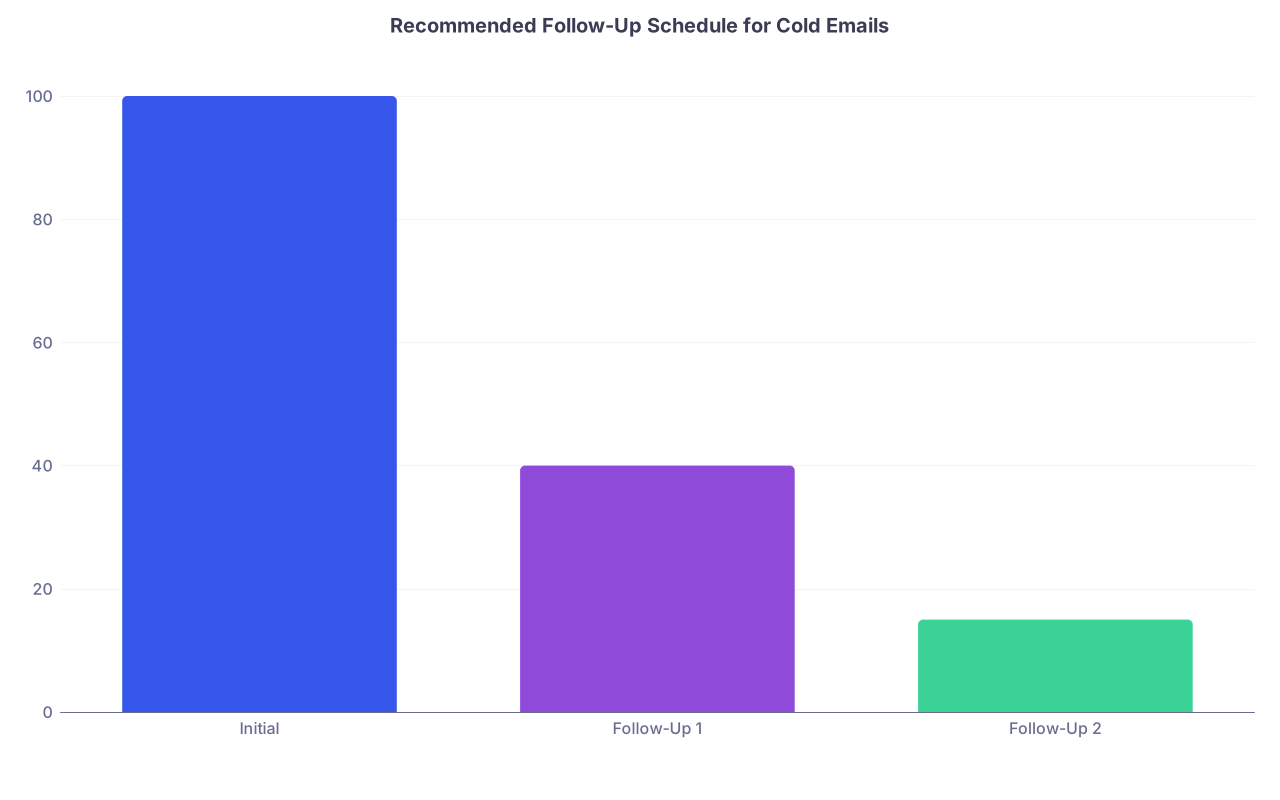
| Category | Value |
|---|---|
| Initial | 100 |
| Follow-Up 1 | 40 |
| Follow-Up 2 | 15 |
Basic follow-up framework
- If no response:
- First follow-up: 7–10 days later.
- Second (and final) follow-up: 10–14 days after that.
- After two follow-ups: you’re done. Move on.
Follow-up wording example
Subject: Re: MS2 Interested in [Topic] Research
Dear Dr. [Last Name],
I wanted to briefly follow up on my email from last week about potential opportunities to help with [topic] research. I know your schedule is very busy, and I completely understand if there are no openings on your team right now.
If that is the case, and you know of any colleagues who might be open to working with a student, I’d appreciate any suggestions.
Thank you again for your time,
[Name]
Short. No guilt‑tripping. No “circling back to the top of your inbox” nonsense.
If they don’t reply after that, take the hint. Some people just won’t respond. It’s not (always) about you.
Special Cases: What About Shadowing, Away Rotations, and LORs?
Shadowing
- Hospital‑based shadowing usually runs through:
- Medical school office
- GME office
- Volunteer office
- Cold emailing random attendings for shadowing works sometimes in smaller systems, but often hits policy walls.
If you do cold email for shadowing, your ask must be conservative:
- Limited time (e.g., “a half‑day or day in clinic”)
- Acknowledge institutional rules: “If your institution allows students in this capacity…”
Away rotations / sub‑Is
Bad move: emailing 6 months before ERAS saying, “If I rotate with you, will I get a letter?” They hate that.
Better move:
- Email before your scheduled rotation:
- Introduce yourself.
- Signal you’re serious about the field.
- Ask if there are expectations/resources you should review beforehand.
- During the rotation: impress them.
- Near the end: ask about letters in person, not by surprise email.
Letters of recommendation
Let me be blunt: do not cold email attendings and ask for LORs if they have never supervised you. That letter will be garbage or politely declined.
The correct route:
- Work with them clinically or in research.
- Demonstrate reliability, work ethic, and actual competence.
- Then ask, ideally face to face, or by email after a strong interaction.
How Many Emails Is “Too Many”?
You should not be emailing 40 attendings with the same vague pitch. That’s how you end up on spam filters and informal “do not encourage this student” lists.
A reasonable approach:
- For a single research area at one institution: 3–5 well‑targeted faculty.
- For career conversations across institutions: 5–10 attendings over a few months.
- For highly competitive specialty research (e.g., derm, ortho): you may need to expand the radius, but keep it deliberate, not shotgun.

| Step | Description |
|---|---|
| Step 1 | Need Help or Opportunity |
| Step 2 | Do More Homework |
| Step 3 | Find Better Target |
| Step 4 | Draft Short Specific Email |
| Step 5 | Send at Reasonable Time |
| Step 6 | Reply Promptly and Professionally |
| Step 7 | Follow Up 1-2 Times Then Move On |
| Step 8 | Clear Specific Ask |
| Step 9 | Attending Relevant and Realistic? |
| Step 10 | Response? |
If you’re sending more than that, it usually means your ask is too generic.
Quick Reality Check: What to Expect
You will not get a “yes” from everyone. Or even most people.
Realistic expectations:
- Response rate: 20–40% if your emails are good and well‑targeted.
- Actual “yes, let’s work together”: maybe 10–20%.
- Some replies will be redirects: “Email Dr. X instead.” That’s still a win.
What separates students who eventually land strong research/mentors from those who don’t:
- They send better emails, not just more emails.
- They follow through reliably when someone says yes.
- They don’t take non‑response as a personal insult and spiral for a week.
FAQ: Cold Emailing Attendings in Medicine
Is it rude to cold email an attending I’ve never met?
No. It’s normal. Faculty in academic centers are used to students emailing about research and mentorship. It’s only rude if your email is long, entitled, or asking for something inappropriate (like a letter from someone who’s never seen you work).How long should I wait before sending a follow‑up?
About 7–10 days for the first follow‑up. If no response, one more follow‑up 10–14 days later is reasonable. After two follow‑ups, stop. At that point the silence is your answer, even if it’s just “I’m too busy for this right now.”Should I mention my Step score or grades in the first email?
Usually no. For research or basic mentorship, they don’t need your metrics up front. Mention scores only if it’s directly relevant (e.g., you’re asking about competitiveness for a specialty and want context) or they specifically asked for it in a posting.Is it better to have someone introduce me instead of cold emailing?
Yes, a warm introduction from a resident or faculty member boosts your chances. But don’t sit around waiting months for that to magically happen. If you don’t have a connector, a well‑written cold email is perfectly acceptable.What if my CV is weak and I don’t have prior research? Should I still email?
Yes, but be honest about your experience and emphasize reliability, time commitment, and willingness to do grunt work (chart review, data entry, lit searches). Many projects need exactly that. Do not pretend to know advanced stats if you don’t.Can I reuse the same email template for multiple attendings?
You can reuse the structure, not the content. Every email should have at least 2–3 genuinely personalized lines (their paper, their talk, their niche). If you can swap the name and nothing else and it still works, it’s too generic.What should I do if an attending says “no openings right now”?
Thank them genuinely, ask if they know anyone else you should reach out to, and keep that relationship warm. You’d be surprised how many “no for now” turn into “actually, something just came up” six months later if you were polite and professional.
Key Takeaways:
- Cold emailing attendings is normal and effective when you have a clear, specific, reasonable ask.
- Keep your emails short, targeted, and respectful of their time; follow up once or twice, then move on.
- Focus on the right people, realistic timing, and actually following through when someone gives you a “yes” — that’s how you turn a cold email into real opportunities.