
The belief that you need alumni connections to get real physician sponsors is a lie that keeps a lot of capable nontraditional premeds stuck. You are not locked out. But you do have to play a different game.
You’re older. You did not go to a “feeder” school. Nobody in your family wears a white coat. And when people say “just ask your school’s premed office” you want to scream because…what premed office?
Fine. Then your job is not to complain about that; your job is to build, from scratch, the kind of network that other people are handed at 18. You can do it. It just won’t feel natural at first.
Here is exactly how to find your first true sponsors as a nontraditional premed with zero alumni ties.
Step 1: Understand What a “Sponsor” Actually Is
You’re not looking for “a doctor to shadow” or “someone to look over my personal statement.” That’s too small.
A sponsor in medicine does at least one of these things for you:
- Puts their name on the line to get you access (shadowing, research, a job, a committee)
- Picks up the phone or sends a heavy-weight email on your behalf
- Actively looks for ways to move you forward once they decide you’re worth backing
Mentors give advice. Sponsors give access.
You need both, but sponsors change your trajectory.
Look for people who:
- Have positional power (attending physicians, clinic directors, department admins, program coordinators, experienced PAs/NPs who are deeply embedded with docs)
- Are stable in their role (not someone who’s about to leave fellowship in 3 months)
- Actually like teaching or supporting learners
You are not going to walk into a hospital cold and walk out with three sponsors. You’re going to build toward sponsorship through a series of small, intentional interactions.
Step 2: Fix Your “Premed Without a Home Base” Problem
If you don’t have alumni ties, your first job is to create an institutional identity that’s respectable and easy to understand.
That doesn’t mean full-time enrollment at a fancy school. It can be lean and practical.
Here are your realistic entry points:
Community College or Local University Continuing Ed
- Take at least one science class where you can be physically present.
- Be the adult in the room: on time, engaged, talking to the professor after class.
- Your goal: become “the serious nontrad premed” in that professor’s head.
Clinical Job or Volunteer Role with a Badge
- Scribe, medical assistant (if you can get trained), ER tech, CNA, patient transporter, unit secretary, or consistent ED volunteer.
- You need a badge and a regular presence somewhere in the healthcare system. A badge does more for your network than another 20 hours of Anki.
One Structured Program You Can Leverage
- Post-bacc, extension school, city college pipeline programs, or even structured hospital volunteer programs.
- You’re not collecting certificates; you’re buying access and visibility.
Your “home base” is whatever place can honestly introduce you as: “This is [Your Name], one of our students/volunteers/staff.”
That sentence matters. It legitimizes you in the eyes of strangers.
Step 3: Target the Right Places to Find Potential Sponsors
Stop chasing prestige. Chase density.
You want locations where:
- Many physicians cycle through
- There’s a natural pretext for you to be there
- Repeated exposure is normal, not weird
Realistic targets:
- Emergency department (ED)
- Academic hospital outpatient clinics
- Community health centers with teaching affiliations
- Large private practices that host residents or med students
- Free clinics with supervising attendings
If you’re totally starting from zero, your best bet is:
- Get into a hospital or clinic in any semi-clinical role (scribe, volunteer, MA, transporter).
- Use that role to meet attendings and residents repeatedly over time.
- Convert “familiar face” → “trusted helper” → “person I will vouch for.”
Stop trying to “network” by cold-emailing 50 chief physicians out of the blue. That’s not networking. That’s spam. You need context.
Step 4: Use One Role to Open Three Doors
Let’s say you get a job as a scribe in a community ED or a primary care clinic. Good. That single role can be multiplied.
In that one job, you can:
- Impress the attending physicians you work with
- Build trust with the lead MA or nurse
- Become known to the practice manager or clinic director
All of those people can either sponsor you directly or introduce you to someone who can.
Here’s how you turn that job into leverage:
First 4–6 weeks: Zero asks.
- Show up early.
- Do your actual job extremely well.
- Learn people’s names.
- Ask smart questions about patient care and workflow, not about your future.
Week 6–10: Light framing about your goals.
- To a physician after a shift:
“By the way, I should mention—I’m working on my premed requirements as a nontraditional student. I’m hoping to apply in a couple of years once I get more experience under my belt.” - That’s it. No request yet.
- To a physician after a shift:
Weeks 10+: Targeted, low-friction ask.
- “Dr. Nguyen, you’ve probably noticed I’m pretty serious about this path. Would you be open to me shadowing you one day a month formally? I’d really like to understand more of your decision-making that I miss while I’m scribing.”
You’re not begging. You’re making a calm, reasonable request after proving value.
From that shadowing, you can later move to:
- “Would you be willing to be a letter writer when the time comes?”
- “Is there anyone in [specialty/area] you think I should talk to as I explore options?”
Sponsors rarely come from a single coffee chat. They come from this kind of long, steady presence.
Step 5: Email and Cold Outreach That Actually Works
Sometimes you don’t have a job yet. Or your current role is in a place with no physicians (like a rehab facility with visiting providers only). Then you need to reach out cold, but not the way most people do.
Here’s the framework that works better:
Anchor yourself to some institution or experience
- “I’m a night-shift ED tech at [Hospital].”
- “I’m a student in [College] taking my premed prerequisites.”
- “I volunteer at [Free Clinic] on Saturdays.”
Make a specific and time-limited ask
- 15–20 minute phone/Zoom call
- 1–2 half-days of shadowing to start
- Quick feedback on one piece (e.g., “my plan for the next two years,” not your full application)
Show you’ve done your homework on them
- Mention a talk, clinic type, or interest of theirs that you actually care about.
Here’s a cold email template you can adapt:
Subject: Nontraditional premed at [Hospital/College] seeking brief advice
Dear Dr. Patel,
My name is [Name]. I work as a [role] at [place] and I’m completing my premed prerequisites at [school]. I’m a nontraditional student coming from [brief background, 1 sentence].
I’m very interested in how you’ve built your career in [their specialty / clinic type]. I’ve seen your name on the schedule at [clinic/ED] and heard from staff that you’re particularly good with [patients/teaching/communication].
Would you be open to a 15–20 minute call or quick meeting sometime this month so I can ask a few focused questions about how to make the most of my next 1–2 years before applying to medical school?
If it feels appropriate after that, I’d also be grateful for the chance to shadow you for a half-day to better understand your day-to-day work.
I know you’re busy, so no pressure at all if your schedule doesn’t allow it.
Best,
[Name]
[Role, Place]
[Phone]
Keep it short. Respectful. Specific. And if they say no or do not respond, you don’t take it personally. You move on.
Step 6: Leverage Staff and Non-MD Allies (Underrated Move)
A lot of nontraditional students make the mistake of focusing 100% on physicians. Here’s the truth: the gate to physicians is usually controlled by staff.
Front desk staff. Nurses. MAs. Practice managers. Volunteer coordinators.
They can:
- Put your email directly in front of the doctor who actually answers it
- Vouch for you as “reliable and not weird” (this matters more than you think)
- Tell you which physicians like students and which ones you should avoid
So if you’re volunteering or working somewhere:
Ask the nurse manager:
“Are there any physicians here who really enjoy teaching or working with premeds? I’d love to learn from someone like that.”Ask the practice manager:
“If I wanted to shadow one of the doctors here, what’s the right way to request that so I follow all the rules?”
People who work in healthcare are used to students and learners. They’re mostly just trying to avoid extra work and awkwardness. If you’re low-drama and clear, they’re more likely to help you.
Step 7: Turn a One-Off Interaction into an Ongoing Relationship
You don’t need 20 sponsors. You need 2–4 people who know you well enough to go to bat for you. That means you need continuity.
Here’s what you do after a positive interaction (shadowing, call, or short meeting):
Same day or next day:
Send a short thank-you email. Not a novel.“Thank you again for letting me shadow yesterday. Watching how you explained [specific situation] was especially helpful. I appreciate you taking the time.”
2–4 weeks later:
Small update + one question.“Quick update: I just started my organic chemistry and I’m picking up extra shifts at the clinic. I’ve been thinking about what you said about getting experience with underserved patients. Do you think [free clinic X] or [community program Y] would be a better fit at this stage?”
Every 2–3 months:
Short progress note. No ask, or a very light one.“I wanted to share that I finished this semester with [X result] and I’ve now logged about [X hours] in the ED. I’m starting to plan for the MCAT in [timeline]. If you ever need an extra set of hands for [clinic/research/teaching], I’d be happy to help in any way that’s useful.”
This cadence does two things:
- Keeps you in their mental “this student is serious” bucket
- Shows a pattern of follow-through and growth
That’s exactly what a future sponsor wants to see before they put their name on you.
Step 8: Use One Sponsor to Meet the Second and Third
Once someone has signaled they’re in your corner—meaning they’ve said things like “keep me posted,” “happy to help,” “let me know when you’re applying”—you can make a direct, respectful ask for introductions.
Example:
“Dr. Lopez, you mentioned that getting exposure to different practice types would be useful. Is there anyone you know—maybe in [specialty] or in a community clinic setting—who might be open to a short shadowing experience or a brief conversation? I’d be very grateful for any introductions, and I promise to be respectful of their time.”
This is how you stop trying to claw your way into random inboxes and start traveling through warm referrals.
Many physicians are far more comfortable saying “yes” when:
- You came through someone they trust
- You’ve already demonstrated you’re normal, punctual, and not a liability
Your early sponsor’s strongest gift is not their own letter. It’s their network.
Step 9: Know When to Ask for Real Sponsorship (Letters, Big Favors)
Do not ask for a letter of recommendation after knowing someone for 2 hours. That’s how you get polite, useless letters.
You ask when:
- They’ve seen you in action over at least a few months
- You’ve shown up consistently and improved
- You’ve asked for and taken feedback at least once
And you ask like this:
“Dr. Singh, I’m starting to assemble my letters for medical school applications. Given that I’ve been working with you since [month/year] and you’ve seen me in [specific contexts], would you feel comfortable writing me a strong letter of recommendation?”
Use the word “strong.” It gives them an easy out if they don’t feel they can really advocate for you. You want honest sponsors, not warm bodies.
If they say yes, you:
- Provide a one-page summary of your path, highlights, and what you’re aiming for
- Remind them of 1–2 specific stories they’ve seen that might be worth mentioning
- Keep them updated when you submit, interview, and get results
That last part—keeping them in the loop—turns a letter writer into a long-term sponsor.
Step 10: Make Lack of Alumni Ties Your Advantage, Not Your Excuse
Being a nontraditional premed without alumni connections is not a death sentence; it’s just a different constraint. Some advantages you actually have:
- You’ve probably worked in real jobs and can be useful in a clinic right away.
- You can talk to adults like an adult, not like a terrified sophomore.
- You often have a clearer “why medicine” that reads as authentic instead of scripted.
Leverage that:
- Don’t pretend to be 19. Own your age and background.
- Don’t over-explain your path. One or two sentences of context, then focus on where you’re going.
- Don’t apologize for not having alumni ties. Nobody in a hospital cares what your undergrad alumni base is. They care whether you’re competent and sane.

| Step | Description |
|---|---|
| Step 1 | Get clinical or school home base |
| Step 2 | Prove reliability in role |
| Step 3 | Lightly share premed goals |
| Step 4 | Ask for small shadowing or call |
| Step 5 | Send thank you and updates |
| Step 6 | Ask for introductions |
| Step 7 | Deeper relationship and more exposure |
| Step 8 | Ask for strong letter or sponsorship |
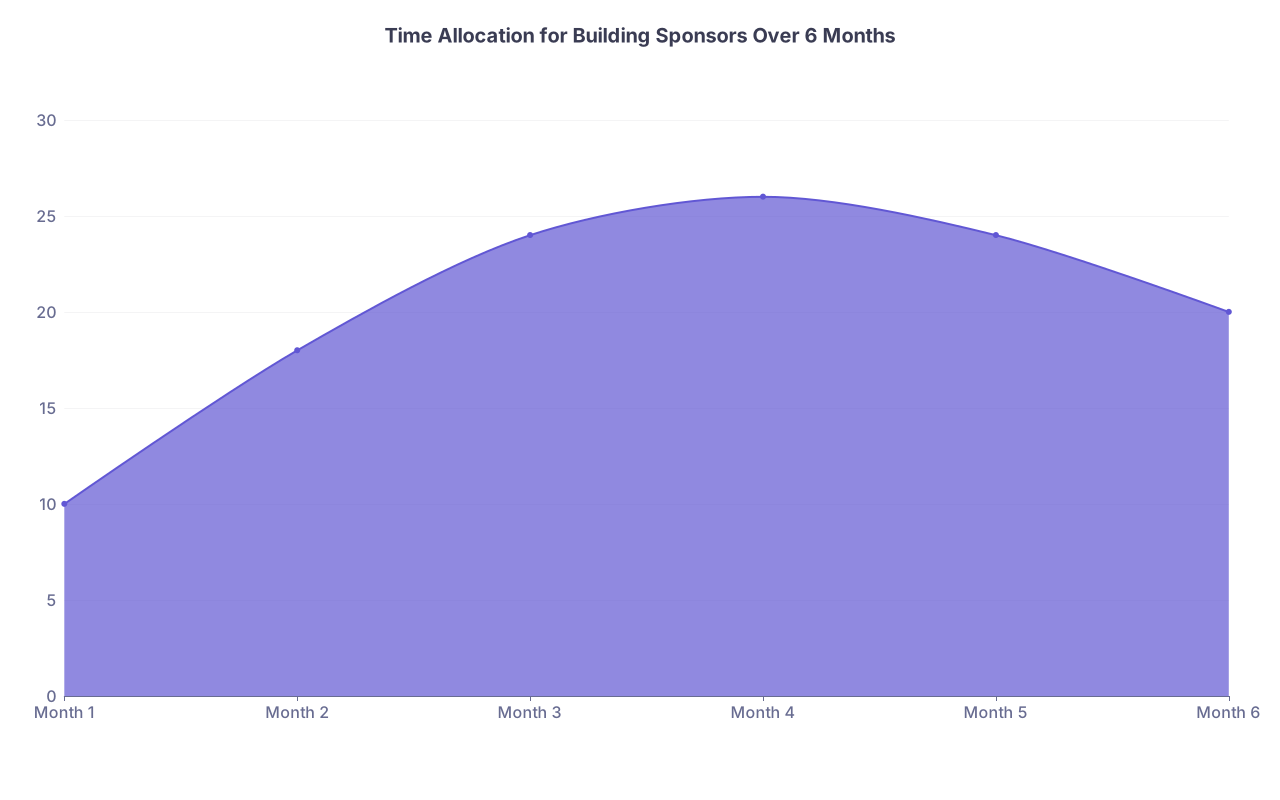
| Category | Value |
|---|---|
| Month 1 | 10 |
| Month 2 | 18 |
| Month 3 | 24 |
| Month 4 | 26 |
| Month 5 | 24 |
| Month 6 | 20 |

| Move Type | Example |
|---|---|
| Low-Access (Weak) | Cold emailing 50 random attendings with generic requests |
| High-Access (Strong) | Asking your ED nurse manager which attendings like teaching and requesting an introduction |
| Low-Access (Weak) | Sending a long life story as first contact |
| High-Access (Strong) | Asking a specific physician for a 15-minute call with 3 focused questions |
| Low-Access (Weak) | Requesting a letter after one shadowing day |
| High-Access (Strong) | Requesting a strong letter after 4–6 months of consistent work and updates |

Boiled down, here’s what matters:
- Get yourself a real-world home base: a badge, a classroom, a clinic. Then overperform there.
- Turn repeated, low-key interactions into relationships by being reliable, curious, and easy to help.
- Ask for specific, earned favors at the right time—and then keep your sponsors close with real updates.
You do not need alumni ties. You need proximity, proof, and persistence. The rest is noise.