
The honest truth: if more than about 20–30% of your rank list is brand‑new programs, you’re probably taking on more risk than you realize.
Let’s break that down so you can actually make decisions, not just worry about them.
The Core Answer: What’s “Too Many” New Programs?
You’re not trying to win an award for bravery. You’re trying to match.
Here’s the rule of thumb I use with students:
- If ≤ 10% of your list is new programs → low risk (assuming the rest are appropriate “safety/target” tiers).
- If ~10–25% are new programs → reasonable but noticeable risk; needs justification.
- If > 25–30% are new programs → high risk for most applicants, unless you are unusually strong and geographically flexible.
To be clear: new programs are not bad. Some are excellent, led by motivated faculty, with tons of opportunity.
But they’re unknown quantities. And the match is already stochastic enough without you voluntarily adding more uncertainty.
So the real question isn’t “Can I rank new programs?” It’s:
“How much of my match probability am I willing to stake on places with no track record?”
That’s the decision you’re making.
What Makes New Programs Risky (and When They’re Not)
New programs share a few consistent issues. Some are manageable; some are deal‑breakers if you ignore them.
1. No Board Pass Track Record
You’re betting your entire early career on: “We think our board pass rate will be good.”
For a mature program, you can look at their last 3–5 years of board pass data, or at least ask senior residents. For a new program, what you’ll hear is:
“We have strong faculty and a robust didactic curriculum. We’re confident in our ability to prepare residents for the boards.”
Translation: “We hope so, but we don’t actually know yet.”
For a core specialty (IM, FM, Peds, Psych), that may be acceptable if everything else is strong. For surgical subspecialties, anesthesia, EM, radiology—where board certification is a big gatekeeper—this matters even more.
2. Growing Pains and System Chaos
New programs go through a predictable messy phase:
- Scheduling glitches
- Too few ancillary staff
- Unclear expectations
- Faculty still learning how to teach and evaluate
- Inconsistent feedback culture
- Rotation sites not yet well‑coordinated
I’ve heard countless versions of:
“Yeah, our first year we didn’t have an ICU rotation locked in until October.”
Or: “We were the ones finding out which attending actually liked having residents.”
Some people thrive in that environment. Most do not want their PGY‑1 to be a live beta test.
3. Reputation and Fellowship Placement
This part is uncomfortable but real.
Program directors at competitive fellowships and jobs know the “brands.” A brand‑new residency isn’t one of them.
If you:
- Need a visa
- Want a competitive fellowship (GI, Cards, Derm, Ortho, etc.)
- Plan to move to a big academic center afterward
…then a program with no alumni network and no track record is a harder path.
Is it impossible? No. But you’re building a reputation from scratch while also learning medicine. That’s a lot to carry.
The 5 Key Factors To Weigh Before Ranking a New Program
New does not automatically mean “do not rank.” But you need a structured filter instead of vibes.
Here’s the framework I’d use every time.
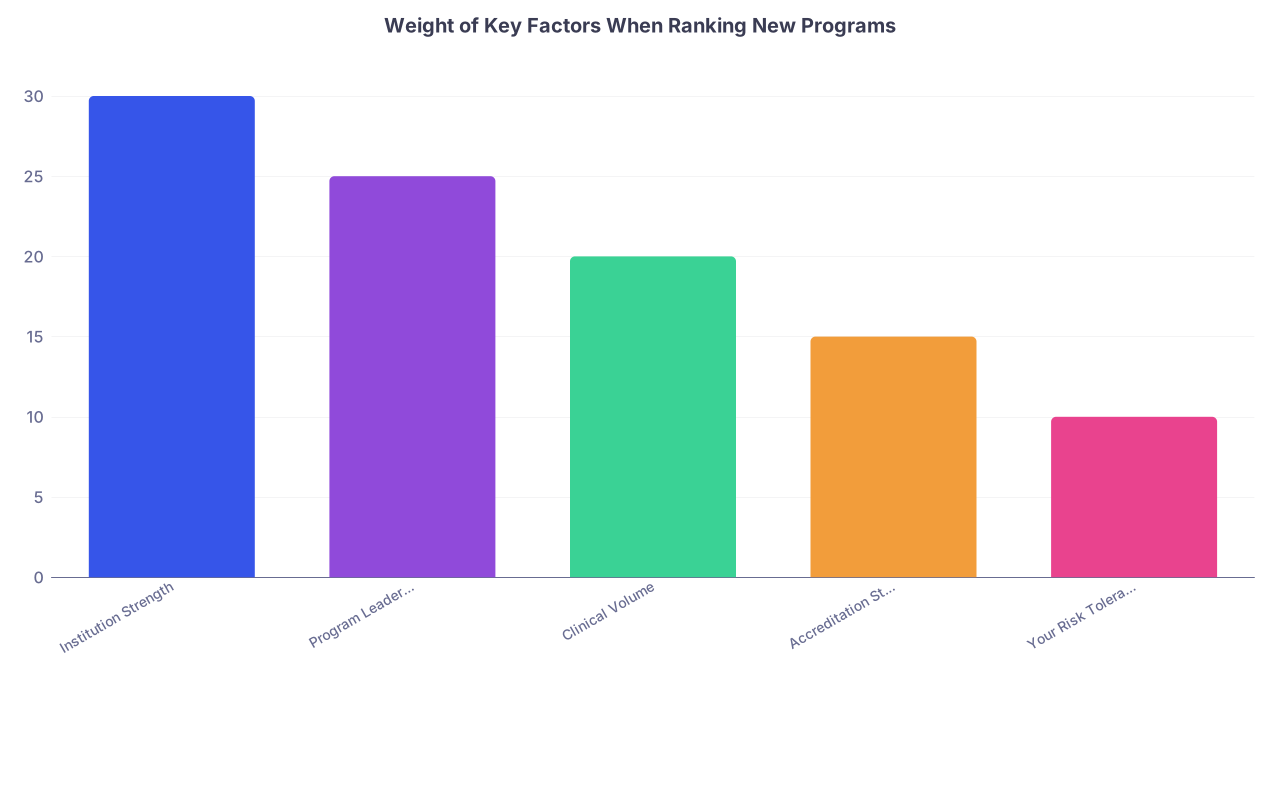
| Category | Value |
|---|---|
| Institution Strength | 30 |
| Program Leadership | 25 |
| Clinical Volume | 20 |
| Accreditation Stability | 15 |
| Your Risk Tolerance | 10 |
1. Institutional Backbone: New Program vs New Hospital
Huge distinction:
New residency at a well‑established hospital/health system
(Example: new IM program at a long‑standing tertiary center that’s adding GME.)
Usually much safer. Strong clinical volume, existing specialty services, known reputation among faculty.New residency at a small, newly expanded, or community hospital with limited historical GME
Much more variable. Could be great. Could be chaos.
Questions to ask or look up:
- How long has the hospital/health system existed?
- Do they already have other residencies or fellowships? How are those regarded?
- Is there an affiliated med school or major academic partner?
- What’s the volume and complexity of patients (e.g., Level I trauma, transplant, NICU, etc., depending on specialty)?
If the hospital is top‑tier but the program is new, I’m far more comfortable with it making your list.
2. Leadership Quality: The PD and Chair Matter More Than the Logo
A strong program director can make a new program feel stable very fast. A weak one can make a 30‑year program feel like a circus.
On interview day, pay attention to:
- Can the PD give specifics about:
- Didactics structure
- How feedback is given
- Procedural opportunities
- Plans for teaching clinics or subspecialty exposure
- Do they have prior leadership experience (APD, clerkship director, site director)?
- Can they name their own mentors and describe how they built the program design?
Red flag phrases I’ve heard from weak new programs:
- “We’re still figuring that out.” (repeated for core things like clinic, ICU, night float)
- “You’ll help us build that.” (for basic structures like evaluation systems or call schedules)
- “Our hospital really wanted a program, so we’re starting with a small class and will see.”
You are not joining a startup for fun. You’re training to be a safe, competent physician. You want leadership that already has a roadmap, not leadership asking you to write it.
3. Accreditation Status and Class Size
For U.S. ACGME programs, verify:
- They’re fully ACGME accredited or at least have clear, stable initial accreditation.
- There are no current citations severe enough to threaten the program.
- They’re not expanding too fast (e.g., jumping from 4 to 12 residents per class within 1–2 years).
Tiny first classes (1–2 residents) can be rough: you cover everything, every gap hits you. Giant new classes in a young program can feel out of control.
A moderate initial size (4–8 depending on specialty), with clear explanation of how they’ll support that many residents, is ideal.
4. Clinical Volume and Breadth
You want to graduate feeling overtrained, not undercooked.
Ask tactically:
- For IM/FM: annual admissions per resident, ICU exposure, subspecialty clinics, outpatient continuity volume.
- For surgery: case logs per PGY level, typical index cases by graduation, presence of trauma, complex cases.
- For EM: ED annual volume, acuity level, proportion of high‑acuity vs low‑acuity, availability of procedures.
If they dodge specifics or give only adjectives (“robust,” “strong,” “busy”) without numbers, assume they either don’t know or don’t like the answer.
5. Your Personal Risk Tolerance and Situation
Here’s where the “how many is too many” actually gets personal.
You can tolerate more new programs on your rank list if:
- You’re U.S. MD with solid scores, no red flags, and balanced geography flexibility.
- You have a backup year plan (prelim, research, SOAP) and are emotionally okay with possibly not matching.
- You’re in a less competitive specialty (FM, Psych in some regions, Peds in many areas, etc.) and your list is still long (12–15+ programs).
You should tolerate fewer new programs if:
- You need a visa.
- You’re aiming for a narrow geographic region for family reasons.
- You want competitive fellowship or academic careers.
- Your application is already at risk (low scores, gaps, failed attempts).
How to Build a Rank List That Uses New Programs Safely
Let’s get concrete. Say you have 15 rankable programs.
How many new ones is reasonable?
| Total Programs | New Programs | Risk Level | Comments |
|---|---|---|---|
| 10 | 1–2 | Low | Very reasonable for most applicants |
| 12–15 | 2–4 | Moderate | Needs strong established core programs |
| 15–20 | 3–5 | Moderate–High | Acceptable only if geography flexible |
| 20+ | 4–6 | Variable | Depends heavily on your strength and specialty |
For most average‑risk applicants, I like:
- 1–3 new programs total,
- Typically ranked below your clearly established, solid programs,
- Only moving higher if you have specific, clear reasons to believe they’re strong (e.g., major academic center, excellent leadership, strong personal fit).
Where to Place Them on Your List
The match algorithm favors you more than programs—so you should always rank in your true preference order, not in “safety” order.
But be honest with yourself about why you prefer a new program.
Good reasons to move a new program higher:
- It’s at a strong, well‑known institution and you clicked with the faculty.
- Location is a huge plus (family, cost of living, partner’s job).
- Leadership is obviously experienced and transparent, with a clear curriculum.
Bad reasons:
- “They seemed really excited about me.”
- “The residents said I’d get to shape the program.”
- “Their email said I was one of their top candidates.” (You and 200 others.)
I’d rarely put a brand‑new program as rank #1 unless:
- It’s attached to a powerhouse institution,
- The PD has an established track record at a strong program, and
- Your alternative choices are significantly weaker or worse fit.
How to Vet New Programs More Aggressively
You have to do more homework for a new program than for a legacy name. Here’s how to do it without wasting hours.
Talk to Current Residents — And Listen Between the Lines
If they already have a PGY‑1 or PGY‑2 class, ask:
- “What’s something that has gone better than you expected?”
- “What’s something that has been harder or more chaotic than you anticipated?”
- “If you were re‑ranking now, would you rank this program the same?”
Residents will usually be honest in tone, even if they’re polite in words. Watch for:
- Long pauses
- Laughter before answering
- “It’s been a learning experience” type phrases
That’s code for “there’s a lot of chaos.”
Look at Who’s Actually There
Search the faculty:
- Do they have multiple fellowship‑trained subspecialists in your area of interest?
- Are they publishing anything? Presenting at meetings?
- Do they have clear niche expertise (e.g., heart failure, epilepsy surgery, addiction, etc.)?
A new program with 3–5 strong subspecialists is far better than a new program where everyone is “general” and spread thin.
Ask Brutal, Specific Questions on Interview Day
Not rude. Just precise.
Examples:
- “What specific board preparation plan do you have for residents—books, question banks, protected time?”
- “Can you walk me through a typical PGY‑2 week, including call and clinic?”
- “What are one or two things you already know you want to change about the program next year?”
Good programs will have specific, grounded answers. Weak ones will spiral into vague philosophy.
How the Future of Medicine Factors In
Here’s the wildcard: many new residency programs exist because hospitals want cheap labor and prestige, not because there’s a carefully designed educational mission.
At the same time, some new programs are being built to:
- Address physician shortages in underserved regions
- Add training pathways in community‑based care, telemedicine, addiction medicine, etc.
- Integrate technology, AI, and new models of care more aggressively than rigid older programs
So you’ll see both:
- Garbage “service‑heavy” programs with minimal teaching, and
- Innovative, resident‑focused programs that may surpass older, complacent ones in a few years.
This is why a blanket rule like “never rank new programs” is lazy. The right move is more nuanced: limit how many you depend on, then selectively choose the few you’d actually bet on.
Visual: How New Programs Affect Match Risk
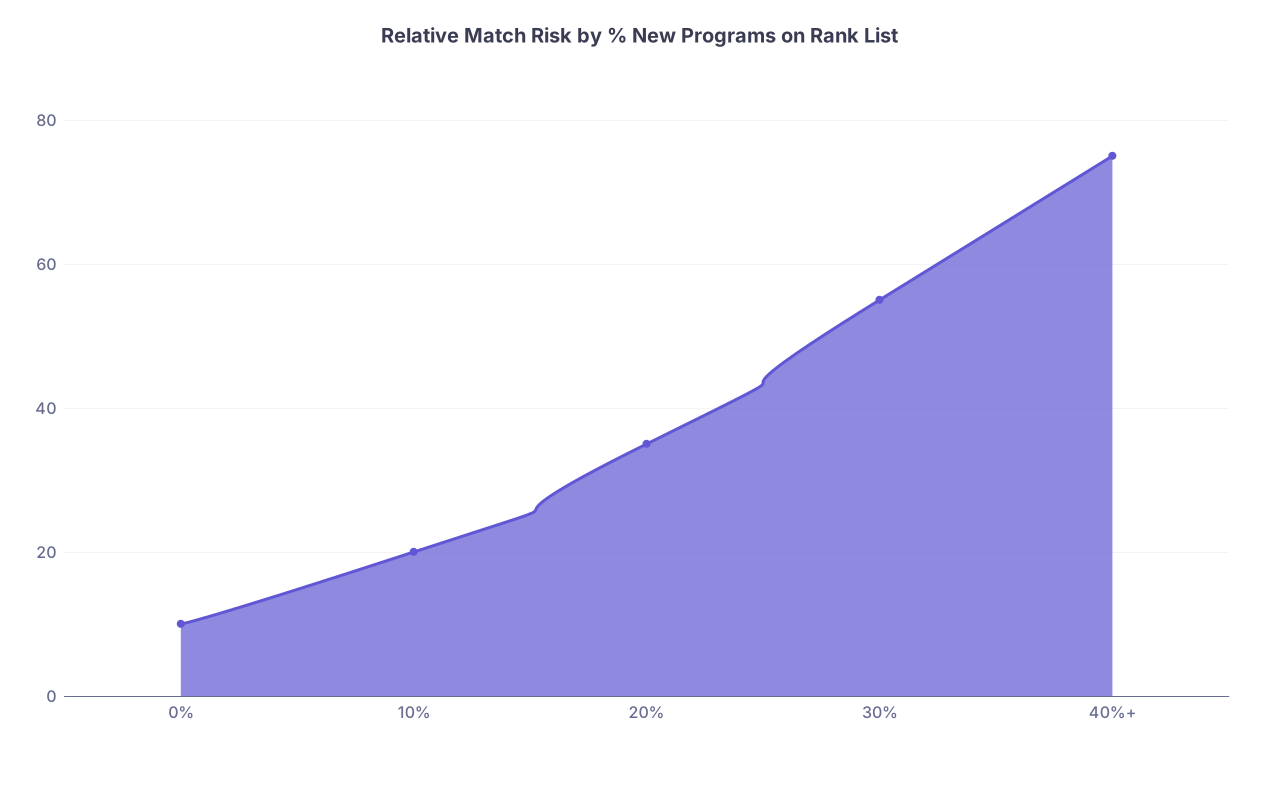
| Category | Value |
|---|---|
| 0% | 10 |
| 10% | 20 |
| 20% | 35 |
| 30% | 55 |
| 40%+ | 75 |
(This isn’t official NRMP data—this is reality‑based judgment: as the proportion of new programs on your list rises, your risk clearly goes up.)
Practical Scenarios
A few typical situations I’ve seen:
Scenario 1: Average IM Applicant, 15 Interviews
US MD, IM, 215–225 Step 2, no red flags, wants Northeast but flexible.
You have 3 new community IM programs on your list.
What’s reasonable?
- Rank all three if they’re acceptable to you.
- But keep them in the bottom half unless one is clearly attached to a very strong system that fits your priorities.
- 3 out of 15 (20%) is fine if the rest are established.
Scenario 2: IMG Needing Visa, 8 Interviews, Mostly New Programs
This is where things get uncomfortable.
If 5 out of 8 (62%) of your interviews are new programs and you need a J‑1 or H‑1B, your match risk is high no matter how you rank them. You’ll still rank them all—in your true preference order—because your best move is to maximize any chance of matching.
But you should be:
- Aggressively clarifying visa support
- Realistic about possibly needing SOAP or a re‑apply year
- Extra cautious about board prep and clinical exposure questions
Scenario 3: Strong Applicant, Competitive Fellowship Goals
US MD, 250+ Step 2, IM, aiming for Cards, 18 interviews including 3 brand‑new programs at mid‑tier community hospitals.
My advice: you can still rank them, but they should probably live near the bottom. Your fellowship‑friendly trajectory will almost always be stronger from solid, known programs unless those new ones are part of a respected academic system.
One More Visual: Timeline of New Program Stabilization
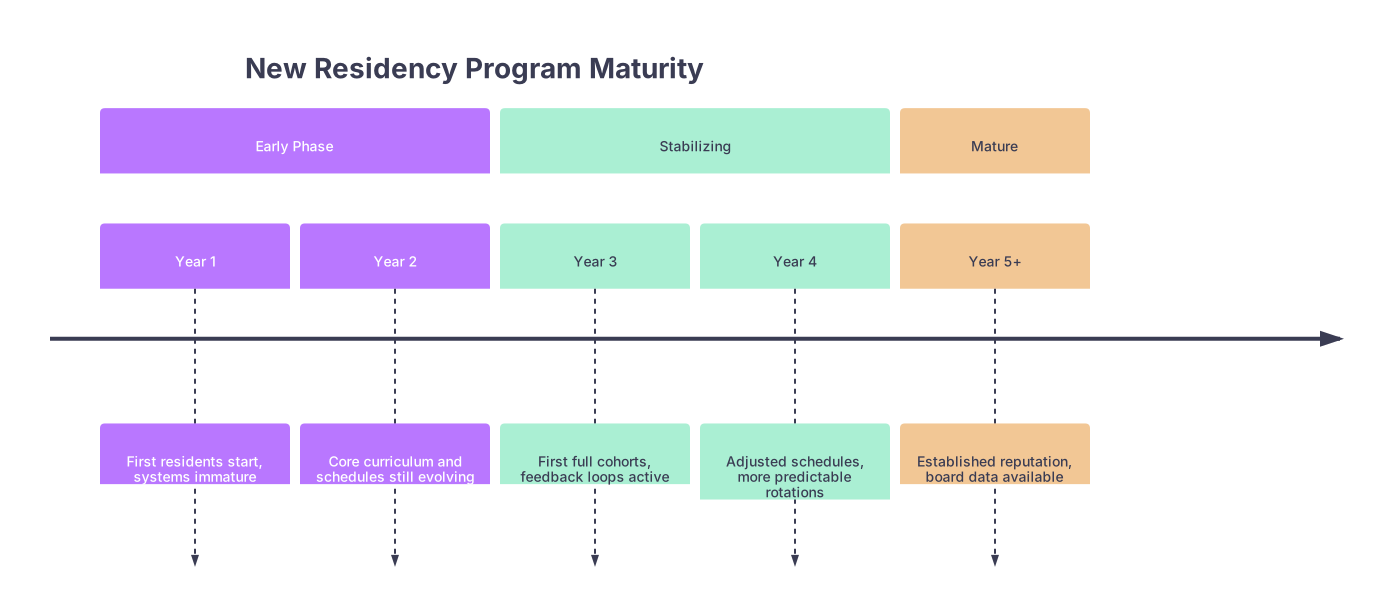
| Period | Event |
|---|---|
| Early Phase - Year 1 | First residents start, systems immature |
| Early Phase - Year 2 | Core curriculum and schedules still evolving |
| Stabilizing - Year 3 | First full cohorts, feedback loops active |
| Stabilizing - Year 4 | Adjusted schedules, more predictable rotations |
| Mature - Year 5+ | Established reputation, board data available |
If you join in years 1–2, you’re trading more chaos for more “shaping” influence. By year 4–5, the program is usually much more predictable.
FAQ: New Residency Programs and Rank Lists
1. Can I rank a brand‑new program #1 on my list?
You can. The algorithm will honor your true preference. But it’s rarely wise unless:
- It’s attached to a strong, known institution,
- Leadership is clearly experienced and transparent, and
- Your other options are materially worse for your goals or life.
If your #2 and #3 are established, reputable programs, think carefully before putting a totally unproven site above them.
2. Is it safer to rank only established programs and leave new programs off completely?
Not if you’d actually be willing to train there. If a program is acceptable, rank it. Leaving it off doesn’t “protect” you; it just removes a potential match spot. The key is not whether to rank them, but how many you rely on and how high you place them.
3. How do I know if a new program is just cheap labor for the hospital?
Red flags:
- Heavy emphasis on “service needs” and little talk of education.
- Vague answers about didactics, board prep, or evaluation.
- Minimal faculty depth in your specialty.
- No clear plan for wellness, backup coverage, or schedule review.
If the conversation feels more about filling gaps in coverage than about training you, believe them.
4. Does being in the first or second class help me get more procedures or autonomy?
Often yes, but in a messy way. You might get more hands‑on time because there’s no competition. You might also be doing scut that shouldn’t be yours because systems aren’t built yet. Autonomy without structure can hurt you if it comes without supervision or feedback.
5. Bottom line: how many new programs should I have on my list?
For most applicants, aim for no more than 20–25% of your ranked programs being new, and only that many if:
- The rest of your list is solid and appropriate to your competitiveness,
- You’ve vetted leadership and institutional strength carefully, and
- You’d genuinely be okay training at those places.
Condensed: use new programs as supplements, not the foundation of your rank strategy.