Subspecially Exposure in New Residencies: Reading Between the Lines
You are standing in a brand‑new residents’ workroom. Fresh drywall smell, brand‑new computers, empty whiteboards. And a giant banner from marketing: “Welcome Inaugural Class!”
Looks impressive. But you want to be an interventional cardiologist. Or a GI fellow. Or at least to keep doors open. The brochure says “robust subspecialty exposure” and “strong fellowship preparation.”
Here is the problem: those phrases are almost meaningless without context. New programs love them. Applicants keep falling for them.
Let me break down what actually matters, how to read between the lines, and how to figure out whether a new residency will genuinely prepare you for subspecialty training—or quietly box you into general practice.
1. What “Subspecialty Exposure” Actually Means (When It Is Real)
Programs throw around “subspecialty exposure” like confetti. You need to translate that into concrete, checkable elements.
At minimum, real subspecialty exposure in a residency means:
- Dedicated, required rotations with subspecialty teams.
- Accessible subspecialty clinics (not just inpatient consults).
- Faculty who actually live and breathe that subspecialty, on site.
- Opportunities for letters, projects, and mentorship that will matter to fellowship PDs.
If a new internal medicine program tells you, “We have strong cardiology exposure,” I want you asking three very specific questions:
- Who are the cardiologists, and how many are physically on this campus?
- What percentage of your time will be on cardiology, and where (wards vs clinic vs cath lab)?
- In the last 2–3 years, how many residents matched into cardiology or related subspecialties from this institution (even if from other programs)?
If they cannot answer those clearly, it is not “strong exposure.” It is wishful branding.
2. New Programs: The Structural Problem With Subspecialties
Every new program starts with the same structural handicap: they are usually built around a service the hospital already has plenty of (general internal medicine, general surgery, EM, family medicine). Subspecialties come later or may be spread across affiliated sites.
That leads to a few predictable problems.
2.1 Faculty numbers and availability
Brand‑new programs are almost always thin on subspecialty faculty. When you see “robust subspecialty experience through our regional partners,” translate that to: “We do not actually have those people employed here full‑time.”
- How many full‑time cardiologists / nephrologists / oncologists are employed at this hospital?
- Are they salaried academic faculty with teaching contracts, or pure private practice with occasional consult exposure?
- Who is the subspecialty education lead for each area?
If the answer to “who directs your GI teaching?” is “we are recruiting” or “one of our hospitalists with an interest in GI,” that is a red flag if you care about subspecialty training.
2.2 Required rotations vs. “elective” mirages
New programs love the word “elective.” It sounds flexible and resident‑centered. Often it is actually code for “we do not have enough core content built yet, so we’ll call everything an elective.”
Serious subspecialty‑oriented residencies have:
- Clearly defined core rotations in the major subspecialties.
- Pre‑allocated spots for residents on those teams.
- Protected clinic half‑days in subspecialty practices.
If cardiology exposure is “available as an elective at a partner site if you arrange it early,” that is not stable structure. That is you doing the administrator’s job.
2.3 The service vs. education balance
New programs often over‑rely on residents to cover general services. That means more time on “medicine A/B/C wards” and less time on structured subspecialty teams.
You want to know:
- How many months per year are floor or ICU heavy?
- At what PGY level can you realistically start doing subspecialty electives?
- When there is a service crunch, what gets canceled first—wards or your cardiology elective?
I have seen new programs promise PGY‑2/3 elective freedom and then revoke it when census spikes. Guess what disappears first? Electives. Not the wards.
3. Reading Program Materials Like a Cynic (You Should)
Let us dissect the usual marketing language and what it often hides.

3.1 Common phrases and what they likely mean
| Brochure Phrase | What You Should Suspect |
|---|---|
| Robust subspecialty exposure | Probably some consults, unclear structure |
| Strong fellowship preparation | No actual match data yet |
| Access to regional subspecialty centers | Travel, scheduling hassles, limited continuity |
| Faculty with diverse interests | Few true subspecialists on site |
| Growing research opportunities | No funding or infrastructure yet |
| Innovative curriculum | Unproven, still being built |
None of these are automatically bad. But they are not evidence. You need receipts.
3.2 The “fellowship preparation” trap
“Fellowship preparation” gets used in three ways in new programs:
- They mean: “We encourage you to think about fellowships.”
- They mean: “Our faculty trained at big‑name places, so we assume we can get you there too.”
- Best case, they mean: “This hospital already sponsors fellowships in X, Y, Z or has a consistent pipeline of grads matching into them.”
You are looking for the third. Ask:
- Does this institution currently have any ACGME‑accredited fellowships in your field of interest? (Cardiology, GI, heme/onc, PCCM, etc.)
- If not, do residents from any other residencies here (like IM, peds at an affiliate) routinely match into those fields elsewhere?
- Can they show you match lists—not aspirations, actual outcomes?
If the answer is “we just started, we don’t have graduates yet,” then you lean heavily on institutional track record. Has this health system historically produced fellows via its other residencies?
4. Concrete Things To Check Before Ranking a New Program
You need a structured way to interrogate subspecialty exposure. Otherwise you will be seduced by glossy photos and a very nice PD.
4.1 Rotation schedule: look at the grid, not just the words
Demand to see a sample 3‑year schedule. Not a cartoon. An actual grid.
Look for:
- How many blocks explicitly labeled as “Cardiology,” “Nephrology,” “Heme/Onc,” etc.
- How early they appear. Subspecialty exposure that starts in the last 4 months of PGY‑3 is borderline useless for fellowship applications.
- Amount of elective time, and when it starts.
If all you see is “Inpatient Medicine,” “ICU,” “Night Float,” and “Ambulatory” with no specific subspecialty months, that is a generalist‑heavy structure. That may be fine if you want to be a hospitalist. It is not ideal if you want early subspecialty mentoring.
4.2 On‑site vs off‑site subspecialty time
Subspecialty off‑site is not always bad. But it can cripple your ability to build continuity and relationships.
Ask specifically:
- Which subspecialty rotations are on the main campus, and which are at partner sites?
- For off‑site rotations:
- How far is the travel?
- Who arranges housing or commuting costs, if needed?
- Are you the only resident there or one of many?
- Are these rotations new and “in development,” or long‑standing teaching services?
If they say “we partner with [big academic center] for your subspecialty experience,” find out whether that center even knows you exist as a residency. A 1‑month “observer” experience where you shadow their fellows is not the same as being embedded in their teaching structure.
5. Faculty: The Real Currency of Subspecialty Exposure
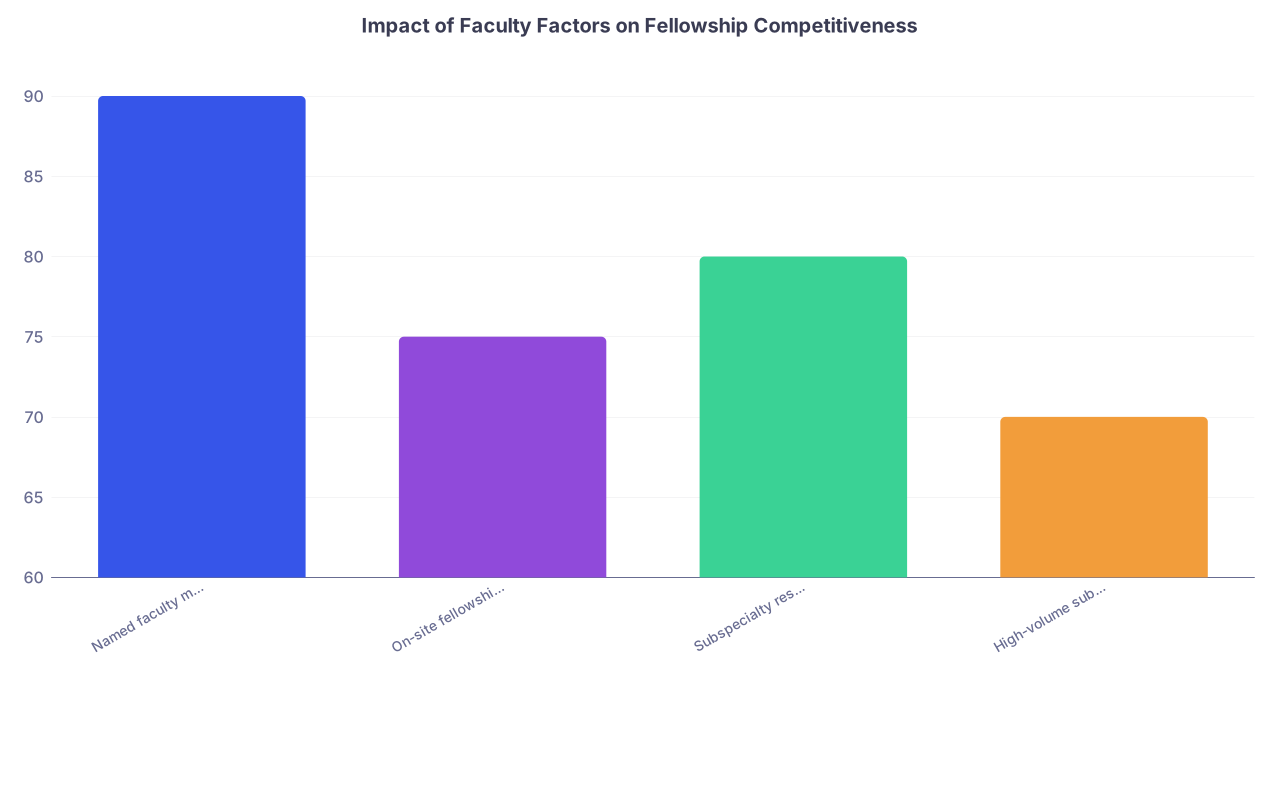
Forget slogans. Subspecialty training lives or dies on people: who is going to pick up the phone or write the email for you when you apply for fellowship.
| Category | Value |
|---|---|
| Named faculty mentor | 90 |
| On-site fellowship program | 75 |
| Subspecialty research | 80 |
| High-volume subspecialty service | 70 |
(The values above are conceptual: you should mentally treat faculty mentorship as near top priority.)
5.1 How to evaluate subspecialty faculty on paper
Go to the hospital or program website and actually click on faculty profiles. Look for:
- Board certification in subspecialty vs only “internal medicine” with “interest in cardiology.”
- Academic appointments (assistant/associate professor) at a medical school vs private practice status only.
- Recent publications in that field. Even a few case series or retrospective studies show engagement.
- Involvement in national societies (ACC, AASLD, ATS, ASCO etc.).
If you cannot find a single true heme/onc specialist on site, then the “oncology exposure” is just generalists managing chemo orders.
5.2 How to interrogate this on interview day
When you meet with the PD/APDs, ask pointed questions:
- For [your subspecialty of interest], who would likely be my main mentor?
- How many residents are currently working on projects with that faculty member?
- Do any of your subspecialists attend major national meetings with residents (ACC, ASH, ATS)?
- Can I get protected time to go to a national meeting if I have an abstract?
If the answer is vague or deflective, you have your answer: there is no true subspecialty culture yet.
6. Research and Scholarship: Do Not Overcomplicate This
Everyone overthinks research. You do not need a lab. You need output and relationships.
New programs often advertise “research is a priority” while having zero infrastructure. Here is what you actually care about:
- Is there a research office or coordinator who can help with IRB, data pulls, etc.?
- Are there standing subspecialty projects that residents can plug into (retrospective cohorts, quality improvement, database work)?
- Has any resident—of any program in this system—presented subspecialty work at national meetings in the last 3–5 years?
If a health system runs a big heart failure program with 500+ admissions a year and not one abstract has gone to ACC, HFSA, or AHA, that tells you something. They are not academically wired, no matter what the brochure says.
6.1 Reading between lines on “growing research program”
You will see:
- “We are building a culture of inquiry.”
- “Many opportunities exist for resident involvement in quality projects.”
- “We anticipate starting a research track.”
Translation: right now, there is nothing consistently structured. If you are intrinsically driven and know how to create your own projects, you might carve something out. If you need guidance and structure, you will struggle.
7. Fellowship Prospects From New Programs: Hard Reality
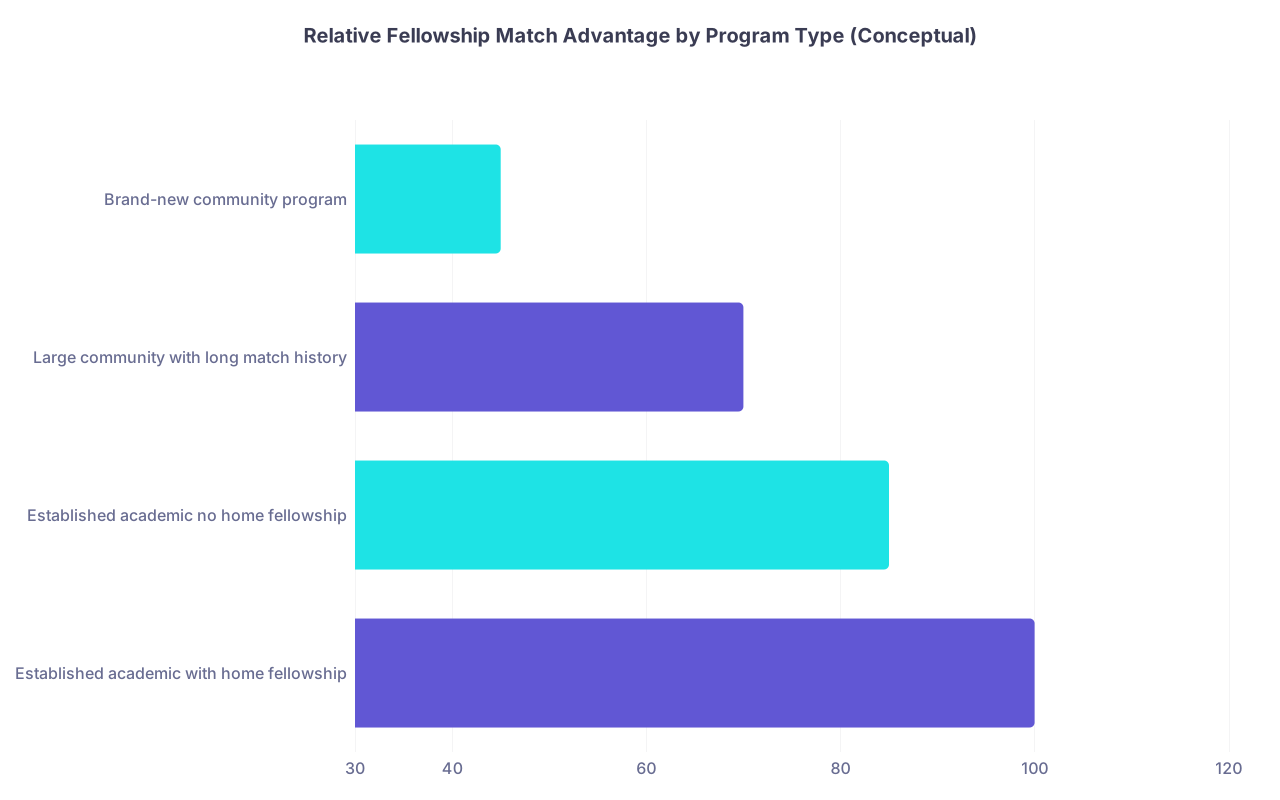
Let us talk about the part no one wants to admit. Program age matters for fellowship. Not because older is always better, but because fellowship PDs are conservative about unknown quantities.
| Category | Value |
|---|---|
| Established academic with home fellowship | 100 |
| Established academic no home fellowship | 85 |
| Large community with long match history | 70 |
| Brand-new community program | 45 |
Again, conceptual. The point is: you start from a deficit and must overcome it with other strengths.
7.1 How fellowship PDs actually think
When a fellowship PD sees an application from “XYZ Regional Medical Center Internal Medicine Residency (est. 2023),” they ask themselves three things:
- Do I know anyone there?
- Have I seen any graduate from there before?
- Does this applicant’s record overcome my uncertainty about their training environment?
Strong letters from known faculty, clear subspecialty mentorship, and tangible scholarship help soften that skepticism. Vague “robust exposure” does not.
7.2 Proxy markers when there is no match history yet
No graduates yet? You still have a few proxies:
- Does the hospital already host the fellowship you want, even if your residency is new?
Example: New IM residency in a hospital with an existing cardiology and GI fellowship is far better than a new residency in a hospital with zero subspecialty training programs. - Do other residencies in this health system (FM, peds, surgery) regularly place graduates into competitive fellowships? Systems have cultures.
- What is the local academic ecosystem? Being the “community arm” of a major university system (with real rotation and research integration) is different from being a standalone community hospital in the middle of nowhere.
8. Specialty‑Specific Nuances: Not All Subspecialties Suffer Equally
Subspecialty exposure challenges look different across parent specialties. Internal medicine, surgery, pediatrics, and family medicine all have distinct patterns.
8.1 Internal Medicine
This is where the subspecialty track anxiety is highest: cards, GI, heme/onc, PCCM, nephro, ID, endocrinology, rheum.
For a new IM program, I would look for:
- At least some on‑site fellowships (PCCM or cardiology are particularly helpful).
- Volume: a low‑acuity community hospital with 50 mostly social‑admission medicine patients is not great prep for high‑volume subspecialties.
- Strong ICU experience supervised by critical care trained intensivists (not just hospitalists who “cover ICU”).
If there is literally no on‑site fellowship, you want at least:
- Established, multi‑year rotation agreements with a major academic center.
- Evidence that other trainees (students or residents from elsewhere) already rotate there in subspecialty services.
8.2 General Surgery
For surgery, subspecialties (surg onc, vascular, CT, MIS, trauma/critical care) depend heavily on case mix and faculty mix.
Red flags in a new surgery program:
- No dedicated vascular, CT, or trauma faculty on site.
- Low trauma level designation (Level III/IV) with few complex cases.
- No subspecialty clinics; everything is “general surgery plus whatever walks in.”
You want to see active, named division chiefs in at least some subspecialty areas and a documented case log showing breadth, not just hernias and cholecystectomies.
8.3 Pediatrics
New peds programs struggle if they are not embedded in a true children’s hospital with subspecialty depth. Aspiring NICU, PICU, peds cards, or peds heme/onc folks will feel this sharply.
Check:
- Is there a free‑standing or distinct children’s hospital with multiple pediatric subspecialties?
- Are pediatric hospitalists doing everything, or do you have actual pediatric cardiologists, endocrinologists, gastroenterologists, etc. on staff?
- NICU and PICU level and volume.
Subspecialty fellowships in peds are even more pedigree‑sensitive. A brand‑new community peds program with minimal subspecialty presence is a rough launchpad.
8.4 Family Medicine
FM subspecialties are more niche (sports med, geriatrics, palliative, OB, addiction). Here the key is exposure during residency and local fellowship options.
For a new FM program:
- Is there a sports med or geriatrics fellowship on site or in the sponsoring institution?
- Does the OB volume and autonomy support someone interested in FM‑OB or maternal‑child track?
- Are there FM‑owned clinics in your interest areas (sports clinic, addiction clinic, geri clinic) rather than purely hospitalist‑style work?
9. New Program Advantages You Should Not Ignore
I am not anti‑new program. I am anti‑naive. There are real advantages for subspecialty‑minded residents in some new settings—if the structure is right.
Advantages I have seen:
- More flexibility: You can often shape elective time and be the “first” to build a subspecialty niche.
- Closer contact with leadership: PDs and chairs know every resident intimately, which can help with letters and advocacy.
- Less competition for local projects: You are not fighting 30 other residents for the one cardiology QI project.
But these advantages only matter if:
- There is at least a minimal critical mass of subspecialists in your area of interest.
- Leadership is truly supportive of residents pushing for subspecialty paths, not just saying it.

| Step | Description |
|---|---|
| Step 1 | Interested in subspecialty |
| Step 2 | High risk - reconsider ranking high |
| Step 3 | Potentially strong environment |
| Step 4 | Moderate risk - depends on mentorship |
| Step 5 | Reasonable to rank if other fit good |
| Step 6 | Expect to self-create opportunities |
| Step 7 | New program has on site subspecialty faculty? |
| Step 8 | On site fellowship or strong rotation partner? |
| Step 9 | Research and mentorship available? |
10. How To Grill a New Program Without Sounding Hostile
You do not want to be “that applicant,” but you also cannot be passive. There is a tactful way to get real answers.
When you talk to the PD:
- “Can you walk me through how a resident who is interested in [subspecialty] would be supported here, step by step?”
- “If a resident wanted to apply to a competitive fellowship like [cards/GI/onc], what has your department done historically—or what is your plan—to help them be successful?”
When you talk to current residents (even if they are transitional/inaugural):
- “Has anyone here already identified a subspecialty interest? How have they been supported?”
- “Are electives easy to arrange, or do service needs get in the way?”
- “Has anyone worked on subspecialty projects or gone to a national meeting yet?”
And for faculty in your field:
- “What kinds of projects are you currently doing that could involve residents?”
- “Do you typically write letters for fellowship applicants, and how do you get to know them well enough for a strong letter?”
If you get buzzwords instead of specifics, you have your answer.
11. When It Is Still Worth Betting on a New Program
Sometimes the math works out, even if the program is new.
A new residency can still be a smart choice for subspecialty‑bound applicants if:
- The hospital already hosts your target fellowship (or several others), with established faculty and case volume.
- The health system has a strong academic track record elsewhere (large university affiliate, prior match history from other programs).
- You have a specific, realistic plan and the personality to push your own agenda—because you will be doing more legwork.
If, on the other hand, you see:
- No subspecialty fellowships anywhere in the system.
- Few identifiable subspecialists on site.
- No clear rotation schedule beyond wards and ICU.
- Vague “research is coming” promises.
Then ranking that program highly when you are dead‑set on a competitive subspecialty is playing on hard mode. On purpose.
Key Takeaways
- Ignore buzzwords like “robust subspecialty exposure” and “fellowship preparation” unless they come with actual faculty names, rotation blocks, and some track record—either of the hospital or the overarching system.
- For any new residency, subspecialty readiness lives in three places: on‑site subspecialty faculty, structured rotations (especially early), and real opportunities for mentorship and scholarship. If one or more of those is missing, assume you will be doing a lot of self‑rescue.
- A new program can still be a good bet if the hospital already runs fellowships and has engaged subspecialists. Just do not confuse institutional strength with glossy promises. Read between the lines, and ask questions like someone whose future depends on the answers—because it does.