
The belief that a big-name hospital automatically means a high‑quality new residency program is dangerous—and can wreck the first years of your career.
The Brand-Name Trap: Why You Are More Vulnerable Than You Think
You are exactly the kind of person brand-name hospitals love when they launch new programs: ambitious, flattered, worried about competitiveness, eager for prestige.
They know the script:
- Slap “Teaching Hospital of [Famous University]” on the program.
- Put a few glossy phrases in the brochure: “innovative,” “cutting-edge,” “early adopters.”
- Drop a famous institution name in the interview: “Our affiliation with [Top-10 med school]…”
And applicants stop asking hard questions.
I have watched strong students rank brand-new programs at “University of [Prestige] – Community Campus” above well-established mid-tier residencies. They assumed the big logo guaranteed structure, education, and fellowships. Some did fine. Many did not.
Here is the key mistake: confusing the reputation of the hospital system with the actual readiness and quality of a brand-new residency program. Those are not the same thing. Sometimes they are not even close.
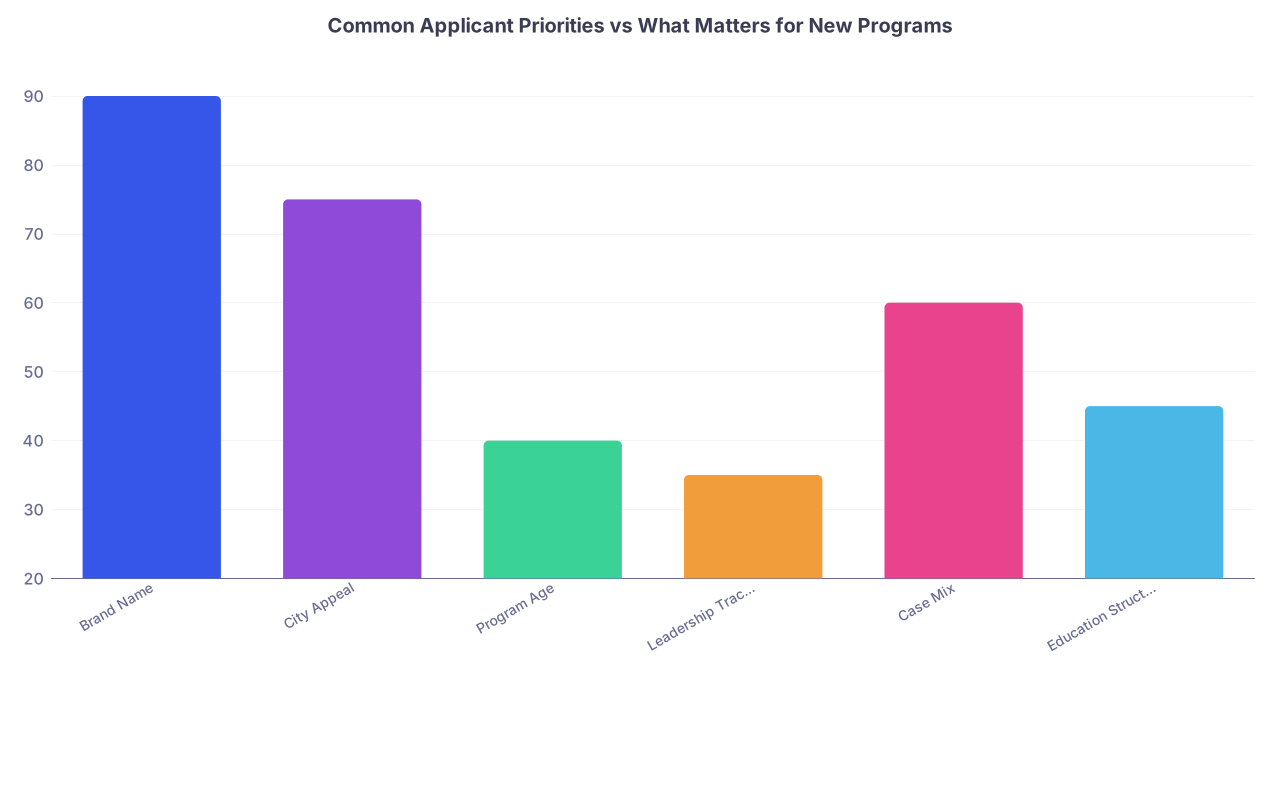
| Category | Value |
|---|---|
| Brand Name | 90 |
| City Appeal | 75 |
| Program Age | 40 |
| Leadership Track Record | 35 |
| Case Mix | 60 |
| Education Structure | 45 |
Brand name and city get almost all the mental bandwidth. Program maturity and leadership history—what really determines your training life—are treated like footnotes. That imbalance is how people get burned.
Do not make that mistake.
What a New Program Actually Looks Like From the Inside
A new residency program at a famous hospital is not a smaller version of Mass General or Mayo. It is usually a construction zone. Sometimes literally.
I am talking about:
- Rotations that exist on paper but not in practice.
- Schedules rewritten five times in July.
- Faculty who are excellent clinicians but have never supervised residents properly.
- EMR access problems, credentialing delays, no clear escalation pathways.
The “We Are Building Something Great” Line
You will hear this constantly:
“We are building something special here—you can be part of the founding class.”
Translation:
“We do not have much in place yet, and we are hoping you tolerate the chaos.”
Sometimes that gamble pays off. More often, the first few classes pay in stress, reputation risk, and lost opportunities while the institution “figures it out.”

The Hidden Cost: You Are the Beta Test
Brand-name hospitals launching new residencies are running a beta test. You are the test subject.
Common early-year problems I have seen:
- Required rotations not meeting ACGME case or patient volume expectations.
- No real wellness support, just a slide in orientation.
- On‑call rooms “under construction” months into the year.
- Residents discovering that “affiliated with [X] University” means one shared conference per month, not integrated academics.
- Faculty frustrated with new documentation or supervision requirements they did not actually sign up for.
Some of these improve over time. Your problem is simple: your three to five years of training do not happen “over time.” They happen right now. If your class is the one living through the chaos, future improvement does not help you.
The Illusion of Affiliation: What That Brand Name Might Actually Mean
A brutal truth: “Affiliated with [famous institution]” can mean almost nothing day to day.
There are very different levels of connection that all get marketed with similar language. If you do not distinguish them, you can be badly misled.
| Affiliation Type | What Applicants Assume | What It Often Actually Is |
|---|---|---|
| Fully Integrated Campus | Same culture, same faculty | Sometimes true, but rare for new sites |
| Teaching Affiliate | Shared curriculum and prestige | Limited shared conferences, loose ties |
| Community Partner Hospital | Almost same as main hospital | Separate leadership, different status |
| Named Health System Member | Equal across sites | Huge variation between hospitals |
People hear “XYZ Health System – West Campus Internal Medicine Residency” and mentally translate that to “XYZ Internal Medicine Residency with a slightly longer commute.” That is how you end up in a program that borrows prestige but not infrastructure.
Red Flags in the Affiliation Story
Watch for these phrases and treat them as warning lights, not selling points:
- “We are in the process of deepening our affiliation.”
- “Our residents may have opportunities to rotate at the main campus in the future.”
- “Our research relationship with the university is evolving.”
These lines usually mean: the relationship is not solid, and your ability to leverage the brand is uncertain at best.
Ask them clearly:
- “How many months per year do residents rotate at the main campus?”
- “Are our badges, EMR, and call systems integrated with the flagship hospital?”
- “Do graduates receive letters from flagship faculty who know them well?”
If they duck or generalize, do not fill in the gaps with optimism. Assume the connection is weaker than they want you to believe.
Concrete Risks You Are Underestimating
You think: “Worst-case, I still have the brand name on my CV.” That is naïve. The downsides of a shaky new program can follow you for years.
1. Fellowship and Job Perception
Program reputation travels fast—internally among attendings and fellowship directors, not on websites.
If your brand-name hospital’s new program develops a reputation as “disorganized,” “scut-heavy,” or “weak clinically,” that label spreads.
I have heard fellowship directors say things like:
- “We like graduates from [Big System’s main campus], but we have had issues with the new satellite program.”
- “We are cautious about that new community site. Their graduates have been uneven.”
You could be an excellent resident. It does not always matter if your program itself has become a question mark.
2. Accreditation Growing Pains
New programs sometimes pass initial accreditation but stumble later when ACGME does a deeper dive.
Problems that can bite you:
- Overreliance on residents for service without real education.
- Incomplete documentation of supervision and evaluations.
- Not meeting required experiences (ICU time, subspecialty clinics, continuity clinic standards).
Worst case: severe citations or a probation status while you are in the program. That stains your record, not just the hospital’s.
3. Workload vs. Support Mismatch
Big-name hospitals often have high patient volumes and complex cases. Good. That is why you train.
What you do not want is:
- That level of acuity with thin resident staffing.
- Attendings who are excellent clinically but not used to structured teaching.
- Expectations of “main campus performance” without main campus resources.
A new program can quickly become a dumping ground for every unstructured service the hospital never wanted the flagship program to touch.
4. Identity Crisis: Are You Service or Learners?
Established academic programs usually know what they are. New programs at big hospitals often do not.
You get this Frankenstein situation:
- Administration wants residents to reduce staffing costs.
- Leadership says the right things about education but has to appease the C-suite.
- Faculty are torn between productivity metrics and teaching.
Guess who loses in that triangle. You do.
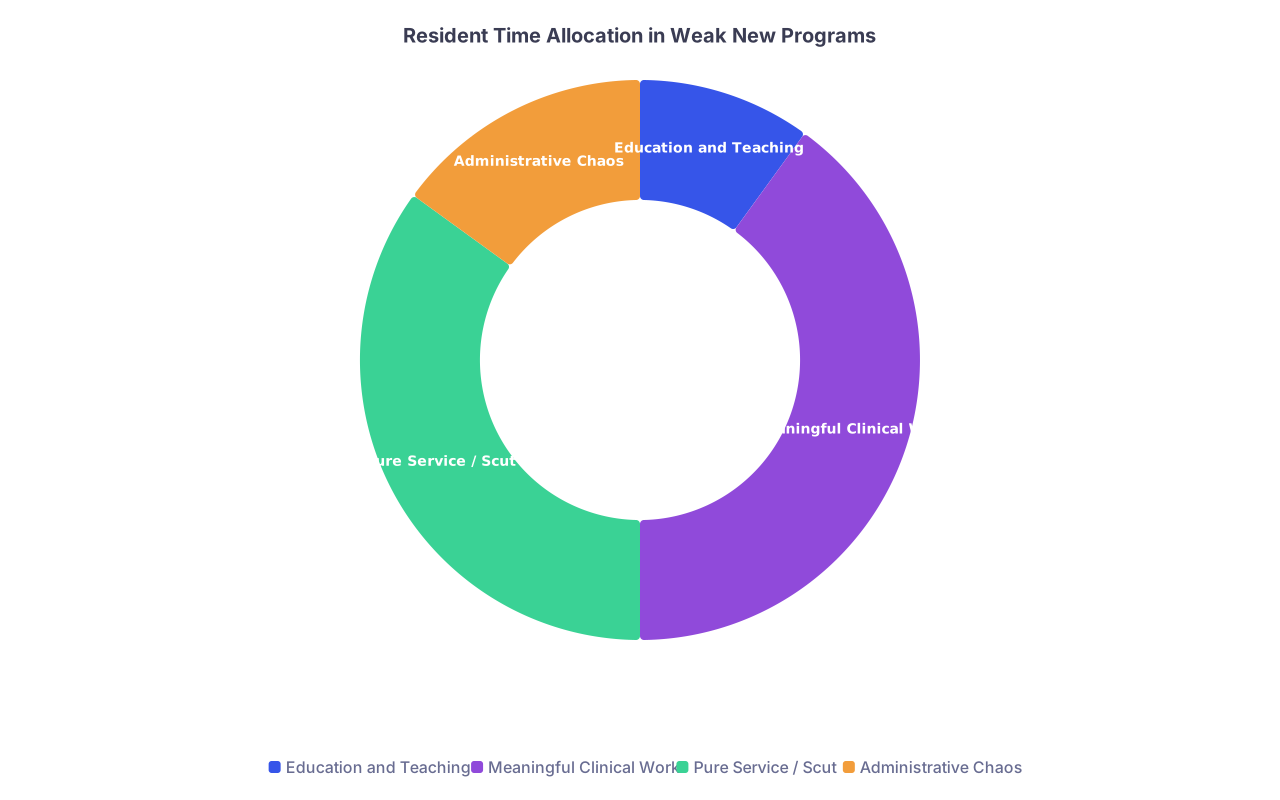
| Category | Value |
|---|---|
| Education and Teaching | 10 |
| Meaningful Clinical Work | 40 |
| Pure Service / Scut | 35 |
| Administrative Chaos | 15 |
Too much of your time can disappear into “system fill-in” instead of structured education. And brand prestige does not protect you from that.
How to Evaluate a Brand-New Program at a Big-Name Hospital (Without Getting Manipulated)
You should not automatically avoid every new program. But you must stop treating the logo as a safety net. Here is how you protect yourself.
1. Ignore the Name for the First 30 Minutes
Do this mentally: cover the hospital name with your hand. Now evaluate:
- Age of the program. How many classes have graduated?
- Board pass rates for recent grads, if any.
- Where graduates matched for fellowship or took their first jobs.
- Presence and stability of core program leadership (PD, APDs, chief residents).
If they have no graduates yet, your risk goes up significantly. The first 1–2 classes are pure experiments. You might choose that, but do not pretend otherwise.

| Step | Description |
|---|---|
| Step 1 | Interested in new program |
| Step 2 | Ignore name for now |
| Step 3 | High risk - founding class |
| Step 4 | Review outcomes |
| Step 5 | Moderate risk |
| Step 6 | Increased risk |
| Step 7 | Ask hard questions about structure |
| Step 8 | Brand name influencing you |
| Step 9 | Any graduates yet |
| Step 10 | Leadership with prior PD/APD success |
2. Drill Into Leadership Experience
Do not be shy here. You are trusting them with your career.
Ask:
- “What other programs have you led or been core faculty for?”
- “What happened to those programs over time—growth, accreditation, fellowships?”
- “Can you describe a concrete example where you improved resident education at a prior institution?”
Vague answers = red flag.
“First time being a PD, but I have always wanted to teach” is not enough for a brand-new program in a complex system.
You want leaders who either:
- Have successfully run programs before, or
- Have a clear, detailed, realistic educational plan anchored in actual infrastructure, not just buzzwords.
3. Ask Residents the Questions That Make Them Uncomfortable
If you are interviewing and there are already residents there, they are your best reality check. Not the brochure. Not the PD.
Ask them, privately if you can:
- “What surprised you in a bad way about training here?”
- “What changed between recruitment and reality?”
- “If you had to do it again, would you come here? Why or why not?”
- “Have you ever seriously considered transferring?”
Pay attention not just to their words, but their face and tone. Hesitation is information.
4. Verify Actual Educational Structure, Not Promises
Do not accept “we are building” as an answer to everything.
Request or ask about:
- Current block schedules with actual sites named.
- Confirmed teaching conferences: how often, attendance expectations, who runs them.
- Protected didactic time—has it really been protected or constantly eroded by “just one more admission”?
If multiple answers are “we are planning to…” instead of “we currently…” then you are signing up for uncertainty. At that point, the brand name should count for almost nothing in your decision.
5. Be Honest About Your Risk Tolerance
Some people are wired to handle chaos and ambiguity. Some are not. You need to know which one you are.
You should avoid being a founding or early class in a new brand-name hospital program if:
- You are pursuing a hyper-competitive fellowship and need an unambiguous track record.
- You do poorly in disorganized environments.
- You already carry significant life stress (family, finances, health).
Do not sacrifice your mental health and long-term trajectory so that a hospital system can cheaply build out its GME portfolio.
When a Brand-New Program Might Actually Be Worth It
Let me be fair. Not every new program at a big hospital is a trap. Sometimes they really are building something excellent—and fast.
You can cautiously consider these programs if:
- Leadership has a strong, documented history of success elsewhere.
- The hospital has a long tradition of education in other specialties and is expanding logically (for example, adding an IM program to a place with longstanding fellowships and surgical residencies).
- They have already secured core rotations with clear, stable faculty who are invested in teaching.
- You see early classes matching into solid fellowships or landing respected jobs.
Even then, compare them against established, “less sexy” programs. If the only real advantage is a shinier logo and a more famous city, you are likely being seduced by branding, not substance.
FAQ: Do Not Let These Questions Go Unasked
1. Is it always a bad idea to be in the first class of a new residency program?
No, not always—but it is always high risk. Being the founding class at a small community program with deeply committed, experienced leadership can be safer than being the founding class at a huge branded hospital that sees residents as workforce expansion. If you choose to be first, do it with your eyes open and a solid backup plan for what you will do if the program deteriorates or you need to transfer.
2. How much should fellowship ambitions influence my willingness to join a new brand-name program?
A lot. If you want cardiology, GI, derm, ortho, or any fellowship where letters and program reputation carry heavy weight, you should be very wary of being early in a new program’s life cycle—brand name or not. Fellowship directors care far more about how residents from your program have performed than about which giant logo sits at the entrance.
3. Does ACGME accreditation guarantee a new program is “safe”?
No. Accreditation just means the program meets minimum standards on paper and passed an initial review. It does not guarantee stable leadership, healthy culture, reasonable workloads, or strong teaching. I have seen fully accredited programs where residents were miserable and undertrained. Accreditation is baseline, not a seal of quality.
4. What if my main goal is to live in a particular city and the only option there is a new brand-name hospital program?
Then admit that you are prioritizing geography and lifestyle over training certainty. Some people do that and still do well, but do not pretend the training risk disappears. If you take that path, commit to aggressively seeking mentors, external research, and away rotations to protect your future options in case the program is weaker than advertised.
5. How can I tell if a brand-name hospital is using residents mainly for service?
Look for patterns: constant talk about “coverage needs,” heavy night and weekend demands without matching educational benefits, thin or frequently canceled conferences, attendings who round fast and disappear, and residents who look chronically exhausted and vaguely cynical. If residents sigh before answering questions about workload or quietly warn you “it is very busy, but we are learning,” interpret that as: service load is high, and education may be secondary.
Two things to walk away with:
- A powerful logo on the building does not protect you from the growing pains, chaos, and misalignment that plague new residency programs.
- Never let a brand name substitute for hard questions about leadership, structure, outcomes, and how residents’ lives actually look on the ground.
You get only one residency in this specialty. Do not trade it for marketing.