
It’s March of your MS3 year. You’re walking past the GME office bulletin board and see a flyer: “NOW ACCEPTING APPLICATIONS – Inaugural Class, [Your Hospital] Internal Medicine Residency.”
You stop. Because this is your home hospital. Your attendings. Your patients. Your city.
And now there’s a brand-new residency program popping up right as you’re trying to plan your future.
You’ve got immediate questions:
- Is this an opportunity or a trap?
- Should you try to be part of the first class?
- How do residency programs even get started?
- Will this help your application elsewhere—or make you look like you’re settling?
Let’s walk through what to actually do in this situation. Not theory. Not fluff. The real moves.
1. First Reality Check: New Programs Are Not All the Same
Do not lump all “new programs” into one bucket. A brand-new psych program at a giant, respected academic center is not the same as a random community hospital suddenly launching neurosurgery.
The risk-reward profile depends on three things:
- Who’s actually running it
- What infrastructure already exists
- Why the program is being started now
You need to figure those out early.
Start with basic reconnaissance
Ask these concrete questions and write the answers down somewhere:
- What specialty is the program?
- How many residents per year?
- Who is the Program Director (PD)? Where did they train? Previous leadership roles?
- What’s the sponsoring institution? Is it ACGME-accredited for other residencies already?
- Does the hospital already train residents in anything (FM, IM, surgery, EM, etc.)?
- Did they just get ACGME Initial Accreditation or are they still in the pipeline?
If your hospital already has several strong ACGME-accredited residencies and they’re just adding another one—lower risk. If this is the very first residency of any kind at a hospital, that’s significantly higher risk.
2. Understand the ACGME Reality (Without Becoming a Policy Nerd)
You do not need to memorize the ACGME manual. But you do need to understand the skeleton of how this works, because it tells you what you’re walking into.

| Step | Description |
|---|---|
| Step 1 | Idea for New Program |
| Step 2 | Develop Curriculum |
| Step 3 | ACGME Application |
| Step 4 | Site Visit |
| Step 5 | Initial Accreditation |
| Step 6 | Recruit First Class |
| Step 7 | ACGME Reviews and Citations |
| Step 8 | Continued Accreditation or Probation |
Key point: if they are recruiting residents, they already hold Initial Accreditation. That means ACGME has at least checked the basics: faculty, structure, supervision, duty hours, etc.
What Initial Accreditation does not guarantee:
- Stable leadership
- Good culture
- Reasonable workload
- Good fellowship or job placement
- Competent teaching
I’ve seen programs with full accreditation that are dysfunctional and miserable. And I’ve seen new programs with rock-solid leadership that produce phenomenal grads.
So you treat “ACGME approved” as the minimum safety bar, not a stamp of quality.
3. How This Affects You as a Student Right Now
Let’s talk immediate impact before we talk about whether you should match there.
Your rotations may change
When a hospital starts a new residency while you’re a student, three things usually happen:
- Attendings suddenly care more about teaching structure.
- Students may get slightly pushed aside on some services as residents arrive.
- New rotations or electives may appear, especially “Acting Internship” experiences.
You might see:
- New teaching conferences: morning report, noon conference, journal club.
- Attendings practicing “handing off” to imaginary residents before the first class even arrives.
- The med school trying to “align” clerkships with the new program.
Your move:
- Get on those services early. If there’s a new IM or EM service gearing up for residents, ask your clerkship director if you can rotate there.
- Attend the conferences even if they’re “resident-focused.” You’ll learn and you’ll get seen.
- Start remembering names: core faculty, PD, APDs, GME staff.
This is now social capital for you.
4. Should You Apply to This New Program?
That’s probably the question that brought you here. Let’s be blunt.
You should consider applying if:
- You like the hospital and the patient population.
- You trust the leadership. (You’ve seen them on the wards, you know their reputation.)
- The specialty is one where new programs are not insane (IM, FM, peds, psych, EM in some settings).
- You’re not sitting on a 270/270, 4 pubs, and 3 national presentations for derm. In other words, you’re competitive but not automatic anywhere.
You should be cautious or avoid if:
- The hospital has a history of chaos—constant leadership turnover, financial trouble, or poor care.
- The new program is in a highly specialized surgical field and the hospital volume is marginal.
- You hear faculty saying things like “We’re going to rely on the residents to cover all this overnight; it’ll solve all our staffing issues.” Red flag.
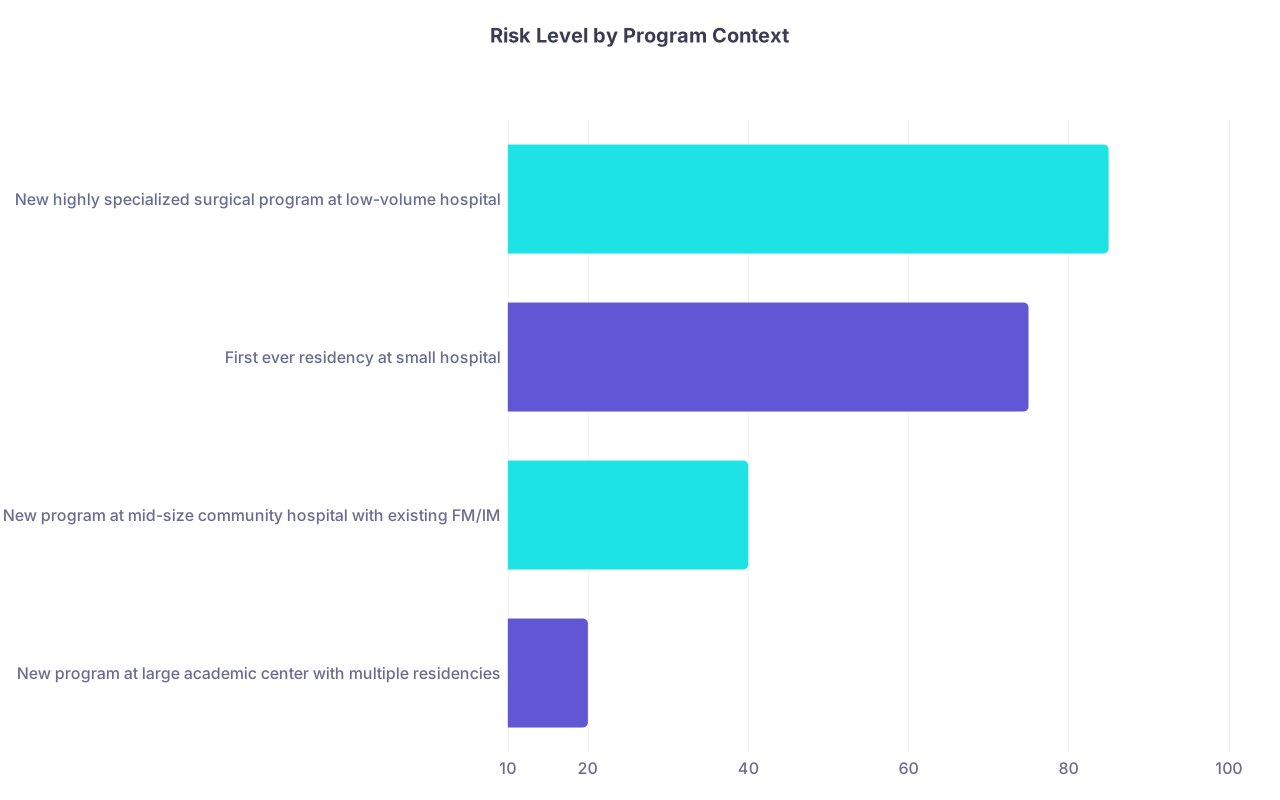
| Category | Value |
|---|---|
| New program at large academic center with multiple residencies | 20 |
| New program at mid-size community hospital with existing FM/IM | 40 |
| First ever residency at small hospital | 75 |
| New highly specialized surgical program at low-volume hospital | 85 |
(Think of these numbers as “risk units.” Lower is better.)
5. How to Vet the Program From the Inside (Your Hidden Advantage)
You have something outside applicants won’t: access. Use it.
Here’s how you actually evaluate this new program instead of guessing.
Step 1: Talk to the people who’ll be in the trenches
Find:
- GME office staff (“Residency coordinator” or “Program administrator”)
- Future core faculty
- The PD and associate PDs
- Any fellows in that specialty if they exist
Ask specific questions:
- “What’s the vision for this program in 5 years?”
- “What kind of resident are you hoping to attract?”
- “Where do you see graduates going—fellowships, hospitalist, community practice?”
- “How are you planning to balance service vs education as you ramp up?”
You’re not interrogating them. You’re listening for whether they’ve actually thought about these issues or they’re just winging it.
Step 2: Look for infrastructure, not brochures
Things that mean they’re serious:
- A real, populated conference schedule (morning report, didactics, M&M, journal club).
- A working evaluation system (MedHub/New Innovations/whatever) already being used for students.
- A clear policy document for supervision, handoffs, duty hours.
- Faculty meetings happening regularly and visibly.
Red flags:
- Nobody knows the exact number of residents they’re recruiting.
- Faculty shrug when you ask about curriculum structure.
- “We’re still figuring that out” is the answer to half your questions.
- Every answer is about service needs, not education.
6. Using the New Program to Boost Your Application Anywhere
Even if you have zero intention of going there, a new program at your home hospital is leverage. You can use it for:
- Letters of recommendation
- Sub-I / AI experiences
- Research or QI projects
- Leadership roles
Here’s how.
A. Get in early with the PD and core faculty
Do:
- Ask to do an AI or elective specifically with the future residency team.
- Volunteer for small projects: designing teaching cases, helping with simulation days, collecting QI data.
- Show up to anything “pilot” they run for lectures and offer feedback.
Your ask later: a strong letter that says you helped with early program building, curriculum development, or QI. That absolutely plays well to other programs—shows initiative and systems-level thinking.
B. Turn the “new program” situation into a story
Program directors love hearing that you understand systems and change.
On your personal statement or in interviews, you can say things like:
- “During my clinical years, my home institution was launching a new residency program in X. I got involved with…”
- “Working with the new program leadership taught me how much invisible work goes into creating a safe and educational training environment…”
That’s not fluff. It shows you’ve seen behind the curtain.
7. Deciding Whether to Rank the New Program (If You Apply)
Fast forward: you applied. Maybe you interviewed. Now you’re sitting at your computer building a rank list and this new program is in the mix.
Here’s how to think about it.
| Factor | What You Want to See |
|---|---|
| Leadership | Clear vision, stable PD, accessible faculty |
| Existing Infrastructure | Other residencies, GME support, teaching culture |
| Volume and Case Mix | Enough patients and complexity to train you well |
| Graduate Outcomes Plan | Realistic ideas about jobs and fellowships |
| Resident Support Systems | Wellness, backups, response to problems |
Ask yourself three brutal questions:
- If this program were 10 years old with the same leadership and hospital, would I be excited to match here?
- Do I trust these people enough to let them shape my career?
- If the program grows slower than expected—fewer electives, less research—will I still be okay?
If the answer to #1 is “no,” stop trying to justify it because it’s local or convenient. If you wouldn’t want it mature, you shouldn’t want it new.
If your Step scores, grades, and letters put you on the bubble for your dream tier, a new home program can be a very reasonable safety net. Just be honest with yourself about that.
8. Common Student Fears (And What’s Actually True)
Let’s knock down or clarify a few things I hear every year.
“Will other programs think less of me if I rank or match at a new program?”
No. They’re not even in the conversation once you’ve matched. After Match Day, nobody cares how old your program is. They care whether you’re competent and whether your PD writes a good letter later.
What does matter: whether your program leadership is respected in the field and networked enough to help you get a fellowship or job.
“Will my training be worse at a new program?”
It can be, if leadership is weak and the hospital is chaotic. But I’ve seen the opposite: early residents get incredible one-on-one time with attendings because faculty are over-committed to making it work.
Your training quality comes from:
- Patient volume
- Case complexity
- Faculty engagement
- Your own effort
Age of program is secondary. It’s a risk factor, not a death sentence.
“Will it hurt my fellowship chances?”
If the program is at a known institution with solid faculty letters, you’ll be fine. Especially in core fields like IM or peds. For hyper-competitive procedural fellowships, yes, being from a brand-new small program may make the road steeper—but not closed.
9. How to Talk About the New Program in Interviews
You’re going to get asked about it. Either by that program or by others.
Here’s how to position it intelligently.
When visiting other programs and they ask about your home institution’s new program:
You:
“I’ve actually had a front-row seat as my home hospital launched a new X residency. I’ve worked with the program director and faculty as they built out the curriculum and conferences. It gave me a lot of respect for what it takes behind the scenes to run a good training environment—and it also made me more thoughtful about what I’m looking for in a residency.”
You’re not trashing or overselling it. You’re showing insight.
At the new program’s interview:
You:
“Because I’ve trained here as a student, I’ve seen both the strengths of this hospital and some areas where a residency could have real impact. What excites me about being in an inaugural cohort is the chance to help shape systems early—things like [X, Y, Z you’ve actually seen]. I’m very aware that there’s some uncertainty with a new program, but having seen the leadership and infrastructure here, I’d be comfortable training in that environment.”
They know their program is new. They want to see if you’ve thought about the risk and still choose them deliberately, not just because it’s close to home.
10. If You Decide Not to Touch the New Program at All
Totally valid. Maybe the vibe is bad. Maybe leadership is a mess. Maybe the specialty is just wrong for a brand-new program at a small hospital.
If you opt out:
- Still use the situation for learning and networking. Go to some conferences. Talk to the PD anyway.
- Do not trash the program in public. Medicine is small. PDs talk.
- If asked about it in interviews, be neutral and professional:
- “I’m excited the hospital is growing its GME footprint, but my personal interests and career goals fit better with programs that already have X/Y/Z in place.”
That’s much better than, “Oh, I didn’t want to be a guinea pig.”
11. The Long Game: What This Says About the Future of Medicine
Your hospital starting a new residency while you’re a student is not a random event. It’s part of a bigger shift:
- Hospitals want residents because they need workforce.
- GME is expanding, often faster than faculty and infrastructure.
- Many regions are trying to “grow their own” physicians to stay local.
So you’re seeing the early stages of what your generation of doctors is going to live with: more programs, more variability in quality, more responsibility on you to vet where you train rather than trusting the brand name alone.
Treat this as training for your career decisions:
- First job
- Fellowship
- Leadership roles
- Moving to new systems
You’re learning to read beyond the brochure and figure out what an organization is really like on the inside. That skill will matter more than any shelf score.
FAQ (Exactly 3 Questions)
1. If I match at a brand-new residency, can the program lose accreditation while I’m there? What happens to me?
Yes, in extreme cases programs can lose accreditation, but it’s rare and usually preceded by warnings and citations. If ACGME pulls accreditation, there’s a formal process to help residents transfer to other programs. It’s stressful and chaotic, but you’re not left without options. The more established the institution and the more other accredited programs it already runs, the lower this risk tends to be.
2. Is it easier to match at a new residency program?
Often yes—at least in the first couple of cycles. Many applicants are wary of being the “guinea pig,” so newer programs sometimes struggle to fill, especially outside major cities or in less popular specialties. That can be an opportunity if you’re a solid but not superstar applicant. Just don’t let “easier to match” be the only reason you rank them.
3. How do I tell if the program director at a new program is actually good?
Watch how they behave on the wards and in meetings, not how they talk on interview day. Good PDs: know the nurses and staff by name, give specific teaching pearls on rounds, respond to feedback without getting defensive, and can clearly explain their vision for the program with concrete examples. Bad signs: vague answers to direct questions, blaming “the system” for everything, or obsessing over service coverage while barely mentioning education or resident development.
Key Takeaways:
- New residency programs are neither automatic gold mines nor automatic disasters—you have to judge leadership, infrastructure, and hospital reality.
- As a student at the home hospital, you have inside access—use it for letters, projects, and a clearer picture than any outside applicant will ever get.
- Whether or not you apply there, treat this as reps for your future: learning how to evaluate an institution matters just as much as your next test score.