

Last week, a friend called me right after an interview day, voice shaking. A program director had basically asked her to promise she’d rank them first, then hinted she’d “do well in the Match if she reciprocated their interest.” She hung up, stared at the wall, and said the thing I’ve heard way too many times: “If I report this, am I just destroying my own chances?”
If you’re reading this, I’m guessing you’ve got that same knot in your stomach. You think a program violated NRMP rules. You’re pretty sure it wasn’t okay. But you’re terrified that speaking up means you’ll be blacklisted, not just by that program but somehow by everyone. Because of course the Match already feels rigged against you, and the last thing you want to do is poke the bear.
Let’s walk through this like two stressed applicants talking in an empty call room.
First: What “violating NRMP rules” usually looks like
You’re not crazy for wondering if something is wrong. Most of the time, people get that gut feeling for a reason.
Common scenarios I keep hearing over and over:
- “If you rank us highly, you’ll match here.”
- “We’d like some reassurance you’ll rank us first.”
- “Your chances depend a lot on how you plan to rank us. Can you tell me?”
- A program directly asking for your rank list, or to send a screenshot.
- Pressure to verbally commit: “We want you if you want us, so can we take that as a commitment you’ll rank us first?”
Then there’s the more subtle stuff:
- “We don’t usually rank people who aren’t serious about coming here, so we need to know if you’ll rank us high.”
- “If you tell us we’re your number one, we’ll rank you to match.”
- “Our program requires a pre-Match commitment call.”
- Asking you where else you’re interviewing and reacting with weird pressure.
Those are not just “awkward.” A lot of that is straight-up against NRMP Match Participation Agreement rules. Programs aren’t allowed to ask you to disclose or commit your rank order list. They also can’t make your ranking them highly a condition for ranking you.
But here’s the part that’s twisting your stomach: even if what they did is clearly wrong, will reporting it blow back on you?
The big fear: Will reporting hurt my chances of matching?
Let me be blunt: this is the fear that paralyzes almost everyone.
You start spiraling:
- “Will this program find out it was me?”
- “Will they pull my rank? Retaliate?”
- “Will the NRMP flag me somehow?”
- “What if other programs hear about it and think I’m a problem applicant?”
I’ve heard all of this. I’ve felt all of this.
Reality is a lot less dramatic than your 2 a.m. catastrophizing brain is telling you.
The NRMP has a whole system for this. When you submit a violation report, they do not send out a mass email saying, “Applicant X reported Program Y.” They don’t add some secret “troublemaker” tag to your ERAS. Programs don’t get a list of “complainers.”
Could a program guess it was you if there were only 2 candidates on that day or you were the only one they did this with? Sure. That’s the piece that keeps people up at night. But that’s not the same as “all programs will now hate me.”
To break it down a little more concretely:
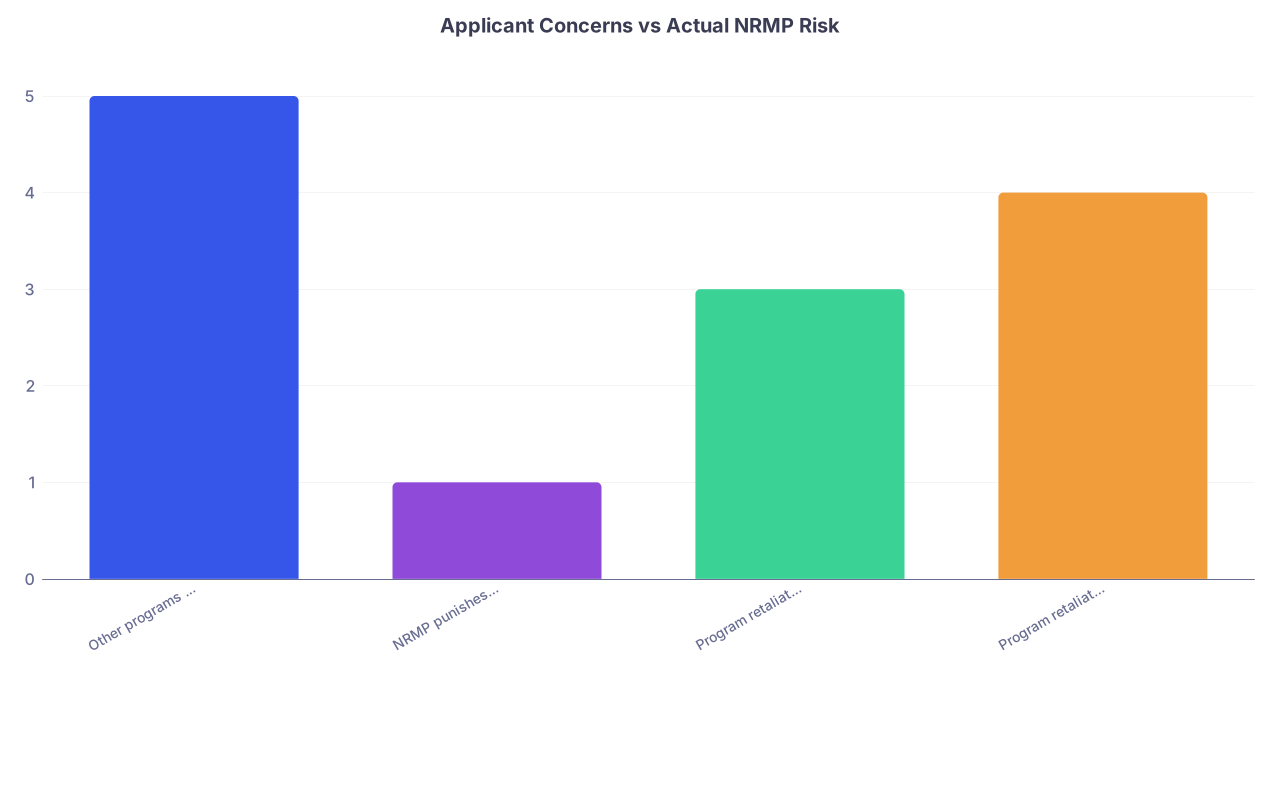
| Category | Value |
|---|---|
| Other programs know I reported | 5 |
| NRMP punishes me | 1 |
| Program retaliates pre-Match | 3 |
| Program retaliates after learning outcome | 4 |
Think of 1 as very unlikely, 5 as most anxiety-provoking (not necessarily most likely—just what your brain screams about most).
- Other programs knowing? Very low. There’s no mechanism for that unless you tell people.
- NRMP punishing you? Basically no, unless you yourself break rules.
- Retaliation? This is the one people obsess about. It’s theoretically possible, but programs know they are under scrutiny, not you. And they also don’t want to end up in NRMP’s violation reports.
I won’t sugarcoat it: if this is a very small specialty, a tiny program, a tight-knit PD inner circle, you might worry they’ll put 2 and 2 together. I get that. But the idea that reporting one violation destroys your entire career? No. I’ve simply never seen that happen.
What actually happens if you report an NRMP violation
This is the part nobody explains well, which is why it seems so mysterious and dangerous.
Step-by-step, very roughly:
- You submit a report through the NRMP (usually online).
- You give details: who, what was said, when, any documentation (emails, screenshots, notes).
- NRMP reviews. They may contact you for clarification. They may also contact the program.
- If they open an investigation, they’ll look at patterns: Is this happening to multiple applicants? Is it a one-off? Is it systemic?
- If they determine a violation, the consequences are usually on the program—not you.
For programs, consequences can include:
- Being flagged publicly on the NRMP’s “Violation Report.”
- Being barred from a future Match cycle.
- Being required to do remedial actions.
Compare that to what happens to you: nothing punitive, unless you yourself broke rules (like accepting a binding pre-Match outside the system or lying in an official way).
Is the process emotionally draining? Yeah, it can be. You relive the situation. You worry about fallout. But structurally, the power of the NRMP is aimed at keeping programs in check, not at punishing vulnerable, stressed-out fourth-years.
Should you report? Honest pros and cons
Here’s where your brain is probably doing that awful ping-pong: “I should do the right thing” vs “I don’t want to ruin my life over this.”
Let’s strip this down.
Reasons people choose to report:
- The behavior was clearly coercive. It wasn’t just “awkward small talk”; it was targeted pressure.
- They don’t want future applicants to get put in the same position.
- The program’s behavior feels like a pattern (you’ve heard similar stories from other applicants).
- They want documentation in case anything else weird happens with that program.
Reasons people choose not to report right now:
- They’re terrified of jeopardizing Match chances.
- This is their dream specialty or geographic area, and the program is “too important” in that ecosystem.
- They’re emotionally at capacity and can’t handle another stressful process on top of apps, rotations, and Step exams.
- They’re not 100% sure what happened actually qualifies as a violation.
And here’s the uncomfortable truth: both choices are valid. You’re not a bad person if you don’t have the bandwidth or courage to be the whistleblower this cycle. You’re also not overreacting if you decide, “No, this crossed a line and I want it on record.”
One thing that can help: clarify whether what happened is definitely a violation vs just gross but technically allowed.
| Scenario | Likely Status |
|---|---|
| “Will you rank us first?” | High risk of NRMP violation |
| “We will rank you highly” (unsolicited) | Allowed but shady |
| “If you promise to rank us first, we’ll rank you to match” | Clear violation |
| Asking your rank list or screenshot | Clear violation |
| Non-binding “we like you” email | Allowed, common |
If yours looks like the “clear violation” column, you’re not misreading the situation.
How to protect yourself while still keeping options open
There’s the ideal world, and then there’s the world you’re actually applying in. Your job is to get through this mostly intact.
Some concrete things you can do, even if you’re not ready to file anything official:
Write everything down now.
Date, time, who was in the room, what they said—actual phrases as close as you remember. Your brain will try to soften or distort it later. Don’t let it.Keep receipts.
If anything was in writing—emails, interview portal messages, text reminders that were sketchy—save screenshots. Back them up somewhere not tied only to your school email.Talk to someone who’s not in the program.
Dean of students, academic advisor, trusted faculty from another program, or even your student affairs office. Ask, “Is this an NRMP red flag?” and get a real-world read.Don’t engage in rule-breaking yourself.
If they push you for ranking promises, you’re allowed to be vague:- “I’m still finalizing my list.”
- “I’m very interested, but I won’t know my exact list until closer to the deadline.”
Do not send written promises, rank screenshots, or anything that could put you in the wrong.
If you do report, time it strategically.
Some people wait until after submitting rank lists. Some even wait until after Match. Is that ideal for regulation? Maybe not. But it’s a way to protect your mental health and sense of safety, and yes—that matters.
What about being “blacklisted”?
This word comes up constantly. Like there’s some inter-program Slack channel where they say, “Watch out for this applicant, they reported us.”
In practice?
- Programs don’t get to see “this applicant filed an NRMP report.”
- Most PDs are too busy fighting their own fires to organize some coordinated blacklist.
- The programs most likely to retaliate are also the ones NRMP is more likely to keep an eye on, especially if there are multiple complaints.
The darker truth: the real “blacklists” in medicine often happen informally—whispers, word of mouth, personality clashes—long before anyone talks about rules. But an official NRMP complaint is not some automatic branding.
If anything, programs that have been hit with an NRMP violation are the ones that quietly panic and get extra cautious, because they know another violation can get them publicly shamed or banned.
Can I promise you there is zero risk of a single vindictive person making your life harder? No. Attending-level pettiness is a thing. But the vision of your entire Match collapsing because you dared to report something? That’s your fear talking, not the actual mechanics of the system.
How to decide what you can live with
Strip away the noise and come back to two simple questions:
- If I say nothing, will this eat at me later?
- If I report it now, will I be so anxious about retaliation that it wrecks the rest of my application season?
You’re balancing emotional safety now vs systemic safety for future applicants. That’s a heavy thing to lay on one fourth-year’s shoulders. Honestly, it shouldn’t all fall on you, but here we are.
Some people make a compromise: document now, file later. After rank lists. Or even after Match day, once you know where you’re going and the immediate threat brain has calmed down. It’s not perfect, but it’s something.
Also, remember: you don’t have to decide overnight. You can:
- Write it all down.
- Talk to your dean or advisor.
- Sleep on it for a week.
- Then decide what feels survivable for you.
You’re not the NRMP police. You’re a stressed applicant trying to match.

| Step | Description |
|---|---|
| Step 1 | Possible NRMP Violation |
| Step 2 | Document details |
| Step 3 | Talk to dean or advisor |
| Step 4 | Save notes for later |
| Step 5 | Submit NRMP report now |
| Step 6 | Wait until after ranks or Match |
| Step 7 | Need to act now? |
| Step 8 | Report before rank list? |


