
You’ve just opened ERAS. Your personal statement file is sitting there: “IM_PS_FINAL.docx.”
Except now you’re wondering: you’re interested in cardiology and maybe pulmonary critical care. Or you like heme/onc but could also see yourself as a general internist.
And the question hits:
“Do I need a different personal statement for each subspecialty interest… or am I overthinking this?”
Here’s the answer you’re looking for.
The Short Answer: Usually No, Sometimes Yes
Let me be blunt.
If you’re applying to one core residency (e.g., Internal Medicine, Pediatrics, General Surgery) and simply have multiple future subspecialty interests?
You do not need a different personal statement for each subspecialty interest.
In fact, writing one statement that is:
- logically consistent
- future-facing but flexible
- and focused on the core specialty, not the fellowship
…is almost always the better move.
Where you might need different statements:
- You’re applying to more than one core specialty (e.g., IM and Anesthesiology).
- You’re applying to categorical and a very different preliminary backup (e.g., Neurology + TY or Prelim Surgery with a different story).
- You’re applying to standard and highly niche tracks that want very different things (e.g., IM categorical vs. Primary Care vs. Physician-Scientist Track).
Notice what’s missing from that list: “I like cardiology and GI” or “I like NICU and PICU.” That alone does not justify multiple PS versions.
Why Program Directors Don’t Want a Fellowship Essay Disguised as a PS

Most program directors skim your statement. They’re not doing literary criticism. They’re scanning for:
- Red flags (ego, lack of insight, bizarre logic)
- Alignment with the residency program’s mission
- Evidence that you understand what their core specialty actually is
- Maturity, resilience, and a consistent story
What they are not hiring for: your future cardiology fellowship.
You’re applying to their residency, not to hypothetical you-5-years-from-now.
So when you write an Internal Medicine statement that reads like a cardiology fellowship application:
- “I’ve always known I wanted to be a cardiologist…”
- “My goal is to train at a top-tier cardiology fellowship to do advanced EP procedures…”
It can backfire. Especially at community or balanced academic programs where:
- half their graduates go into primary care or hospitalist roles
- they don’t even have a cardiology fellowship
- they care more about: “Will this person be a solid intern?” than “Will they publish in Circulation?”
You can absolutely mention future subspecialty interest. Just do it proportionally.
One sentence, maybe a short paragraph. Not the whole essay.
Exactly When You Do Need Different Personal Statements
Let’s separate real reasons from fake reasons.
Real reasons to write different statements
Different core specialties
- IM vs. Neurology
- Pediatrics vs. Family Medicine
- General Surgery vs. Anesthesia
Each specialty wants a different narrative, different “why,” and often different clinical experiences highlighted.
Core vs. transitional / preliminary when the angle changes
Example: You’re applying:- Categorical Neurology (your primary goal)
- Transitional Year programs as a general clinical year
In that case, one statement can still often work. But if your Neuro PS is hyper-specific (“I’m committed to becoming an academic epileptologist…”) and your TY programs are broad community sites, you might want:
- A Neuro-focused PS for Neurology
- A more general “I want a strong, well-rounded clinical foundation” PS for TY
Distinct tracks with very different missions
Within the same specialty:- IM Categorical vs. Primary Care
- IM Categorical vs. Research/Physician-Scientist Track
- Pediatrics Categorical vs. Community Health / Advocacy Track
If a track explicitly says on their website: “We’re looking for applicants committed to X,” and your standard PS barely mentions X, then yes, consider a tailored version.
Fake reasons to write different statements
These are where applicants waste hours for no benefit.
- “I like cardiology and GI, so I should have two versions in case a GI PD reads it.”
- “I might do fellowship or might be a hospitalist, I need a separate one for each life path.”
- “I’m worried saying ‘cards’ will turn off programs without a fellowship.”
None of those justify multiple PS versions. You just need better wording in a single, coherent statement.
How to Mention Multiple Subspecialty Interests Without Sounding Scattered
A lot of anxiety comes from this scenario:
You genuinely like more than one area. You’ve got a cardiology project, a heme/onc attending who loves you, and you enjoyed your MICU month. You don’t want to lie or artificially pick one love.
Good. Don’t lie. But be deliberate in how you phrase it.
Here’s an approach that works:
Anchor everything in the core specialty.
Start by explaining why Internal Medicine (or whatever field) fits you:- The pace, the kind of thinking, the patient relationships, the team structure, etc.
Frame subspecialty interests as examples, not destinies.
Something like:During residency, I’m particularly excited to explore cardiology and pulmonology, areas where I’ve already enjoyed research and ICU exposure.
That says: “These are on my radar,” not “I will absolutely die if I don’t match cards.”
Keep the future open, not rigid.
Good wording:- “I’m leaning toward a career that combines inpatient medicine with subspecialty training, potentially in cardiology or pulmonary/critical care, while remaining open to where residency leads me.”
Bad wording:
- “My only goal is to match into a top-tier cardiology fellowship and perform complex interventions.”
Don’t make the whole essay about subspecialty content.
If your PS reads like a cardiology review article with some residency sprinkled in, it’s unbalanced. Bring it back to:- being an intern
- learning to manage common bread-and-butter problems
- being a good teammate
- developing as a clinician, not only as a future subspecialist
A Simple Framework: One Statement vs. Multiple
Here’s a decision grid you can run in under a minute.
| Situation | How Many PS Versions? |
|---|---|
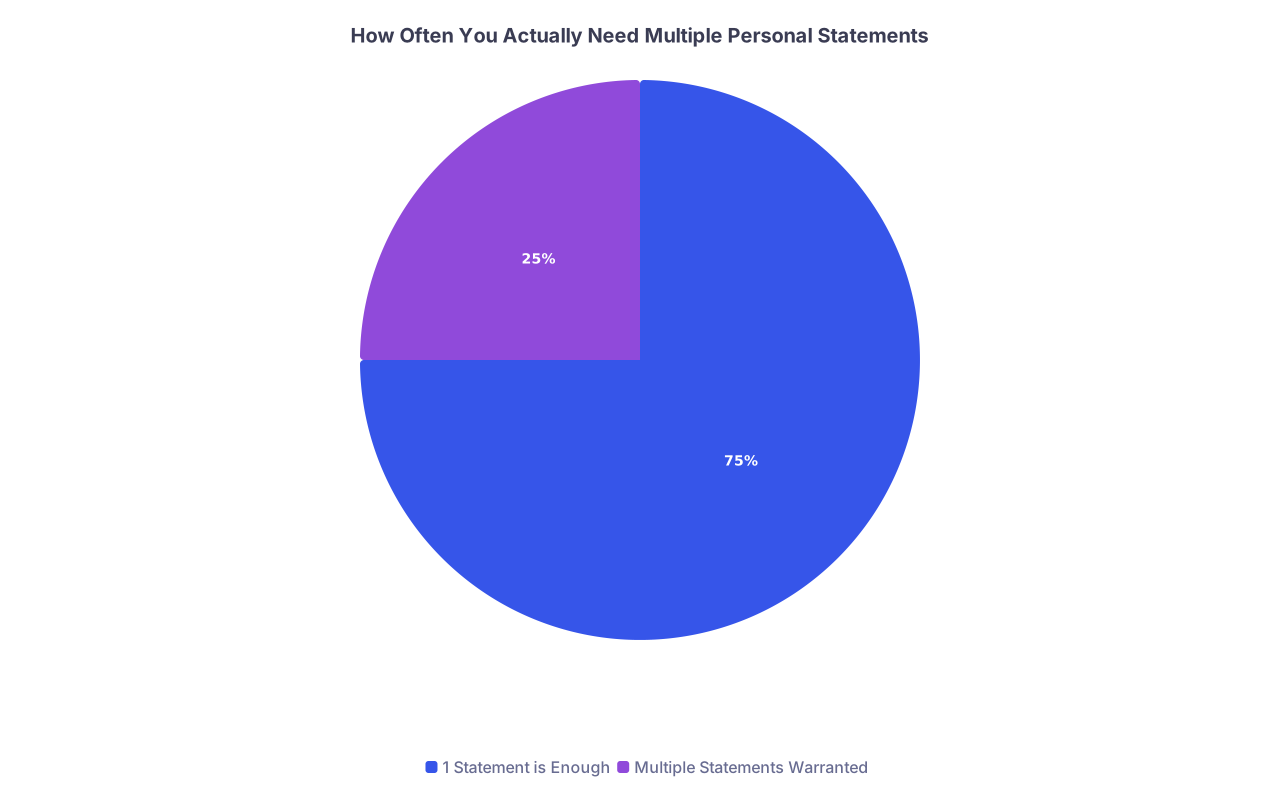
| One core specialty, several subspecialty interests | 1 |
| Two different core specialties (e.g., IM + Neuro) | 2 |
| One core specialty + TY or prelim as backup | 1–2 (case dependent) |
| Same specialty, categorical + research track | Usually 1, maybe 2 if research-heavy |
| Same specialty, categorical + primary care track | Usually 1, maybe 2 if PC-focused |
| Category | Value |
|---|---|
| 1 Statement is Enough | 75 |
| Multiple Statements Warranted | 25 |
Rule of thumb:
If the core story of “why this field?” and “what I want from residency” fundamentally changes, you probably need another statement. If the core story is the same and only the imagined fellowship changes, you don’t.
How to Write a Single Statement That Works Across Subspecialties
Let’s talk craft for a minute. Here’s how you structure one strong, flexible statement.
Hook with a core specialty moment, not a subspecialty fetish.
Good: an intern-level experience with diagnostic reasoning, longitudinal care, or a challenging patient encounter that shows you acting like a budding internist, pediatrician, surgeon, etc.Less good: “The first time I saw an LVAD…” unless your whole essay convincingly zooms back out to Internal Medicine as a whole.
Middle: Show growth across different settings.
Mix in:- inpatient + outpatient (if relevant)
- acute + chronic care
- team-based learning, feedback, and self-reflection
Use subspecialty moments as episodes inside a larger generalist arc.
One paragraph for future direction.
Literally one. For example:Looking ahead, I anticipate pursuing fellowship training, with current interests in hematology-oncology and pulmonary/critical care. My research in lymphoma outcomes and my time in the MICU have both been energizing. At the same time, I value the breadth and continuity of inpatient Internal Medicine and remain open to how residency will shape my ultimate path.
That paragraph works at:
- community programs
- big academic centers
- places with or without those specific fellowships
Because it’s balanced, not dogmatic.
Close with what you offer the residency, not what they can do for your fellowship dreams.
PDs want to read about:- your reliability
- your work ethic (without cliché)
- how you function on teams
- your attitude when things are hard
“I will be a curious, thorough intern,” lands better than “I will bring prestige to your program when I match a top fellowship.”
A Few Concrete Examples (Good vs. Bad Phrasing)

Example 1: Overcommitted subspecialty
Bad:
I am applying to Internal Medicine so I can become a cardiologist. Since my first echo in medical school, I have been certain that general medicine is only a stepping stone to the cath lab.
Better:
Internal Medicine appeals to me because it combines complex problem-solving with sustained relationships across time and settings. Within that broad field, cardiology has been a particular interest, especially through my work on heart failure readmissions, but I’m most excited to build a strong foundation as a resident caring for diverse adults with a wide range of conditions.
Example 2: Multiple interests, sounds scattered
Bad:
I love cardiology, heme/onc, nephrology, and GI. I can see myself in any of them. I hope residency helps me decide.
Better:
Within Internal Medicine, I’ve been drawn to the longitudinal care and serious illness conversations in heme/onc, as well as the physiology-driven decision-making in nephrology. Rather than having a single fixed destination, I’m looking for a residency that will expose me to a range of subspecialties while pushing me to grow into a thoughtful, reliable internist first.
How Programs Actually Read This Stuff
Here’s the unpolished truth I’ve heard repeatedly in committee rooms.
Most programs:
Spend way more time on:
- Your letters
- MSPE
- Transcript
- Step scores (where still relevant)
- CV / research
Use your personal statement mainly to:
- explain red flags (leaves of absence, career changes)
- understand context (non-traditional background, major challenges)
- confirm that you can string coherent sentences together
- get a feel for your voice
They are not mapping your subspecialty interests to their faculty one by one.
The only time your subspecialty obsession hurts you is when it screams:
- “This person is going to be miserable if they do not get their dream fellowship.”
- “They see our residency as a necessary evil, not a formative training period.”
Avoid that, and you’re fine.
Practical Workflow: What You Should Actually Do This Week

| Step | Description |
|---|---|
| Step 1 | List specialties youre applying to |
| Step 2 | Plan separate PS for each |
| Step 3 | Draft single core PS |
| Step 4 | Add 1 paragraph on future interests |
| Step 5 | Polish and upload one PS |
| Step 6 | Decide if mission/angle differs |
| Step 7 | Create tailored variant |
| Step 8 | More than one core specialty? |
| Step 9 | Applying to TY/Prelim or special track? |
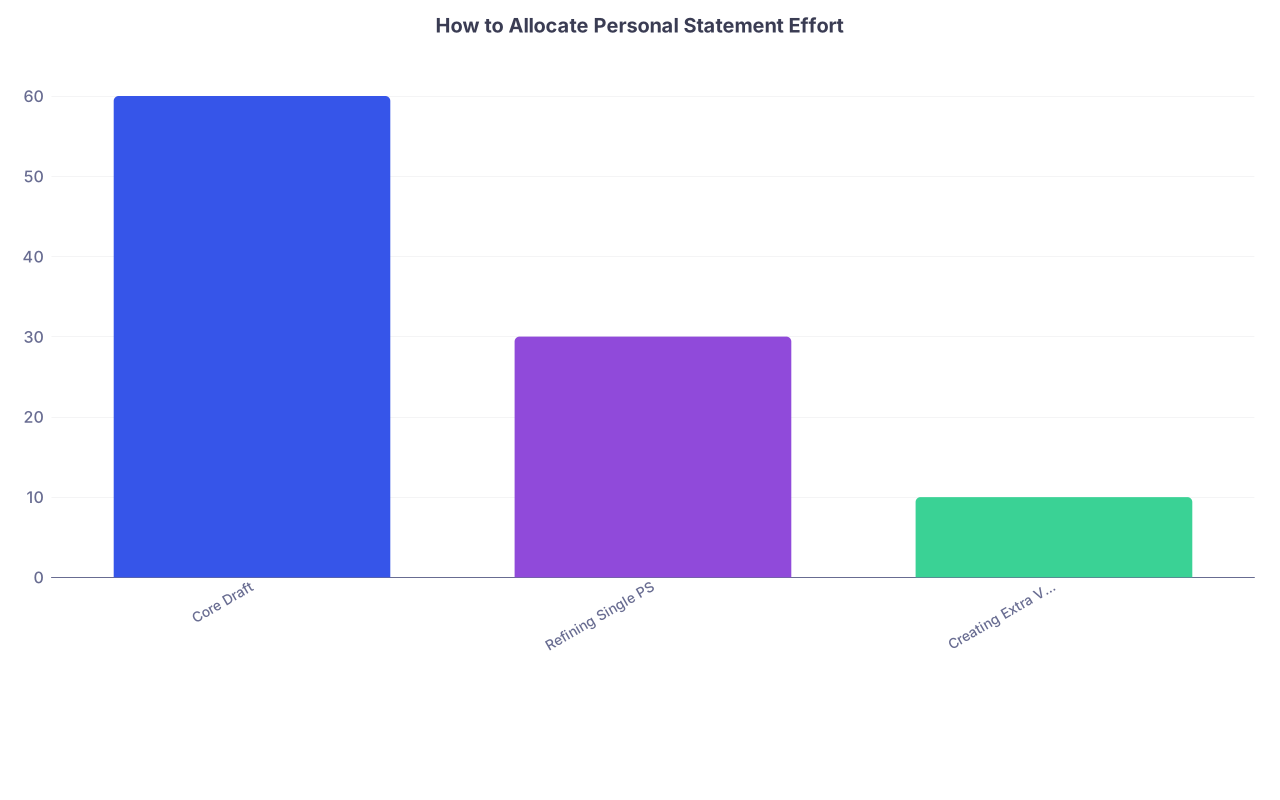
And if you like numbers, here’s how to think about your effort allocation.
| Category | Value |
|---|---|
| Core Draft | 60 |
| Refining Single PS | 30 |
| Creating Extra Versions | 10 |
You should be spending:
- ~60% of your time getting one strong core statement
- ~30% tightening it, cutting fluff, and cleaning language
- maybe 10% on extra versions, only if you truly need them based on different specialties or tracks
Not 50% of your time debating whether to change “cardiology” to “subspecialty training” in version B.
FAQ: Personal Statements and Subspecialty Interests
1. Will saying I’m “undecided” about subspecialty hurt me?
No. Saying “I’m open” or “I’m looking forward to exploring different paths within Internal Medicine” is normal and healthy. It actually sounds more grounded than claiming you’ve known since childhood that you must be a transplant hepatologist.
2. Should I avoid naming any subspecialty at all to stay safe?
No. A complete vacuum can make you sound disengaged. One or two interests mentioned briefly is ideal. It shows curiosity without rigidity. Just do not make your whole essay about one narrow field.
3. What if my research is in one subspecialty, but I’m leaning toward another?
That’s fine. Address it logically in a sentence or two: you gained skills and insight from that research, and residency will help you see where you fit long-term. No one expects perfect alignment at this stage.
4. I already uploaded a fellowship-heavy personal statement to ERAS. Do I need to fix it?
If your current statement reads like a fellowship application and barely mentions the core specialty or residency training, yes, you should fix it and re-upload before programs download. Shift the focus: core specialty first, fellowship as a possible future direction, one paragraph only.
5. I’m applying IM categorical and IM primary care tracks. One statement or two?
If your current PS already emphasizes continuity, outpatient care, communication, and underserved populations, you can probably use one. If your main PS is heavily inpatient/research/ICU-focused and you’re serious about primary care, write a PC-leaning variant that you assign only to those tracks.
Open your current personal statement right now and find every sentence that talks about a specific subspecialty. Ask yourself: “If I replaced the subspecialty name with ‘residency training in [core specialty],’ would the essay still make sense?” If the answer is no, rewrite until it does—then stop worrying about separate versions.