
The way most unmatched applicants rewrite their personal statement is wrong. They tweak a few sentences, add a pity paragraph about failing to match, and hope programs will not notice. Programs notice. And they are not impressed.
You are not doing a light edit. You are doing a salvage operation and a strategic rebuild. Treat it that way.
This is the playbook I have used with unmatched applicants who went from zero interviews to double digits the next cycle. It is not pretty. It is not soft. But it works if you are willing to be brutally honest and specific.
Step 1: Get Clear on What Actually Went Wrong
You cannot fix a personal statement in a vacuum. You have to understand your whole application failure first.
Here is the uncomfortable reality: for most unmatched applicants, the personal statement was not the ONLY problem. But it often made things worse or failed to compensate for weaknesses.
Start with a structured post‑mortem:
Pull your last ERAS application
Print it. Yes, print. Highlight:- Scores (USMLE/COMLEX, first-time passes or fails)
- Transcript: any failures, LOAs, repeats
- Clerkship grades, especially in target specialty
- Number and type of programs applied to
- Number of interviews received (if any)
- Letters of recommendation: from whom, how strong (honestly)
Categorize your main risk factors Use this rough triage:
- Academic risk: exam failures, low scores, remediation, gaps
- Specialty risk: late switch, weak exposure, few home rotations
- Professionalism risk: leaves of absence, red flags, poor narrative
- Competitiveness risk: aiming too high for your stats / specialty
- Communication risk: weak personal statement, generic experiences, unclear story
Identify where the statement failed you Ask yourself honestly:
- Did it explain why you chose this specialty with concrete evidence?
- Did it address any obvious red flags or weird timeline issues?
- Did it give a coherent, believable narrative that matched the rest of your app?
- Would a stranger reading it think, “I know what this person brings to my program”?
If the answer is no on multiple counts, you do not revise that statement. You scrap it and rebuild.
Step 2: Decide How Direct to Be About Not Matching
You have two options:
- Address the failed Match directly
- Address only the underlying issues, not the Match outcome
The right choice depends on how bad the previous cycle was and how “visible” the failure is.
You must address it directly in your personal statement if:
- You are applying in the same specialty after clearly applying previously
- You had very few or no interviews with an otherwise okay profile
- You had obvious problems (exam failures, professionalism concerns) that you did not explain last cycle
- You did a transitional year, prelim year, or research year clearly after not matching
You can be more subtle if:
- You switched specialties and have a plausible, well-supported pivot
- You had decent interviews and just got squeezed in a competitive field
- You already have a strong structured explanation in your MSPE or advisor letter
Here is the rule:
If a PD will look at your file and immediately think, “Why did this person not match?” and they do not see a convincing answer anywhere else, you address it in the statement. Briefly. Calmly. Strategically.
What you do not do:
- Whine about the process
- Blame programs, “fit,” or “bad luck”
- Turn the statement into a therapeutic essay
You acknowledge, frame, and pivot. That is it.
Step 3: Rebuild the Narrative From Zero
Most unmatched personal statements have the same problems:
- Too generic (“I have always wanted to be a doctor…”)
- Too descriptive and not reflective (lists events, no insight)
- Too fluffy (“I am passionate about…”) and not concrete (no proof)
- Too self-focused, not enough about what you offer a program
You fix this by rebuilding your structure, not just changing words.
A simple structure that actually works
Use this as your spine:
- Opening: Present, not childhood
- Evidence: 2–3 focused clinical experiences
- Growth and repair: How you have matured / improved since last cycle
- Program value: What you bring on Day 1 of residency
- Closing: Forward-looking, specific to the specialty
Now let us break those down.
Step 4: Craft a Strong Opening That Does Not Sound Desperate
Your opening paragraphs must do three things fast:
- Anchor you clearly in the specialty
- Show you understand real work in that field
- Make you sound like someone who has actually grown since last year
What you do not do:
Open with your unmatched status. Or with COVID. Or with some dramatic ICU story unless it truly changed your trajectory and you can prove that with actions.
Example of a weak “after not matching” opening:
Not matching last year was a painful experience, but it strengthened my resolve to pursue internal medicine. I have always been passionate about caring for others and I know I will be a hardworking and dedicated resident.
This tells me nothing. It sounds like 500 other statements.
Stronger version:
Over the past year, I have spent my mornings pre-rounding on a busy safety-net hospital ward and my evenings revisiting physiology textbooks I once rushed through. Working as an internal medicine preliminary resident after an unsuccessful Match cycle forced me to confront two realities: my preparation had not been enough, and I still could not imagine doing anything else.
Notice what changed:
- Concrete setting: safety-net hospital, wards
- Specific role: prelim resident
- Honest self-critique: preparation was not enough
- Affirmation of fit: still cannot imagine another path
If you did a research year, observership, or non-clinical gap year, you can still write a grounded opening. But you must show continued contact with medicine, not “I just waited and reapplied.”
Step 5: Show, Do Not Announce, Your Fit for the Specialty
This is where most people’s previous statements fell apart. They declared love for the specialty but did not prove it.
You need 2–3 specific, concrete experiences that:
- Show you understand the day-to-day of that field
- Show growth in judgment, communication, or reliability
- Match the skills PDs actually care about
Think in scenes, not slogans.
Instead of:
My neurology rotation confirmed my passion for the field.
Try:
On my neurology sub-internship, I followed Mr. K, a man in his 40s with new-onset seizures and rapidly progressive weakness. I watched the team balance the temptation to chase every rare diagnosis with the need to stabilize his airway and blood pressure first. Presenting his updates each morning forced me to prioritize data, distinguish what was noise, and defend my assessment when the fellow pushed back. That rotation taught me that neurology is not only about localization, but also about disciplined clinical reasoning and communication with frightened families.
Then you connect that to the specialty:
I am drawn to neurology because it demands this combination of methodical thinking and patient-centered explanation. The moments I remember most are not the unusual MRI findings, but sitting with Mr. K’s wife to explain why we needed another lumbar puncture and what we were ruling out each time.
PDs read this and think: this person gets what we do.
Now, because you are rewriting after an unsuccessful cycle, you also need to demonstrate trajectory. Not just isolated moments.
Use phrases like:
- “Since that rotation, I have…”
- “Over the past year, I have deliberately…”
- “Recognizing this weakness, I did…”
You are showing that you learn and self-correct. That matters more than pretending you were perfect all along.
Step 6: Strategically Address The Failed Match (Without Sounding Broken)
This is the hard part. Here is the rule:
- One short paragraph.
- Neutral tone.
- Fact → reflection → action.
You are not writing an appeal. You are writing an executive summary for a PD who wants to know: “Did this person understand what went wrong and fix it, or are they going to be a headache?”
Bad version:
Unfortunately, I did not match last year despite applying broadly and believing I had a strong application. This was devastating, and I felt the process was unfair. Many of my classmates with similar scores matched while I did not.
This is how to get passed over again.
Better framework:
- State what happened in one clear sentence.
- Own your part without self-flagellation.
- Show concrete steps you took to improve.
- Pivot back to the present and what you now bring.
Example (same specialty, did research year):
I applied to internal medicine last cycle and did not match. Looking back with my advisor, two issues stood out: my limited clinical exposure in medicine and a lack of recent scholarly activity. Over the past year, I have addressed both by completing a dedicated internal medicine sub-internship, working as a full-time research assistant in a heart failure clinic, and co-authoring a retrospective study currently under review. These experiences have strengthened both my understanding of inpatient medicine and my commitment to pursuing a career in this field.
Example (switching specialty after failed match):
After an unsuccessful Match cycle in general surgery, I took time with my mentors to reassess where my skills and values aligned. While I enjoyed procedures, the moments that stayed with me were the longitudinal clinic visits, complex diagnostic puzzles, and collaborative care plans on my medicine rotations. Over the last year I have intentionally sought out more internal medicine experiences, including a sub-internship and ongoing work in a hospitalist-led quality improvement project. These have confirmed that internal medicine is the environment where I can contribute most as a physician.
Notice:
No drama. No excuses. Just cause → effect → corrective action.
Step 7: Make Your Growth Concrete, Not Aspirational
Programs are flooded with unmatched applicants who say, “I learned resilience,” or “I have grown so much.” That means nothing without proof.
You need measurable changes that a PD can picture.
Think in categories:
Clinical skills
- Took an extra sub-I and earned honors
- Got direct feedback from attendings and improved presentations
- Managed more patients per day, with more autonomy
Knowledge base
- Completed a structured board review and improved practice scores
- Passed Step 3 or COMLEX Level 3
- Joined regular case conferences, morning reports, journal clubs
Professionalism / work habits
- Showed up daily as a research assistant or observer, reliable and prepared
- Took responsibility for follow-up calls, discharge summaries, or QI tasks
- Handled feedback without defensiveness and changed behavior
Spell this out briefly, with examples.
Example paragraph:
The past year has changed how I approach my work. On the inpatient cardiology service, I started each day by pre-reading guidelines related to my patients’ problems, which allowed me to make specific, evidence-based recommendations on rounds instead of simply reporting data. Feedback from my attending in mid-rotation reflected this shift; he noted my “progressive improvement in synthesizing complex data into clear plans” and trusted me with presenting at our weekly case conference. This deliberate approach to preparation is one I intend to bring to residency.
You are not just asking for another chance. You are presenting evidence that you are a better investment now.
Step 8: Translate Your Experience into “Resident Value”
Here is a harsh truth: programs do not primarily care that you are sad about not matching. They care if you will make their lives easier or harder.
So you must answer, in your statement: What do I offer this program on Day 1 that makes me worth the risk as a reapplicant?
Think in very practical terms:
- Can you carry a patient list safely?
- Do you know when to ask for help?
- Have you demonstrated reliability under pressure?
- Can you communicate clearly with nurses, patients, and consultants?
Stop with the “I am passionate” language. Replace it with:
- “Colleagues know I…”
- “My attending trusted me to…”
- “I consistently took ownership of…”
Then anchor it in specifics.
Example:
On my family medicine sub-internship at a community clinic, I routinely managed a panel of up to ten patients per day, from uncontrolled diabetes to acute depression. I took responsibility for calling patients with lab results, adjusting medications under supervision, and coordinating referrals with social work. By the end of the month, my preceptor told me she felt comfortable letting me lead visits while she observed quietly. That trust was grounded not in my test scores, but in showing up early, following through on every task, and being honest when I did not know something. These are the same habits I will carry into residency.
You want PDs to think: “I can put this person on a ward team and not worry every second.”
Step 9: Avoid the Most Common “Post-Failure” Traps
I have read dozens of reapplicant statements that self-sabotage in predictable ways. Do not repeat these mistakes.
Trap 1: Over-explaining the failure
If half your statement is about not matching, you are signaling that you are stuck in last year. You get:
- 1 paragraph to acknowledge
- 1–2 paragraphs to show growth
Everything else is your specialty fit and future.
Trap 2: Apologizing constantly
Phrases like:
- “I know my application is not the strongest…”
- “I understand if programs are hesitant to consider me…”
- “Despite my many shortcomings…”
Cut them. They add no value. You already showed humility by owning errors and fixing them.
You want the tone: “I understand what happened. Here is what I have done. Here is what I offer now.” Calm. Controlled.
Trap 3: Emotional overshare
It is fine to say the failed Match was hard. But avoid:
- Long descriptions of depression, hopelessness, or breakdowns (unless clinically relevant and very carefully framed)
- Complaints about the system, other applicants, or “luck”
- Personal life crises described in graphic detail
Remember the audience: busy PDs, often cynical, scanning for risk. Do not give them reasons to doubt your stability.
Step 10: Tighten the Language and Align with the Rest of Your Application
Once your content is solid, you still have to make sure it is not working against you technically.
Run your draft through these filters:
Alignment with ERAS
- Do your stories match what is listed in experiences?
- Are your timelines consistent (dates, roles, gap year explanation)?
- Do you reference key experiences that matter (sub-Is, research, prelim year)?
Specialty-specific emphasis
Different fields look for different core traits. Emphasize the right ones:
| Specialty | Core Traits to Highlight |
|---|---|
| Internal Med | Reasoning, reliability, teaching |
| Family Med | Continuity, communication, community |
| Surgery | Grit, stamina, team loyalty |
| Psych | Listening, empathy, boundaries |
| EM | Decisiveness, calm under pressure |
Word count and structure
- Aim ~650–800 words. Under 600 often feels thin, over 900 is bloated.
- 4–6 paragraphs. No wall-of-text.
- Each paragraph has a purpose: intro, evidence, growth, value, closing.
Tone check
Read it aloud. Ask:- Do I sound bitter or entitled anywhere?
- Do I keep repeating the failed Match?
- Would I want to work with the person described in this statement?
Step 11: Use a Simple Process to Draft and Revise
Do not wordsmith line-by-line from the old statement. That is how you end up with the same weak core dressed up in nicer words.
Use this workflow instead:

| Step | Description |
|---|---|
| Step 1 | Audit last cycle |
| Step 2 | Outline new narrative |
| Step 3 | Draft from scratch |
| Step 4 | Add brief Match explanation |
| Step 5 | Align with ERAS & specialty |
| Step 6 | Get targeted feedback |
| Step 7 | Revise & tighten |
| Step 8 | Final polish & proofread |
Concrete 5-day timeline
You are busy. So be efficient.
Day 1:
- Do your application post-mortem
- Decide how directly to address non-match
- Write a bullet outline (5–7 bullets, no sentences)
Day 2:
- Draft the opening and 2–3 clinical stories
- Stop. Do not edit while drafting.
Day 3:
- Add the “failed Match + growth” paragraph
- Add “what I bring to residency” paragraph and closing
Day 4:
- Cut anything repetitive or vague
- Replace adjectives (“hardworking”) with actions (what you did)
- Ensure consistency with ERAS entries and dates
Day 5:
- Get one or two qualified reviewers: advisor, faculty, senior resident in your specialty
- Ask them specific questions:
- “Does this address my non-match appropriately?”
- “Do I sound like someone you would want as an intern?”
- Incorporate feedback, then final proofread
Step 12: Evidence That You Have Actually Leveled Up
If you want to be more than words on a page, make sure you are also changing the underlying data of your application while you rewrite.
Programs respond to numbers and concrete upgrades. A few examples:
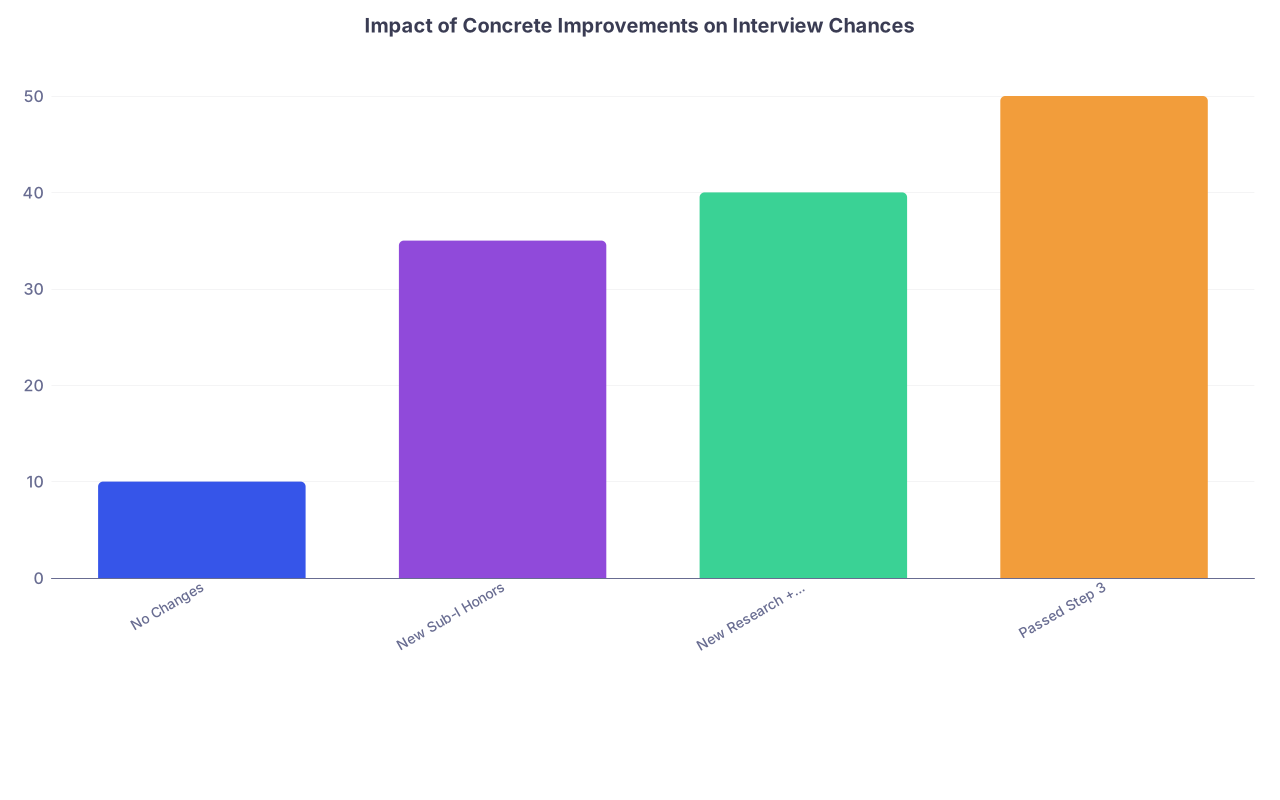
| Category | Value |
|---|---|
| No Changes | 10 |
| New Sub-I Honors | 35 |
| New Research + LOR | 40 |
| Passed Step 3 | 50 |
These are illustrative numbers, but the pattern is true:
Applicants who pair a stronger narrative with real, verifiable improvements get more interviews.
Make sure your personal statement points directly at those upgrades:
- “Since last cycle, I completed…”
- “This led to…”
- “My attending noted…”
You are connecting narrative to proof.
Step 13: A Quick Before-and-After Example
Let me show you a compressed sketch of how a paragraph shifts from weak to strong.
Before (actual style I see all the time):
Not matching last year was one of the most difficult experiences of my life. I was very disappointed, but it has made me stronger and more resilient. I have always been passionate about internal medicine and enjoy the complexity of patient care. I believe my dedication and work ethic will make me a strong resident in your program.
This says nothing. It could belong to anyone.
After (same content, actually useful):
After not matching into internal medicine last year, I met with my dean and two faculty mentors to review my application in detail. They helped me see that while my grades were solid, my experiences did not demonstrate sustained commitment to internal medicine, and my letters were generic. Over the past year, I have addressed these gaps by completing an additional internal medicine sub-internship, working as a part-time research assistant in a heart failure clinic, and seeking direct feedback from attendings on my performance. These changes have clarified for me not only that internal medicine is the right field, but also how I can contribute meaningfully to a residency team starting on day one.
Specific. Accountable. Action-driven.
Step 14: Sanity Check From the Program Director’s Chair
Before you finalize, imagine a PD reading your statement on a screen with 100 others. Ask three blunt questions:
Is it clear why I did not match and what I did about it?
If they would still be guessing, rewrite that paragraph.Would I trust this person with my sickest patients at 3 a.m.?
If you sound fragile, angry, or passive, cut and reframe.Do I sound like every other applicant?
If you could swap names and nothing would change, your examples are too generic. Add one or two concrete scenes.
Key Takeaways
- You are not revising; you are rebuilding. Scrap the old statement and construct a new narrative that directly acknowledges the failed Match, owns your part, and shows concrete growth.
- Move from vague passion to specific proof. Use 2–3 real clinical experiences and concrete improvements (sub-Is, research, Step 3, stronger LORs) to demonstrate why you now belong in that specialty.
- Keep the tone calm and forward-looking. One tight paragraph on not matching, clear evidence of change, and a strong focus on what value you bring to a residency program on Day 1.