
The order you do an MD and PhD can accelerate your career—or chain you to the wrong track for a decade.
Let me be blunt: there is no universally “correct” order. But for most people, one sequence makes a lot more sense once you’re honest about your goals, tolerance for debt, and how certain you actually are.
This is about career strategy, not prestige points.
The Core Question: What Are You Actually Trying To Become?
Before arguing MD‑first vs PhD‑first, you need a target.
Most people considering both fall into one of these buckets:
- You want to be a physician‑scientist (substantial clinical work and serious research).
- You think you want clinical work but like research and academic medicine.
- You’re mainly into research, with medicine as “nice to have” or as job insurance.
- You’re not sure what you want, but you’re smart, high achieving, and everyone tells you to “keep your options open.”
Each of these points to a different “best order.”
Here’s the short version:
- If you’re 90–100% sure you want to be a physician‑scientist → Integrated MD/PhD (MSTP) is usually best. (MD and PhD together.)
- If you’re medicine‑leaning, curious about research → MD first, then decide if you need a PhD or not.
- If you’re research‑dominant and could skip clinical work entirely and be happy → PhD first, maybe add an MD later only if needed.
- If you’re unsure → MD‑first typically keeps more doors open with less long‑term regret.
Now let’s be systematic.
Time, Money, and Flexibility: The Big Tradeoffs
You’re not choosing between letters. You’re choosing between:
- Years of training
- Debt and lost income
- Future flexibility (how easy it is to pivot later)
Here’s a clean comparison for typical scenarios.
| Pathway | Total Training (Post-College) | Typical Debt | Flexibility to Pivot |
|---|---|---|---|
| MD only | 7–11 years | High | High |
| MD → PhD later | 10–14+ years | Very High | Medium |
| PhD → MD | 10–14+ years | Very High | Medium |
| Integrated MD/PhD (MSTP) | 10–12 years | Low–Moderate | Medium–High |
“Total training” includes med school + residency, and PhD years where relevant. Real numbers:
- MD only: 4 yrs med + 3–7 yrs residency/fellowship
- PhD only: 5–7 yrs (biomed averages 5.5–6 in many places)
- MD/PhD integrated: 7–9 yrs school + 3–7 yrs residency/fellowship
The worst financial scenario—by far—is doing sequential, fully separate degrees with minimal funding support:
- PhD (stipend-level pay for 5–7 yrs)
- Then MD with full tuition and med school debt
- Then residency (low salary relative to hours)
…you’re in your mid‑30s with debt that looks like a mortgage.
So if you’re going to do both, you want to be very intentional about order and funding.
Option 1: Integrated MD/PhD (MSTP) – The Default for True Physician‑Scientists
If you know—like really know—you want a career where:
- You see patients regularly, and
- You run a lab, write grants, and publish as first/last author
…then an integrated MD/PhD (like MSTP in the US) is usually the smartest move.
Why?
Funding:
- Tuition is often fully covered.
- You get a stipend during the PhD years and often some MD years.
- You dramatically reduce (or erase) med school debt.
Integration:
Programs are designed so you:- Start MD → transition to PhD → return to MD/clinical
- Keep some clinical continuity through the PhD (optional clinics, short experiences).
- Finish with a coherent identity as a physician‑scientist.
Signaling and mentoring:
- You’re tagged early as “future physician‑scientist,” which gets you:
- Mentors who do exactly what you want to do
- Early exposure to grants, K‑awards, career development pathways
- Networking that helps in competitive residencies (heme/onc, neuro, derm, etc.)
- You’re tagged early as “future physician‑scientist,” which gets you:
Downsides:
- It’s long. You’re often 30+ before you start residency.
- You’re somewhat “locked in” to the physician‑scientist identity early.
- If you later decide you just want to be a community clinician, you’ve essentially over‑trained.
Who this is for:
- You’ve already done substantial research (multiple years, serious output).
- You like hypothesis‑driven work, not just “helping patients.”
- You can imagine yourself writing grants at 45, and that image doesn’t make you want to scream.
If this is you, the order fight (PhD first vs MD first) is mostly moot. The integrated route is built for what you want.
Option 2: MD First, Then Decide on a PhD – Best for Clinically Leaning, Research‑Curious
This is the most underrated path.
If you’re genuinely not sure whether you need a PhD, starting with an MD only gives you:
- A high‑value career outcome (practicing physician) even if you do nothing else.
- Exposure to:
- Academic medicine
- Clinician‑educator paths
- Research opportunities during med school and residency
- The chance to realize, “I actually don’t need a PhD for the kind of work I want.”
Here’s what MD‑first really looks like for research‑interested people:
During med school
You do summer research, maybe a research year, maybe enroll in a research track or scholarly concentration.
You learn:- Do you like designing projects or just executing them?
- Do you care about mechanistic bench work, clinical trials, outcomes research, QI, etc.?
During residency/fellowship
Most academic programs have research time. You:- Work on projects
- See what role you naturally gravitate toward
- Watch how your attendings balance clinic vs lab
At that point, you can answer:
“To do the jobs I now know about and actually want…is a PhD essential, optional, or a bad use of time?”
Often, the honest answer is: not essential.
You can do:
- Clinical trials
- Outcomes research
- Quality improvement
- Medical education research
- Industry roles (medical affairs, clinical development)
…with just an MD, maybe plus a master’s (MPH, MS, MEd, etc.), which is far shorter and less disruptive than a full PhD.
Who should still do an MD → PhD later?
- You genuinely want to lead independent, mechanistic, grant‑funded research at a major academic center.
- You feel a real gap in your methodological depth that a 1–2 year master’s can’t fix.
- Your field strongly values or expects PhDs for serious lab‑based roles (e.g., certain basic neuroscience or immunology labs).
Is MD → PhD later ideal? Not really:
- You interrupt your training (often after residency or between residency and fellowship).
- You delay attending‑level income even more.
- You risk social whiplash going back to grad‑student status.
But as a career decision made with eyes open, it can still be rational.
If you’re med‑leaning and unsure now, I’d bet on MD first, keep research alive, revisit PhD only if your future self still wants it.
Option 3: PhD First, Then MD – Best for Hardcore Research People Who Might Add Clinical
This path makes sense only if you’d be perfectly content never becoming a physician.
You do a PhD first if:
- You already know you love research and could do it full‑time.
- You don’t want to commit to med school debt unless you’re sure clinical work is worth it.
- You’re aiming at careers where a PhD is already a full ticket: academia, biotech, pharma, government labs.
Why it can be smart:
You test your love for research at full intensity.
You’ll find out:- Do you like independent thinking, or do you just enjoy being in labs as a helper?
- Can you tolerate long, uncertain projects?
- Do you like the culture of academia?
You can often get med schools to respect your PhD work.
- You’re attractive to research‑heavy MD programs.
- You may get advanced standing in some curricula (or more flexibility in electives).
If you never go to med school, you still have a real career.
The catch:
- You’ll still have to:
- Pay for med school (unless you land a funded special program).
- Then do residency.
- You risk burnout or “training fatigue” by the time you reach late 30s and are still in structured training.
Who this fits:
- You’re already in or accepted to a strong PhD program you’re excited about.
- Your primary identity is as a scientist, and “MD later” is a bonus option, not the whole point.
- You’re okay with the idea that MD might never happen—and that’s not a tragedy.
How the Order Affects Your Career Options
Let’s be concrete about what each order tends to lead to.
| Path | Most Common End Roles |
|---|---|
| MD only | Clinician, clinician-educator, clinical leader |
| MD → PhD | Clinician-scientist, academic faculty, niche researcher |
| PhD → MD | Scientist-clinician, translational researcher, hybrid |
| Integrated MD/PhD | Physician-scientist, lab head, academic leadership |
Rough translation:
MD only:
Easiest path to:- Community practice
- Academic clinician roles
- Clinician‑educator tracks
- Many industry roles
MD → PhD:
- You’re a clinician who went “deeper” into research mid‑career.
- Strong fit for academic medicine with a heavy research component, sometimes niche/technical areas.
PhD → MD:
- You’re a scientist who added clinical tools.
- Strong for translational work, industry R&D leadership, and certain academic niches.
Integrated MD/PhD:
- You’re groomed from early on for the classic physician‑scientist model: split time between lab and clinic, often in major academic centers.
Practical Decision Framework: Which Order Makes More Sense For You?
Use this no‑nonsense checklist.
If all or most of these are true:
- You’ve done 2+ years of serious research (not just summer stuff).
- You like designing experiments, not just “helping out.”
- You’ve had a taste of clinical exposure and still feel pulled strongly to research.
- You’re comfortable with long training and grant‑writing as part of your future.
Then your best move is likely:
Apply directly to integrated MD/PhD programs (MSTP if in the US).
If those don’t work out, strongly consider MD‑only with heavy research, not an unfunded, separate PhD + MD.
If instead you:
- Feel that clinical work is your non‑negotiable core, and
- Think research is interesting but maybe not central, and
- Don’t have enough experience to know which you prefer
Then:
MD first. Do real research during med school.
Revisit whether you truly need a PhD once you understand what academic medicine actually looks like from the inside.
If you:
- Could happily do pure research your whole life
- Are already on a strong PhD track or deeply integrated into a lab
- See the MD more as a future optional enhancement
Then:
PhD first is reasonable.
Only sign up for med school debt later if a specific clinical goal appears that’s worth the cost and extra years.
One More Hard Truth: You Probably Don’t Need Both
A lot of smart premeds overestimate how “required” dual degrees are.
Reality:
You do not need a PhD to:
- Teach med students
- Do clinical research
- Work in industry
- Become a department chair (clinically)
You do not need an MD to:
- Run an NIH‑funded basic science lab
- Do drug discovery
- Lead many translational research teams (especially in industry)
The MD/PhD route—whichever order—is for a relatively small group who want to sit directly at the medicine‑science interface and are okay with a long, sometimes precarious path.
Make sure you’re one of them before you volunteer for 10–15 years of training.
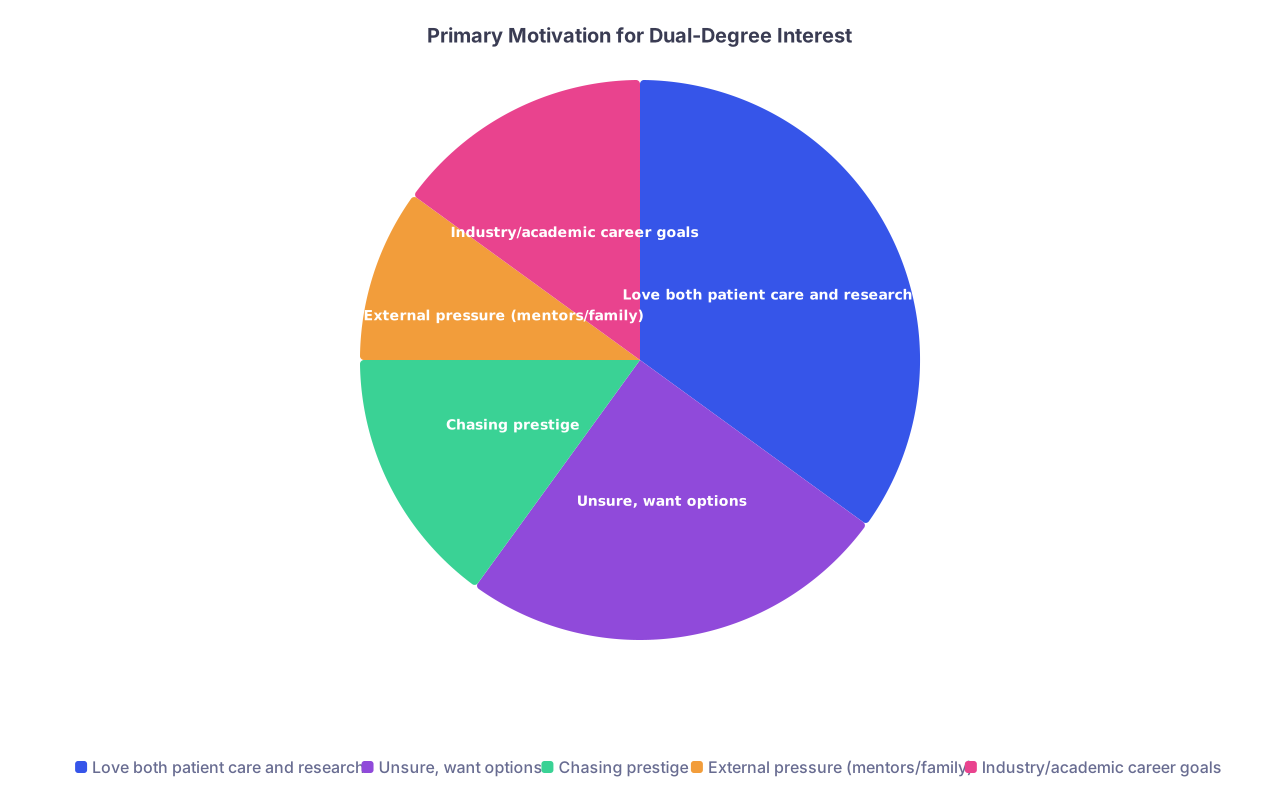
| Category | Value |
|---|---|
| Love both patient care and research | 35 |
| Unsure, want options | 25 |
| Chasing prestige | 15 |
| External pressure (mentors/family) | 10 |
| Industry/academic career goals | 15 |

| Step | Description |
|---|---|
| Step 1 | Start |
| Step 2 | MD first |
| Step 3 | PhD first |
| Step 4 | Apply MD PhD |
| Step 5 | MD only or MD + masters |
| Step 6 | Consider PhD later |
| Step 7 | Integrated MD PhD path |
| Step 8 | Primary passion |
| Step 9 | Happy without MD? |
| Step 10 | Need deep methods? |
FAQs
1. Is it easier to get into an MD program if I already have a PhD?
Not automatically. You’ll look attractive to research‑heavy schools if your PhD is strong (publications, clear story), but they still care about MCAT, GPA, clinical exposure, and whether you actually understand what being a physician involves. A PhD is a plus, not a golden ticket, and it can also raise questions like “Are you going to stay in research or jump ship?” if your story isn’t coherent.
2. Will doing a PhD after an MD hurt my residency chances?
If you step away from clinical work for years right before or after residency, programs may worry about clinical atrophy. But many people successfully do research years (or even a formal PhD) around residency and still match well—especially into research‑friendly specialties. The key is:
- Maintaining some clinical connection if possible.
- Having strong mentors who can vouch for you.
- Making your trajectory make sense: “I’m training for X specific career,” not “I just like collecting degrees.”
3. Can I get similar skills with a master’s instead of a PhD?
For many roles, yes. If what you really need is:
- Biostats, epi, or clinical trial design → MPH or MS.
- Health systems, policy, management → MPH, MHA, MBA.
- Education research or curriculum design → MEd.
A PhD is about becoming a producer of original, sustained research with deep methods expertise. If you mostly need tools and credentials, a master’s is often more time‑ and career‑efficient.
4. I’m already halfway through a PhD and now want to apply to med school. Should I quit the PhD?
Usually, no. Finishing the PhD:
- Gives you a real credential for the years you invested.
- Strengthens your application, assuming decent output and letters.
- Shows you can complete long projects.
Exceptions: the PhD is toxic (environmental disaster), your mental health is tanking, or the field is so irrelevant to your future that finishing gives almost no benefit and will delay you for years. But most of the time, I’d say: finish, then apply.
5. What’s one concrete step I should take if I’m torn right now?
Pick three people who are 10–20 years ahead of you—one MD, one PhD, one MD/PhD—and ask each for a 20‑minute Zoom. Ask exactly:
- How do you actually spend your time in a typical week?
- What part of your job do you love?
- What part would you drop if you could? Then compare their answers to what you think you want your day‑to‑day life to look like. That exercise is more honest than any pros/cons list.
Open a blank page right now and write two columns: “What I 100% want in my career” and “What I think I want but could live without.” Then ask yourself which order—MD first, PhD first, or integrated MD/PhD—actually fits the left column, not the fantasy in the right.